
DD
MM
YYYY

PAGES

DD
MM
YYYY

spot_img

PAGES

Home Blog Page 326

Bitcoin Slips Below $105K as Tariff Tensions And Liquidations Trigger Market Panic

0

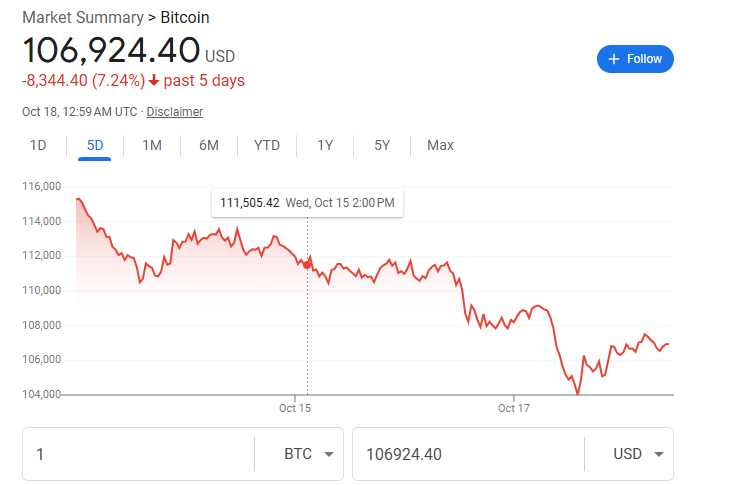
Bitcoin has plunged massively with a recent price slump that has sent shockwaves through the crypto market, as the world’s largest digital asset dipped below $105,000 for the first time since June.

Data from Cointelegraph stated that the  decline marked a near 9% drop on the weekly charts following its record high above $126,000.

The downturn reflects waning market momentum amid rising uncertainty and renewed U.S.–China trade tensions. The latest drop mirrors last week fall, when Bitcoin dipped to $104,000 on Friday, after U.S President Donald Trump announced 100% sweeping tariffs on Chinese imports.

Adding to the recent market unease, Trump’s recent speech accusing China of “economic sabotage” has intensified geopolitical tensions. The U.S. president hinted at potential increase to 500% on tariffs should China continue supporting Russia’s energy sector. Treasury Secretary Scott Bessent noted that over 85 U.S. senators back the tariff initiative.

Amid Bitcoin downward price action, the Crypto Fear & Greed Index has now plummeted to 22, indicating a state of “extreme fear” among investors. Massive liquidations further amplified the sell-off. According to CoinGlass, roughly $961 million worth of crypto positions were wiped out within 24 hours, affecting over 260,000 traders globally. Long positions accounted for approximately $749 million of the total, accelerating Bitcoin’s decline below the key $106,000 support level.

Leading cryptocurrency analyst Chris Burniske, noted that last week crypto crash, has severely damaged investor confidence. He predicts that the crypto market may remain broken for some time before a significant recovery starts.

Burniske, who is currently a partner at Placeholder VC, said he is more and more convinced that last Friday’s massacre negatively impacted the crypto market for a while. “It has been difficult to quickly develop a sustained bid due to the sell-off’s extreme violence”, he said, noting that the market’s structural and psychological harm is more extensive than most people realize.

He further noted that this cycle has been disappointing for most investors, not only due to price underperformance in comparison to expectations but also to the waning of the enthusiasm that once propelled speculative growth.

Market sentiment also soured following a sharp drop in U.S. regional banking stocks, reminiscent of the March 2023 mini banking crisis. Then, Bitcoin and altcoins experienced a similar flash crash before staging a swift recovery. “In March 2023, regional bank stocks collapsed, the crisis was ‘contained,’ but nothing really changed,” observed trading resource The Kobeissi Letter in a recent X post.

Traders now warn that Bitcoin may retest the crucial $100,000 support zone, a level many view as pivotal for maintaining market stability. At present, Bitcoin (BTC) is trading at $103,682, at the time of writing this report. Traders remain divided over whether this pullback signals the start of a deeper correction or a healthy consolidation before the next upward move.

Meanwhile, gold’s surge to a new record high of $4,200 has drawn attention  and capital away from Bitcoin’s “digital gold” narrative. Gold advocate Peter Schiff, chairman and chief economist of Europac, renewed his criticism of Bitcoin, predicting that gold could reach $1 million per ounce before Bitcoin achieves similar valuation milestones.

“It’s not just a de-dollarization trade but a de-bitcoinization trade. Bitcoin has failed the test as a viable alternative to the U.S. dollar or digital gold,” he wrote on X.

For now, fear dominates the crypto landscape as traders brace for further volatility. Should Bitcoin breach last week’s low of $104,396, analysts warn the market could face another wave of selling pressure on the path toward the $100,000 threshold.

Future Outlook

Currently, market analysts are watching the $107,000–$110,000 range as a key short-term demand zone. A break below could open the door to $100,000, while recovery above $115,000–$123,000 may help restore bullish momentum.
Microsoft Tests Advanced AI Functionalities That Integrate Copilot Assistant Deeply Into Windows 11

0

Microsoft has officially ended support for Windows 10, marking the end of a decade-long era for one of the world’s most widely used operating systems.

The move, which took effect on Tuesday, underscores the company’s renewed push into artificial intelligence as it seeks to drive adoption of Windows 11 through a new wave of AI-powered features.

The transition comes as Microsoft begins testing advanced AI functionalities that integrate its Copilot assistant more deeply into Windows 11. These features, currently available to participants in both the Windows Insider Program and the Copilot Labs testing group, reflect the company’s vision of turning personal computers into intelligent, interactive partners rather than passive tools.

Yusuf Mehdi, Microsoft’s consumer marketing chief, explained during a press briefing that the updated Copilot assistant will be able to perform complex tasks involving both desktop and web applications. Users could, for example, instruct Copilot to resize photos stored locally on their PCs or to compile all available Brian Eno songs into a Spotify playlist and start playing them automatically. Such capabilities represent the kind of seamless AI integration Microsoft hopes will define the Windows experience in the years ahead.

The company’s latest AI push builds on a broader trend in the technology industry. Anthropic, Google, and OpenAI have all developed similar AI models known as “computer-use agents,” designed to carry out multi-step operations that involve typing, clicking, and interacting across different software environments. Microsoft’s own variant of this technology, called Copilot Actions, is being introduced first to enterprise users through its corporate platforms and to consumers with premium subscriptions. The company now plans to extend this innovation directly to Windows 11.

According to Microsoft, Copilot Actions will be turned off by default when it launches. However, users who enable it will find that the tool operates in a secure, self-contained environment with its own virtual desktop. Users can observe Copilot performing tasks in real time, step by step, and can take manual control at any point. Alternatively, they may continue working on other activities while the AI handles assigned tasks in the background.

“You may see the agent make mistakes or encounter challenges with complex interfaces, which is why real-world testing of this experience is so critical,” Mehdi wrote in a company blog post. “We need to apply learnings from these tests to make the experience more capable and streamlined.”

The rollout strategy reflects Microsoft’s cautious approach as it integrates AI deeper into its flagship operating system. The company aims to ensure that privacy, reliability, and usability are not compromised in the process. During the preview phase, Copilot Actions will only function in common folders such as desktop, documents, downloads, or pictures. Users will have to give explicit permission before the assistant can access other areas of their computers.

As part of the upcoming update, Microsoft will also introduce a feature in Windows 11’s File Explorer built in partnership with Manus, a Singaporean startup specializing in AI-assisted content creation. Through this integration, users will be able to right-click a file and select a new option — “Create website with Manus” — allowing Copilot to automatically generate a website using the chosen file’s content.

Additionally, Windows Insiders will gain enhanced control over Copilot Vision, which allows the assistant to analyze what’s displayed on the screen. Previously, this feature could only be activated through voice commands, but users will now be able to engage with it directly through text chat.

Microsoft is also redesigning the Copilot interface to make it more accessible. A new shortcut will appear immediately to the right of the Start button, providing users with a one-click option to launch the assistant. The updated widget will include quick-access buttons for activating Copilot Vision or initiating spoken AI conversations. Users can also summon the assistant hands-free by saying, “Hey Copilot.”

The company’s renewed focus on AI reflects both competitive and commercial pressures. In recent years, Microsoft’s Windows and devices division has struggled to generate strong growth. In the second quarter of 2025, the segment brought in $4.3 billion in revenue, up just 2.5 percent from the previous year. Integrating AI deeply into the operating system could give the company a stronger edge against rivals like Apple, whose Mac computers continue to draw creative professionals, and Google’s Chrome OS, which dominates in the education market.

Windows 11, first introduced in 2021, shifted the familiar Start button and taskbar icons from the left corner to the center of the screen — a design meant to symbolize a new beginning for the operating system. According to data from web analytics firm Statcounter, Windows 11 became more widely used than Windows 10 for the first time in July 2025. By September, Microsoft commanded 72 percent of the global operating system market share.

Yet despite its reach, Microsoft’s challenge is no longer about expanding Windows adoption but about transforming what users can do with it. The company’s heavy investment in AI, both through its OpenAI partnership and its in-house engineering, is intended to make the PC relevant again in an era increasingly dominated by mobile computing and cloud platforms.

Which RICS Survey Level Is Right for Your Property? A Quick Comparison

0

Buying a property is exciting, but it’s also one of the biggest financial commitments you’ll make. You want to feel confident that the home is safe, sound, and worth the price you’re paying. That’s where RICS surveys come in, giving you professional insight into a property’s condition.

Choosing the right level can feel tricky, so let’s break it down and make it easier to understand. Keep reading to see which survey level best fits your needs.

Understanding The Purpose Of RICS Surveys

A RICS survey helps you spot issues before you commit to buying. It checks the condition of the property and highlights potential problems that might not be obvious. These surveys are carried out by RICS-qualified surveyors who use a clear traffic-light rating system. This makes it easier to see what needs urgent attention and what’s less serious.

If you want RICS home survey levels explained in straightforward terms, think of them as options that range from basic to detailed. The right choice depends on the age, type, and condition of the property you’re buying.

RICS Survey Level 1: A Simple Check

Level 1 surveys are the most basic. They’re best for newer homes that look well-maintained. You’ll get a clear overview of the property’s general condition without going into deep detail. While it’s the cheapest option, it won’t give you much insight into hidden issues.

This level is suitable if you’re buying a modern flat or house that hasn’t shown signs of problems. It’s a way of confirming everything looks as expected but it’s not enough for older or unusual homes.

RICS Survey Level 2: A Balanced Choice

Level 2, also called the HomeBuyer Report, is the most popular option. It offers a more detailed look at the property’s condition, including damp checks, structural movement, and urgent repairs. It also includes advice on ongoing maintenance, which can help you budget.

You’ll get a report that explains not just what’s wrong but also what might need fixing in future. Many buyers choose this level because it strikes a balance between cost and detail.

RICS Survey Level 3: A Detailed Review

Level 3, often known as the Building Survey, is the most comprehensive. It’s recommended for older homes, listed buildings, or properties that have been altered. The surveyor examines the structure in detail and reports on potential risks and repair costs.

This level gives you the fullest picture of the property’s condition. It may take longer and cost more, but it can save you from unexpected expenses later. If you’re considering a renovation project, this level provides the insight you’ll need.

Deciding Which Level Suits You

Choosing the right survey depends on how much reassurance you want. If the property is nearly new, Level 1 may be enough. If it’s fairly standard but not brand new, Level 2 usually makes sense. And if you’re buying an older or unique home, Level 3 gives you peace of mind.

Think about how much you’re investing and the risks involved. Spending a bit more upfront on the right survey could save you thousands down the line.

Making A Confident Choice

Understanding RICS survey levels helps you weigh up cost, detail, and reassurance. Level 1 suits simple cases, Level 2 gives balanced protection on modern homes in fairly good condition, and Level 3 is required for in-depth detail on larger or older homes. By matching the survey to your property type, you’ll avoid surprises and feel more secure in your decision.

Africa’s Greatest AI Opportunity And How Business Models Will Drive Value Creation

0

In 1907, U.S. Steel sat on the mountaintop as America’s most capitalized company. Fifty years later, IBM took the crown, when its mainframe computers defined an age where bits began to rival bricks. In the 1980s, Jack Welch’s General Electric ruled, turning conglomerate efficiency into an art form. And today, the race of titans continues with Apple, Microsoft, and Nvidia exchanging relay batons in the global market. Yet, one lesson remains timeless: moments come, and moments go.

Steel built bridges and railways, and those who forged it ruled. Then transistors came from Bell Labs as Shockley’s genius heralded the dawn of automation. When Bill Gates and his Microsoft team democratized computing, they didn’t merely create products; they redefined how business operates. Windows was not just software; it was a gateway to a new business model. And that has always been the difference between a product and a revolution: a product sells; a model transforms.

Jack Welch perfected the conglomerate as a performance machine, optimizing for efficiency, process, and scale. But we have moved into a different era, what I have called the Accelerated Society, an age when computational systems compound value and intelligence faster than human planning cycles. Artificial Intelligence sits at the center of this transformation. Yet, as I have often written, no one eats AI. The value is not in AI itself, but in what AI enables you to do, just as transistors birthed the electronics age and microprocessors powered the digital economy.

Africa’s opportunity is not in chasing the next chatbot or AI language model. It is in rethinking business models using AI as leverage. In the 1990s, Nigeria’s new generation banks did not merely install computers; they rewired the banking model. The Integrated Banking System they deployed made geography irrelevant; you could open an account in Lagos and withdraw in Kano. That was not technology; that was a new model of value creation. Nigeria’s finest banking innovator, Chairman Paschal Dozie (RIP) of Diamond Bank, transformed a nation with DIBS (diamond integrated banking system) and others copied!

Good People, as AI arrives and scales, the call is the same: do not just deploy technology, TRANSFORM with it. Let AI become the transistor of your enterprise, not the toy on your dashboard. Business models, not machines, will define Africa’s next wealth creation frontier. And those business models are Africa’s Greatest AI Opportunity!

Japan’s Megabanks Collaborate on Stablecoin Issuance for Corporate Payments

0

Japan’s three largest banks—Mitsubishi UFJ Financial Group (MUFG), Sumitomo Mitsui Financial Group (SMBC), and Mizuho Financial Group—are teaming up to issue stablecoins pegged to the Japanese yen (JPY) and eventually the U.S. dollar (USD).

This initiative, reported by Nikkei aims to standardize and accelerate corporate payments, settlements, and cross-border transactions using blockchain technology. The move reflects Japan’s accelerating embrace of tokenized assets amid global stablecoin growth, with the market’s total value recently exceeding $300 billion.

Starting with a JPY-pegged stablecoin, the banks will build a shared framework for issuance, transfer, and governance. This will enable seamless interoperability for corporate clients, reducing remittance costs and administrative burdens. A USD-pegged version is slated for later rollout to support international payments.

The first real-world application will be a pilot with Mitsubishi Corporation for internal financial settlements, leveraging MUFG’s Progmat Coin platform—a blockchain-based system for token issuance on public networks.

Collectively, these banks serve over 300,000 corporate clients, providing a massive distribution network to drive adoption. The stablecoins will be designed for business use, functioning as digital tokens backed by fiat reserves to maintain stability.

Following proof-of-concept trials, the JPY stablecoin is expected to be operational by the end of Japan’s fiscal year March 2026, pending regulatory approvals.

This collaboration builds on Japan’s progressive stance toward digital assets. In August 2025, the Financial Services Agency (FSA) signaled readiness to approve domestic yen stablecoins, with fintech firm JPYC already securing a money transfer license.

Other institutions are advancing similar efforts: Japan Post Bank plans to launch DCJPY, a tokenized yen deposit, by fiscal 2026. SMBC is partnering with blockchain firms like Ava Labs and Fireblocks for regulated stablecoin infrastructure.

SBI Holdings aims to distribute Ripple’s USD-pegged stablecoin (RLUSD) in Japan starting Q1 2026. The banks have also enlisted crypto partners, including Bitbank exchange and infrastructure provider Fireblocks, to ensure compliance and security.

This positions Japanese-issued stablecoins as alternatives to dominant USD-backed ones like USDT and USDC, potentially fostering native yen liquidity within Japan’s financial ecosystem.

By integrating stablecoins into corporate workflows, the initiative could slash transaction times from days to near-instantaneous, enhancing efficiency for supply chain payments and trade finance. It aligns with Asia-wide trends.

South Korea is drafting stablecoin legislation, while Hong Kong rolls out licensing regimes. For global markets, this could bolster yen-denominated digital assets, challenging U.S. dollar hegemony in crypto payments.

Stablecoins enable near-instant corporate payments and settlements, cutting days-long delays and reducing costs. Lower remittance and administrative expenses for businesses, especially in cross-border trade.

Shared framework among Japan’s megabanks ensures seamless stablecoin use across 300,000+ corporate clients. JPY-pegged stablecoins could challenge USD-dominated stablecoins, boosting yen’s role in digital finance.

Japan’s FSA approvals signal a model for regulated stablecoin adoption, potentially influencing Asia and beyond. Accelerates integration of blockchain in traditional finance, enhancing efficiency and transparency.

Increased stablecoin adoption by Japan’s megabanks could drive demand for blockchain infrastructure, boosting related crypto assets. JPY-pegged stablecoins may enhance yen’s global digital presence, potentially strengthening its forex market position.

Regulated stablecoin issuance signals institutional trust in crypto, likely attracting investment to Japan’s fintech sector. Success of the initiative could spur broader tokenized asset adoption, lifting blockchain-related stocks and tokens.

Japan’s move may accelerate stablecoin development in Asia, increasing market activity in South Korea and Hong Kong. This development underscores how traditional finance is increasingly converging with blockchain, with Japan’s megabanks leading the charge in regulated innovation.