DD
MM
YYYY

PAGES

DD
MM
YYYY

spot_img

PAGES

Home Blog Page 3280

Chainlink’s Telefonica Partnership and Bitcoin Halving Fade Away Before BlockDAG’s 1000x ROIs

0

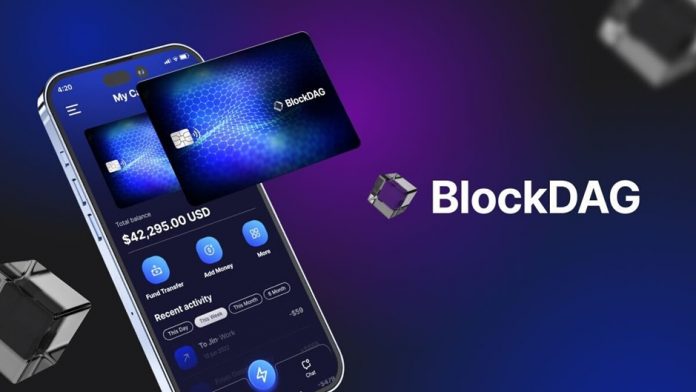
As the Bitcoin halving event approaches, new investors are feeling the heat. With the mining of new coins set to be set in half, new investors are looking for safer bets. Entering presale stablecoins, BlockDAG coin is one of them, boosting successful returns of 1000x for its early investors. But that’s not all! While Bitcoin mining rewards are halving, Chainlink, the Ethereum-based crypto, is making great progress. Partnering up with telecom giant Telefónica, which has made Chainlink price rise. As the market buzzes with excitement, one thing’s for sure: BlockDAG’s success story is one to watch closely. 

Chainlink’s Telefónica Partnership Results in Price Surge

As we have seen in the past, whenever there’s a partnership between crypto coins and big firms or some influencers talk about it, the price of that crypto goes up. The same is happening with Chinlink coin, as they are partnered with Telefonica. Telefonica is a multinational telecom company, originating from Spain.

Chainlink is responsible for improving SIM swap detection. This will allow for enhanced security in carrier providers running in Web3 environments. As Chainlink is an Oracle provider that is decentralized, it allows it to run smart contracts on different networks like Polygon. It will help them to gain information about a SIM card people using, this will restrict SIM swaps, which are used for hacking. This is projected to cause Chainlink’s price to increase soon. 

Bitcoin Gears Up for Halving Event 

Recently, top crypto assets like Bitcoin and Ethereum have experienced fluctuations in their price brackets. While Ethereum is making progress and ascending on the price chart, Bitcoin is expected to face a significant drop. Why is this happening? Bitcoin will undergone a halving event, which means its mining rewards will be cut in half.

If you’re unfamiliar with the term “halving,” don’t worry, we’re here to help you understand. Halving is a process where mining rewards are reduced by half, and it occurs approximately every four years. This has led new investors to wonder whether they should still invest in Bitcoin or explore other options. While Bitcoin is in the halving process, it’s advisable to hold off on investing, as rewards are not as lucrative during this time.

BlockDAG: Next Crypto Giant?

BlockDAG is emerging as a top crypto asset, selling rapidly in its presale stage. This is attributed to its utilization of technology similar to other crypto giants like Bitcoin. BlockDAG uses Proof-of-Work (PoW) for security and decentralization, setting it apart from traditional blockchain-based cryptocurrencies. Its adoption of PoW ensures the safety of all transactions, contributing to its swift sales.

BlockDAG prioritizes security and transparency, fostering a secure blockchain environment for investors and miners alike. As a proven stable coin, BlockDAG presents an opportunity for substantial returns similar to Bitcoin. Investing in stable coins like BlockDAG is advisable, especially during presales, which can yield ROIs of more than 1000x.

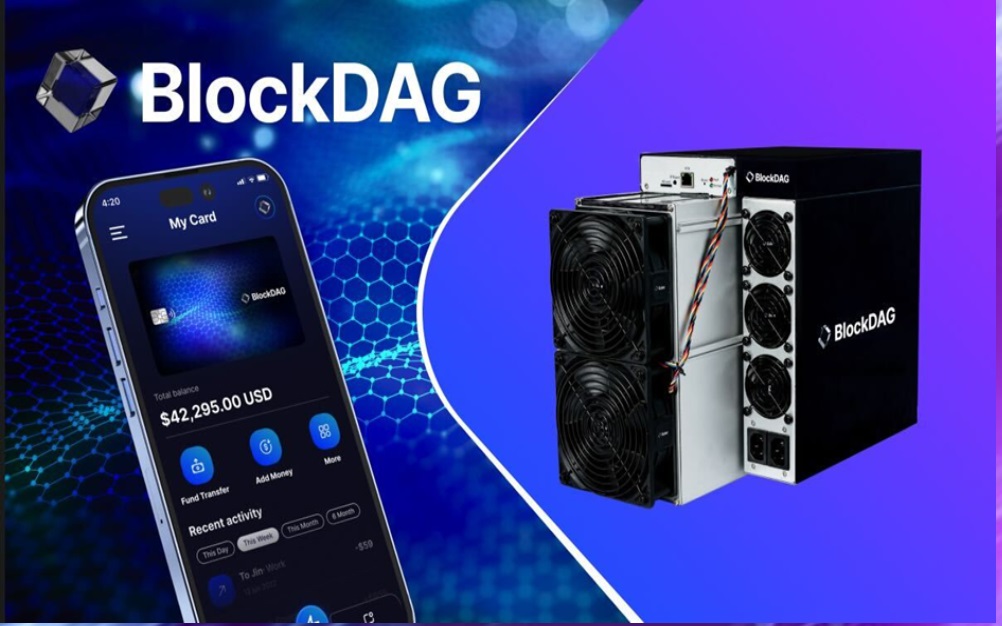
With BlockDAG already in batch 2 and demonstrating significant potential within its community, it stands as a promising investment opportunity, with early investors in batch 1 enjoying up to a 50x return. If you still invest now, you can take advantage of good returns.

There is a lot to offer by BlockDAG yet, it’s gearing up to hit the target of $600 million dollars in 2024. No other crypto coins in presales have shown such positiveness except for BlockDAG. So, be a part of this community, as you have the option to buy this coin in presale.
Don‘t forget

The rise in Chainlink price, boosted by its partnership with Telefónica, makes the crypto market stable. Meanwhile, Bitcoin struggles due to halving which fades its attractiveness as an investment option currently. Therefore, it’s essential to seek stable and decentralized cryptocurrencies with comparable technologies, such as BlockDAG. Merely investing in presale coins isn’t sufficient; one must check stats to validate their stability. BDAG has demonstrated stability in the crypto market, earning the trust of its investors to deliver more than 1000x ROIs.


Invest In BlockDAG Presale:

Website: https://blockdag.network

Presale: https://purchase.blockdag.network

Telegram: https://t.me/blockDAGnetworkOfficial

Discord: https://discord.gg/Q7BxghMVyu

Nigeria to Extend Social Security Payments to Unemployed Graduates, Introduces Consumer Credit Scheme

0

In a fresh move aimed at alleviating the economic challenges faced by Nigerian youths and citizens, the Federal Government announced plans to extend its social security payments net to unemployed graduates and introduce a consumer credit scheme.

These initiatives were disclosed by the Minister of Finance and Coordinating Minister of the Economy, Wale Edun, after the Federal Executive Council (FEC) meeting on Monday.

Edun emphasized President Bola Tinubu’s commitment to assisting the poorest segments of society, particularly in the face of heightened food prices. He revealed that the government would implement a Social Security unemployment programme to provide stipends to unemployed Nigerian youths, including graduates.

“At this period of heightened food prices, Mr. President has committed to doing all that can be done to assist in giving purchasing power to the poorest and in that line…we have coming, in the nearest future, an unemployment benefit for the young unemployed, in particular,” he said, without giving the timeline for the implementation.

Furthermore, the Federal Government plans to establish a consumer credit scheme to ease the economic adjustment pains faced by citizens. Edun said that the Chief of Staff to the President, Femi Gbajabiamila, will lead a committee tasked with implementing this scheme, which aims to make consumer credit available and increase the affordability of goods.

Regarding the review of the National Social Investment Programme (NSIP) implemented by the Special Presidential panel, Edun highlighted its outcomes, including the resumption of direct payments to 12 million households comprising 60 million Nigerians. He emphasized the importance of beneficiary identification through national identity numbers and bank verification numbers to ensure transparency and accountability in the distribution of funds.

“The big change that has allowed Mr. President to approve the restart of that direct payments to beneficiaries programme is the verification of the identity of beneficiaries. Each person that receives 25,000 Naira for a total of three months will be identifiable,” he explained.

Similarly, the Minister of Communications and Digital Economy, Dr. Bosun Tijjani, underscored the importance of leveraging existing datasets such as the Bank Verification Number (BVN) and National Identity Number (NIN) to vet beneficiaries and prevent multiple payouts to individuals.

“One of the initial moves that we’re making is leveraging the existing dataset that we have on our people…we will get commitment to ensuring that no one is paid twice, because you have to be properly IDed before you can benefit from that programme,” stated Tijjani.

However, despite the laudable intentions behind these initiatives, challenges such as the lack of reliable data and adequate funding could pose significant hurdles to their successful implementation.

Similar schemes introduced by the government in the past, such as N-Power, had been mired in allegations of corruption. The schemes were alleged to harbor many ghost beneficiaries owing to a lack of reliable identification.

Thus, the success of these social security programmes and the consumer credit scheme is said to depend heavily on accurate and up-to-date information about beneficiaries. Analysts note that without reliable data systems and proper verification mechanisms, there is a risk of inefficiencies, errors, and even potential abuse of the system.

Additionally, the availability of funds is crucial for sustaining these programmes in the long term. While the government has expressed its commitment to assisting the poorest segments of society, the availability of funds for such large-scale initiatives remains a concern.

Limited funding could lead to delays in payments, inadequate coverage of beneficiaries, or even the inability to sustain the programmes over time – particularly now that the government is grappling with heavy economic headwinds that have left its treasury empty.

Similar schemes initiated by the government in the past suffered from inadequate funding, with fund disbursement being abandoned halfway or the scheme being entirely suspended.

Stakeholders said that addressing these challenges will require concerted efforts from the government to invest in data infrastructure, improve data collection and verification processes, and allocate sufficient funds to support these social security programmes and the consumer credit scheme.

However, these initiatives are said to mark a concerted effort by the Federal Government to address unemployment and economic challenges. Economic experts believe that with proper planning, coordination, and resources, these programmes have the potential to make a meaningful impact in improving the livelihoods of Nigerian citizens and stimulating economic growth.

Tinubu Orders Full Implementation of Oronsaye Report: Overhaul of Government Agencies Underway

0

In a decisive move aimed at streamlining government operations and reducing the cost of governance, President Bola Tinubu has ordered the full implementation of the Oronsaye report.

This directive, announced by Minister of Information and National Orientation, Mohammed Idris, signals significant changes in the structure of various government agencies.

Idris announced to State House Correspondents after Monday’s Federal Executive Council meeting: “in a very bold move today, this administration, under the leadership of President Bola Ahmed Tinubu, consistent again with his courage to take very far-reaching decisions in the interest of Nigeria, has taken a decision to implement the so-called Oronsaye Report.”

He further explained, “Now, what that means is that a number of agencies, commissions, and some departments have actually been scrapped. Some have been modified and marked while others have been subsumed. Others, of course, have also been moved from some ministries to others where the government feels they will operate better.”

The implementation involves merging, subsuming, scrapping, and relocating several government agencies, as outlined by Tinubu’s Special Adviser on Policy Coordination, Mrs. Hadiza Bala-Usman. A committee has been constituted by the President to oversee these changes within 12 weeks.

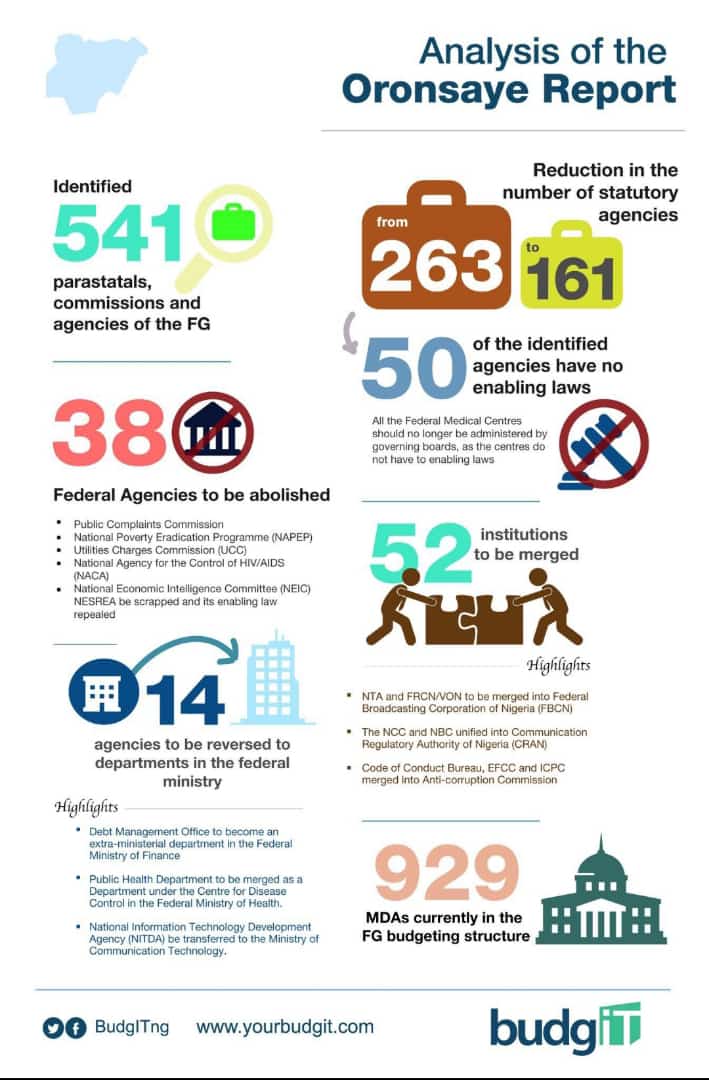
Submitted in 2012, the Oronsaye report on public sector reforms identified 541 statutory and non-statutory Federal Government parastatals, commissions, and agencies to be slashed or submused. The 800-page report recommended significant restructuring, including slashing the number of statutory agencies from 263 to 161, scrapping 38 agencies, merging 52, and reverting 14 to departments within ministries.

Among the recommendations is the repeal of the law establishing the National Salaries and Wages Commission, with its functions to be absorbed by the Revenue Mobilization and Fiscal Responsibility Commission. Additionally, the report proposes merging Nigeria’s top three anti-corruption agencies—the Economic and Financial Crimes Commission, the Independent Corrupt Practices and Other Related Offences Commission, and the Code of Conduct Bureau.

It is estimated that the Nigerian Government could save over N241 billion if the report is fully implemented.

Bayo Onanuga, the Special Adviser on Information and Strategy to President Bola Tinubu, said that the measure aims to enhance efficiency in the federal service and reduce the cost of governance.

“An eight-man committee has a 12-week deadline to ensure that the necessary legislative amendments and administrative restructuring needed to implement the reforms are effected in an efficient manner,” Onanuga stated.

The committee comprises key government officials, including the Secretary to the Government of the Federation, the Head of the Civil Service, the Attorney General and Justice Minister, the Budget and Planning Minister, the Director-General of the Bureau of Public Service Reform, the Special Adviser to the President on Policy Coordination, and the Special Assistant to the President on National Assembly. The Cabinet Affairs Office will serve as the secretariat.

Below is the list of ministries and agencies affected by the reform according to the Senior Special Assistant to the President on Print Media, Abdulaziz Abdulaziz.

AGENCIES TO BE SCRAPPED

  1. Pension Transitional Arrangement Directorate to be scrapped and functions transferred to the Federal Ministry of Finance
  2. The National Senior Secondary Education Commission (NSSEC) is to be scrapped and functions transferred to the Department of Basic and Secondary Education in the Federal Ministry of Education.

AGENCIES TO BE MERGED

  1. National Agency for the Control of Aids (NACA) to be merged under the Centre for Disease Control in the Federal Ministry of Health.

  2. The National Emergency Agency (NEMA) is to be merged with the National Commission of Refugee, Migration, and Internally Displaced Persons [NCFRMI].

  3. The Directorate of Technical Cooperation in Africa (DTCA) is to be merged with the Directorate of Technical Aid (DTAC) and to function as a department in the Ministry of Foreign Affairs.

  4. Infrastructure Concession and Regulatory Commission (ICRC) to be merged with the Bureau for Public Enterprise (BPE).

  5. The Nigerian Investment Promotion Commission (NIPC) is to be merged with the Nigerian Export Promotion Council (NEPC).

  6. The National Agency for Science and Engineering Infrastructure (NASENI) is to be merged with the National Centre for Agriculture Mechanization (NCAM) and Project Development Institute (PRODA)

  7. The National Biotechnology Development Agency (NABDA) is to be merged with the National Centre for Genetic Resources and Biotechnology (NACGRAB).

  8. The National Institute for Leather Science Technology (NILEST) is to be merged with the National Institute for Chemical Technology (NARICT).

  9. The Nomadic Education Commission (NEC) is to be merged with the National Commission for Mass Literacy, Adult Education, and Non-Formal Education.

  10. Federal Radio Corporation (FRCN) to be merged with Voice of Nigeria (VON)

  11. The National Commission for Museums and Monuments to be merged with the National Gallery of Arts.

  12. The National Theatre to be merged with the National Troupe of Nigeria.

  13. The National Metallurgical Development Centre (NMDC) is to be merged with the National Metallurgical Training Institute (NMTI).

  14. Nigerian Army University (NAUB)should be merged Nigerian Defence Academy (NDA)

  15. The Airforce Institute of Technology (AFIT) should be merged Nigerian Defence Academy (NDA)

AGENCIES TO BE SUBSUMED

  1. Service Compact with all Nigerians (SERVICOM) to be subsumed to function as a department under the Bureau for Public Service Reforms (BPSR).

  2. Border Communities Development Agency (BCDA) to be subsumed to function as a department under the National Boundary Commission (NBC).

  3. National Salaries, Income, and Wages Commissioned (NSIWC) to be subsumed into the Revenue Mobilization & Fiscal Allocation Commission (RMAFC).

  4. Institute for Peace and Conflict Resolution to be subsumed under the Nigerian Institute of International Affairs (NIIA)

  5. Public Complaints Commission (PCC) to be subsumed under the National Human Rights Commission (NHRC).

  6. Nigerian Institute for Trypanosomiasis (NITR) to be subsumed into the Institute of Veterinary Research (VOM).

  7. Nigerian Natural Medicine Development Agency (NNMDA) to be subsumed under the National Institute of Pharmaceutical Research and Development (NIPRD).

  8. National Intelligence Agency Pension Commission to be subsumed under the administration of the Nigerian Pension Commission (PenCom).

  9. The Nigerian Film and Video Censors Board (NFVCB) is to be subsumed as a department in the Ministry of Arts, Culture and Creative Economy.

AGENCIES TO BE RELOCATED

  1. Niger Delta Powerholding Company (NDHC) to be relocated to the Ministry of Power.

  2. National Agricultural Land Development Agency [NALDA] to be relocated to the Federal Ministry of Agriculture and Food Security

  3. National Blood Service Commission to be converted into an Agency and relocated to the Federal Ministry of Health

  4. Nigerians in Diaspora Commission (NIDCOM) to be converted into an Agency and transferred to the Ministry of Foreign Affairs.

Egyptian Fintech Company MoneyHash Secures $4.5M to Address Payment Challenges in Africa and The Middle East

0

MoneyHash, an Egyptian Fintech company has secured $4.5 million in seed funding to address payment challenges in Africa and the Middle East.

The seed round was Co-led by COTU Ventures and Sukna Ventures, with participation from RZM Investment, Dubai Future District Fund, VentureFriends, Tom Preston-Werner, GitHub’s founder and early Stripe investor, and a group of strategic investors and operators.

Despite the significant slowdown in market activity, this investment illustrates the market’s confidence in MoneyHash and its potential for continued growth and market leadership.

Speaking on the investment, Amir Farha, general partner at COTU, said his firm believes that the full potential of digital payments in MEA is yet to be realized and MoneyHash’s platform can catalyze the growth of digital payments across the region, enabling both global and local merchants to tap into new revenue streams.

“We are thrilled to renew our support to a team that has consistently demonstrated superior execution, not just in securing top mid-market and enterprise customers, but also in expanding value across the entire chain, even under challenging market conditions,” he added.

It is understood that the payment landscape in the Middle East and Africa (MEA) region is marked by significant fragmentation, with numerous payment providers and methods in each country, evolving regulations, and diverse customer preferences.

This complexity is further compounded by, challenges such as payment fraud, low checkout conversion rates, and high transaction failure rates.

In a bid to address the challenges in the MEA region, MoneyHash is set to offer remarkable payment features to enable seamless transfer of funds. The startup offers a checkout experience powered by its API.

This solution combines payment and fintech tools through a single integration point. Businesses onboarded on the platform benefit from a centralized dashboard that simplifies their technical infrastructure, consolidates data, and streamlines operational reporting.

MoneyHash’s product includes a unified API to integrate pay-in and pay-out rails, a fully customizable checkout experience, transaction routing capabilities with fraud and failure rate optimizers, and a centralized transaction reporting hub. This is complemented by tools enabling various use cases such as virtual wallets, subscription management, and payment links.

According to Elena Panchenko, the chief product officer at MoneyHash, he said,

“An integrated set of solutions is essential for enterprise merchants to address challenges comprehensively and explore opportunities freely. The infrastructure is powered by over 200 pre-integrated APIs with payment service providers and payment methods across 80+ markets. This not only offers merchants maximum flexibility and coverage but also helps us gain the trust of our customers, knowing that all scenarios and implementations fall within our expertise.”

Established in 2021 by Nader Abdeomlrazik and Mustafa Eid, MoneyHash strives to simplify the process of building and maintaining payment functionalities by providing an agnostic cloud that aggregates all payment APIs, features, and technical capabilities.

The startup goal is to make financial infrastructure efficient and scalable, empowering businesses worldwide to focus on what they do best.

CBN’s Distribution-Focused Intervention Is Not Helping Naira

1

The Central Bank of Nigeria (CBN) is approaching the Naira FX paralysis as a distribution-related problem instead of a typical demand-supply problem. Their playbook is the reason I do not think it will fix this problem in the short-term. The structural asymmetric imbalance between Demand and Supply for USD in Nigeria remains, and provided that is the case, the channels’ impacts will be muted. 

Even if you ban banks, BDCs, Binance, etc on distribution of FX, the Naira will still lose value because Demand outweighs Supply of USD. And provided we do not have substitutes for those foreign products which trigger the high Demand for USD, restricting “inelastic foreign products” with no local substitutes via channel suppression has NEVER worked in classical economics.

The CBN’s approach can only work if we go Keynesian (using government resources to reshape pricing equilibrium) but that cannot happen because we do not have the funds. So, if we look at all these things, it comes down to my village boy suggestion in June 2023 when I warned: “Nigeria’s floating of its currency, while progressive, will cause severe perturbations in the economy – and a stable state may not come as most experts have predicted”.

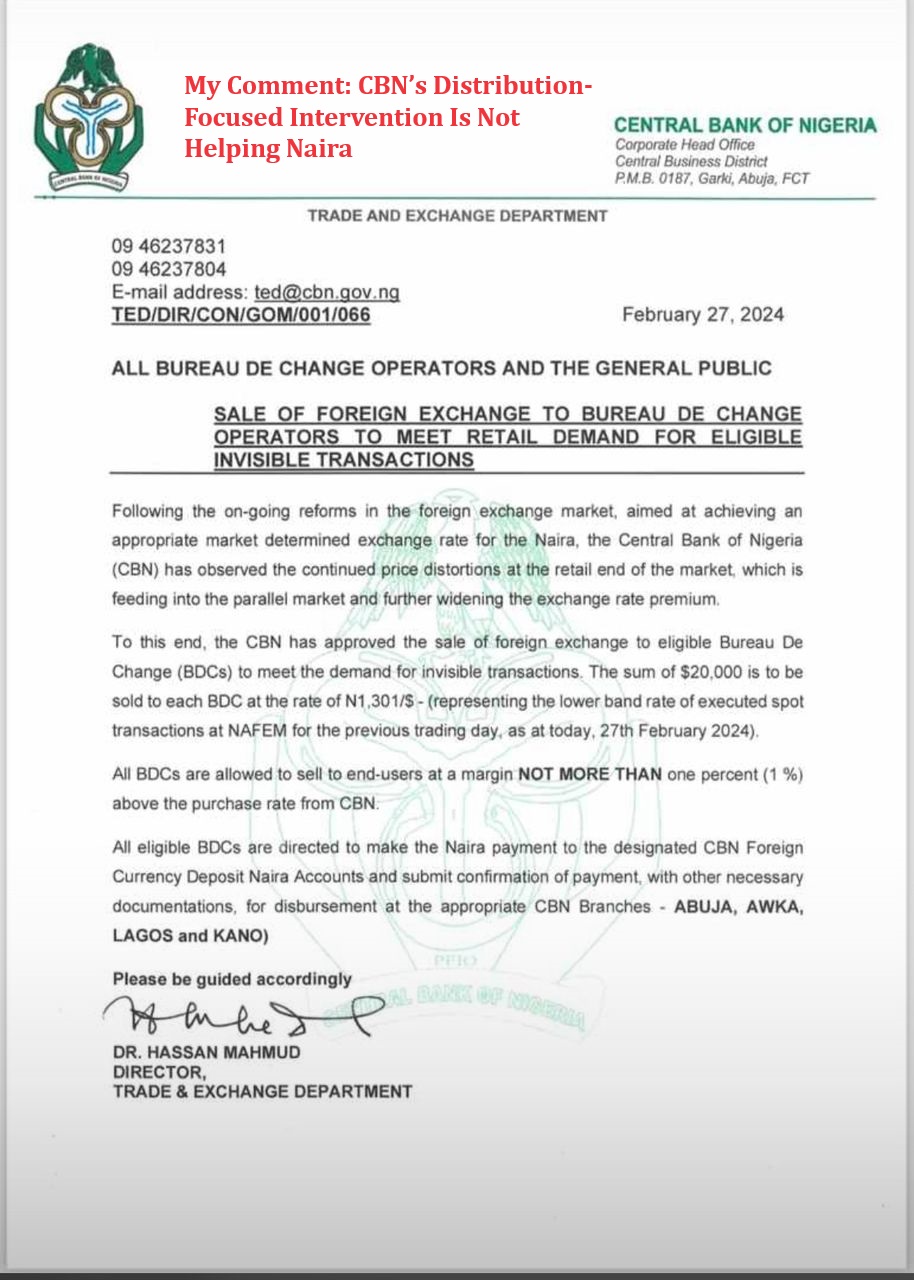
This is to note that giving BDCs $20,000 daily means nothing for a big economy like Nigeria. We need to focus on improving Supply of USD by going back to manufacturing-first economic policy, over our finance-driven and finance-first economy policy which began when IBB introduced SAP in late 1980s, and flooded Nigeria with finance Houses and new banks, even as our factories faded.