DD
MM
YYYY

PAGES

DD
MM
YYYY

spot_img

PAGES

Home Blog Page 3287

Only 5% of Nigerians have N500k and above in their bank accounts – finance minister

0

In a recent interview with Channels TV, Nigeria’s Minister of Finance and Coordinating Minister of the Economy, Wale Edun, revealed startling statistics regarding the financial situation of the country.

According to Edun, only approximately 5% of Nigerians have more than N500,000 in their bank accounts, indicating a significant wealth disparity within the nation.

“In the past eight years, only about 5% of the population have bank accounts with more than half a million in them,” Edun stated. “The majority was left out, while a small minority enjoyed.”

Highlighting the need for corrective measures, Edun emphasized that the government’s reforms aim to rectify economic imbalances that have favored a small group of elites over the majority of citizens in the past eight years. He noted the importance of redirecting government revenue into the national treasury to address these disparities.

“The reforms are corrective measures to mop up the liquidity in the economy that was not tied to production or supply of goods and services,” Edun explained. “These imbalances only benefit a few people in the economy.”

Edun further elucidated the historical context, noting that the preceding years saw a buildup of liquidity, with funds predominantly flowing to a privileged minority while the majority of the population remained sidelined. He reiterated that President Tinubu’s administration is committed to addressing these inequalities through comprehensive microeconomic reforms.

To mitigate the impact of poverty and the high cost of living, Edun announced President Tinubu’s initiative to provide a palliative package ranging from N25,000 to N15 million to households over the next three months. This measure is aimed at alleviating financial strain on vulnerable segments of the population and fostering economic stability.

His statement: “There has been an effort to ensure that the people’s money is not in the hands of a few. And on that point, I must emphasize that when we talk about the last eight years before Mr. President came to power, there was this liquidity built up.

“The Issue was that the funds were going to a few. Only about 5% of the population have bank accounts that have more than half a million in them. So, the majority was left out for eight years. They are on the sidelines while a small minority enjoy.

“That is the major correction being made by Mr. President now. These are the major microeconomic reforms that have been put in place.

“So therefore, government revenue that was outside the federal government consolidated revenue funds have been brought back to the government funds.”

The economic implications

The economic impact of the stark wealth disparity is profound and far-reaching. With only about 5% of Nigerians possessing substantial funds in their bank accounts, the vast majority of citizens are left grappling with meager earnings, which in turn has significant ramifications for the overall economy.

The concentration of wealth among a small elite segment of the population not only exacerbates inequality but also constrains economic growth. Economists note that when a large portion of the populace struggles with low incomes, their purchasing power is limited, leading to reduced consumer spending. This, in turn, dampens demand for goods and services, hampering businesses’ ability to thrive and expand. Ultimately, it stifles economic activity and hampers the nation’s potential for development.

Furthermore, a high population made up of poor people has been described as a recipe for social unrest and instability. This is because, as a significant portion of the population grapples with poverty and financial insecurity, frustration and resentment towards the privileged few who control a disproportionate share of the nation’s wealth can escalate, leading to social tensions and even unrest. Such instability undermines investor confidence and hampers economic progress.

Addressing the meager earnings of the populace and tackling wealth inequality are said to be imperative for fostering inclusive growth and sustainable development in Nigeria. The nation’s decision to distribute N25,000 to N15 million to households over the next three months, as a way of filling the gap has been criticized by experts.

Economists advocate empowering a broader segment of society with financial security and opportunities for economic advancement, which they said is not only morally imperative but also essential for building a robust and resilient economy that benefits all Nigerians.

CBN Reversal of Customs Divergent FX Rate is Good Policy for Nigeria

0

Well done Team; a great policy which I support: “To this effect, the Central Bank of Nigeria wishes to advise the Nigeria Customs Service and other related parties to adopt the FX rate on the date of opening the Form M for importation of goods, as the FX rate to be used for import duty assessment. This rate remains valid until the date of termination of the importation and clearance of goods by the importers.”

Recall last week that we made a case that it was a bad policy for the Nigerian Customs to use a different FX rate, from the one on Form M, when calculating duties: “Floating Naira does mean we cannot honour contracts. I have posited that Customs should not become a blinded rainmaker for Nigeria as doing that we will make it a poison pill: the more radical revenue from Customs, the more Nigeria’s economy is dying since these revenues are import-driven, not export-driven.  We must ask the government to allow predictability in the market system.”

The nation’s economic team has listened, and has made it clear to the Customs: if the Form M has N1000/$, you are not allowed to compute duties at any figure but N1000/$ even if Naira has shifted to N1200/$ (and I guess N800/$). Mr. Peter Obi led that charge; happy the government listened.

This reversal will bring predictability in the system and even help the Naira as it looks for a number to settle on.

CBN Directs Nigerian Customs to Adopt Same FX rate from Importation to clearance

CBN Directs Nigerian Customs to Adopt Same FX rate from Importation to clearance

0

In a bid to address pricing irregularities and provide more predictability in the cost of imported goods, the Central Bank of Nigeria (CBN) has instructed the Nigerian Customs Service (NCS) to adopt the FX closing rate on the date of Form M submission by importers for the clearance of goods and import duty assessment.

The directive, outlined in a circular issued on Friday by Hassan Mahmud, the apex bank’s Director of Trade and Exchange Department, aims to mitigate the disruptions caused by frequent updates on customs duties rates, which have led to inconsistencies in pricing and unpredictable increases in the final cost of goods in the market.

The circular states: “To this effect, the Central Bank of Nigeria wishes to advise the Nigeria Customs Service and other related parties to adopt the FX rate on the date of opening the Form M for importation of goods, as the FX rate to be used for import duty assessment. This rate remains valid until the date of termination of the importation and clearance of goods by the importers.”

The constant changes in customs duty rates have led to pricing irregularities, resulting in unpredictable increases in the final cost of goods in the market. The new directive is to enable the Nigeria Customs Service and the importers to effectively plan appropriately and reduce uncertainties around varying exchange rates in determining revenue, or cost structure respectively.

The circular mandates the NCS to utilize the foreign exchange (FX) closing rate on the date of Form M submission by importers for the clearance of goods and import duty assessment. This fixed rate will remain valid until the termination of the importation and clearance process by the importers.

Effective from February 26, 2024, the closing rate on the date of opening of Form M for importation of goods and services will be the rate applied for assessment purposes, superseding the previous requirement outlined in Memorandum 9, J (2) of the Central Bank of Nigeria Foreign Exchange Manual (Revised Edition) 2018.

This directive comes in the wake of yet another Customs duty rate review by the CBN, raising the duty rate for clearing imported items by 4.5 percent on February 21, 2024. The updated rate, according to the Nigeria Customs Service official trade portal, increased from N1,537.073/$ to N1,605.82/$, necessitating importers to allocate more funds for duty payment compared to previous rates.

The new rate is notably the highest the nation’s port industry has witnessed since the central bank introduced FX reforms in June 2023 to stabilize the foreign exchange rates.

Concerns have arisen regarding the potential adverse impact of elevated customs clearance rates on the already strained economic situation in Nigeria, prompting calls for government intervention.

Former Labour Party’s presidential candidate, Peter Obi, cautioned against arbitrary and continual increases in customs duties, citing their contribution to inflationary pressures and escalating living costs.

“If this situation is not corrected, our importers may resort to using ports of nearby countries, a situation that will leave our ports under-productive, and further deepen our economy into a worse situation as a result of loss of revenue,” he warned.

The Nigerian Customs embarked on the auctioning of seized food items, especially rice, at a reduced price (N10,000 per 25kg bag) on Friday, as a way of easing the economic pains of Nigerians.

Economists, however, advocate for a reduction in import duties and tariffs as a more effective means of alleviating economic hardships for Nigerians, citing direct benefits such as increased disposable income and enhanced purchasing power.

Crypto Investors Flock to Buy BlockDAG, Crushing ATOM’s Hopes to Beat Bitcoin

0

Digital currencies that draw attention from the market because of their distinctive qualities, cutting-edge technology, or potential for significant profits are, by definition, considered trending crypto coins. Finding and evaluating these currencies is crucial for investors who want to remain ahead of the curve as the cryptocurrency market develops.

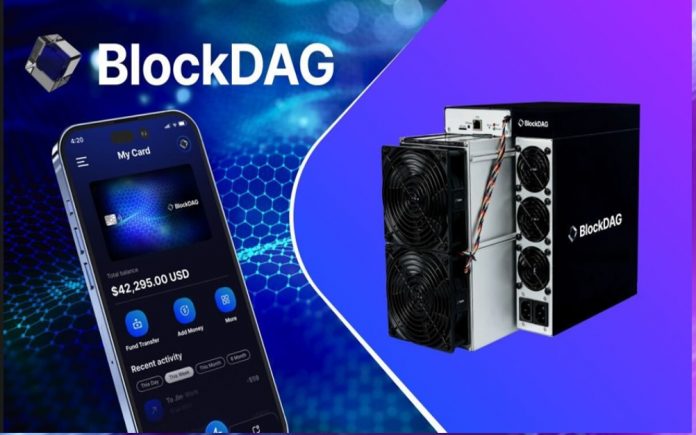
BlockDAG (BDAG) Coin distinguishes itself in the crypto market with its dedication to providing multiple earning streams for its contributors. This platform offers its users a highly profitable earning options such as mining experiences that are user-friendly, whether they’re using a smartphone or home-mining rigs. For instance, the BlockDAG x1 mobile app, which can be downloaded from Google Play and the App Store, makes cryptocurrency mining more accessible by enabling anybody to easily mine up to 20 BDAG coins worth $1 at launch per day.

What Is Cosmos (ATOM)?

According to its marketing, Cosmos addresses some of the “hardest problems” the blockchain sector is now confronting. By providing an ecosystem of interconnected blockchains, it seeks an alternative to “slow, expensive, unscalable, and environmentally harmful” proof-of-work methods, such as those employed by Bitcoin. Among the project’s main objectives is to demystify decentralized apps using a modular structure, reducing the complexity and difficulty of blockchain technology for developers.

The founding of Tendermint, a major network contributor, in 2014 marked the beginning of Cosmos. A Cosmos white paper was released in 2016, and the following year saw the launch of a token sale. The hybrid proof-of-stake mechanism used to generate ATOM tokens contributes to the security of the project’s primary blockchain, Cosmos Hub.

Trending Crypto Coins and Blockchain Technology

A well-rounded cryptocurrency portfolio necessitates striking the correct balance between blockchain technology and popular cryptocurrencies. By spreading out your assets, you may benefit from the potential profits of individual currencies as well as the revolutionary potential of blockchain technology. With this calculated method, you can position your portfolio for growth and stability in the ever-changing cryptocurrency market.

A common question among investors is identifying popular cryptocurrency coins in the large ocean of digital assets. Effective techniques include monitoring social media activity, staying current on industry news, and utilizing trustworthy market analysis tools. Using these strategies, you may improve your capacity to spot potential currencies in the volatile cryptocurrency market.

BDAG Mobile Mining App: A New Gold Rush

BlockDAG (BDAG) offers investors a transparent and smart plan with a 6-month mainnet launch and an ambitious goal of reaching $600 million by 2024. The project’s development and execution are made more confident by the specified milestones. The pledge to launch the mainnet in the allotted period suggests a proactive attitude to project completion. The team’s bold goal of raising $600 million by 2024 indicates its belief in BlockDAG’s (BDAG) capacity to dominate the industry and set high standards. In an industry where uncertainty is common, this plan and vision provide investors with a concrete framework for comprehending the project’s course while promoting confidence and transparency.

The BlockDAG X10 Mining application has sparked a FOMO in the crypto mining community, resembling a modern-day gold rush. Miners flock to this platform, hypnotized by the prospect of earning up to 20 BDAG coins daily. With coins initially valued at $1 on BlockDAG’s launch, miners are eager to capitalize on this lucrative opportunity within the cryptocurrency mining landscape.

Along with its remarkable success in raising $1.6 million so far while still being in the very initial stages of its presale, the BlockDAG project catches the attention of both miners, and crypto investors looking for explosive gains. The ongoing presale success of BlockDAG highlights the project’s viability and the community’s anticipation of its potential, making it the most sought after crypto of 2024.


Join BlockDAG Presale:

Website: https://blockdag.network

Presale: https://purchase.blockdag.network

Telegram: https://t.me/blockDAGnetworkOfficial

Discord: https://discord.gg/Q7BxghMVyu

Aba is Back As Geometric Power Commissions Its Electricity Power Plant

0

Let me take this moment to congratulate Geometric Power as it plans to commission its Aba power station. The tenacity the team led by Prof Barth Nnaji has demonstrated is legendary. I also commend His Excellency,  Dr Alex Otti, the executive governor of Abia State, for his focused intervention, with a mindset of whatever it will take to get this power plant operating within a year of inauguration.

To the members of Abia State Government Transition Council, I also commend everyone of you, because during all the meetings and strategy sessions, everyone zeroed on this: Geometric Power must begin operations within 9 months of inauguration. Men and women posited that for Greater Aba Development Authority (GADA), as proposed by the Council, to be meaningful, Geometric Power must be working. By the action of Mr. Governor, GADA is now the law of the land,  and the Authority is tasked with overseeing the development of Aba, the Enyimba City.

The British established a military post in Aba, Nigeria in 1901 and  In 1915, a railroad was built to connect Aba to Port Harcourt, to move agricultural goods like palm oil and palm kernels. By the 1920s, Aba had assumed a position as one of the most important cities in Nigeria, post the Lord Lugard amalgamation. But Aba, after the Biafra War, began to fade, due to structural negligence.

Good People, I am excited that Aba is BACK, and Nigeria will be back stronger and bolder, because when Aba thrived, Nigeria rose to the mountaintop.

Let me also use this moment to say that Abia needs more new cities. Yes, we have opportunities to build new cities. If your firm specializes in such, please connect. The Government of Alex Otti will provide any support you will need. We want to have mini-Abas, modern cities of innovation, across Abia. Reach out to me and I will connect you to our special assistants, commissioners, and if the vision is big, to Mr. Governor directly. In Abia, we like investors; no person will give you troubles. #InvestInAbia

Ndubuisi Ekekwe, PhD

Member, Abia Global Economic Advisory Council

Co-chair, Abia State Economic Transformation Council