DD
MM
YYYY

PAGES

DD
MM
YYYY

spot_img

PAGES

Home Blog Page 3295

Implications of Nigeria Going Tough on Cryptocurrency Exchanges and BDC Merchants as the Naira Plummets Against the US Dollar

1

In an unprecedented move, Nigeria has embarked on a rigorous campaign to stem the tide of its currency’s devaluation by blocking access to cryptocurrency exchanges. This bold step underscores the government’s determination to stabilize the financial situation in Africa’s largest economy, which has been grappling with a rapidly sliding Naira.

The Central Bank of Nigeria (CBN) recently lifted its restrictions on cryptocurrency transactions in commercial banks in December 2023. This decision comes after two years of waiting, during which crypto enthusiasts and companies yearned for the apex bank to lift the ban.

The CBN recognized that current global trends necessitate regulation of crypto activities, acknowledging that virtual asset service providers (VASPs), including cryptocurrencies and crypto assets, play a significant role in today’s financial landscape.

Press Release from Binance
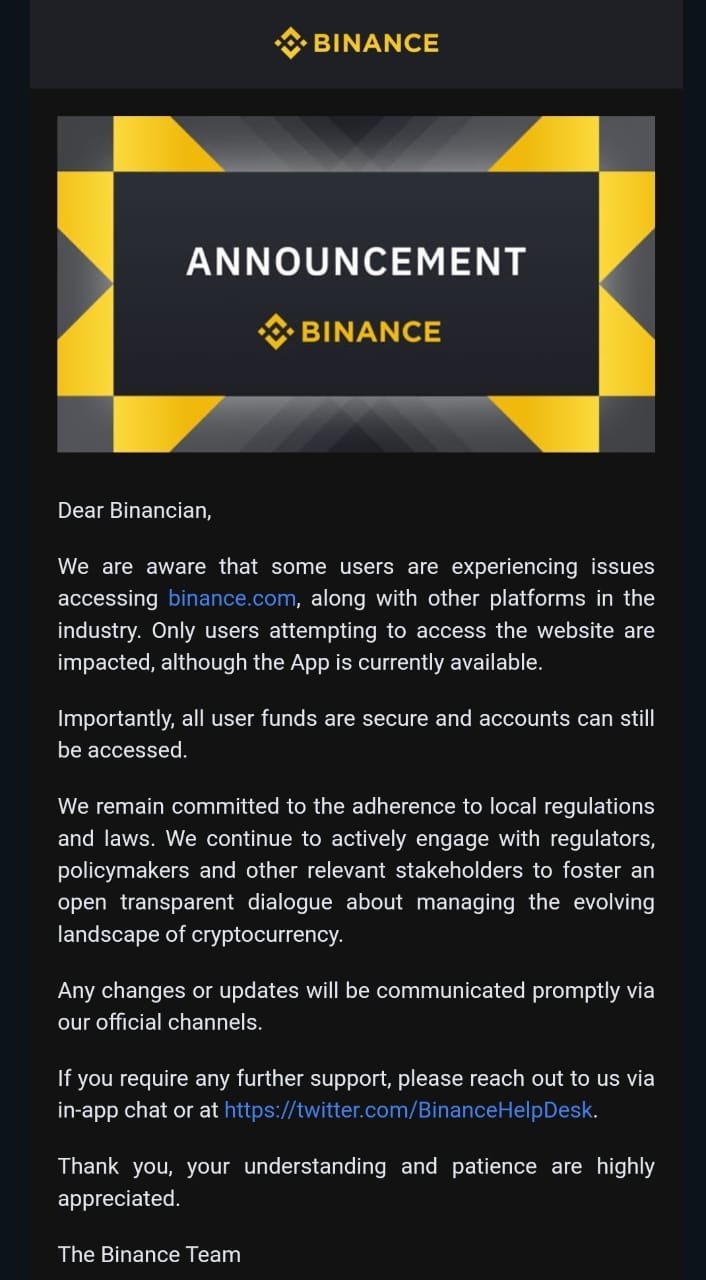
However, Nigerian authorities have taken a compelling step by imposing a ban on accessing cryptocurrency exchanges. The Central Bank of Nigeria (CBN) and the Nigerian Communications Commission (NCC) jointly directed telecommunication companies to block access to crypto companies, their websites, and applications.

This move aims to curb perceived manipulation of the foreign exchange (FX) market, a claim which the government refuted but many Crypto like myself have haven’t been able to connect some Airdrop sites and some relatively slow to access at the time of writing this post.

As a result of this directive, some Nigerian users are currently unable to access major crypto platforms like Binance, Kraken, and Coinbase through local networks. Even initial access that was granted through some selective applications has been revoked.

The government’s decision to clamp down on crypto exchanges follows concerns over continuous FX market manipulation, which the government believes is contributing to the rapid depreciation of the Naira.

Government officials, including Bayo Onanuga (the Special Adviser to the President on Information and Strategy), have called for regulatory action against market manipulation by crypto platforms, specifically singling out Binance. Binance has been accused of setting exchange rates and operating beyond regulatory oversight.

Interestingly, this development contrasts with events just over a year ago when the CBN imposed a ban on crypto transactions between banks, exchanges, and individuals. However, in December 2023, the CBN lifted its restrictions on banks facilitating cryptocurrency transactions.

The future of digital asset adoption in Nigeria remains uncertain. While the government aims to stabilize the Naira by banning access to crypto exchanges, this move may prove to be a hurdle for the country’s development of the crypto industry. Crypto users in Nigeria remain optimistic and hope for eventual access to crypto exchanges once again.

Apparently, the government have not been able to follow through the process, mode of trading operations of the blockchain, Pricing is not determined by set of individuals but on the sole forces of supply and demand, market forces suchlike demand and supply result in up/downwards in prices of crypto asset. Crypto traders have the peculiarities in determining price according to demand and real market value of a said coin which is the purpose of decentralization.

P2P is a free market, the CBN can go on Binance P2P and sell their own dollars for let’s say 800 NGN/$ and march trade with other merchants who they claim are selling above the proscribed government exchange rate. Total volume on Binance today is barely $30 million. In the kind of scenario, the Central Bank of Nigeria should bring out $100 million, counter crypto traders by crashing prices in Binance if they so see crypto p2p trades as conventional bank trading, crypto prices hedge on value of demands and supply.

Also, CBN and the Nigerian government should fix the problem from its core, which is the Naira value to the Dollar $, bring it down to let’s say 100 naira to the dollar, how? Increase oil output to 1.8M barrel per day. Maintain consistency for two quarters then lobby OPEC to increase allocation. Secondly attract private equity capital.

Thirdly, cutting down of our bourgeoisie government circle, which translate to cutting down of unnecessary frivolities in government structure. Above all incubation of production mechanism as against dependency on imports should be an aggressive drive of Nigeria.

The CBN has released guidelines for banks and other financial institutions when operating with entities that provide crypto services. While banks can now facilitate crypto transactions, they are prohibited from trading, holding, or transacting cryptocurrencies directly. Here are some key points from the guidelines:

Banking Relationships with VASPs: Banks are allowed to open accounts for crypto companies (VASPs), provide them with designated settlement accounts, and act as channels for foreign exchange flows and trade.

Licensing Requirement: Crypto companies wishing to use banks must obtain a license issued by the Nigerian Securities Exchange Commission (SEC) to operate.

I expect crypto companies to urgently look in the way of its users in order to maintain her leverage, and more so, negotiate a soft laden with the government, this is crypto where centralization and government interference isn’t treated with levity by crypto natives. The government should find ways to balance the Naira against the US Dollars and not to subjugate legitimate organizations into shifts, not healthy for the crypto industry.

The outcome of the rift between the government and cryptocurrency in Nigeria might be a long haul as many crypto degenerates are scaping for leverage in order to continuing trading with many joggling from Telegram OTC to local merchant via P2P channel.

President Tinubu’s Adviser Pushes For Crypto Platforms Ban in Nigeria Amid Forex Crisis

0

Special Adviser to President Bola Tinubu on Information and Strategy, Bayo Onanuga is advocating for the ban of cryptocurrency trading platforms in Nigeria amidst the forex crisis.

Mr. Onanuga accused these platforms of manipulating the Naira, which according to him has caused the local currency to significantly lose value.

In a post made on X (formerly Twitter), which he titled “The Naira-Dollar Manipulators”, he urged the Economic and Financial Crimes Commission (EFCC) and the Central Bank of Nigeria (CBN), to move against these platforms trying to manipulate the national currency to Ground Zero.

He wrote,

Binance which is blatantly setting exchange rate for Nigeria, hijacking CBN role, is a cryptocurrency trading platform, and suffers access limitations from multiple jurisdictions, such as the US, Singapore, Canada and the The UK. According to Data Wallet, Binance is prohibited in the United Kingdom by the Financial Conduct Authority from conducting any regulated activities. In Japan, the Financial Services Agency (FSA) banned Binance from operating without the necessary regulatory approval.

Ontario, Canada, has also suspended Binance services following its inability to meet the province’s securities regulation criteria. The Monetary Authority of Singapore also banned Singaporean investors from accessing Binance’s services. Binance, facing regulatory showdown in many countries, and causing disruptions in the currency market, should not be allowed to dictate the value of the Naira, not on its crypto exchange platform.

“Other crypto platforms such as Kucoin, and Bybit should be banned from operating in our cyberspace. FX platform Aboki should be re-banned. The EFCC and the CBN should move against these platforms trying to manipulate our national currency to Ground Zero. Crypto should be banned in our country or else this bleeding of our currency will continue unabated”.

The accusation of Binance for setting the exchange rates for Nigeria and hijacking the CBN role is followed by a blogpost from the crypto exchange, distancing itself from the Forex crisis in Nigeria.

Binance wrote,

“Don’t believe the FUD. We would like to assure users that their funds are secure and our peer-to-peer (P2P) product remains operational. Binance provides a P2P marketplace, not as a price discovery platform. To be clear: it is market-driven and is not intended to be a proxy for currency pricing in Nigeria. It is important to note that foreign exchange rates are influenced by various complex factors, which Binance has no influence on. 

“However, we continue to actively engage with regulators, policymakers, and other relevant stakeholders to foster an open transparent dialogue about managing the evolving landscape of cryptocurrency and financial markets. We remain dedicated to providing market-driven, fraud-free, and manipulation-free products for users. We take our responsibility to protect users and their confidential data very seriously.”

Mr. Onanuga’s call for the ban of crypto platforms in Nigeria comes amidst reports that a fresh crypto crackdown is brewing in Nigeria.

Although, regulators such as the Nigerian Communications Commission (NCC) the Securities Exchange Commission (SEC), and the Central Bank (CBN) are yet to release public notices on the matter. Meanwhile, it is alleged that the NCC has directed telecom operators to interfere with the operations of players like Binance, OctaFX, Coinbase, Kraken and FXTM.

Sources disclose that the recent movement against the crypto industry is inspired by the belief that digital currency exchanges have been weaponized by currency speculators and money laundering groups for dubious activities that continue to undermine the strength of the naira against the dollar.

EV Maker Rivian Slashes Workforce by 10% Amid Competitive Market And Macroeconomic Challenges

0

American Electric Vehicle (EV) Manufacturer and Automotive technology company, Rivian, has slashed its workforce by 10%, amid an increasingly competitive EV market and macroeconomic challenges.

The company made this disclosure during its fourth quarter (Q4) earnings report. Speaking on the layoff of some part of its workforce, founder and chief executive of the company RJ Scaringe in an email sent to employees disclosed that the company is facing a challenging macroeconomic environment.

In his words,

“Our business is facing a challenging macroeconomic environment, including historically high-interest rates and geopolitical uncertainty, and we need to make purposeful changes now to ensure our promising future”.

Due to these several challenges, Rivian has carried out several rounds of layoffs in its short history. The company let go 6 percent of its workforce both in July 2022 and May 2023. This current round of layoffs is expected to affect over a thousand workers at the Irvine, California-based company, which has a combined workforce of 16,700 salaried and hourly employees.

A spokesperson said the layoffs would mostly affect the company’s salaried employees, as well as a limited number of hourly non-manufacturing workers.

During the fourth quarter earnings report, the company said that it would likely not produce any more vehicles than it did in 2023. Rivian disclosed tights it made 57,232 vehicles in 2023, of which 50,122 were delivered. It expects to produce 57,000 vehicles in 2024, roughly the same number it made in 2023.

Scaringe boasted that Rivian produced the best-selling electric vehicle over $70,000 last year. In its shareholder letter, Rivian said it expected deliveries to be the same this year although it expects to achieve a “modest gross profit” by the end of 2024.

During an earnings call with investors, Rivian’s CEO said the company was focused on reducing costs, most notably by shrinking the number of electronic control units (EUs) found in each vehicle.  He also talked up the imminent release of R2, despite the fact that the vehicle won’t go into production until late 2026.

“We’re in a very interesting moment in time where there is a lack of choice of highly compelling EV products in that $45 to $55,000 price range,” he said.

Rivian will unveil its new smaller and less expensive consumer models, the R2S SUV and R2T pickup, in March, but those vehicles are not expected to be in production until 2026.

On the broader EV market, it is worth noting that sales of electric vehicles have not expanded as rapidly in the past year as they had before, and automakers have blamed high-interest rates for some of that slow-down.

Coupled with pressure from Chinese competitors, major U.S. and European auto manufacturers are pushing hard to cut electric vehicle costs so they can have price tags and profit margins.

This has spurred giant EV maker Tesla to aggressively cut prices of its vehicles, which has put pressure on other automakers. Ford, for instance, recently announced it was deeply cutting prices of its Mustang Mach-E, a direct competitor to the Tesla Model Y SUV.

The arrival of lower-cost Chinese EVs has no doubt added new impetus to European automakers’ ongoing efforts to develop more affordable models.

Rivian to cut 10% of staff – LinkedIn News

Slowing demand for electric vehicles is hitting Rivian. The company announced plans to eliminate 10% of its salaried jobs, while production this year is expected to match that of 2023 levels at 57,000 vehicles, missing analysts’ estimates. Rivian blames “economic and geopolitical uncertainties and pressures, most notably the impact of historically high interest rates.” The electric truck maker has been trying to challenge Tesla, but has faced supply-chain issues and related problems, as it works to boost production and reduce losses. Rivan laid off workers last year and in 2022.

  • Major automakers, including GM and Ford, have been walking back investments in “battery factories and other facilities” tied to electric vehicle production, notes The Wall Street Journal.
  • Rivian rival Lucid said it was only increasing its EV output by 500 vehicles this year.
  • EV sales in the U.S. rose 47% last year, compared to about 70% growth in 2022.

Nvidia Surpasses Expectations with Record-Breaking Revenue Growth

0

Nvidia has defied expectations yet again, reporting fourth fiscal quarter earnings that soared above Wall Street’s projections.

The semiconductor giant not only surpassed forecasts for earnings and sales but also delivered a bold outlook for the current quarter, exceeding even the most optimistic predictions for revenue growth.

Following this announcement, Nvidia’s shares surged approximately 10% in extended trading, signaling resounding confidence from investors.

The figures paint a vivid picture of Nvidia’s outstanding performance: Adjusted earnings per share stood at an impressive $5.16, surpassing the $4.64 expected by analysts. Revenue reached an astounding $22.10 billion, comfortably surpassing the projected $20.62 billion. Looking ahead, Nvidia anticipates revenue of $24.0 billion for the current quarter, eclipsing the $22.17 billion anticipated by analysts.

At the core of Nvidia’s success lies its pivotal role in the technology industry’s fervor for large artificial intelligence (AI) models. The company’s graphics processors for servers have become indispensable in the development of these models, positioning Nvidia as the primary beneficiary of this trend.

“Strong demand was driven by enterprise software and consumer internet applications, and multiple industry verticals including automotive, financial services and health care,” the company said in commentary provided to investors.

Addressing concerns about sustaining this remarkable growth trajectory, Nvidia’s CEO Jensen Huang expressed unwavering confidence in the company’s future prospects. He highlighted the enduring demand for Nvidia’s GPUs, fueled by the proliferation of generative AI and a broader industry shift towards accelerators over central processors.

Huang told to analysts, “Fundamentally, the conditions are excellent for continued growth in 2025 and beyond…Demand for the company’s GPUs will remain high due to generative AI and an industry-wide shift away from central processors to the accelerators that Nvidia makes.”

The latest financial report denotes Nvidia’s staggering ascent, with net income skyrocketing to $12.29 billion, marking a remarkable 769% increase compared to the previous year. Total revenue surged by 265%, primarily driven by robust sales of AI chips for servers, notably the highly sought-after “Hopper” chips like the H100.

Nvidia’s Data Center business, now the cornerstone of its revenue stream, witnessed a remarkable 409% increase to $18.40 billion. This surge was propelled by robust demand across various sectors, including enterprise software, consumer internet applications, automotive, financial services, and healthcare.

Addressing the impact of recent U.S. restrictions on exporting advanced AI semiconductors to China, Huang noted, “We understood what the restrictions are, reconfigured our products in a way that is not software hackable in any way, and that took some time so we reset our product offering to China. Now we’re sampling to customers in China.”

Chief Financial Officer Colette Kress acknowledged the persistent supply constraints, especially with the impending launch of its next-generation chip, the B100.

“We are delighted that supply of Hopper architecture products is improving,” Kress said on a call with analysts. “Demand for Hopper remains very strong. We can expect our next-generation products to be supply constrained as demand far exceeds supply.”

“Whenever we have new products, as you know, it ramps from zero to a very large number and you can’t do that overnight,” Kress added.

Meanwhile, Nvidia’s gaming business, although up 56% year over year to $2.87 billion, pales in comparison to the meteoric rise of its data center segment. Nevertheless, the company’s diverse portfolio, including its automotive business and OEM ventures, demonstrates resilience and potential for future growth. It rose 7% to $90 million while business making graphics hardware for professional applications rose 105% to $463 million.

Nigerian Customs, Think Beyond Revenue To How To Support Economic Growth

0

Everyone knows my testimony: Nigeria worked for me. It provided me EVERYTHING a young man would have wished for. So, my desire daily is that Nigeria works for others, and that is why we try to explore how we can have a working nation. On that, I do hope the Nigerian government considers this observation from Peter Obi:

“A situation where at the point of initiating importation, Form M and other documents related to importation are based on a particular rate of exchange, for example, N1000 to $1, being the prevailing exchange rate at the time which the importer of goods was used to calculate the entire process, from the import initiation to receipt of goods in his warehouse. Then suddenly when the goods arrive in Nigeria, and duties are calculated at different rates, say N1400 to $1, it becomes a serious business challenge that results in business losses,” Peter Obi said.

Floating Naira does mean we cannot honour contracts. I have posited that Customs should not become a blinded rainmaker for Nigeria as doing that we will make it a poison pill: the more radical revenue from Customs, the more Nigeria’s economy is dying since these revenues are import-driven, not export-driven.  We must ask the government to allow predictability in the market system.

The newspapers and TV pundits hailed that for the nation. Yet, if you look deeper, you will notice one thing: Nigeria is becoming a trading hub as companies shift to export instead of make in Nigeria, since the Customs revenue is not coming from exports as ships are still leaving our ports largely empty. Also, these are not equipment and machinery; these are basic imports of household and business consumables which ought to be made in Nigeria.

Again, we commend the Customs team but we must not celebrate these huge numbers. For everything, the double digit growth we’re seeing in the customs revenue will remind us that Nigeria is being de-industrialized!