DD
MM
YYYY

PAGES

DD
MM
YYYY

spot_img

PAGES

Home Blog Page 3306

West African currency, ECO, will Not Improve Intra-Trade in West Africa Without Foundational Infrastructures

0

Comment: The single West African currency, ECO, will reduce transaction costs. Businesses wouldn’t need to exchange currencies for cross-border trade, saving time and money.

My Response: Between currency transaction and transportation distribution costs, the currency cost is insignificant. The currency transaction cost of importing a container from China to Lagos port is insignificant compared to the infrastructure distribution cost between Lagos port and Sokoto. Similarly, the Port of Lome is now the busiest  port in West Africa, and many Nigerian importers import from China to Togo, and then to Nigeria, even though they have to deal with three currencies and absorbing currency transaction costs of Yuan, CFA franc and Naira. Those currency costs are  way cheaper than the extra distribution costs they experience in Nigerian ports where containers could be stuck for weeks.

Togo is a country of less than 10 million people but its port is busier than Nigeria’s with about 220 million people because many Nigerians import via Togo, and enjoy the free right of way within ECOWAS. The extra currency cost of moving across CFA Franc is nothing compared to the challenges in Nigerian ports. I ran some of the numbers for the Africa Union on this paper. .

As I noted in the earlier post, currency will not fix the infrastructure challenges in West Africa, and the gains are going to be marginal. Those infrastructures are foundational, and the ECO, the rumoured currency, will not leapfrog those. To deliver welfare gain to the West African people, West Africa needs to integrate infrastructure wise, as Europe did, and that will help it to trade more closely. Then, the single currency will come later.

Finally, the reason Jumia and Konga do not deliver to Ovim, my great village in Abia, is not because of currency friction. Jumia and Konga do not because of unbounded distribution costs of moving things from Lagos to a village. My village uses Naira just as Lagos does! lol. Yet, Jumia cannot ship to that destination. Why? It is not due to currency transaction cost, it is the distribution cost which is the bigger part of the marginal cost. So, even if you make West Africa to have the same currency, as my village and Lagos enjoy on Naira, if that distribution cost is not addressed, intra-trade will not happen.

What do I propose? I support using technology to make different currencies “disappear”, making it possible that a man in Lagos, with Naira, and  buying a hat in Ghana, and paying in Cedi, will not even know that he is paying across the border. Yes, the seamless experience would be like he is paying someone in another part of Lagos! But using convergence of currency to achieve that will be a mistake for Africa.

Why The West African ECO Currency Is An Illusion

In 2015, 1 CFA franc in Cotonou would have given you N0.25 (or 25 kobo); today, you will get N2.50. If you run the numbers, that is a 10X appreciation over the Naira in less than ten years!  They have even done better than the US dollars against the Naira.

If any person tells you that Togo, Benin Republic, etc, will abandon their currency and join together with Nigeria on ECO, tell him to test for malaria. It is like asking the United States dollars to co-join with the Naira for a new currency.  For what?
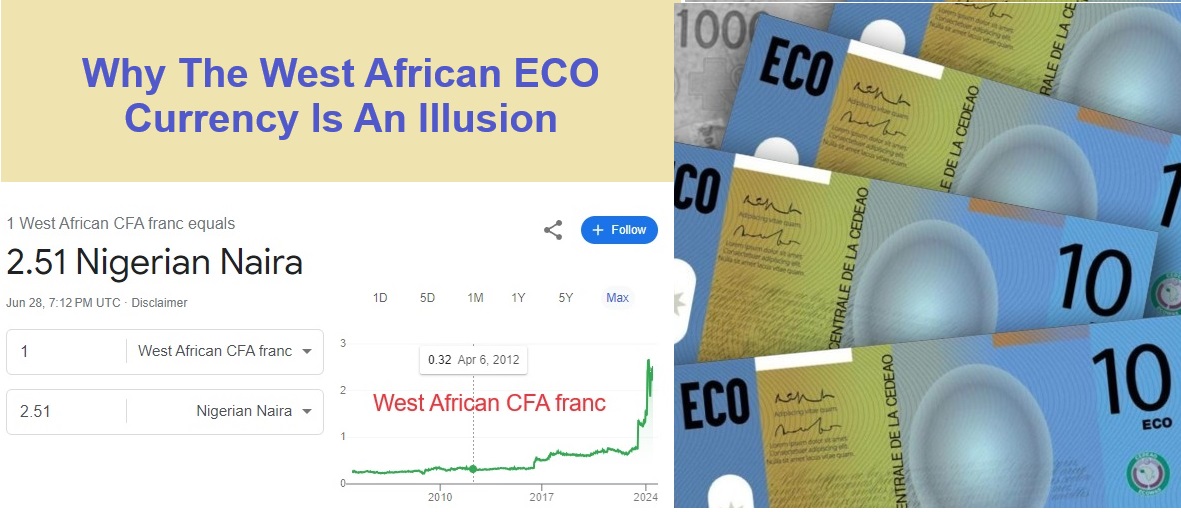
For most of these West African countries, ECO will deliver one thing: massive welfare losses. And that is why ECO will not happen for a really long time, until the elephant in the room (Nigeria) improves its fiscal governance. Nigeria’s economy is asymmetrically huge in West Africa that Nigeria will set the direction of the currency more than 90% of the time. Those Togolese, Ivorians, etc will not like that game of chess. And that is why ECO is an illusion.

ECOWAS Does Not Need A Single Currency Now

The Global Foreign Exchange Market is a Big Deal

0

The global foreign exchange (FX) market is indeed a significant entity in the financial world, with a daily volume that dwarfs other markets. It is the largest financial market globally, with a staggering $6.6 trillion daily volume as of 2019, and it has only grown since then. This market is essential for a multitude of reasons, not least of which is its role in facilitating international trade and finance.

Understanding the FX Market

The FX market, also known as forex or currency market, is where currencies are traded. This trading is crucial because it determines the exchange rates for currencies around the world and allows for currency conversion for international trade settlements and investments. The market operates 24 hours a day, five days a week, with a network of banks, dealers, and traders engaging in transactions.

The FX market’s importance cannot be overstated. It serves as the backbone of international trade and investment by enabling businesses to convert one currency to another. This function is vital for global commerce, as it allows companies to purchase goods and services across borders and invest in foreign enterprises.

Moreover, the FX market contributes to economic stability by providing liquidity to other financial markets. Its continuous operation ensures that currency exchange rates are stable, which is crucial for businesses that deal with imports and exports. The market’s size and scope mean that it can absorb large trades without significantly impacting the exchange rate of a currency, thus maintaining market stability.

The participants in the FX market are diverse, ranging from central banks to retail investors. Central banks play a pivotal role by setting monetary policy and exchange rates for their respective currencies. Commercial banks, investment firms, hedge funds, and individual traders all contribute to the market’s liquidity and depth.

Here are some of the major currency pairs:

EUR/USD (Euro/US Dollar): Known as the ‘Fiber’, this pair is the most traded currency pair in the world, representing two of the largest economies: the European Union and the United States.

USD/JPY (US Dollar/Japanese Yen): This pair is often referred to as the ‘Gopher’ and is the second most traded pair, highlighting the economic powerhouses of the United States and Japan.

GBP/USD (British Pound/US Dollar): The ‘Cable’ is a historically significant pair that denotes the trading relationship between the United Kingdom and the United States.

AUD/USD (Australian Dollar/US Dollar): This pair, known as the ‘Aussie’, reflects the economic interactions between Australia and the United States, with Australia’s economy heavily influenced by commodity exports.

USD/CAD (US Dollar/Canadian Dollar): The ‘Loonie’ represents the trade between neighboring countries, the United States and Canada, with Canada being a major exporter of natural resources.

USD/CHF (US Dollar/Swiss Franc): Referred to as the ‘Swissie’, this pair indicates the relationship between the United States and Switzerland, a country known for its financial services.

Apart from these major pairs, there are also ‘cross-currency’ pairs that do not include the US dollar. These pairs offer traders exposure to different currency dynamics and can include combinations like the EUR/GBP (Euro/British Pound) or the EUR/JPY (Euro/Japanese Yen).

Role of Technology in the FX Market

Technology has transformed the FX market, making it more accessible to the average investor. Online trading platforms have democratized access to forex trading, allowing individuals to participate alongside large financial institutions. This technological advancement has increased market transparency and efficiency, benefiting all participants.

As the global economy continues to evolve, the FX market will remain an integral part. Its ability to adapt to changes in technology, regulation, and economic conditions will continue to make it a critical component of the world’s financial infrastructure.

The global FX market is more than just a big deal; it is a fundamental element of the modern economy. Its smooth functioning ensures that businesses can operate internationally, and economies can grow and integrate. As such, understanding the dynamics of the FX market is essential for anyone involved in financial activities or interested in the global economy.

Privacy Pays: Old Generation of Crypto Investors Are Betting Big on Rollblock (RBLK) and Monero (XMR) As DOT Rumoured To Be Facing Financial Difficulty

0

Polkadot (DOT) is being criticized by millions of investors after publishing its latest treasury report. This report detailed Polkadot’s spending, revealing that the early Ethereum competitor is running the business at a loss. Investors are concerned that Polkadot will be gone in less than 2 years. This has prompted many to search for new investments with good growth and financial structures like Monero (XMR) and Rollblock (RBLK). Analysts predict that with Rollblock’s structure, the new altcoin could experience a 50x rise in the next few weeks.

Polkadot (DOT) Faces Backlash After Losing $108 Million Annually

Polkadot (DOT) may be losing thousands of new investors after its recent publication as many compare it to FTX. Based on the report, over $36 million of Polkadot’s spending went into marketing and outreach to attract new users into the ecosystem.

Polkadot’s head ambassador, Tommi Enenkel included in the report that Polkadot is losing around 17 million DOT ($108 million) every year. Polkadot’s price reflects investors’ sentiments about this news as it dropped from $6.50 to $5.80 in the last 24 hours. However, some analysts predict that despite Pokadot’s bearish sentiment, DOT’s price could still increase in the coming months.

Monero (XMR) Investors Maintain Neutral Sentiment Despite The Market Downturns

Unlike Polkadot (DOT), Monero’s investors continue to hold Monero (XMR) tokens. Monero has always been known for its strong security and privacy features, which allow for anonymous transactions. This has kept Monero stable despite the broader market downturns.

Monero (XMR) currently trades at $154.46, a 2.17% drop from its $160 price in the last 24 hours. However, analysts suggest this price drop is due to the recent Bitcoin decline. Monero has already shown increasing patterns toward its previous price levels, highlighting the importance of security and privacy to investors.

Rollblock’s (RBLK) Revenue-Sharing Feature Drives New Investors To The Presale

Rollblock (RBLK) is the first ever play-to-earn token in the iGaming sector that aims to close the gap between centralized and decentralized gaming experiences. Offering users access to over 150 classic table games, Rollblock places a strong emphasis on transparency and trustworthiness. Rollblock uses blockchain technology to secure all transactions, ensuring that bets placed are traceable and can’t be changed. This adds a significant layer of security to the platform and draws the attention of investors seeking a secure investment with high growth potential.

Rollblock sets itself apart from other iGaming platforms with its user-friendly approach to registration. Users don’t need to complete KYC verification when registering. Instead, they can simply connect their crypto wallets or sign up with an email address. This ease of access has significantly increased the user base, which in turn has attracted more investors to the native $RBLK token. Within the Rollblock ecosystem, the $RBLK token serves as a reward for player activities and offers staking opportunities for additional earnings. Unlike Polkadot (DOT), which allocated most of its funds to marketing, Rollblock (RBLK) has also introduced a revenue-sharing feature, where up to 30% of daily casino profits are allocated to repurchasing $RBLK tokens from the open market. These tokens are then burned to increase their value, and the remaining portion is distributed as rewards to token holders.

Currently in stage 3 of the presale, Rollblock’s price sits at $0.015. Over 100 million tokens sold in less than a month highlights the project’s broad appeal to investors. Given that the current price is the lowest it will ever be, this would be the best time for investors leaving Polkadot (DOT) to invest in $RBLK. Rollblock’s tokenomics specify a fixed supply of 1 billion $RBLK, with only 60% available during the presale. Analysts predict that due to limited supply, Rollblock’s value could rise by over 800% before the presale ends, making it one of the best altcoins to invest in.

As the native token of a platform designed to lead the future of online gaming and casinos, $RBLK is expected to become one of the top DeFi tokens of 2024. The token’s extensive features, security standards, revenue-sharing model, and various opportunities for holders increase its growth potential. With Rollblock’s plan to become a 100x token, investors who get in during the presale are in for the biggest returns.

Discover the Exciting Opportunities of the Rollblock (RBLK) Presale Today!

Website: https://presale.Rollblock.io/

Socials: https://linktr.ee/Rollblockcasino

ECOWAS Does Not Need A Single Currency Now

2

The news is that ECOWAS wants to unveil ECO, a currency. First, as I wrote to the African Union Congress 15 years ago, I stand on my call: a single African currency would be a disaster for the continent. We overestimate the potential value of this single currency for Africa. My note to the African Union.

We must understand that Africa’s economies are heterogeneous in nature which means that trade shocks will not be easily managed, unlike the European Union, which has a more homogenous economy, and which has been trading together for decades before the adoption of the Euro. So, you do not want a situation where we have this ECOWAS currency, rumoured to be ECO, and Nigeria’s economy which has undue influence on all ECOWAS countries, will blow things up because everyone is using one currency.

A single currency will not remove the rascality of our politicians, and without an autonomous local central bank, many bad things will happen, since a supranational bank will assume control of the ECO. In other words, when Nigeria mismanages, it will not have the power to re-calibrate its currency, and any impact of that will be shared by all ECOWAS states due to the size of its economy. Good People, expect a massive welfare loss when that happens.

Then, the big one. The CFA Francs zone has been trading for decades. There is no statistical data to show that a single currency has improved intra-trade there. Currency does not solve the problems of ports, roads, innovation and other basic amenities which are needed for trade development and growth.

What do I propose? I support using technology to make different currencies “disappear”, making it possible that a man in Lagos, with Naira, and  buying a hat in Ghana, and paying in Cedi, will not even know that he is paying across the border. Yes, the seamless experience would be like he is paying someone in another part of Lagos! But using convergence of currency to achieve that will be a mistake for Africa.

That was my banking & finance doctoral research while in banking, and I did publish many of my findings in the African Union, World Bank, etc. We need to focus on building foundational pillars so that West Africa’s economies could become more homogenous before we can introduce the ECO, if we expect this to deliver welfare gain for the people.

Comment on Feed

Comment: the single currency will Reduce transaction costs. Businesses wouldn’t need to exchange currencies for cross-border trade, saving time and money.

My Response: between currency transaction and transportation distribution costs, the currency cost is insignificant. The currency transaction cost of importing a container from China to Lagos port is insignificant compared to the infrastructure distribution cost between Lagos port and Sokoto. Similarly, the Port of Lome is now the busiest port in West Africa, and many Nigerian importers import from China to Togo and then to Nigeria because those three currency costs are way cheaper than the distribution costs they experience in Nigerian ports where containers could be stuck for weeks. I ran some of the numbers for Africa Union on this paper.

Experts Predict That DTX Exchange Can Challenge The Market Dominance of Litecoin and Ripple By 2025

0

Forget the “new kid on the block” narrative. DTX Exchange is a calculated move in the cryptocurrency chess game, poised to disrupt the dominance of established players like Litecoin (LTC) and Ripple (XRP). Experts predict DTX could capture significant market share by 2025, thanks to its innovative hybrid exchange model and features exceeding those of its competitors.

This article dives into the core functionalities of DTX Exchange and explores how it might redefine the cryptocurrency landscape.

DTX Exchange: A Hybrid Powerhouse Redefining Cryptocurrency Trading

DTX Exchange breaks the mold with its innovative hybrid exchange model. This unique approach merges the security and user-friendliness of centralized exchanges with the control and transparency of decentralized platforms. The result? A feature-rich environment that prioritizes both user experience and asset security.

Unlike traditional exchanges, DTX offers a wider range of assets for trading, extending beyond popular options like Litecoin (LTC) and Ripple (XRP). This caters to a more diverse investor base seeking a comprehensive trading experience.

The platform leverages distributed liquidity pools to create a seamless trading experience. By aggregating liquidity from various sources, DTX Exchange minimizes slippage, ensuring your trades are executed at the most favorable prices.

But DTX doesn’t stop there. It pushes boundaries further by offering industry-first 1000x leverage without requiring KYC verification. This caters to experienced traders seeking amplified returns, allowing them to maximize their trading potential.

With a clear focus on user needs and a commitment to innovation, DTX Exchange emerges as a strong contender in the ever-evolving cryptocurrency landscape.

Litecoin (LTC) Faces Bearish Pressure, Drops 15% in 24 Hours

Litecoin, often referred to as “silver to Bitcoin’s gold,” has carved a niche as a well-established altcoin. It has enjoyed significant success, with a loyal user base appreciating its reliability and speed. However, recent times have seen LTC struggle to keep pace with the broader market.

Litecoin (LTC) is experiencing a significant price decline, dropping 15% in the last 24 hours and 18% over the past week. This downward trend has pushed LTC below its support level of $66.91, bringing its current price to $59.56. The sharp price movement indicates strong bearish sentiment in the market, suggesting a cautious outlook for Litecoin’s immediate future.

These losses come amidst a broader market correction, with Bitcoin (BTC) recently losing its market dominance and dipping below $55,000. This overall bearish pressure is intensifying the selling pressure on LTC, with some analysts predicting a potential drop below $50.

Ripple (XRP) Feels the Market Chill, Dips Below $0.40

Amidst a broader crypto market downturn, Ripple’s XRP token hasn’t been spared. The price has taken a 13% tumble in the last 24 hours, slipping below the crucial $0.40 mark for the first time since March 2023. This decline comes despite earlier analyst predictions of a bullish trajectory for XRP, with some even expecting a new all-time high.

However, a glimmer of hope remains. The XRP Relative Strength Index (RSI) suggests a potential short-term revival for the asset. Additionally, a final resolution in the ongoing lawsuit between Ripple and the US Securities and Exchange Commission (SEC) could significantly impact XRP’s price. A decisive victory for Ripple is most likely to trigger a rally.

The lawsuit, which began in December 2020 and is currently in its trial phase, centers around allegations that Ripple sold unregistered securities in the form of XRP tokens. The SEC initially sought a hefty $2 billion fine, with Ripple countering with a proposed $10 million. More recently, the regulator softened its stance, proposing a reduced penalty of $102.6 million.

While nearing its conclusion, the legal process can be complex and lengthy, with potential appeals from either side extending the wait for a final outcome.

DTX Exchange Makes Waves in Presale, Poised to Challenge Established Players Like LTC and XRP

DTX Exchange is emerging as a major disruptor in the cryptocurrency market. Its innovative hybrid model offers a secure and feature-rich platform, addressing limitations present in both Litecoin (LTC) and Ripple (XRP)’s ecosystems. This innovative approach has fueled significant investor interest, with the ongoing presale surpassing an impressive $824,000.

Currently in the second stage, DTX tokens offer a compelling opportunity for early investors. At $0.04 each, they represent a 100% increase from the first stage price. This price is expected to rise further to $0.06 in the next stage, making DTX an attractive option for those seeking entry into a potentially revolutionary platform.

Learn more:

Visit DTX Presale

Read Whitepaper

Join The DTX Community