DD
MM
YYYY

PAGES

DD
MM
YYYY

spot_img

PAGES

Home Blog Page 331

Whales Accumulation Continue as Nexchain AI’s Token Presale Raises $10M+ Fueled by Testnet 2.0

0

The crypto presale of Nexchain AI is quickly gaining traction, drawing in whales and other investors as it continues to raise millions. As of Stage 28, the token presale has already amassed over $10.9 million in funding, with $11.9 million as its target. This momentum is attributed to both the innovative features of Nexchain AI and the upcoming Testnet 2.0 launch scheduled for November. These factors are solidifying Nexchain AI’s position as one of the most promising blockchain projects in the space today.

Whales Fueling the Growth of the Token Presale

Nexchain AI has proven to be a standout in the blockchain sector, combining artificial intelligence (AI) with decentralized security features. The token presale continues to gather interest as investors capitalize on the early access to Nexchain’s native token, NEX. Stage 28 has shown continued momentum, with one NEX token priced at $0.112 and more than $10.9 million raised. This level of participation underscores the growing confidence in the project’s utility and future prospects.

What sets Nexchain AI apart is its hybrid consensus mechanism that integrates AI to optimize scalability, security, and transaction processing. The token presale is structured in a way that balances the need for liquidity with long-term sustainability, making it attractive to both large investors and smaller participants. The project’s ability to integrate AI-driven optimizations into blockchain technology has allowed it to stand out in an increasingly crowded market.

Testnet 2.0 and the Ongoing Crypto Presale

The crypto presale is just one part of Nexchain AI’s ongoing development. Another key factor contributing to the interest in the presale is the Testnet 2.0, scheduled for launch in November. This major update will bring several new features to the platform, including a fresh design and AI events designed to prevent scam transactions and offer real-time AI Risk Scores during transaction confirmation.

The token presale is closely tied to the upcoming release, with participants in the presale benefiting from bonuses like 100% rewards when using the promo code TESTNET2.0. The integration of AI in Nexchain AI’s ecosystem is not only intended to improve scalability and transaction efficiency, but it also strengthens security measures with post-quantum cryptography and AI-driven anomaly detection. As the token presale progresses, Nexchain AI is continuing to build trust with the community, providing a clear roadmap for its future.

The Airdrop and Ongoing Community Engagement

Nexchain AI’s community involvement doesn’t stop at the token presale. The project is running an active airdrop, which continues to engage users by offering rewards each week. The airdrop features a $5 million NEX prize pool, and the more active users are, the higher their chances of claiming significant rewards at the finale. This initiative complements the token presale, further incentivizing early participation and ensuring that the community remains engaged and motivated throughout the presale stages.

The token presale for Nexchain AI shows no signs of slowing down, with whale accumulation continuing and strong community support. Nexchain AI’s unique integration of artificial intelligence, along with its upcoming Testnet 2.0 and ongoing community initiatives, sets it apart from many blockchain projects.

Investors in the crypto presale have a clear path to future growth, with the platform’s innovations aimed at improving transaction efficiency, scalability, and security. As the Testnet 2.0 launch approaches, the Nexchain AI project is proving that it has the potential to revolutionize the blockchain space. With its well-structured token presale and future development roadmap, Nexchain AI is positioned to make a lasting impact on the industry.

More Details:

Website: https://nexchain.ai/

Telegram: t.me/nexchain_ai/3

X: https://x.com/nexchain_ai

Airdrop: https://nexchain.ai/airdrop
 

Polymarket Odds For BTC to $95k Is Higher Than Reaching $130k In October

0

Based on the latest data from Polymarket’s “What price will Bitcoin hit in October?” markets resolved using Binance BTC/USDT 1-minute high candles from October 1 to October 31, 2025, ET timezone, the implied probabilities for key price thresholds show a bullish but nuanced sentiment.

The higher Polymarket odds for Bitcoin hitting $95K (90%) versus $130K (13%) in October 2025 imply strong belief that Bitcoin is already at or near $95K, making it a near-certain threshold, while $130K is seen as a stretch, reflecting caution about short-term upside.

Traders anticipate limited explosive gains in the next two weeks, possibly due to recent price stabilization or macroeconomic headwinds.

Higher $95K odds suggest a safer bet for “Yes” shares, but low $130K odds could offer value for risk-tolerant traders betting on a breakout. The 94% historical accuracy of Polymarket’s short-term predictions supports these odds as reliable, though crypto’s volatility introduces risk of sudden shifts.


These are independent binary markets for each threshold—e.g., “Will BTC hit $95K or higher this month?” vs. “Will BTC hit $130K or higher this month?”—so higher thresholds naturally have lower probabilities.

As of mid-October 2025 around October 16, the “Yes” share prices which directly represent probabilities are: High confidence in surpassing this level, assuming current BTC price is well above $95K. Lower odds reflect the challenge of reaching this from current levels; earlier in the month, odds were higher at ~64%.

Is the Probability Higher for $95K Than $130K?

The odds of Bitcoin hitting $95,000 this month (90%) are substantially higher than for $130,000 (13%). This aligns with market dynamics: lower thresholds are easier to achieve, especially if BTC is already trading above $95K recent reports suggest it’s in the $100K–$120K range.

The gap highlights tempered expectations for explosive gains in the remaining ~2 weeks of October, though volumes indicate heavy interest in the $130K bet. Earlier snapshots showed more optimism for $130K like 46–64% in early October, but sentiment has cooled, possibly due to volatility or macroeconomic factors like Fed signals.

Polymarket’s historical accuracy for predictions is approximately 94% for short-term events, based on analyses of resolved markets.

This figure comes from studies of Polymarket’s track record, where the “Yes” share price representing the crowd’s predicted probability closely aligns with real-world outcomes across various event types, including crypto price movements, elections, and other binary events.

For instance, in markets like “Will Bitcoin hit $X by [date]?”, the final share price before resolution often reflects the true outcome with high fidelity, especially for shorter timeframes like days to weeks.

However, accuracy can vary: Short-term markets days to a month, like the Bitcoin $95K/$130K markets tend to be more accurate due to less uncertainty and fresher data. The 94% figure is most relevant here.

Longer-term markets months to years or those with low liquidity can see wider spreads and less precision, as sentiment shifts or new information emerges.

Crypto-specific markets are influenced by high volatility, which can reduce accuracy compared to more stable events like election outcomes. For example, Bitcoin’s rapid price swings in 2025 have caused odds to fluctuate significantly within days like $130K odds dropped from ~64% to 13% in early October.

Accuracy depends on market participation and volume. High-volume markets like the $130K market with $1.49M traded are generally more reliable than low-volume ones.

Polymarket’s crowd-sourced model benefits from diverse trader input but isn’t infallible—black swan events or low-probability outcomes can skew results. Data is drawn from Polymarket’s resolved markets and third-party analyses.

For context, related 2025 year-end markets price ~61% odds for $110K overall, dropping to 29% for $150K. If you’re betting, note these are crowd-sourced predictions with ~94% historical accuracy on short-term events, but crypto remains volatile—always DYOR.

Solana and XRP Forecasts Look Strong, Yet Ozak AI’s Flip Potential Is What Traders Are Chasing

0

Solana and XRP are both showing strength heading into the next leg of the bull market, and their price forecasts continue to reinforce confidence among long-term holders. SOL is riding strong momentum from growing network activity, while XRP’s recent technical structure hints at a potential breakout if macro market conditions align. Yet despite these solid setups, many traders are shifting their attention elsewhere—not to big caps, but to early-stage plays. Ozak AI has become one of the hottest targets for those seeking exponential returns, not just steady gains.

Ozak AI Attracts Traders Looking Beyond Solana and XRP

Solana’s ecosystem expansion and XRP’s network utility are well-documented, but their upside potential is far more conservative compared to early presale projects. SOL pushing to $300 or XRP breaking $2 would be impressive, but those moves pale in comparison to the kind of multiples possible when getting in early on a promising low-cap token.

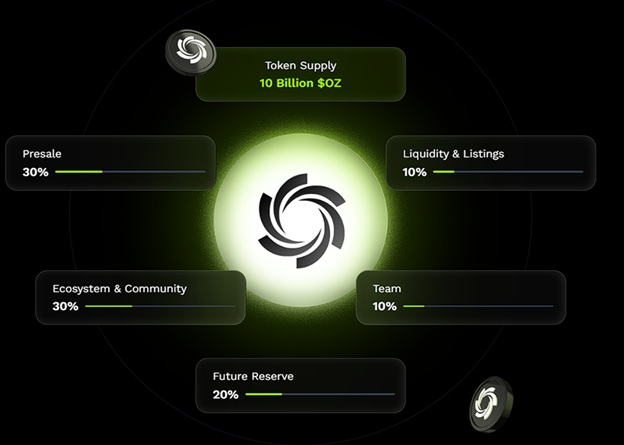
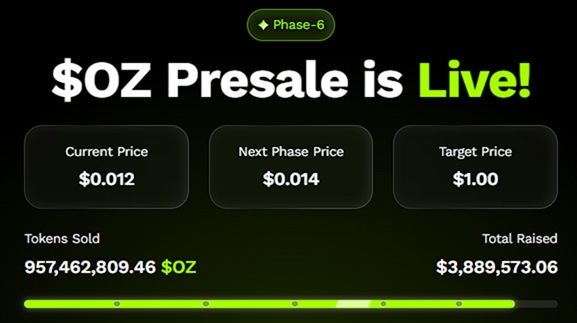
Ozak AI, currently in its 6th OZ presale stage at $0.0012, offers traders that very early entry point. With more than 950 million tokens sold and over $3.8 million raised, the project has already drawn significant attention from both retail investors and early whale capital. For traders seeking 20x, 50x, or even 100x upside potential, Ozak AI represents an opportunity that Solana and XRP simply can’t match at their current valuations.

Ozak AI’s Flip Appeal Comes From Early Positioning

The biggest fortunes in crypto are often made by those who position early, long before tokens become mainstream. Ozak AI’s presale stage gives traders a front-row seat to exactly that kind of positioning. At $0.0012, even a modest allocation can secure a large token stack. If Ozak AI lists between $0.01 and $0.05 during a heated bull market, the resulting returns could easily dwarf those from larger, more established projects.

While Solana and XRP provide stability and steady appreciation, Ozak AI caters to traders chasing aggressive upside. It’s the same mentality that fueled early investments in meme coins like Dogecoin and Shiba Inu, but with a narrative rooted in one of the fastest-growing sectors in tech: artificial intelligence.

Ozak AI Rides the Strongest Narrative of the Cycle

This bull run is already being defined by the rise of AI narratives. Just as DeFi dominated 2020 and meme coins defined 2021, AI integration with blockchain is emerging as the star theme of this cycle. Ozak AI sits directly at that intersection, leveraging AI-powered predictive agents and data intelligence to create real utility on-chain.

For traders, narrative matters just as much as fundamentals. When the broader market begins chasing a dominant narrative, tokens aligned with that story often experience explosive demand. Ozak AI is already building traction before listing—a sign that momentum could accelerate sharply post-launch.

Ozak AI Could Outperform Even Strong Forecasts

Solana and XRP are positioned to deliver respectable returns for investors who prefer larger caps, but traders seeking outsized gains are increasingly looking toward Ozak AI. The combination of low entry price, strong narrative positioning, and growing presale traction creates a setup that mirrors some of the biggest winners of past cycles.

If the AI narrative continues to heat up and Ozak AI executes on its roadmap, it could deliver far more dramatic flips than SOL or XRP in this bull run. While big caps build the foundation, it’s often the early-stage plays like Ozak AI that define the stories traders talk about for years.


About Ozak AI

Ozak AI is a blockchain-based crypto project that provides a technology platform that specializes in predictive AI and advanced data analytics for financial markets. Through machine learning algorithms and decentralized network technologies, Ozak AI enables real-time, accurate, and actionable insights to help crypto enthusiasts and businesses make the correct decisions.


For more, visit:

Website: https://ozak.ai/

Telegram: https://t.me/OzakAGI

Twitter: https://x.com/ozakagi 

How Nigeria’s National Job Centres Can Truly Empower Youth

0

When the Minister of State for Labour and Employment, Nkeiruka Onyejeocha, unveiled the National Job Centre initiative, the message was clear: Nigeria wants to create a future where young people are not just searching for jobs but connecting with opportunities that match their skills, ambitions, and the realities of a digital economy. The project promises to integrate digital job matching, data tracking, and career advisory services into a single national framework that can help youth contribute meaningfully to local industries while competing confidently on the global stage.

This vision is both ambitious and timely. Across the world, the connection between education, skills, and work is being reshaped by technology. For Nigeria, where millions of young people enter the job market every year, building an integrated system that truly aligns these elements could be transformative. But for that to happen, every player in this ecosystem must be part of a living network that works in sync.

Connecting the Dots Between Policy, People, and Technology

The National Job Centre is not just a set of offices or websites. It represents a growing web of relationships linking human talent, digital systems, data, and public institutions. Each of these parts has a role to play. Policymakers design the framework that guides how job centres operate. Technology developers create the digital tools that match candidates to opportunities. Employers share real-time information about vacancies and required skills. Career advisors guide young people through training and job readiness. Data systems track trends that can inform smarter decisions. The quality of connection among these parts will determine whether the vision of a “harmonised and inclusive system” can hold.

The promise of inclusion lies in how well the system can bridge Nigeria’s deep divides. For young people in cities with strong connectivity and access to training, digital job centres can open new doors quickly. But for those in rural or underserved communities, poor internet access and limited awareness may keep them outside the loop. To make the system inclusive, investment in connectivity, local capacity, and digital literacy must go hand in hand with technological rollout. Otherwise, the job centres may end up amplifying existing inequalities instead of reducing them.

Building Partnerships and Trust

Partnerships will also shape how the centres evolve. The government has already signaled collaboration with organisations such as the Mastercard Foundation through its Young Africa Works strategy. Such partnerships bring resources and innovation but also introduce new priorities and expectations. The success of the initiative will depend on balancing national goals with the influence of external partners. Nigeria’s job framework must remain responsive to its local realities, even as it connects to global opportunities.

Another crucial factor is trust. Young people must believe that these platforms can genuinely help them find decent work. Employers must see value in sharing accurate information and hiring through these channels. Data protection and transparency will be essential for building and sustaining that trust. A single weak link, whether unreliable data, poor maintenance of digital tools, or a lack of follow-up support, can undermine the credibility of the entire system.

Turning Vision into Reality

Technology can be a great equaliser, but only when combined with human guidance and institutional reliability. This is why the advisory component of the National Job Centres is so important. Job seekers need more than job postings. They need mentorship, feedback, and opportunities to learn new skills that keep them competitive. Career advisors and trainers can turn the promise of digital platforms into real human progress.

Ultimately, the National Job Centre initiative represents more than a labour market reform. It is an attempt to weave together the people, technologies, and institutions that shape the future of work in Nigeria. Its success will not depend solely on how advanced the software is or how impressive the launch ceremony appears. It will depend on how well all actors involved stay connected, share information, and adapt to one another’s needs. Creating a harmonised and inclusive system is not a one-time event but an ongoing process of coordination and learning.

China Accuses U.S. of Stoking ‘Panic’ Over Rare Earths as Tension Escalates

0

China on Thursday accused the United States of deliberately stoking “panic” over Beijing’s new export restrictions on rare earth minerals, escalating a dispute that has revived fears of another trade war between the world’s two largest economies.

“The U.S. interpretation seriously distorts and exaggerates China’s measures, deliberately creating unnecessary misunderstanding and panic,” Ministry of Commerce spokesperson He Yongqian said at a press briefing in Beijing, according to the state-run Global Times.

The remarks came a week after Beijing unveiled sweeping controls on exports of rare earth elements — minerals essential to defense and advanced manufacturing — in a move that coincided with preparations for a meeting between President Donald Trump and President Xi Jinping in South Korea later this month. Trump has warned that if Beijing does not reverse the curbs, he could impose 100% tariffs on Chinese goods as early as November 1.

The Ministry of Commerce said Thursday that China remains “open to talks” to defuse the situation, signaling that the door is not yet closed on negotiations.

China insists the restrictions are a matter of national security, designed to prevent rare earth materials from being used in the development of weapons of mass destruction.

“The accusations from the U.S. reveal that the U.S. is projecting its own behavior onto others,” He said, pointing to Washington’s own restrictions on semiconductor exports and “foreign content” rules that limit China’s access to advanced technologies.

Rare earths — a group of 17 elements used in the production of magnets — are critical inputs for U.S. defense systems such as the F-35 stealth fighter jet, Tomahawk cruise missiles, and Predator drones. They are also essential to electric vehicles, robotics, and semiconductor manufacturing, industries that have become flashpoints in the intensifying U.S.–China technology rivalry.

Washington has long viewed China’s dominance of the global rare earths market, controlling nearly 90% of processing capacity, as a strategic vulnerability. Beijing’s decision to impose export curbs has therefore been seen as a direct challenge to the Trump administration’s industrial policy and its efforts to secure U.S. supply chains.

The Trump administration has responded by doubling down on efforts to build a domestic rare earths ecosystem independent of China. In July, the Department of Defense signed a landmark deal with MP Materials, the largest rare earth miner in the United States, involving an equity stake, a price floor, and an offtake agreement designed to guarantee a stable supply for U.S. defense needs.

Treasury Secretary Scott Bessent told CNBC on Wednesday that the administration could take similar steps across other critical sectors.

“I wouldn’t be surprised,” Bessent said when asked about additional equity stakes. “When we get an announcement like this week with China on the rare earths, you realize we have to be self-sufficient, or we have to be sufficient with our allies.”

Bessent accused Beijing of using its market dominance to distort global prices, saying China had “slashed prices to drive foreign competitors out of the market.” He added that Washington plans to impose price floors in several industries to counter what he called “market manipulation” by China.

“When you are facing a nonmarket economy like China, then you have to exercise industrial policy,” Bessent said at the CNBC Invest in America Forum in Washington, D.C.

The Trade Stakes

The rare earth standoff marks a new phase in the U.S.–China trade confrontation, one that extends beyond tariffs into the strategic resources underpinning modern technology. U.S. Trade Representative Jamieson Greer told CNBC earlier in the week that China’s export controls were “a clear attempt to control the world’s technology supply chains.”

Greer warned that Beijing’s actions would determine whether Trump proceeds with the threatened 100% tariffs. Still, he noted that the White House remains open to diplomacy and confirmed that Trump’s planned meeting with Xi in South Korea is still on schedule.

For China, the calculus is equally complex. While Beijing sees rare earths as a strategic lever, analysts note that further escalation could undermine its broader manufacturing sector, which relies heavily on stable access to U.S. markets.

Economic and Political Undercurrents

The rare earth confrontation has emerged against the backdrop of Trump’s broader trade and industrial agenda, which includes sweeping tariffs and efforts to reassert U.S. manufacturing strength. Just this week, S&P Global estimated that Trump’s tariffs would cost global companies more than $1.2 trillion in 2025, with most of that cost likely to fall on consumers.

Those policies, combined with targeted restrictions on Chinese technology and renewed scrutiny of critical mineral supply chains, form part of what administration officials describe as a strategy to “reindustrialize America.”

For Trump, who has made economic nationalism a pillar of his presidency, the dispute offers both political risk and opportunity. The President’s trade team argues that curbing dependence on China is necessary to safeguard national security and protect U.S. workers. But business leaders warn that the cost of decoupling — both for American manufacturers and global supply chains — could be substantial.

Trump’s team views the South Korea meeting with Xi as a test of whether diplomacy can avert an all-out economic confrontation. For Beijing, the challenge lies in balancing its need to defend strategic interests while preventing a repeat of the 2018–2019 trade war, which slowed growth and triggered capital flight.