DD
MM
YYYY

PAGES

DD
MM
YYYY

spot_img

PAGES

Home Blog Page 332

What Is a Cost Recovery Model, and How Does It Work?

0

Companies today are always searching for ways to improve their operations and control resources. Among them, the cost recovery model is a remarkable method. By enabling the business to plan its usage of expenses strategically, you ensure that the allocation of resources is done efficiently while continuously maintaining financial health.

With knowledge of this model and the practice, organizations can increase their business performance and maintain growth. A cost recovery model provides a structured approach that helps businesses align their costs with revenue generation, creating a foundation for long-term success.

Understanding the Cost Recovery Model

A cost recovery model is a technique for recovering costs and helps businesses sync costs with their revenue generation. In this model, the pricing strategies ensure the recovery of all expenses incurred in producing the goods and/or services. Organizations can use it as a guiding system to evaluate and understand their financial performance.

Elements of the Cost Recovery Model

This model is based on a few elements. Businesses that want to adopt it must first understand these elements.

Direct Costs

Direct costs are those associated with the production of a good or service. These are the cost of materials, the cost of labor, and the cost of manufacturing. It is essential for businesses to accurately account for these costs when determining the required price for cost recovery.

Indirect Costs

Although these costs are not directly associated with production, they remain essential for conducting business operations. This might include things like utilities, rent, or administrative costs. Proper allocation and identification of these costs is crucial for a successful cost recovery strategy.

Pricing Strategies

Secondly, pricing is a large portion of the cost recovery model. Organizations need to determine prices that cover direct and indirect costs while being competitive in the marketplace. It may require closely studying market dynamics and the demand for the pricing of competitors.

Revenue Management

Another aspect of effective revenue management is that revenue will match expenses. Businesses need to track sales and price accordingly to remain profitable. This continual evaluation aids in things like adjusting to changes in the market and staying above water financially. According to the U.S. Small Business Administration, effective revenue management is critical for maintaining business sustainability and growth.

Advantages of Adopting a Cost Recovery Model

Many companies favor adopting this model because it provides multiple benefits to businesses.

Financial Stability

By accounting for all expenses, businesses can enhance their financial stability. This cuts the risk of running short on funds and increases the ability to plan the next investment.

Informed Decision-Making

Having a clearer picture of costs and revenues allows organizations to make more informed choices. By having such a model, we can visualize the insights that can help us strategize and optimize resources, which will lead toward operational efficiency.

Competitive Advantage

A good cost recovery model provides the opportunity for businesses to provide their product at a competitive price. When you have a clear understanding of costs, organizations can provide attractive prices to consumers without jeopardizing profitability.

Sustainability

This model helps encourage the responsible usage of resources. By tying expenses to revenue generation, companies can sustain their business operations over the long term.

Challenges in Implementing the Cost Recovery Model

As beneficial as this model might be, it is not without its challenges of implementation. By knowing these challenges, businesses can prepare and adapt accordingly.

Accurate Cost Allocation

Pinpointing costs and knowing exactly where to assign them can be difficult. It requires time and resources to make sure every expense is recorded correctly, which isn’t easy, especially for big companies.

Market Fluctuations

Pricing is highly dependent on changing conditions, and these market circumstances change quite rapidly. Organizations must be flexible and adapt to these changes to continue to meet their cost recovery targets.

Consumer Perception

Aiming for prices that can cover every expense will cause prices to go up for consumers. Fortunately, between cost recovery and consumer aspirations, businesses have to strike the right balance or risk losing market share.

Resource Intensity

Having an effective cost recovery model needs money to establish and sustain. It requires the allocation of personnel and technology to track and analyze costs and revenues, which is resource-intensive for businesses.

Conclusion

This cost recovery model can be a very beneficial tool for a business to run most efficiently in terms of finance. With this model in hand, organizations will be equipped to remain financially stable, make better choices, and also be well-positioned to stay ahead of the competition. Although it has its challenges, businesses can easily adapt and implement the model into their businesses if they know the right strategies and are committed to using it with a long-term growth mindset.

Nigeria’s Benin Win: Victor Osimhen as a Renewed Hope Site for 2026 World Cup

0

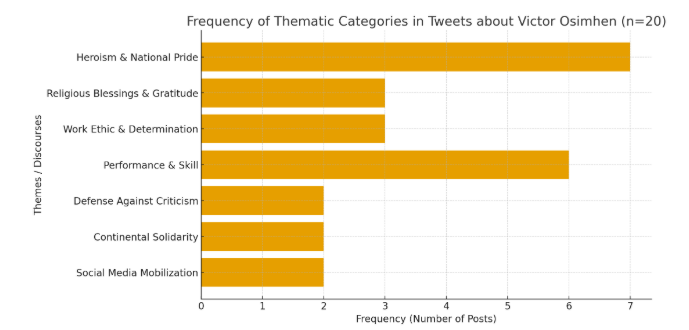
When Victor Osimhen scored a hat-trick against Benin, the moment went far beyond football. It became a shared expression of joy, pride, and renewed confidence in Nigeria’s ability to rise again. Across social media, fans celebrated not just the victory, but the man who made it possible. Their words revealed a deeper narrative about how Nigerians find meaning, faith, and hope through sport, especially in moments of national uncertainty.

The reactions of fans tell a story about the cultural power of football in shaping collective emotions. Many messages praised Osimhen as a blessing to the nation, a man whose passion and commitment reflect the best of Nigeria. Statements such as “You are a huge blessing to Nigeria” and “May God bless the womb that birthed you” combined patriotism with spirituality. This kind of praise reflects a broader moral framework in which achievement is not just a product of talent and discipline, but also of divine grace. For many Nigerians, Osimhen’s journey from modest beginnings to international success symbolizes both destiny and hard-earned merit.

Osimhen’s image as a hero operates on several levels. His performance on the pitch displays unmatched focus, power, and technical skill. Yet, beyond football, he represents an ideal figure of national responsibility. Fans see him as someone who gives everything for the country, who carries the weight of expectation without losing his determination. When supporters write “He carried his nation” or “He’s HIM,” they express a longing for figures who embody excellence and accountability. In a society often frustrated by leadership failures, Osimhen becomes a model of what it means to deliver when it truly counts.

Source: X Accounts, 2025; Infoprations Analysis, 2025

The religious tone in many comments reveals how faith continues to frame national hope. Fans speak blessings over Osimhen and his family, not simply to honour him, but to connect their joy to a sense of divine order. In a context where people often face political and economic struggles, this spiritual dimension provides comfort and meaning. Osimhen becomes a vessel for both national pride and divine favour. He represents a form of emotional renewal, a sign that greatness is still possible for Nigeria and its people.

The celebration also crossed borders. South African fans, for example, called him a “true hero,” highlighting the continental appeal of his achievements. Osimhen’s success resonates as part of Africa’s shared pursuit of recognition and respect in global football. His performance reminds Africans everywhere that excellence does not need external validation. It stands on its own.

Not all the online conversations were purely celebratory. Some fans rose to defend Osimhen from critics who questioned his personal life or social connections. They argued that his private choices should not affect his professional reputation. One supporter wrote, “The man is young, successful, and enjoying his life. That doesn’t change the fact that he’s still one of the best strikers we’ve ever had.” This kind of defense marks a shift in public discourse, as more Nigerians learn to separate character judgment from athletic performance. It shows a growing awareness that celebrities are complex individuals, not moral templates.

Social media itself plays a crucial role in sustaining this culture of fandom. When users call for likes, retweets, and hashtags, they are doing more than celebrating a footballer. They are performing a shared identity. Each interaction becomes a small act of belonging, an expression of unity in a digital community built around pride and optimism. Through this participatory energy, football becomes a cultural language of togetherness.

Our analyst notes that Osimhen’s brilliance represents the idea that Nigeria’s future is not limited by its past. His journey and his goals tell a story of perseverance and hope, a message that resonates far beyond football. As the countdown to 2026 begins, his performance offers more than victory. It gives Nigerians a reason to believe again in their collective strength and the promise of better days ahead.

How AI, Human Expertise Are Transforming Fact-Checking in Nigeria

0

Across Nigeria, a new generation of fact-checking organisations is using artificial intelligence in combination with human expertise to strengthen the verification process. In this piece, our analyst notes that understanding how these tools work and the challenges they face reveals the growing sophistication of digital truth-seeking and the urgent need to balance technology with human judgment.

Artificial Intelligence Enters the Fact-Checking Room

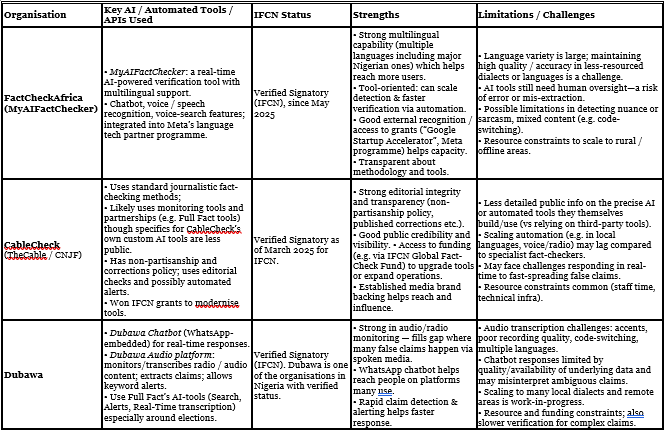
Artificial intelligence is now a partner in the newsroom. Nigerian fact-checkers have adopted automated systems that scan digital platforms for potential misinformation. These tools identify trending claims, transcribe audio broadcasts, detect manipulated visuals, and even provide automated responses to user queries. While AI offers unprecedented speed and reach, it is the human fact-checker who ensures that evidence is valid, context is correct, and communication remains ethical. The collaboration between machines and people defines the future of verification.

FactCheckAfrica’s MyAIFactChecker 

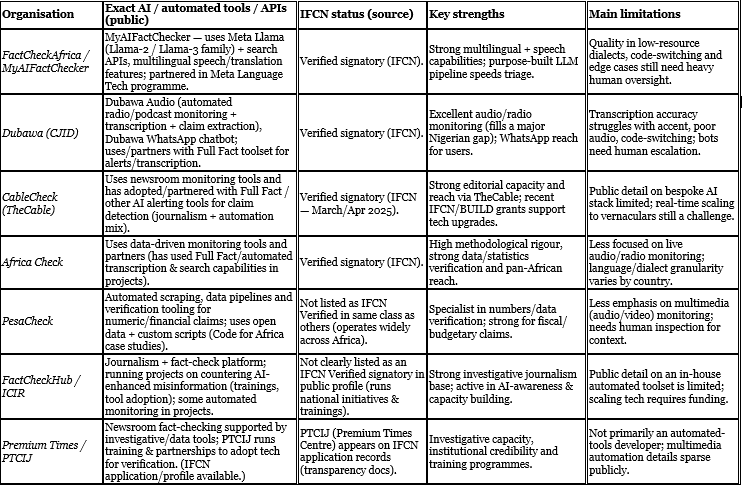
At the forefront of this movement is FactCheckAfrica.net with its MyAIFactChecker tool. Built on large language models such as Meta’s Llama and integrated with multilingual speech recognition, the platform enables quick checks across text and voice formats. The system can process claims in several African languages, making it especially valuable in multilingual societies. Yet, it remains supervised by editors who validate each claim before publication. This human oversight is critical to prevent the algorithm from spreading false positives that arise from sarcasm, cultural nuance, or regional slang.

Dubawa’s Innovation in Audio and Chat Verification

Dubawa, operated by the Centre for Journalism Innovation and Development, represents another major step in AI-driven verification. Its audio platform monitors radio shows, transcribes them, and flags possible claims for investigation. This innovation is significant because information pollution (misinformation, disinformation, fake news, and hate speech) in Nigeria often circulates through radio conversations rather than only on social media. The same organisation also manages a WhatsApp chatbot that allows citizens to check viral messages in real time. Through these tools, Dubawa shows how artificial intelligence can extend the reach of verification to places where journalists cannot be present physically.

CableCheck and the Power of Partnerships

CableCheck, the fact-checking arm of The Cable newspaper, has integrated AI alert systems developed through partnerships with Full Fact, a United Kingdom organisation that pioneers automated claim detection. These collaborations show how international cooperation accelerates innovation. By combining AI tools with experienced reporters, CableCheck can quickly identify misleading statements made by public officials and media outlets.

Regional and Youth-Led Innovators

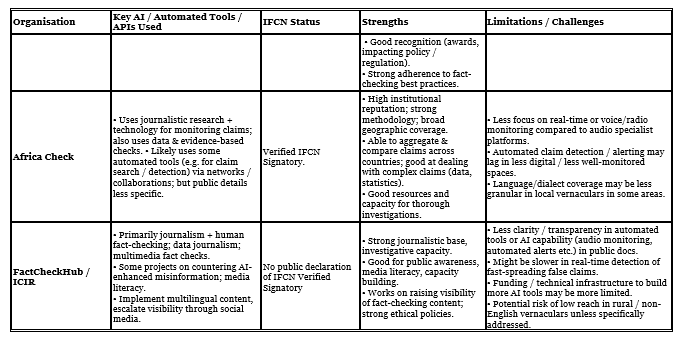
Pan-African initiatives such as Africa Check and PesaCheck demonstrate the regional dimension of the verification network. Africa Check uses automated search and transcription tools to monitor political and social discourse across multiple countries, while PesaCheck applies algorithmic scripts to verify statistical and financial claims.

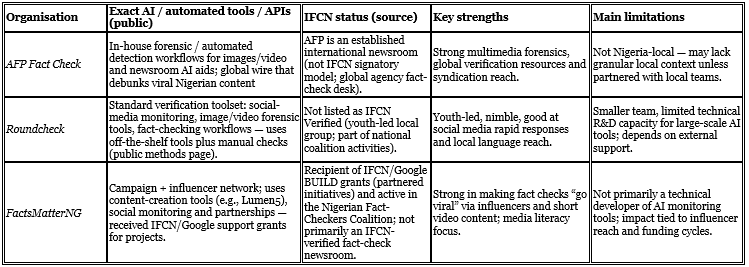
The younger generation of Nigerian fact-checkers is also experimenting with automation. Projects such as Roundcheck and FactsMatterNG use open-source forensic software, influencer networks, and automated content-creation tools to monitor and correct misinformation. These efforts are less about building complex AI systems and more about adapting existing technologies to local realities. They show that innovation in information verification does not always require massive funding, but rather strategic creativity.

The Persistent Challenges

Despite the progress, there are significant challenges. Many AI systems still struggle to interpret local dialects, cultural idioms, and the fluid mix of English and Nigerian languages common in online conversations. Audio transcription tools may misinterpret poor recordings or background noise. Automated systems cannot yet fully understand context, intent, or the political undertone of a message. Therefore, human intervention remains the ethical and analytical backbone of fact-checking.

The key issue is sustainability. Developing and maintaining AI systems demands technical capacity, reliable funding, and secure infrastructure. Fact-checking organisations rely on grants and partnerships to stay afloat, which may limit their independence. Our analyst stresses that transparency in how AI models reach conclusions is essential to preserve public trust. “When algorithms are opaque, the risk of bias or misuse increases,” he pointed out.

The Human-AI Partnership for Truth

The integration of AI into fact-checking in Nigeria is not about replacing journalists with machines but about empowering them. Artificial intelligence enhances speed, detects patterns at scale, and filters massive amounts of information, while human fact-checkers provide context, ethics, and judgment. The strongest systems will continue to be those that recognise this partnership as symbiotic rather than competitive.

As information pollution evolves with the same technological sophistication, the fact-checking community must also adapt. Nigeria’s fact-checkers are showing the world that responsible use of AI can make truth more discoverable and accessible. The lesson for media, academia, and policymakers  is that technology alone cannot defend the truth, but when guided by human values and critical reasoning, it can help rebuild public trust in information.

This position has been earlier emphasised by our analyst during AI Fundamentals Workshop held in Ibadan, where we walked participants through the processes of applying existing AI tools by exploring different information pollution cases. According to him, critical thinking is a key element in the verification and acting stages of controlling information pollution as well as protecting information ecosystem.

JPMorgan Expands Blockchain Strategy, Plans to Offer Crypto Trading Services

0
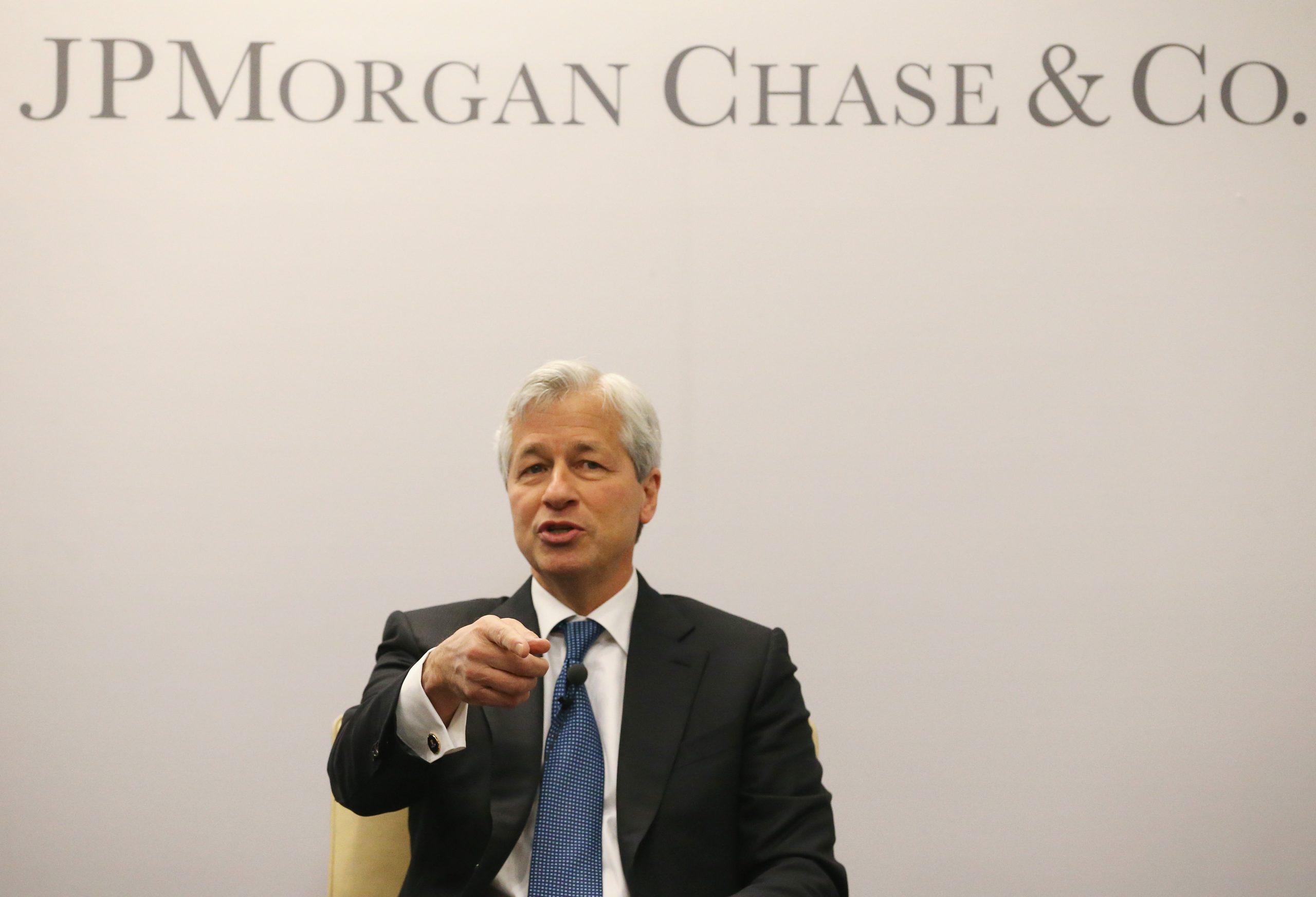
JP Morgan Chase puts contents through its CEO account, it goes viral. But the same content via JPMC account, no one cares (WSJ)

American multinational finance corporation JPMorgan Chase is preparing to deepen its involvement in blockchain and cryptocurrency, with new plans underway to introduce crypto trading services.

This was revealed by Scott Lucas, the bank’s Global Head of Markets and Digital Assets. In an interview on CNBC’s Squawk Box Europe on Monday, Lucas clarified that while JPMorgan is exploring the crypto trading space, directly custodying cryptocurrencies remains off the table for now. When asked whether the bank would follow peers like Citibank in offering crypto custody services, he stated that such a move was “not on the horizon near-term.”

In his words,

“I think Jamie Dimon was pretty clear on investor day that we’re going to be involved in the trading of that, but custody is not on the table at the moment. There’s a lot of questions around our own risk appetite and how far we want to go down that path, from trading and other sides of it, and custody, I guess would follow.”

In the meantime, the firm is assessing what the right custodians for crypto might look like. Throughout the discussion, Lucas emphasized JPMorgan’s strategic approach and outlook, which focuses on embracing multiple opportunities across the blockchain and digital asset landscape, rather than prioritizing one over another. “There’s the existing market, and there’s opportunities to do new things. And those ‘and’ opportunities aren’t exclusive to one or the other,” he explained.

Lucas also discussed the bank’s recently launched deposit token, JPMD, which entered its pilot phase on Base in June. He noted that the initiative is aimed at providing new services for institutional clients while also responding to growing interest in stablecoins. “There’s a real opportunity for us to think about how we can offer different services for our clients on the cash side, as well as respond to client demand to do things like stablecoins,” he said.

In the broader blockchain ecosystem, Lucas expressed the belief that no single network, such as Ethereum, will dominate the space. Instead, he anticipates a more fragmented but vibrant market with multiple competing blockchains. 

His comments highlight a growing shift in JPMorgan’s stance toward crypto. The banking giant, once cautious about digital assets, has become more open to blockchain innovation, striking notable partnerships with industry leaders like Coinbase.

Recall that in late 2023, JP Morgan warned that crypto markets were “overbought” due to hype around spot Bitcoin ETFs and predicted a pullback into 2024, though they saw potential for Ether to outperform Bitcoin post-upgrades. By May 2024, following Bitcoin’s halving event and ETF outflows, they maintained a “cautious stance” on crypto, citing dissipating retail enthusiasm and persistent headwinds like macro uncertainty.

As recently as July 2025, JP Morgan slashed forecasts for stablecoin growth to $500 billion by 2028, arguing there’s “little evidence of mainstream adoption” and payments usage remains negligible at just 6% of demand. The bank now supports a limited range of crypto ETFs (Bitcoin and some Ether-focused ones) but has no plans for broader crypto custody or spot trading desks.

As of October 2025, JP Morgan’s crypto offerings are confined to ETFs and blockchain services, excluding direct altcoin support or DeFi exposure. This evolution in approach is mirrored by a softer tone from CEO Jamie Dimon, who has long been one of crypto’s most vocal critics. In 2021, Dimon described bitcoin as ‘worthless’.

Recently, he described himself as a “believer in stablecoins” and acknowledged the potential of blockchain technology. His changing perspective appears to be influencing JPMorgan’s broader digital asset strategy. 

IMF Raises Global Growth Outlook for 2025 to 3.2%, Says Trump’s Tariffs Have Softer Economic Impact Than Feared

0

The International Monetary Fund has raised its forecast for global economic growth in 2025, citing a surprisingly mild hit from U.S. President Donald Trump’s trade tariffs and stronger-than-expected resilience in private sector activity.

But the Fund cautioned that risks from escalating trade tensions, elevated inflation, and slowing momentum in China remain serious threats to long-term global stability.

In its latest World Economic Outlook (WEO) report released Tuesday, the IMF revised its 2025 global growth projection upward to 3.2 percent, from 3.0 percent in July, while keeping its 2026 forecast unchanged at 3.1 percent.

IMF Chief Economist Pierre-Olivier Gourinchas said the revision reflects “a smaller-than-expected tariff shock,” noting that the private sector in many countries has adjusted quickly to the new trade environment created by Trump’s policies.

“The tariff shock itself is smaller than initially feared,” Gourinchas told reporters in Washington. “The private sector has responded in an agile way, and that adaptability has helped cushion what could have been a sharper slowdown.”

Tariff Impact Milder Than Feared

Since his return to the White House, Trump has reimposed sweeping tariffs on key U.S. trading partners, including China and the European Union, framing the measures as an effort to protect American jobs and manufacturing. Over the weekend, he threatened to double down with 100 percent tariffs on China, following Beijing’s move to tighten export controls on rare earth minerals — crucial inputs for defense and high-tech industries.

While economists initially warned that such aggressive trade policies could severely disrupt global supply chains, the IMF said their impact so far has been tempered by adaptive responses from businesses and governments.

Other factors, including the AI boom and expansionary fiscal policies in Europe and China, were noted to have helped to prop up the global economy.

However, the IMF warned that the broader effects of a trade war “are here” and could dim already weak global growth prospects if tensions escalate further.

The Fund noted that the latest projections were compiled before the most recent tariff threats between Washington and Beijing, meaning future updates could show greater risks if the dispute deepens.

Global inflation, while easing from the multi-decade highs of 2023, remains stubbornly above target in many economies. The IMF expects worldwide consumer prices to rise 4.2 percent this year and 3.7 percent in 2026, with elevated inflation in the United States, the Eurozone, and parts of Latin America keeping pressure on central banks to maintain restrictive policies.

The report said that while inflation has fallen sharply from its post-pandemic peak, the decline has been uneven, especially in advanced economies with tight labor markets.

U.S. Growth Outlook Upgraded

The IMF upgraded its forecast for the United States — the world’s largest economy — by 0.1 percentage point for both 2025 and 2026. U.S. GDP is now projected to grow 2.0 percent in 2025 and 2.1 percent in 2026, slower than the 2.8 percent expansion recorded in 2024 but still stronger than most other advanced economies.

The IMF attributed the resilience of U.S. growth to strong consumer spending, robust labor markets, and fiscal stimulus programs that have offset some of the drag from trade restrictions.

Still, the Fund warned that prolonged tariff conflicts could eventually weigh on investment and productivity.

Trade tensions, by their nature, raise uncertainty and discourage cross-border investment. That remains a risk to the medium-term outlook.

China Faces a Slowing Economy

Despite ongoing trade tensions, the IMF left its forecast for China unchanged, projecting growth of 4.8 percent in 2025 — down from 5.0 percent in 2024 — and a sharper slowdown to 4.2 percent in 2026.

Beijing’s economy, once the engine of global expansion, continues to lose steam amid weak exports, a faltering property market, and declining foreign investment. The Fund said China’s slowdown has been partially offset by stronger domestic demand supported by targeted policy stimulus, including infrastructure spending and consumption incentives.

Still, China faces “structural headwinds,” including high local government debt and demographic challenges, which the Fund said remain serious constraints on future growth.

India, Japan, and Asia Show Momentum

Elsewhere in Asia, the IMF raised India’s 2025 growth forecast to 6.6 percent, up from 6.4 percent in July, citing sustained domestic demand and expanding industrial output. Japan also saw an upgrade to 1.1 percent, a notable 0.4 percentage point increase, as its export sector benefited from the weaker yen and resilient global demand for high-tech components.

Europe’s Recovery Still Fragile

In Europe, economic recovery remains uneven. The IMF said the Eurozone would grow 1.2 percent in 2025 and 1.1 percent in 2026, both slight upgrades from July. Yet, the bloc continues to lag behind the United States, weighed down by sluggish industrial output and subdued investment.

Germany, the continent’s largest economy, is forecast to rebound modestly from recession, expanding 0.2 percent this year before rising to 0.9 percent next year. France, still grappling with political instability and labor unrest, is expected to grow 0.7 percent in 2025 and 0.9 percent in 2026.

Spain stands out as a rare bright spot in Europe, maintaining strong momentum with 2.9 percent growth this year and 2.0 percent in 2026, driven by tourism, construction, and resilient consumer spending.

The United Kingdom, outside the Eurozone, is expected to post steady growth of 1.3 percent this year and next — modest but better than earlier projections.

Russia’s Post-War Slowdown

The IMF sharply downgraded Russia’s outlook, forecasting growth of just 0.6 percent in 2025, compared with 4.3 percent in 2024. The Fund attributed the downturn to the economic fallout from the war in Ukraine, declining energy revenues, and international sanctions that have restricted access to technology and capital.

Risks Loom Despite Upgrades

Despite the upgrades, the IMF warned that the global economy remains vulnerable to multiple risks — including geopolitical instability, inflation persistence, and tightening global financial conditions.

“Everything is very fluid,” Gourinchas told AFP in an interview. “But I think it’s a very useful reminder that we live in a world in which this kind of increase in trade tensions, increase in policy uncertainty, can flare up at any time.”

Analysts say the IMF’s latest report underscores a central reality of the post-pandemic economy: while the world has proven remarkably resilient to repeated shocks — from tariffs and wars to inflation — that resilience has limits. If trade tensions between Washington and Beijing escalate further, or if inflation proves stickier than expected, the Fund’s next outlook could look considerably darker.