DD
MM
YYYY

PAGES

DD
MM
YYYY

spot_img

PAGES

Home Blog Page 3388

No Right Is Absolute.

0

Do you know that you are prohibited from playing loud music from your house if the loudness of the music will disturb the peace and tranquility of your neighbours; though it is your house and the sound system is your own? 

Do you also know that you are prohibited from parking your car in front of your gate if your packing there will obstruct the movement of your neighbours?

There are numerous other examples which you can make up by yourself but these examples point to the fact that your right to enjoy your private properties or exercising your rights is hinged on the convenience of others. This is to say that while you flex your rights you should consider the convenience of your neighbours. if your exercising such rights will inconvenience others you will be barred from it.

This is the principle laid down by the English court in the old English case of Hollywood Silver Fox Farm v Emmett Citations: [1936] 2 KB 468.

In the above-quoted case, The claimant breeds silver foxes for their fur.  The foxes are by their nature, very timid and shy animals and they can be scared easily. Biologically, when these animals are scared or disturbed, the pregnant ones will likely have a miscarriage. The defendant was a farmer and animal rights activist who owned land adjoining the claimant’s fox farm.  He objected to the carrying on of the farm and since he could not get the plaintiff to stop breeding the foxes, he asked his son to always fire his gun close to the claimant’s farm in order specifically to frighten the foxes and cause the pregnant ones to have miscarriages. It was hoped that this would cause economic harm to the fox farm and cause them to end their operation.  The foxes as expected had miscarriages and the claimant sued in private nuisance requesting an injunction to prevent this behaviour. 

The defendant argued that he was only shooting his gun within his own land which unfortunately adjourned to the plaintiff’s. He also argued that he has the right to enjoy his own land the way he likes and the right does not care if the claimant is inconvenienced by him exercising it or not. 

The court ruled contrary to the defendant’s argument that no one has “the absolute right to create noises upon his own land, because any right which the law gives him is qualified by the condition that it must not be exercised to the nuisance of his neighbours”. This is to say that the right of one to enjoy or use his property must be cautiously exercised so as not to inconvenience others, especially his neighbours. 

This is supportive of the law principle that no right is absolute even the right for you to possess and enjoy your property is not absolute. It must be exercised cautiously so as not to subject others to inconveniences which may arise from you enjoying the property. This is to say that where you right stop another person’s own begins. 
Understanding Why China, Saudi Arabia, etc Do Not Fully Float Currency

1

Question: “You did not support the floating of Naira. But the floating is designed to make Nigeria make things locally by closing the gap between the official and black rates of Naira with foreign currencies like US dollar. What is wrong with that?”

My Response: The irony is that you could have done all those without the float!  We need to understand that even China does not fully float the Yuan for an opposite reason (if it floats, the currency will become stronger which it does not want since it is export-dependent. If you have things to export, a weaker currency helps you). What China does is to artificially track the US dollars, and with the funds it has in global reserves, it has been able to achieve that.

Unless you are fully advanced with “international currencies” like the USD, UK, Euro, Yen, etc, OR you generate so much foreign reserves like Russia’s rubles before the Ukraine war,  floating is very risky. In Saudi Arabia, for decades, they did not bother: they simply pegged their currency to USD dollar, with no float, and they have had the foreign reserves to defend that status

Floating has limited values for most countries. The biggest risk in such economies is not the variation between official and black market rates, but the instability in the exchange rate. In other words, that official rate is N415/$ and black rate is N550/$ is a smaller problem compared with weekly gyrations of the currency.

I used to write a lot on currency;  I earned a doctoral degree in banking/finance with focus on international markets and global currency as a banker. I played a core role in advising the African Union  to modulate on a single currency a decade ago via many lead papers and briefs https://base.afrique-gouvernance.net/docs/volume_21.pdf .

I had argued that welfare loss was evident in the model as the heterogeneous nature of Africa’s economy will make it nearly impossible for any supranational bank to deliver value across the continent in a fair way. Today, national central banks have tools to adjust as they want; under a single continental policy, most of those tools will disappear, making what happens in Nigeria to affect Togo, Benin Republic, etc whether they like it or not.

More so, the decades-long monetary union in the CEMAC union did not make that area economically better, and if that is the case, what magic would a single currency deliver? Currency union cannot do what industrialization policy could not deliver.

On Nigeria’s policy, I took just 30 minutes to do basic modeling and extrapolated for 12 months, and concluded that floating would cause “severe economic perturbations in the economy”. Right there, you could see welfare losses! I have always argued for our policymakers to publish briefs as they make policies. If they do, things will improve because all of us can help improve models for better outcomes.

For decades, no one understands how we make policies in Nigeria because no one publishes briefs or working papers which our university professors could challenge, refine, etc to advance the nation. We must change that playbook in the nation.

A Review of Forex Predictions After Months of Floating of the Naira

0

1. Nigeria floats its currency.

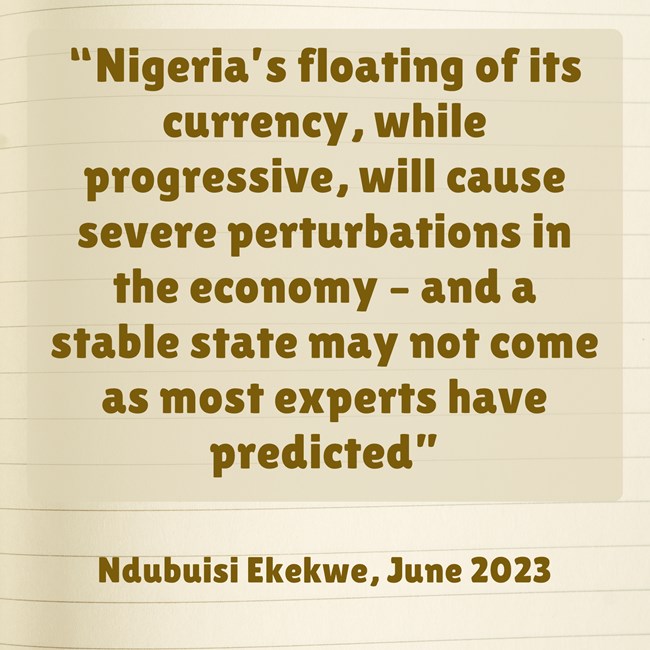
My response: “Nigeria’s floating of its currency, while progressive, will cause severe perturbations in the economy – and a stable state may not come as most experts have predicted” – Ndubuisi Ekekwe, June 2023

2. JP Morgan projects that Naira will settle at N600/$ post-float.

My response: ‘“My perspective: I think JP Morgan may need to review. Whether you float, swim or fly Naira, Naira can only survive if the economy is productive with capacity to produce things (digital, physical, service, etc) to reposition the nation’s balance of payment and trade.”’ – Ndubuisi Ekekwe, June 2023

Can these people pay attention to village boys and girls as they work to fix Naira which has hit an excess of N1400/$? We were lone dissenters to the broad general positive consensus on Naira floating. Of course, I would be happier if We The People here were wrong! Do they read us? Village boys and girls do have things to contribute!

Comment on Feed:

Comment 1: Our country is in need of a major reset, if we can’t earn USD to sustain our dependence on the consumption of foreign goods and services and we can’t switch to the consumption of locally available goods and services, let the naira remain floating to help us with the difficult but necessary reset.

In my view, no policy has exposed the failure of the Nigerian elites more than the policy on the floating of the naira. We need to start the unavoidable shift to the local transformation of locally available resources to create the goods and services for local consumption and export. We need to start growing cotton and start converting same to the textile that we need without any excuses. We need to sustain the refining of our crude oil to start producing the petrol and diesel that we use.

If we can’t grow wheat, we need to start baking and consuming Cassava bread.
The Nigerian elites must take the lead in the redesign of the Nigerian economy.
Let the naira remain floating to help us with making that critical but necessary mindset switch.

According to Newton’s law of inertia, the condition that we have been accustomed to for decades will not change without a force, that force is the floating of the naira.
Let the naira keep floating.

My Response: The irony is that you could have done all those without the float!  We need to understand that even China does not float the Yuan for an opposite reason (if it floats, the currency will become stronger which it does not want since it is export-dependent). What China does is to artificially track the US dollars and with the funds it has, and it achieves that. 

Unless you are fully advanced with “international currencies” like the USD, UK, Euro, Yen, etc, OR you generate so much foreign reserves like rubles (Russia before war) floating is very risky. In Saudi Arabia, for decades, they did not bother: they pegged their currency to USD dollar, no float.

Floating had limited values for most countries. The biggest risk in such economies is not the variation between official and black market rates, but the instability in the exchange rate. I earned a doctoral degree in this space with focus on international markets and global currency as a banker. I played a core role pushing the African Union out of a single currency a decade ago in many lead papers https://base.afrique-gouvernance.net/docs/volume_21.pdf . If you look at the data, what Nigeria did was not smart on this floating.

Thank God For Digital Law Reports

0

I was in court yesterday and as I was addressing the court in counter to my opponent’s argument, I suddenly needed a fresh case as an authority to back up my argument and I quickly typed the topic in question into my online law report while I was still on my feet addressing the court and I was immediately fed with a plethora of cases relating to the issue at hand which I was able to use dislodge my opponent’s counter argument. 

This scenario got me thinking about how difficult and mechanical life must have been for lawyers before the advent of online law reports. Just imagine me on that spot trying to flip through the pages of bogus law reports in search of a relevant case as a counter to my opponent’s point, whilst still on my feet. I would have wasted so much time of the court and I could even be cited for contempt. 

It will therefore be fair to say that one of the best things that have happened that has helped in the advancement and development of the law practice in Nigeria is the advent of online case and law reports. I can not even begin to imagine how difficult and primitive life was with lawyers in Nigeria in the 50s up till the early 2010s before technology became popular and lawyers began to adopt and utilize online case reports in Nigeria. 

Just imagine the time that was spent (wasted) glossing through different hard copies of bogus and voluminous law reports in search of one case as an authority to back up an argument; how many briefs can you as a lawyer be able to work on in a day if you have to always dash in and out of the library to read through pages of hard copies of cases? 

Let us not even forget the cost these digital law reports have saved lawyers. A set of hard-copy foreign law reports currently costs about four million naira while a set of hard-copy local law reports costs over a million niara. How many lawyers can be able to afford that, especially young lawyers starting up their practice or indigent lawyers?

You can just type the topic you need a case to back up on online law reports and in nanoseconds, you are fed with a plethora of cases for you to choose from. The digital law report can even summarize a case for you if you need the summary of the case and refer you to other cases if you need more.

I was telling a senior lawyer friend about digital law reports and how much they have made law practices easier, cheaper and more interesting. I told him that now, he does not necessarily need to go to the library and flip through voluminous law reports just to read through a case when he can just type in the case in his online law report and in nanoseconds he can see the whole law report but he told me that if it is not a hardcopy, whatever he reads doesn’t feel like he has read about it. 

This is the case with many lawyers of older generations who are conservatives. They will find it difficult adapting and adopting to technology. The prefer the rigorous work of flipping through the pages of the hard copy law reports; that gives them the feeling of being “the law” but technology is here and has penetrated the law practice and the earlier lawyers adopt the better. There is even a technology that helps lawyers arrange and sort through their case files on the cloud instead of stacking the whole shelf with papers.

Kudos to Law Pavilion which took the lead in providing digital law reports for legal practitioners in Nigeria, kudos to Nigerian Weekly Law Report (NWLR), the leading (hard copy) law report in Nigeria that has decided to follow the leading of technology and adapt some of their law reports into electronic format. Kudos to every other law report that is going digital as well; you all have made life easier and cheaper for lawyers in Nigeria. 

Central Bank of Nigeria (CBN) Greenlights Africa Stablecoin Consortium (ASC) to Launch cNGN Stablecoin in February, Meme Moguls (MGLS) Presale Impacts Market Sentiment

0

In a landmark move for the African country, the Central Bank of Nigeria (CBN) has approved Africa Stablecoin Consortium’s (ASC) cNGN Stablecoin to launch in February. Elsewhere in the market, Meme Moguls (MGLS) is creating a bullish buzz during an ongoing presale event of its native token. Let’s unpack these two exciting developments in further detail.

Africa Stablecoin Consortium (ASC) and cNGN Stablecoin Launch

The Africa Stablecoin Consortium (ASC) has been granted permission by the Central Bank of Nigeria (CBN) to test its cNGN stablecoin in the regulatory sandbox. cNGN is scheduled for launch on February 27, 2024.

The cNGN token is pegged on a 1:1 ratio with the Nigerian Naira. To ensure its stability and reliability, the cNGN is backed by Naira reserves that are securely held in specified commercial banks.

It’s worth noting that the cNGN is designed to function in tandem with the eNaira, the Central Bank Digital Currency (CBDC), rather than replace it. For example, the cNGN stablecoin boasts interoperability with Bantu, BNB Smart Chain, and other blockchains.

As the largest economy in Africa, Nigeria has been at the forefront of the continent’s digital transformation journey. With a large unbanked population and a growing reliance on mobile payments, the country is ripe for innovative financial solutions.

The cNGN is primarily designed to make it easier for Nigerians to send money abroad to family or for business purposes. It also offers a viable alternative to traditional remittance service providers, which are known for their high fees and lengthy processing times.

Now, those living outside of Nigeria can send money back to their home country via the cNGN stablecoin with significantly lower fees and quicker transaction times. This will greatly benefit the Nigerian diaspora, as well as businesses that rely on international payments.

Meme Moguls: Transforming Play-to-Earn Gaming

Meme Moguls redefines the play-to-earn landscape by seamlessly merging the appeal of meme culture with the intricacies of stock market trading in a virtual setting. The main premise is to learn about stock trading while having fun in a competitive environment.

What makes Meme Moguls stand out is its diverse range of engaging and profitable gameplay options. Players can engage in friendly rivalries through private competitions, dive into the thrill of global tournaments, or challenge themselves in the “Beat the Market” mode, pitting their investment savvy against market trends.

Players who win these games are rewarded with MGLS tokens and rare NFTs that can be sold for cash or used in the in-game marketplace. The rarest NFTs include additional gaming perks, like improved spreads and increased leverage.

The Meme Moguls experience doesn’t stop at competition. The platform expands into “Moguls World,” an immersive metaverse brimming with additional activities like token mining, participation in liquidity pools, and staking opportunities.

The MGLS Presale Buzz

MGLS tokens can be bought during the presale before the game is launched. Starting at $0.0019 in the first phase, MGLS has risen by 90% to a current price of $0.0036 in phase five of the presale. The price will keep increasing as the presale moves through each phase.

Adding to the buzz is the announcement from the team that they will be awarding $10,000 to a presale participant at the end of each stage. This has caused a surge in interest and investment as players aim to be the lucky winner.

Analysts comment that Meme Moguls presents a unique P2E model that combines fun, education, and rewards. Such a beneficial combination has resulted in predictions of 100x for MGLS as it makes its way to the market.

Visit Meme Moguls