DD
MM
YYYY

PAGES

DD
MM
YYYY

spot_img

PAGES

Home Blog Page 34

The Age of China

2

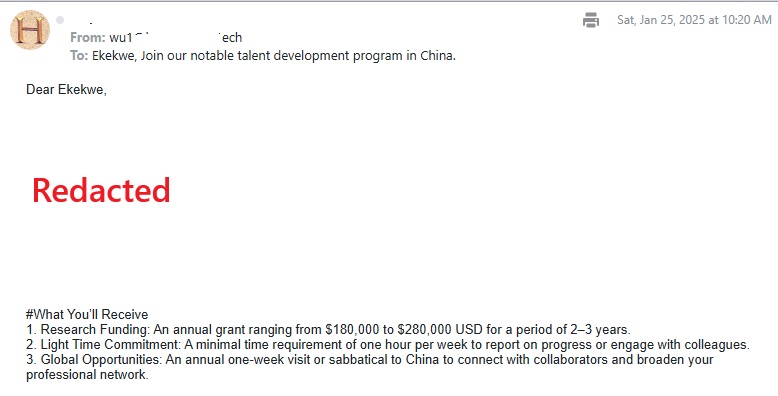
Last year, a major Chinese institution approached me with a  proposal, and it was simple and tempting:

  1. Research Funding: A yearly grant between $180,000 and $280,000 for 2–3 years.
  2. Minimal Commitment: Just one hour a week to mentor students and provide updates.
  3. Global Exposure: A one-week annual visit or sabbatical in China to engage collaborators.

They had studied one of my PhD publications, a body of work patented and partially licensed to the U.S. Government, and wanted me to guide their students in extending that research frontier. On the surface, it looked like a clean path to nearly $600,000 with minimal effort. But beneath the surface, it was a poison pill. Accepting such an offer would violate U.S. scientific-engagement regulations, rules created to protect sensitive intellectual domains. So, out of caution and respect for those boundaries, I declined. (My company is Intel’s only programmable microprocessor knowledge partner in Africa; so the vectors were multidimensional).

Yet, this experience is not unique. Every quarter, any serious U.S. technologist receives an inquiry from China. And to escape regulatory pitfalls, many quietly relocate to Hong Kong, where they can collaborate without stepping on U.S. legal landmines. The implication is clear: China is rising, and rising fast. Its universities are overtaking the world’s most prestigious institutions.

Today: “Harvard University has fallen to third place in global research rankings, overtaken by China’s Zhejiang University. Eight of the world’s top ten institutions in research output are now Chinese.” — LinkedIn News.

Some dismiss this as low-quality output. That is a mistake. Except in ultra-niche semiconductor research, China is now at parity with the West. And companies like BYD, which has leapfrogged Tesla in multiple EV metrics, stand as living evidence that China’s research output is real, applied, and market-validated.

Across human history, knowledge has always been the currency of power. Every great empire, from Babylon to Rome to the British Empire, rose on the wings of intellectual superiority. If China dominates the world’s knowledge production, it will dominate the world, full stop. This pattern has played out for centuries, and history does not lie. This is looking like the Age of China!

OpenAI Tests ads in ChatGPT, betting on Advertising to Fund Soaring AI costs Without Eroding Trust

0

OpenAI on Friday said it will begin testing advertising inside ChatGPT in the coming weeks, a long-anticipated move that marks a turning point for the artificial intelligence company as it searches for sustainable ways to finance the immense cost of building and running large-scale AI systems.

There’s no such thing as a free lunch — or chat. Starting in the coming weeks, U.S. users of ChatGPT will begin to see ads in the chatbot app, owner OpenAI announced Friday. The change will apply only to users of its free and low-cost service tiers, and comes as the AI startup is under pressure to dramatically ramp up its revenue to cover the more than $1 trillion it committed last year to infrastructure spending. OpenAI said ChatGPT’s responses won’t be influenced by ads, which will be labeled as such.

The ads will initially be shown to adult users on the free version of ChatGPT in the United States. OpenAI said users on its newly launched low-cost Go plan will also see ads, while subscribers on Plus, Pro, and Enterprise tiers will remain ad-free. The company framed the rollout as a test rather than a full commercial launch, signaling that the format, placement, and scope could change based on user feedback.

Ads will appear at the bottom of ChatGPT’s responses and will be clearly labelled, OpenAI said. The company stressed that responses generated by the chatbot will not be influenced by advertising and that it will “never” sell user data to advertisers. Users under 18 will not see ads, and advertising will be excluded from sensitive areas such as politics, health, and mental health.

The decision reflects a growing reality for OpenAI: the economics of AI at scale are brutal. Training and deploying frontier models requires massive investment in data centers, specialized chips, energy, and long-term infrastructure contracts.

In 2025, OpenAI signed more than $1.4 trillion worth of infrastructure deals, underlining how capital-intensive its ambitions have become. In November, chief executive Sam Altman said the company was on track to generate a $20 billion annualized revenue run rate last year, driven largely by subscriptions, enterprise tools, and partnerships.

Advertising offers a familiar solution. For decades, digital ads have been the financial backbone of Big Tech, allowing companies like Google and Meta to offer free services to billions of users while monetizing attention at scale. With ChatGPT now embedded in how people search for information, write, code, and solve problems, OpenAI is testing whether a similar model can work for conversational AI.

“It is clear to us that a lot of people want to use a lot of AI and don’t want to pay, so we are hopeful a business model like this can work,” Altman wrote in a post on X on Friday.

That statement captures a central tension in OpenAI’s strategy. ChatGPT’s explosive growth has been driven in large part by free access, which has helped make it a default tool for students, professionals, and casual users. At the same time, the cost of serving those users continues to rise. Ads offer a way to monetize that scale without forcing everyone into paid plans.

Still, the move carries notable risks as Altman has previously voiced reservations about introducing ads into ChatGPT, warning in interviews that advertising could undermine user trust if people believed answers were shaped by commercial incentives. In a November podcast appearance, he said he expected OpenAI to try ads “at some point,” while adding that he did not see them as the company’s biggest long-term revenue opportunity.

Those concerns remain front and center. Unlike social media feeds or search results pages, ChatGPT is often used for focused tasks such as drafting documents, researching topics, or seeking explanations. Users may be less tolerant of interruptions in a conversational interface, especially if ads feel intrusive or poorly targeted.

OpenAI appears to be trying to pre-empt that backlash by placing ads outside the main body of responses and by setting clear limits on where ads can appear. The company said users will be able to learn why they are seeing a particular ad, dismiss ads they do not want to see, and submit feedback on the experience. That level of transparency mirrors practices adopted by other major platforms under regulatory and public pressure.

The introduction of ads also coincides with the launch of OpenAI’s Go plan in the U.S., a lower-cost subscription tier that sits between the free version and more expensive paid offerings. Pairing Go with ads suggests OpenAI is experimenting with a tiered model similar to those used in streaming and media, where users trade a lower price for exposure to advertising.

From a competitive standpoint, the move positions OpenAI more squarely alongside Big Tech incumbents. Google is rapidly integrating ads into its AI-powered search experiences, while Meta is using advertising revenue to bankroll heavy investment in generative AI across Facebook, Instagram, and WhatsApp. OpenAI, which has partnered closely with Microsoft, is now signaling that it is willing to adopt the same commercial tools to remain competitive.

At the same time, OpenAI is keen to draw a line between advertising and influence. The company said ads will not affect how ChatGPT answers questions, a claim likely to face scrutiny as the test expands. Regulators, researchers, and users will be watching closely for any signs that commercial interests bleed into responses, particularly as AI systems increasingly shape how people access information.

For now, OpenAI is presenting the ad test as a cautious, limited experiment rather than a wholesale shift. The company said it will refine the experience over time based on feedback, while maintaining what it described as a commitment to putting users first.

Whether that balance can be sustained will help determine not just ChatGPT’s future, but the broader question of how generative AI is paid for. If ads prove acceptable to users, they could become a crucial pillar supporting the next phase of AI development.

Information Finance (Info Fi) Ends As X Updates Policy, Banning Reward-based Posting

0

Nikita Bier, X’s Head of Product, announced a major policy update revising the platform’s developer API rules. X will no longer permit apps that reward users for posting content on the platform—specifically calling out “InfoFi” (Information Finance) models.

These apps incentivize posting often with crypto tokens or points to drive engagement, but Bier cited them as the root cause of a massive surge in AI-generated slop (low-quality automated content) and reply spam, which has degraded the user experience.

In his post, Bier stated that X has already revoked API access for these apps, predicting improvements soon “once the bots realize they’re not getting paid anymore.” He also offered assistance to affected developers in transitioning their businesses to alternatives like Threads or Bluesky.

This crackdown directly impacts the InfoFi sector, a Web3 niche where platforms reward social activity on X to promote crypto projects, communities, and narratives. Popular examples include tools that track “yaps” (posts) for points or tokens.

The most prominent fallout hit Kaito and its $KAITO token, a crypto analytics and AI-powered search platform heavily tied to InfoFi via its “Yaps” reward program. Kaito’s founder, Yu Hu, quickly responded by announcing the sunset of Yaps and incentivized leaderboards.

The project is pivoting to a more selective creator agency and marketing model under “Kaito Studio”—focusing on curated, high-quality partnerships with creators and brands across platforms including non-X ones like YouTube and TikTok, emphasizing performance metrics over permissionless rewards.

The market reacted sharply: $KAITO dropped roughly 17-20% from around $0.70 to $0.55-0.57 in hours, with increased trading volume signaling heavy selling pressure. Related assets, like Kaito’s Yapybaras NFTs, saw floor prices collapse over 50%.

Other InfoFi-linked tokens like $COOKIE fell 15-18%, and some projects like Cookie DAO halted reward features entirely. Reactions across X and crypto media are mixed: Supporters praise it as a cleanup of spam and bots, restoring authentic discourse.

Critics argue it’s overly broad, hurting legitimate tools and creators reliant on these models, and question why X didn’t target spam more surgically. This marks a turning point for InfoFi, shifting away from open, volume-based rewards toward curated, quality-focused approaches.

Kaito’s pivot strategy, announced by founder Yu Hu shortly after X’s January API policy update banning reward-based posting apps, involves sunsetting the permissionless Yaps program along with incentivized leaderboards and launching Kaito Studio as the new core direction.

This shift moves away from open, volume-driven “InfoFi” rewards that incentivized mass posting often leading to spam and low-quality AI-generated content toward a more curated, professional, and sustainable creator marketing and agency model.

Brands and projects will selectively partner with vetted creators who meet specific quality criteria, rather than open participation for anyone. Creators are chosen based on defined standards e.g., relevance, audience quality, past performance. Partnerships involve clear scopes of work, deliverables, and performance benchmarks.

Leverages Kaito’s existing AI-powered tools for sentiment analysis, attribution, relevance scoring, and performance tracking to ensure measurable ROI for brands and fair rewards for creators. No longer limited to X. Campaigns will span YouTube, TikTok, and other platforms, allowing broader distribution and reach.

Moving beyond crypto Twitter (CT) and the crypto niche into finance, AI, and the wider creator economy estimated at over $200 billion. This positions Kaito to capture a larger market share outside its original bubble.

Benefits emphasized for high-quality creators — Top and emerging creators who already produce relevant, high-impact content stand to gain more under this model, as it prioritizes quality, consistency, and analytics over sheer posting volume or mass incentives.

Core products unaffected — Kaito Pro (AI search and dashboards), API services, Launchpad, and ongoing work like Kaito Market (prediction markets) continue as normal. The $KAITO token retains utility in the new ecosystem.

Yu Hu described the change as a necessary evolution after discussions with X, noting that fully permissionless systems are no longer viable or aligned with high-quality brands, serious creators, or platform goals. The pivot happened rapidly—within hours of Nikita Bier’s announcement—suggesting Kaito had anticipated regulatory and API risks and prepared contingencies.

This positions Kaito more like a professional influencer marketing agency with strong data and AI edges, aiming for long-term sustainability over short-term hype. While it addresses spam concerns and opens bigger opportunities, it reduces accessibility for casual participants and contributed to the immediate ~20% drop in $KAITO amid the sector shakeout.

The full transition is unfolding in 2026, with more specifics likely to emerge as Kaito Studio rolls out partnerships and features. If you’re holding $KAITO or involved in creator and content spaces, this reframes the project from “post-to-earn” toward “perform-and-earn” in a more mature creator economy.

It highlights the risks of building heavily on centralized platforms’ APIs—changes can wipe out models overnight.

West Virginia Proposes Legislation to Form Strategic Reserve which Includes Bitcoin and Gold

0

West Virginia has recently proposed legislation to establish a form of strategic reserve that includes Bitcoin and gold along with other precious metals.

This development emerged in mid-January 2026, with State Senator Chris Rose introducing Senate Bill 143 (SB143), titled the Inflation Protection Act of 2026. The bill would authorize the West Virginia Treasury or Board of Treasury to invest up to 10% of certain public funds or state reserves in.

Qualifying digital assets specifically those meeting a high market capitalization threshold—currently set at an average of over $750 billion in the prior year, which effectively limits eligibility to Bitcoin as the only cryptocurrency that qualifies.

Precious metals like gold, silver, and platinum. Approved stablecoins. The rationale is positioned as a hedge against inflation and currency debasement, treating Bitcoin alongside traditional hard assets like gold as “sound money” or inflation-resistant stores of value.

Storage and custody rules would apply, potentially allowing holdings via qualified custodians, exchange-traded products (ETPs), or secure on-chain methods.

It does not mandate immediate purchases but grants the treasury discretionary authority to allocate in this way, with some mentions of minimum allocations e.g., not less than 1% in certain reserve funds in related discussions.

This aligns with a broader trend among U.S. states exploring Bitcoin as a treasury asset, following examples in states like Texas, New Hampshire, Arizona, and others that have introduced or passed similar measures in recent years.

West Virginia’s proposal joins this growing wave, framing Bitcoin not as speculation but as a legitimate reserve component similar to gold. The bill was introduced very recently and has been referred to committee for review. Its passage is uncertain, as political support and final outcomes depend on legislative processes.

No earlier versions like SB465 from 2025 appear to have advanced to enactment based on available updates, but this 2026 bill represents the current active proposal. This reflects increasing state-level interest in diversifying reserves beyond traditional assets amid ongoing economic discussions around inflation and digital assets.

As of mid-January 2026, the bill remains in early stages—referred to the Banking and Insurance Committee then potentially Finance—with no passage yet, so outcomes depend on legislative support, debates, and the full session.

The bill frames Bitcoin and precious metals like gold, silver, platinum as “sound money” alternatives to fiat currency, aiming to protect state reserves from inflation and dollar debasement. Up to 10% of certain public funds e.g., treasury-managed accounts could be allocated, providing a discretionary tool for the Treasury Board to preserve purchasing power amid economic uncertainty.

The $750 billion average market cap threshold over the prior year restricts digital assets to essentially Bitcoin alone currently. This acts as a safeguard for liquidity and maturity but limits broader crypto exposure. Investments could occur directly via secure custody/on-chain, through qualified custodians, ETFs/ETPs, or even staking/loans for yield.

Proponents see upside from Bitcoin’s historical performance as a scarce asset. However, volatility could expose state funds to short-term losses, though the cap and no-mandatory-buy provision mitigate this. Stablecoins add another low-volatility option.

West Virginia’s treasury and public funds aren’t massive compared to larger states, so even 10% might represent hundreds of millions to low billions in potential allocation—modest nationally but meaningful locally for signaling fiscal innovation.

This joins a wave of U.S. states e.g., Texas, New Hampshire, Arizona, Florida, and others exploring or enacting Bitcoin reserves. If passed, West Virginia would reinforce Bitcoin’s shift from speculative asset to strategic reserve infrastructure akin to gold. It could spark competitive “race” dynamics—states avoiding being left holding only depreciating cash.

Some backers including state figures view it as enhancing state financial independence from federal overreach or potential central bank digital currencies (CBDCs), treating Bitcoin as a decentralized, non-seizable in self-custody alternative.

Amid federal discussions, state actions build bottom-up legitimacy for Bitcoin as a macro tool. Success here could encourage more states, increasing aggregate demand and normalizing BTC in public portfolios. The proposal has generated buzz in crypto communities, with X posts highlighting it as “massive” or part of accelerating adoption.

It contributes to narratives around sovereign BTC accumulation alongside federal seized holdings or other states. As a proposal with no mandated purchases, direct market impact is limited. Bitcoin’s price reflects broader trends, but cumulative state/federal interest could support long-term demand.

Skeptics note volatility, regulatory hurdles, or opportunity costs vs. traditional bonds. Passage isn’t guaranteed—similar prior bills stalled. This reflects growing institutional recognition of Bitcoin as digital gold for reserves, especially in inflation-conscious environments.

It’s a low-risk step for the state but a high-signal move in the evolving landscape of public-sector crypto adoption. Watch committee progress in the 2026 session for updates.

Key Impacts of Interactive Brokers’ Stablecoin Integration

0

Interactive Brokers (IBKR) announced that eligible clients of Interactive Brokers LLC can now fund their brokerage accounts using USDC (USD Coin), a stablecoin backed 1:1 by the US dollar.

This enables 24/7 account funding, including weekends and holidays, with near-instant processing—often within minutes—allowing clients to deposit funds and start trading across over 170 global markets quickly.

Clients send USDC from their personal crypto wallet to a secure wallet address generated via a partnership with Zerohash; a B2B crypto infrastructure provider. The stablecoin is automatically converted to USD and credited to the brokerage account.

At launch, transfers are available on Ethereum, Solana, and Base. This multi-chain support leverages faster, lower-cost networks like Solana for efficiency. Interactive Brokers charges no deposit fees, but Zerohash applies a 0.30% conversion fee minimum $1.00, plus standard blockchain network fees.

This eliminates delays from bank wires which can take days, especially cross-border, offers lower costs, and provides true 24/7 liquidity without banking hour restrictions. Support for additional stablecoins—Ripple’s RLUSD and PayPal’s PYUSD—is planned to go live in the coming weeks as early as next week from the announcement date.

This move bridges traditional finance (TradFi) with blockchain, making it easier for global investors to move capital seamlessly. It’s part of IBKR’s broader crypto integration efforts, though note that this is specifically for funding brokerage accounts converting to fiat USD, not for holding or trading USDC directly in the account.

Zerohash plays a crucial backend role as the regulated crypto infrastructure provider and partner enabling Interactive Brokers’ (IBKR) new 24/7 stablecoin funding feature. Zerohash acts as the intermediary that bridges the blockchain world with traditional brokerage accounts.

When an eligible IBKR client wants to fund their account with USDC or soon RLUSD/PYUSD, they log into the IBKR Client Portal, select “Fund with Stablecoin,” and choose a supported blockchain (Ethereum, Solana, or Base).

Zerohash generates a unique, secure wallet address and QR code specifically for that transaction. The client then sends USDC from their personal crypto wallet to this Zerohash-provided address. Once the stablecoin arrives on the blockchain, Zerohash receives it, automatically converts the USDC to fiat USD at a 1:1 peg, minus fees, and credits the equivalent USD amount to the client’s IBKR brokerage account—often within minutes.

This process enables true 24/7 availability including weekends/holidays, near-instant processing, and avoids the delays/costs of traditional bank wires. IBKR itself charges no deposit fees for this, but Zerohash applies a conversion fee of 0.30% per deposit with a $1.00 minimum.

Clients also cover any standard blockchain network/gas fees. Zerohash is a B2B crypto and stablecoin infrastructure platform often described as “the operating system for digital money”. It provides regulated, compliant tools for banks, brokerages, fintechs, and other financial platforms to integrate onchain money movement, including: Fiat on/off-ramps.

Stablecoin payments, payouts, funding, and remittances. Custody, tokenization, and instant cross-border capabilities. They hold various licenses like money transmission in multiple U.S. states, BitLicense from NYDFS, and recent MiCAR compliance in Europe), which allows them to handle these services compliantly for partners like IBKR.

This partnership is a key example of how Zerohash helps traditional finance (TradFi) players like Interactive Brokers offer seamless crypto-enabled features without building the entire blockchain infrastructure themselves. It’s similar to their work with other platforms for account funding, payouts, and crypto trading integrations.

This launch marks a significant step in making stablecoins practical for everyday brokerage funding, note that availability is primarily for eligible Interactive Brokers LLC clients (U.S.-based entity).