DD
MM
YYYY

PAGES

DD
MM
YYYY

spot_img

PAGES

Home Blog Page 34

Spartans Outranks PokerStars & GGPoker in 2026: The New Era of Culture, Transparency, & 33% Instant CashRake

0

The scope of top online poker sites is shifting, and for those who value championship energy, the choice has never been clearer. While traditional giants like PokerStars and GGPoker lean on legacy prestige and massive tournament overlays, a new era of winners is gravitating toward a platform built on hustle, heart, and undeniable math.

At the summit of this revolution stands Spartans, the only platform currently merging high-stakes culture with a reward system that actually pays you to play.

PokerStars: The Summer of Spain & Live Festivals

As a veteran among top online poker sites, PokerStars continues to focus its 2026 strategy on live event integration. The brand has announced a major summer wave for its flagship tours, bringing the PokerStars Open back to Malaga in June and the European Poker Tour (EPT) back to Barcelona in August. These events are designed for high-stakes glory, with the Malaga Main Event alone carrying a €1,000,000 guarantee and the Barcelona festival attracting thousands of global competitors.

While the prestige of the PokerStars Live League and the allure of winning a Main Event like Thomas Eychenne’s €1.2M victory remain strong, the barrier to entry is high. Players must often navigate complex online qualifiers to reach these live tables. For the modern grinder who wants instant rewards without the travel schedule, the traditional “points toward a leaderboard” model can feel like a secondary benefit compared to immediate liquidity.

GGPoker: The Record-Breaking Overlay Era

GGPoker has maintained its status in the top online poker sites conversation by pushing the limits of tournament guarantees. For the sixth anniversary of the GGMasters, the platform boosted its guarantee to a staggering $10 million while maintaining a modest $150 buy-in. This ambition led to a historic moment in February 2026, as the event concluded with a $1,791,760 overlay, the largest online poker overlay in history.

This means the “house” essentially paid nearly $1.8 million out of its own pocket to cover the prize pool. While this creates massive value for tournament specialists, it also highlights the volatility of the platform’s technical and registration projections. For players at GGPoker, the value is found in these high-variance opportunities and features like the built-in HUD or integrated staking. However, once the tournament ends, the return on your deposit stops there, lacking the automated, recurring safety net of a system like CashRake.

Spartans x Lil Baby: The New Era of Winners

Spartans has officially joined forces with global icon Lil Baby, a partnership powered by authenticity and a shared relentless mindset. Lil Baby carries a specific brand of championship energy, built from the ground up and elevated by pure talent. From his early days in Atlanta to becoming one of the most streamed artists in the world, his rise serves as a masterclass in the grind. This is exactly why Spartans stands behind him; he represents the players who turn pressure into power and setbacks into elevation.

Through the Lil Baby takeover, Spartans members gain access to more than just a table. The alliance delivers exclusive content, including live-streamed studio sessions straight from Lil Baby’s personal studio. Furthermore, the platform features exclusive games designed by the artist himself and boosted basketball odds that allow for massive scores. It is a system built for those who grind hard and play harder, delivering verified fastest payouts and rewards that never stop.

What truly separates Spartans from other top online poker sites is the 33% CashRake. While other platforms hide their loyalty rewards behind opaque tiers, Spartans treats every player like family by giving back even when you are losing. It is not just a reward; it is simple math. The system calculates a 33% total return through a transparent three-tier logic:

  • Instant Cash: Get up to 3% base return instantly on every losing bet. No waiting, no hurdles.
  • The Rakeback: The platform adds up to 33% of the House Edge directly back into your wallet.
  • The Guarantee: Combined, Spartans guarantees that up to 33% of your total deposit comes back to you.

Every hand and wager contributes to a growing pool of rewards. Consistent play quickly accumulates meaningful points that convert into bonuses or entries for exclusive, high-value giveaways. Through this system, even casual sessions feel like progress.

Final Thoughts

In the 2026 ranking of top online poker sites, the distinction is found in how a platform treats your time and your bankroll. PokerStars offers the luxury of live Spain festivals, and GGPoker provides the thrill of massive overlays, but neither offers the consistent, transparent, and culture-driven environment of Spartans.

By aligning with Lil Baby and his 4PF mindset, Spartans has created a home for winners who demand more than just a game. With the first-ever 33% instant CashRake, you are no longer just a player; you are part of a movement where every bet powers your elevation. You win even when you lose, only on Spartans.

Find Out More About Spartans:


Website: https://spartans.com/

Instagram: https://www.instagram.com/spartans/

Twitter/X: https://x.com/SpartansBet

YouTube: https://www.youtube.com/@SpartansBet

While DOGE and XMR Struggle for Momentum, ZKP Presale Auction Pulls in 1000x Seekers

0

The crypto market is starting to split into two clear groups. Some coins are fighting to defend long-standing support levels, while others are gaining attention through early-stage growth. The Dogecoin current price is hovering close to $0.10, an area many traders see as critical. At the same time, Monero news points to rising selling pressure and bearish futures data. Both assets face uncertain short-term paths as market participants wait for a shift in sentiment.

In contrast, a newer project is drawing interest for different reasons. ZKP is now in Stage 2 of its presale auction, where daily token supply continues to fall as interest increases. With analysts describing it as the next crypto to explode and pointing to possible 1000x returns, the gap between struggling legacy coins and ZKP’s deflation-based presale structure is becoming clearer.

Dogecoin Tests a Key Area That Traders Cannot Ignore

The Dogecoin current price near $0.10 has become a major focus. After several weeks of gradual decline, DOGE is once again testing a support zone that has held up in the past. Technical watchers are noting a key detail. Even though the Dogecoin current price has moved lower, selling pressure is starting to fade. This kind of divergence often suggests that sellers may be losing strength.

History also adds context. Long-term charts show Dogecoin still trading inside a rising channel that has been in place since 2020. Previous visits to the lower edge of this channel resulted in long periods of sideways movement before recovery phases followed. Momentum indicators are also near levels seen ahead of strong rallies in 2015 and 2021. While some view it as a possible next crypto to explode, current conditions point more toward consolidation than an immediate breakout.

Monero Pressured as Sentiment Turns Cautious

Monero is currently trading around $381, down more than 6% after opening sharply lower from $407. The privacy-focused asset is sitting just above a long-term support area near $362, a level that has historically limited losses during past pullbacks.

Recent Monero news shows sentiment leaning negative. Futures data reveals that long positions have been liquidated at a much higher rate than shorts, suggesting traders expect further downside. XMR is also trading below its short-term and mid-term moving averages, reinforcing the current downtrend.

That said, oversold readings indicate the price may have fallen enough to allow a short bounce. Latest Monero news suggests analysts expect price movement to remain range-bound between $368 and $420 in the coming week. Unless the wider market improves, the chance of a strong upside move remains below 20%.

ZKP Gains Traction as Daily Supply Continues to Shrink

While long-established coins are struggling to regain momentum, ZKP is seeing a very different reaction from the market. Its presale auction is attracting heavy attention and setting new participation records across the crypto space. The recent move from Stage 1 into Stage 2 has sparked urgency, with many participants racing to secure positions before pricing and supply tighten further.

The core driver is simple. ZKP’s presale auction is structured across 17 stages, with the number of tokens released each day falling at every step. Stage 1 offered 200 million tokens per day. Stage 2 reduced that figure to 190 million. By the final stage, daily availability drops sharply to just 40 million tokens. At the same time, awareness of the project continues to spread, bringing more participants into each new stage.

This setup creates a growing supply squeeze. Fewer tokens are available while interest keeps rising. Any tokens not claimed during a daily presale auction are permanently burned, reducing supply even further. Early participants are able to secure larger allocations before demand peaks, while those entering later face much stronger competition for smaller releases. This structure is why analysts are pointing to possible 1000x outcomes and referring to ZKP as the next crypto to explode.

Beyond supply mechanics, ZKP brings real technology to the table. Its zero-knowledge cryptography allows AI computations to be verified without exposing private data. As AI becomes more common across industries, the need for this type of privacy solution is growing quickly.

The mix of privacy-focused technology and a deflation-driven token model is what sits behind the 1000x projections. The presale auction is expected to raise $1.7 billion, reflecting strong market confidence. With Stage 3 approaching and daily supply set to fall again to 180 million tokens, competition continues to intensify, reinforcing why many believe ZKP could be the next crypto to explode.

How the Market Comparison Is Taking Shape

The Dogecoin current price near $0.10 suggests the asset remains in a holding pattern, while Monero news continues to point toward ongoing weakness without a clear recovery signal. ZKP, however, is moving in the opposite direction, with buying pressure increasing day by day. Stage 2 reduced daily supply from 200 million to 190 million tokens, and Stage 3 is close, bringing that number down again to 180 million.

Each day, fewer tokens are released while more participants enter the presale auction. Early buyers are securing positions that will be difficult for later entrants to match. With forecasts calling for 1000x returns and the presale auction tracking toward a $1.7 billion raise, ZKP is increasingly being described as the next crypto to explode. Participation continues to grow, and the advantage of early entry shrinks with every presale auction that comes to a close.


Explore ZKP:

Website: https://zkp.com/

Buy: https://buy.zkp.com

Telegram: https://t.me/ZKPofficial

X: https://x.com/ZKPofficial

Chinese Company DroidUp Launches $173,000 ‘Fully Biometric’ Social Partner Robot Moya

0

Moya represents a strategic shift in robotics from functional automation to emotionally proximate machines designed to occupy social and care roles.

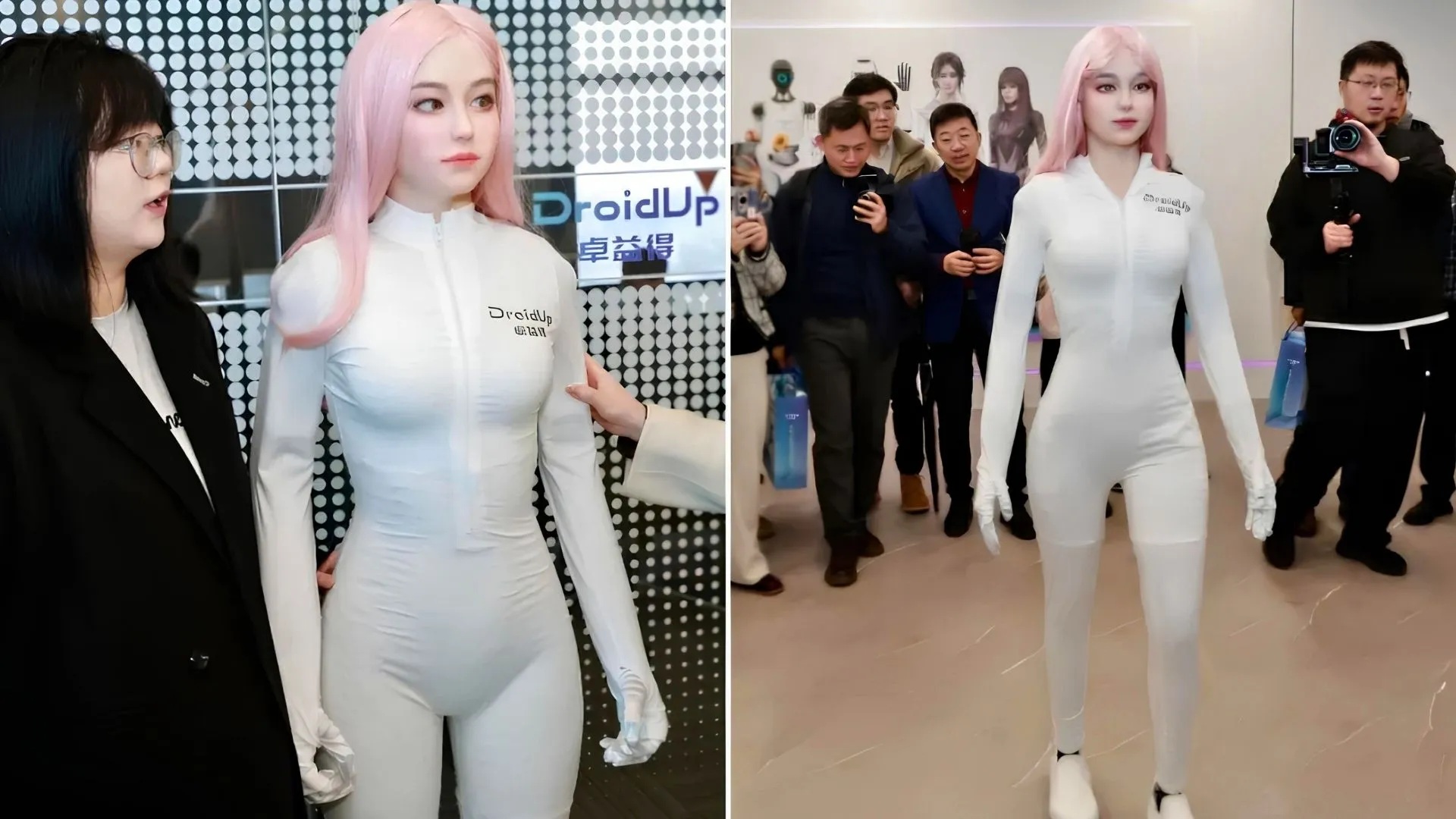
A Shanghai-based robotics company has taken humanoid technology into territory that goes well beyond efficiency or task completion, unveiling a robot engineered to look, move, and even feel human. The machine, known as Moya, has gone viral in China and beyond, not because it folds clothes or walks long distances, but because it is designed to simulate human presence itself.

Developed by DroidUp, a robotics startup focused on humanoid systems, Moya is being positioned as a “fully biometric” robot, a term Chinese media have used to describe its combination of realistic movement, dense skin-like material, and regulated body heat. Unlike most consumer-facing robots, which still present clearly mechanical cues, Moya is built to minimize the sensory distance between human and machine.

Standing 165 centimeters tall and weighing roughly 31 kilograms, Moya mirrors average adult proportions. Its body is modular, allowing users to alter physical attributes such as gender, build, hairstyle, and facial configuration. Beneath the silicone exterior are multiple layers of padding designed to replicate the resistance and softness of human tissue, including a ribcage structure intended to give the torso a natural firmness when touched.

One of the robot’s most discussed features is temperature. Internal heating systems keep Moya’s surface between 32 and 36 degrees Celsius, a range close to that of human skin. In practical terms, this means the robot does not feel cold when interacted with, a detail that DroidUp views as essential for acceptance in social environments. Cameras embedded behind the eyes allow Moya to visually track its surroundings, recognize faces, and maintain eye contact, reinforcing the illusion of attentiveness and presence.

DroidUp founder Li Quingdu has framed the project in explicitly human terms. In comments to Shanghai Eye, Li said a robot meant to integrate into everyday life should feel warm and approachable rather than metallic and distant. His argument is that emotional comfort, not just intelligence or dexterity, will determine whether humanoid robots gain traction outside industrial settings.

That philosophy shapes the company’s commercial strategy. Moya is not aimed at factories or warehouses, but at healthcare providers, rehabilitation centers, and elder-care facilities. DroidUp intends to market the robot as a social companion, capable of interaction, observation, and basic assistance rather than heavy physical labor. With China facing a rapidly ageing population and a shrinking workforce, demand for technological supplements to human care is rising steadily.

At an estimated price of about $173,000, Moya is firmly positioned as an institutional product rather than a consumer gadget. Sales are expected to begin in late 2026, giving DroidUp time to refine both the hardware and the software layer that governs interaction and responsiveness. The company has not detailed the extent of Moya’s conversational AI or cognitive autonomy, suggesting that its immediate value lies more in presence and companionship than in independent decision-making.

Moya’s debut comes amid a broader acceleration in China’s humanoid robotics sector. In recent years, Chinese firms have gained attention for rapid progress in physical robotics, often emphasizing endurance, balance, and real-world navigation. In 2025, Shanghai-based Agibot Innovations set a Guinness World Record when its humanoid robot walked 100 kilometers unassisted, navigating traffic, pedestrians, and uneven terrain. That achievement underscored China’s growing capability in deploying robots outside controlled environments.

What sets Moya apart from these developments is its focus on realism rather than robustness. While many humanoid robots are still clearly identifiable as machines, Moya is designed to blur visual and tactile cues. At technology showcases elsewhere, developers have sometimes cut open humanoid robots on stage to prove they are not human actors in suits. DroidUp appears less concerned with reassuring audiences than with testing how close a robot can come to human likeness without crossing ethical or regulatory lines.

That raises difficult questions about the social implications of such technology. Robots marketed as companions could reshape how societies think about care, loneliness, and emotional labor, particularly in healthcare settings where human interaction is already strained. There are also unresolved issues around consent, dependency, and transparency when machines are built to evoke emotional responses while remaining fundamentally artificial.

Currently, Moya stands as a marker of how robotics is evolving from utility to intimacy, reflecting a broader shift in which companies are no longer satisfied with building machines that work like humans, but are increasingly focused on machines that feel human to interact with.

As Bittensor TAO and Avalanche Adjust, BlockDAG’s 200x Entry Nears Deadline

0

Bittensor TAO price and Avalanche price continue trading inside established ranges, showing steady activity and ongoing adoption within their networks. While neither asset is seeing sharp breakouts, both remain useful markers for wider market direction and participant focus.

BlockDAG (BDAG), in contrast, is drawing notable attention. Its last private allocation offers BDAG at $0.00025, with only a few days left before exchange listings on February 16. With early access, no vesting, and 200x potential, BDAG is being discussed as the most popular cryptocurrency in this cycle. The private sale progress, adoption pace, and launch setup place BDAG in a leading position, creating a limited window for positioning before public trading begins.

Bittensor TAO Price Shows Stable Ecosystem Trends

Bittensor TAO price has recently moved between about $160 and $200 over the past week, reflecting steady trading inside the network. These price changes show how participants react to market updates and developments within the decentralized AI system. The platform supports computational input and transaction validation through validators and stakers, helping maintain network stability and operational consistency.

Although occasional scaling pressures appear as workloads rise, the network continues to operate smoothly. Watching the Bittensor TAO price reveals gradual movement rather than sudden jumps, pointing to balanced adoption and engagement within the community. The trend reflects an ecosystem that stays active and continues to develop, offering insight into participation behavior and market attention over recent sessions.

Avalanche Price Declines 7.81% Inside Weekly Band

Avalanche price has traded within a range near $8.3 to $10.3 in recent sessions, showing active market participation and technical adjustments. Latest data shows AVAX fell about 7.81% to $9.21, signaling short-term downside pressure.

During the week, intraday lows were close to $8.3, while highs moved above $10, indicating moderate volatility within this band. Daily price moves respond to liquidity levels, broader market trends, and network usage. Tracking Avalanche price over time offers a view of trading behavior and short-term changes without promoting hype or bias.

These price bands show measured engagement across the ecosystem, illustrating how participants trade AVAX in live market conditions while keeping a balanced view of its overall performance.

BlockDAG Final Private Allocation Enters Closing Phase

BlockDAG has now moved into its last private allocation stage, and activity around it is clearly rising. Priced at $0.00025, only 106 million coins remain before the coin lists on major exchanges on February 16, 2026. The supply is limited, and the timeline is tightening quickly. Early participants who secure BDAG in this allocation receive direct advantages, including trading access nine hours before public markets, early exposure to launch liquidity, and positioning ahead of expected volatility.

The BDAG private sale includes three structured core bundles designed for different trading goals. The Launch Essentials bundle gives priority access and early airdrop claims, valued at $798 for $999. The Elite Trader Pack, currently the most selected option, unlocks nine hours of elite market access, lifetime insider room membership, and early airdrop claims, representing $848 in value. The Genesis Max Pack, the full bundle, provides elite access, early claims, Genesis protection, and priority handling, delivering a total value of $2,647 for $4,999.

The BDAG presale has already closed after raising more than $452 million, reinforcing its position as the most popular cryptocurrency right now. Exchange listings are confirmed on major global platforms such as Mexc, LBank, XT, Coinstore, BitMart, and 15 additional tier-1 exchanges, setting the stage for its public debut. The outlined 200x potential increases attention, as positions secured during this stage may expand significantly after launch.

BlockDAG combines limited time access, organized bundles, and full token delivery, making this stage important within the current crypto cycle. Compared to the steady pace of Bittensor and the measured progress of Avalanche, BDAG appears as a high-energy, high-potential project drawing strong attention before exchange trading begins.

Market Perspective

While Bittensor TAO price and Avalanche price continue to show steady activity and technical consistency, BlockDAG remains widely discussed as the most popular cryptocurrency with notable upside potential. Its final allocation, private sale format, structured bundles, and early trading access before exchange listing create a focused entry window.

With only a few days left before February 16 and a limited coin supply remaining, the BDAG allocation phase is nearing completion. For those observing market shifts, the difference is visible. Bittensor TAO price and Avalanche price reflect stable progress, while BDAG represents fast-moving early access momentum that could shape the next stage of crypto market development.


Private Sale: https://purchase.blockdag.network

Website: https://blockdag.network

Telegram: https://t.me/blockDAGnetworkOfficial

Discord: https://discord.gg/Q7BxghMVyu

Alibaba Launches RynnBrain AI Model for Robotics, Joining Global Race in Physical AI and Humanoid Development

0

Alibaba Group on Tuesday unveiled RynnBrain, an artificial intelligence model specifically engineered to power robotics by enabling machines to comprehend the physical world and accurately identify objects.

The launch marks Alibaba’s formal entry into the rapidly expanding field of “physical AI”—a category encompassing intelligent systems that interact with the real world—and positions the Chinese tech giant as a significant contender in the global competition to advance robotic capabilities. A demonstration video released by Alibaba’s DAMO Academy (its research arm) showcased RynnBrain’s abilities: a robotic arm identifies various fruits and places them into a basket.

While the task appears straightforward, it requires sophisticated AI to perceive individual objects, understand spatial relationships, plan movements, and execute precise actions—complex challenges at the intersection of computer vision, sensor fusion, and motion planning. Robotics represents a key frontier in the broader “physical AI” domain, which includes self-driving cars, warehouse automation, humanoid assistants, and industrial manipulators.

China has prioritized this area as part of its strategy to compete with the United States for technological leadership, with heavy state-backed investment in AI hardware, software, and manufacturing ecosystems. Nvidia CEO Jensen Huang, a prominent voice in the sector, described AI and robotics last year as representing “a multitrillion-dollar growth opportunity.”

Alibaba’s RynnBrain launch adds momentum to the trend, building on the success of its Qwen family of large language models, widely regarded as among the most advanced open-source offerings from China. Alibaba is pursuing an open-source strategy with RynnBrain, making the model freely available to developers worldwide. This approach mirrors its playbook with Qwen, which has gained significant adoption among global developers and researchers by lowering barriers to entry and fostering ecosystem growth.

Alibaba is not alone in this space. Major tech companies globally are developing “world models” and AI systems tailored for physical intelligence:

Nvidia offers multiple models under its “Cosmos” brand to train and operate AI in robotics, leveraging its dominance in GPU compute for simulation and real-world deployment.

Google DeepMind has advanced Gemini Robotics-ER 1.5, integrating multimodal reasoning with physical interaction capabilities.

Elon Musk’s Tesla is developing its own AI stack for the Optimus humanoid robot, with Musk repeatedly highlighting humanoid robotics as a transformative market.

China is widely seen as leading in the humanoid robot production ramp-up. Companies such as Unitree, UBTech, and Agibot are planning to scale manufacturing significantly in 2026, supported by government subsidies, supply chain advantages, and aggressive R&D investment. This contrasts with the U.S., where firms like Figure AI, Agility Robotics, and Tesla’s Optimus program are advancing but face higher costs and longer timelines.

The RynnBrain launch aligns with China’s broader push to dominate key AI and robotics technologies, particularly as U.S. export controls restrict access to advanced Nvidia chips. Alibaba’s open-source approach aims to accelerate adoption both domestically and internationally, potentially creating an ecosystem advantage similar to what Qwen has achieved in language models.

The robotics market remains in its early stages but is drawing massive interest due to its potential to transform labor-intensive industries, elder care, logistics, and manufacturing. Analysts estimate the global humanoid robot market could reach hundreds of billions of dollars by the 2030s, with China aiming to capture a leading share through scale and cost advantages. Alibaba’s move strengthens its position as a full-stack AI contender, bridging cloud, language models, multimodal AI, and now physical intelligence.

The RynnBrain launch underscores China’s accelerating efforts to lead in embodied AI—the next major frontier after large language models. The race for physical AI is expected to depend on breakthroughs in real-world generalization, safety, dexterity, and cost-effective hardware. These are areas where open-source collaboration, government support, and supply chain advantages could prove decisive. Alibaba’s entry adds another major player to an increasingly crowded and high-stakes competition.