DD
MM
YYYY

PAGES

DD
MM
YYYY

spot_img

PAGES

Home Blog Page 3418

Rule of Law in any Country is the Most Important Intangible Asset

0

One of the key factors that determines the success and stability of a nation is the rule of law. The rule of law means that everyone, from the citizens to the government, is subject to the same laws and principles, and that those laws are fair, transparent, and consistent.

The rule of law ensures that people’s rights are protected, that justice is served, and that corruption is prevented. The rule of law is not a public relations slogan, but a fundamental value that shapes the culture and institutions of a country.

Why is the rule of law so important? Because it creates trust, accountability, and legitimacy. Trust means that people can rely on the legal system to protect their interests and resolve their disputes. Accountability means that those who abuse their power or break the law are held responsible for their actions. Legitimacy means that people respect and support the authority of the law and the government. These qualities are essential for a healthy democracy, a vibrant economy, and a peaceful society.

However, the rule of law is not something that can be taken for granted. It requires constant vigilance, maintenance, and improvement. It also requires the participation and cooperation of all stakeholders, including the judiciary, the legislature, the executive, the media, the civil society, and the public.

The rule of law is not a static concept, but a dynamic and evolving one that adapts to changing circumstances and challenges. The rule of law is not a one-size-fits-all solution, but a context-specific and culturally sensitive one that reflects the diversity and complexity of each country.

The rule of law is not a luxury or a privilege, but a necessity and a right. It is not a burden or a constraint, but an opportunity and an advantage. It is not a problem or a challenge, but a solution and an achievement. The rule of law is not only any country’s most important intangible asset, but also its most valuable investment.

Why is the rule of law so important? Because it is the foundation of a stable, prosperous, and democratic society. Without the rule of law, there is no justice, no security, no opportunity, and no peace. Without the rule of law, there is only chaos, violence, oppression, and fear.

The rule of law is not a given. It is not something that can be taken for granted or assumed to last forever. It is something that has to be nurtured, defended, and promoted by every generation. It is something that has to be respected, upheld, and enforced by every institution. It is something that has to be valued, cherished, and celebrated by every citizen.

The rule of law is any country’s most important intangible asset. It is what makes a country worth living in, worth investing in, worth fighting for. It is what distinguishes a civilized nation from a failed state. It is what defines a free people from a tyrannized population.

The rule of law is not just a legal concept. It is a moral principle. It is a human right. It is a universal aspiration. It is a common good. It is our collective responsibility. Why is the rule of law so important? Because it is the foundation of a stable, prosperous, and democratic society. Without the rule of law, there is no justice, no security, no opportunity, and no peace. Without the rule of law, there is only chaos, violence, oppression, and fear.

The rule of law is not a given. It is not something that can be taken for granted or assumed to last forever. It is something that has to be nurtured, defended, and promoted by every generation. It is something that has to be respected, upheld, and enforced by every institution. It is something that has to be valued, cherished, and celebrated by every citizen.

The rule of law is any country’s most important intangible asset. It is what makes a country worth living in, worth investing in, worth fighting for. It is what distinguishes a civilized nation from a failed state. It is what defines a free people from a tyrannized population.

The rule of law is not just a legal concept. It is a moral principle. It is a human right. It is a universal aspiration. It is a common good. It is our collective responsibility.

Crypto Bulls loses $217M on Grayscale Sales, as Crypto Userbase Surpasses 580M

0

The cryptocurrency market took a hit on Monday, as investors reacted to the news that Grayscale Investments, the largest digital asset manager in the world, had sold some of its holdings in Bitcoin and Ethereum.

According to data from Bybt, Grayscale reduced its Bitcoin Trust (GBTC) by 8,249 BTC, worth about $164 million at current prices, and its Ethereum Trust (ETHE) by 139,012 ETH, worth about $53 million. The sales occurred between January 15 and January 21, and were the largest weekly reductions since Grayscale started reporting its holdings in 2013.

The news sparked a wave of selling pressure in the crypto market, as some traders feared that Grayscale was losing confidence in the long-term prospects of Bitcoin and Ethereum, or that it was preparing for a major market correction. Bitcoin dropped below $30,000 for the first time since December 28, while Ethereum fell below $1,000 for the first time since January 6. The total market capitalization of all cryptocurrencies declined by more than 10%, from $1.07 trillion to $957 billion.

However, some analysts and industry insiders suggested that the Grayscale sales were not a sign of bearish sentiment, but rather a result of technical factors and portfolio rebalancing. Grayscale operates several trusts that allow accredited investors to gain exposure to cryptocurrencies without having to buy or store them directly.

The trusts trade at a premium or discount to the underlying assets, depending on the supply and demand dynamics in the market. For example, GBTC often trades at a premium to the net asset value (NAV) of Bitcoin, meaning that investors are willing to pay more than the actual value of the BTC held by the trust.

One possible explanation for the Grayscale sales is that some investors decided to take profits after GBTC reached a record high premium of 40% on January 14. By selling their GBTC shares at a premium, they could lock in higher returns than if they sold their BTC directly.

Another possible explanation is that some investors wanted to diversify their portfolios by switching from GBTC to ETHE or other Grayscale products, such as the Digital Large Cap Fund (GDLC), which holds a basket of cryptocurrencies including Bitcoin, Ethereum, Litecoin, Bitcoin Cash and Chainlink. GDLC saw an increase of 31,600 shares, worth about $5.6 million, in the same period that GBTC and ETHE saw reductions.

Grayscale itself has not commented on the reasons behind its sales, but it has reiterated its commitment to the crypto space and its bullish outlook for the future. In a tweet on January 21, Grayscale said: “Grayscale is always looking for opportunities to grow our family of products and offer investors exposure to new and exciting areas of the digital currency ecosystem.” The company also announced that it had raised a record $3.3 billion in the fourth quarter of 2020, bringing its total assets under management to over $24 billion as of January 22.

Despite the short-term volatility caused by the Grayscale sales, many crypto enthusiasts remain optimistic about the long-term growth potential of Bitcoin and Ethereum, as well as other emerging projects in the decentralized finance (DeFi) and non-fungible token (NFT) sectors.

They point to the increasing adoption of cryptocurrencies by institutional investors, corporations, governments and retail users, as well as the ongoing innovation and development in the crypto space. As Grayscale CEO Michael Sonnenshein said in a recent interview with Bloomberg: “We’re just getting started.”

Crypto Users surpasses 580M as BlackRock seeing inflows of Investors upon its Spot ETF Approval

According to a recent report by Crypto.Com, the number of global crypto owners reached 580 million in 2023, a staggering increase of 150% from the previous year. The report, which analyzed data from over 300 sources, including exchanges, surveys, and blockchain analytics, revealed that the crypto adoption curve was accelerating faster than ever, driven by factors such as institutional investment, regulatory clarity, innovation, and education.

The report also highlighted the regional differences in crypto ownership, with Africa leading the way with a 230% growth rate, followed by Asia (189%), Europe (180%), North America (161%), and Latin America (151%). The top countries by crypto ownership per capita were Nigeria, Vietnam, India, China, and the US.

Crypto.Com’s report also shed light on the most popular cryptocurrencies among global users, with Bitcoin still dominating the market with a 40% share, followed by Ethereum (18%), Tether (12%), Binance Coin (5%), and Cardano (4%). The report also noted that the rise of decentralized finance (DeFi) and non-fungible tokens (NFTs) contributed to the diversification of the crypto ecosystem, as well as the emergence of new use cases and communities.

The report concluded that the global crypto market was poised for further growth in 2024 and beyond, as more people become aware of the benefits and potential of cryptocurrencies. Crypto.Com’s CEO Kris Marszalek said: “We are witnessing a historic moment in the evolution of money and finance.

Crypto is not only an alternative asset class, but also a powerful force for social and economic change. We are proud to be part of this movement and to serve millions of crypto users around the world.”

BlackRock is seeing flows come from a number of sources, including retail, independent investors.

BlackRock, the world’s largest asset manager, has been witnessing a surge of inflows into its Bitcoin-related products, as more investors seek exposure to the cryptocurrency market. According to the company’s Head of US ETFs, BlackRock is seeing flows come from a variety of sources, such as retail investors, independent advisors, institutional clients, and even newcomers to the Bitcoin space.

In a recent interview with CNBC, BlackRock’s Head of US ETFs said that the company’s Bitcoin futures ETF, which launched in October 2021, has attracted over $1.5 billion in assets under management in less than three months. He also revealed that BlackRock has been offering other Bitcoin-related products to its clients, such as mutual funds and closed-end funds that invest in Bitcoin futures contracts.

The Head of US ETFs explained that the demand for Bitcoin exposure is driven by several factors, including the growing adoption of the cryptocurrency by mainstream companies and institutions, the increasing recognition of Bitcoin as a store of value and an inflation hedge, and the innovation and development of the crypto ecosystem.

He also noted that BlackRock is not only providing Bitcoin products to its clients, but also educating them about the risks and opportunities of investing in the cryptocurrency market. He said that BlackRock is committed to helping its clients navigate the complex and evolving crypto landscape, and to offering them a range of solutions that suit their needs and preferences.

BlackRock’s Head of US ETFs concluded by saying that he expects the interest in Bitcoin and other cryptocurrencies to continue to grow in the future, as more investors realize the potential and benefits of this new asset class.

BlockDAG Presale Shines with 10% Referral Bonus Amidst $6.4M Polygon Whale Move and Ethereum’s $10 Million Burns

0

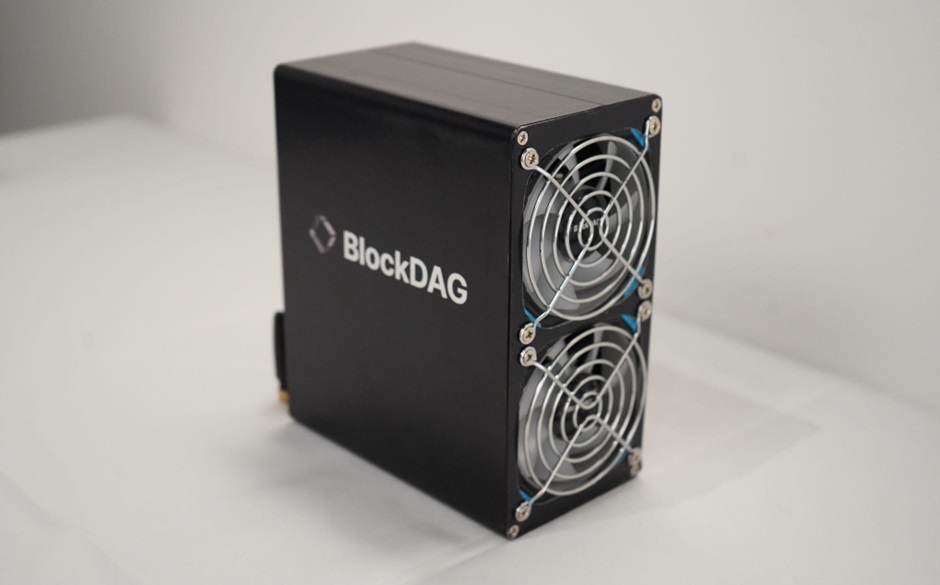
In a recent crypto buzz, Whale Alert surprised everyone by sharing news about a big transfer – 7,627,063 Polygon (MATIC) tokens have been moved from an unknown wallet to the Polygon Staking platform. This unexpected move got people talking and wondering how it might affect Polygon’s world. In another movement, aiming to push the price higher, Ethereum (ETH) has burnt $10 million of its coin, ETH. Adding to all that, the BlockDAG coin (BDAG), the newcomer to the crypto market, has set the promise to launch its mainnet in just six months, and it’s on the way to keep it. Plus, the project has a great new idea for community involvement.

Let’s delve into the article and find out more about these coins.

Polygon Whale Movement Rattles the Market

Whale Alert, a popular blockchain tracking service, has rattled the crypto market by reporting a large transfer of 7,627,063 Polygon tokens worth $6,398,799 from an unknown wallet to the Polygon Staking platform. The purchase sparked speculation in the cryptocurrency community regarding its potential ramifications for Polygon’s ecosystem.

Whale Alert revealed the details of the transactions in a tweet, creating a surge of curiosity among cryptocurrency aficionados. The transfer of such a large number of MATIC tokens from an unknown source to the Polygon Staking platform added mystery to the issue.

Ethereum Burns $10 Million

Ethereum did something pretty bold recently – it burned $10 million worth of its coin, ETH. This move is a step towards altering the currency’s economic model. The $10 million ETH burn resulted from EIP 1559, a substantial update that revamped Ethereum’s pricing system. This burning event is not a prank but a determined move to shift Ethereum’s economic trajectory.

The burning process permanently eliminates a part of ETH from circulation. It offsets the current issuance, potentially driving the Ethereum price into deflation.

BlockDAG Network: Community Involvement and Big Plans

BlockDAG is a brand-new network that operates on the Proof-of-Work (Pow) mechanism and provides users with suitable space for trading and mining. On its way to involve the community, the project comes up with a great idea for a referral system. BDAG gives a 10% bonus to all referred investors. This community involvement strategy establishes the relationship between the project and its supporters. It prompts existing community members to participate actively in the project’s growth and serves as an organic marketing channel.

BlockDAG has a straightforward and comprehensive strategy to launch its mainnet within six months. The team also have great ambitions to achieve $600 million by 2024. The recently opened presale prompted a rush to it, raising $1 million in the first 24 hours. What is in the roadmap demonstrates BlockDAG’s confidence and openness in letting everyone know where the project is headed.

Decode the Market’s Direction

The market expected a price change after spotting the large transfer to the Polygon Staking Platform and the $10 million Ethereum burned. In Ethereum’s case, it’s probable to take the way up; however, for Polygon, it’s still uncertain as the activity itself is suspicious and may have ramifications. But in general, price fluctuations cannot be perfectly predicted, and there is always space for surprises. To be on the safe side, BlockDAG’s referral system bonus and ongoing presale can serve as a more guaranteed way of making profits in the meantime.


Invest in BlockDAG Presale:

Presale: https://purchase.blockdag.network

Website: https://blockdag.network

Telegram: https://t.me/blockDAGnetworkOfficial

Discord: https://discord.gg/Q7BxghMVyu

Nigeria’s Missing “Capital” and Why Nigeria’s Stock Exchange Lags South Africa’s

1

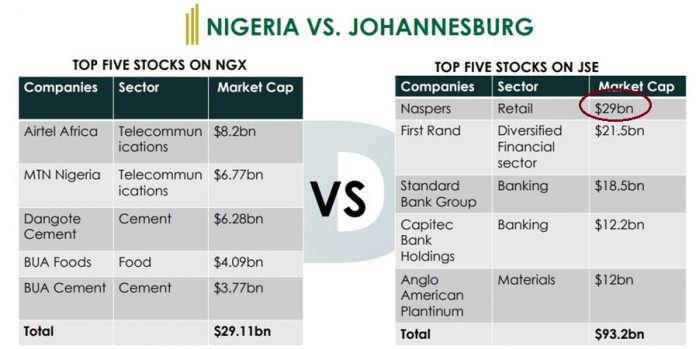
First, we must thank our legendary Bismarck Rewane for producing great business reports which compete supremely with what the Central Bank of Nigeria and National Bureau of Statistics produce.  Specifically, on his table which compares the Nigerian stock exchange (NGX) and the South African one (JSE), I will want to expand the conversion.

First, there is really no basis for comparison between NGX and JSE; while NGX is worth $50 billion, JSE goes for $950 billion. And looking at the top stocks – Airtel Africa vs Naspers, the $8.2 billion and $29 billion may not offer the big picture.

A few years ago, South Africa changed its law, restricting fund managers on how much percentage they could hold on some publicly listed companies. That restriction affected Naspers as it could not grow since most of the funds have already max’d out on its assets. Then, the company was worth close to $133 billion.

With no space to grow in South Africa, Naspers had to create a new entity, Prosus, and listed it in the Netherlands. I chronicled all that here. Prosus quickly shot to $133B but lost momentum when China began the big clamp which affected Tencent and other companies which Naspers has in its portfolio; Prosus is worth about $80 billion now.

If you add a big chunk of Prosus which is majorly owned by Naspers, you can make a point that the largest company in South Africa is directly and indirectly worth close to $90 billion. I have not added other JSE pieces like MultiChoice which Naspers has ownership in. By the time you add everything under Naspers, you can have at least $100 billion consolidated company which is 2x the value of all the publicly traded companies in Nigeria!

In summary, Naspers is not worth $29 billion, but about $100 billion, in the real practical sense for the owners! This does not mean that Nigeria is not there. What is happening is that South Africa has unlocked Capital in its economy even as Nigeria continues to operate on “money” level. Because capital works in South Africa, one of his financial institutions, First Rand, can buy every bank and insurance company in Nigeria, and still have change to spare.

I had written: “Until Nigerian policymakers focus on creating systems for Capital development and evolution over our fixation on Money, we will continue to struggle. Money is a subset of Capital, and companies and nations which allow Money to rule over them underperform. In Nigeria, we’re pursuing so much money, with limited efforts designed to advance Capital,…”

Yes, Nigeria needs to restructure its economy, and move it towards capital, and away from our fixation with money and money! Poor nations operate with money, rich nations are built on capital.

Conflux, and the rise of the ‘EVM type’ polution model off other blockchains

0

Many think I have strong opinions on networks that offer ‘EVM Compatibility’.

Some consider me an ‘ETH hater’, which is a bit unfair, because I’ve pointed to many use cases where the model makes sense, but I am very clear technically on two different things…

  1. The extent to which the Ethereum L1 itself has become increasingly less secure since ‘The Merge’
  2. The increasing risks to user autonomy and security posed by completely different scaling solutions, layers and networks which exhibit ‘EVM Compatibility’.

These two things are not the same.

Though, I’ve also pointed out, that Ethereum itself is also carrying out architectural build-out to extend its functions to improve its speed, as it attempts to compete head-to-head for ‘last mile’ business with the networks built off it, or in its ecosystem.

As it becomes more centralized, it has more investors, and they are only interested in one thing – a pay day.

These weaken its security, but some changes, may also oblige others in the ‘ecosystem’ to change in order to preserve compatibility.

In some ways, if Eth buildout itself ‘lurches’ in the direction of more TPS (Transactions Per Second), and cheaper minting with a trade off against security, it may compound the weaknesses of other networks in the ecosystem.

I’ve warned many times, mostly in responses to content on LinkedIn rather than my own articles, that multipliers of risk compound across EVM Compatible Networks.

Nevertheless, I want to pause that there… because I’ve also said the whole concept of scaling needs to be revisited…

In some ways, the flawed designs that have brought so many hacks and exploits on EVMs, need to be abandoned if and when scaling is attempted off other blockchains.

For example, whether we build out off Bitcoin, Solana, Handshake or a blockchain called ‘poop’, it will be pointless if we simply use the same Modus Operandum that has resulted in ‘Proof of Hack Pandemic’ on EVMs.

Case in point, after all the disasters that have come out of the evolution of ERC 20, its not rocket science to realize if we go somewhere else, we need something different, something new.

Unfortunately for Bitcoin dev. Enthusiasts, BRC 20 already exists.

This reminds me of the evolution of the oil industry in Texas, US. Even worse than the US Goldrush before it, indiscriminate and toxic exploitation of land created environmental damage that won’t recover for decades, in some cases, centuries.

Community pressure brought about environmental legislation, so newer (more expensive) ways had to be found to extract oil.

What did the extraction companies do? Instead of embarking on a road to continuous improvement, they went prospecting all over the world, manipulating easily corruptible indigenous rule structures, and inflicting irreversible damage on environments, and local livelihoods, hitherto vastly dependant on agriculture, fisheries and forestry.

Similar things happened in Europe among ‘Sex Criminals’. When the legislation noose began to tighten, they began to indulge in ‘Sex Crime Tourism’ to countries with weaker enforcement like Cambodia and Vietnam. Such destinations were made notorious by the disgraced ex-singer Paul Gadd (Garry Glitter) at the end of the last century.

We just can’t afford exporting malpractice to sovereignties less equipped to deal with them. The answer instead is to come with a solution.

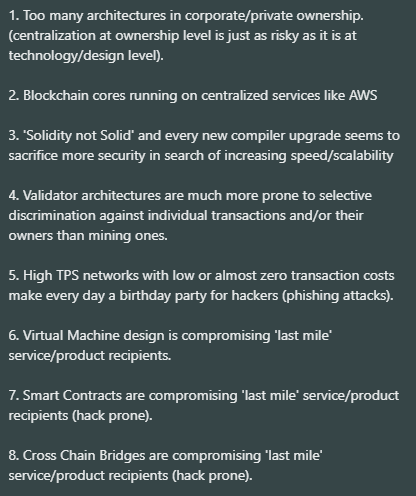
Blockchain Ecosystems are like virtual sovereign territories. The obsession with increasing TPS (Transactions Per Second) on EVM Compatible Networks has made them become the most hacked cryptographic environment, accounting for over 90% of losses, with Smart Contracts and Cross Chain Bridges being top points of intrusion.

While building out on other ecosystems, like Bitcoin, Handshake, Solana and Cardano seems interesting, the model needs to change, and we need to have ‘lessons learned’ from the things that happen on EVM Compatibles that have, and continue, to lose folk large sums of money and destroy hopes and dreams.

The ‘Smart Contract’ model needs to be binned, and in particular, we need to avoid creating (xxx)RC – 20 type token regimes in these other ecosystems.

Otherwise, we are leaving the blockchain world equivalent of the Environmental and Sex Criminals, who already poisoned the EVM landscape after ‘the merge’,  run amok on naïve and under-exploited virtual sovereignties.

Now, Naga Avan-Nomayo , for crypto.news reports that Conflux Network is contributing to bringing the Bitcoin Blockchain further down that road best not travelled.

Conflux, a China based Network is introducing an EVM-compatible layer-2 solution off the Bitcoin Blockchain, which is expected to go live in March.

‘According to Conflux, users can move Bitcoin (BTC) and inscription-powered assets between its blockchain and Bitcoin’s ecosystem. The new L2 network will run atop the main Conflux chain and use BTC for gas fees while supporting Ethereum-based smart contracts via the Ethereum Virtual Machine (EVM) standard.’

9ja Cosmos is here…

Get your .9jacom and .9javerse Web 3 domains  for $2 at:

.9jacom Domains

.9javerse Domains

Visit 9ja Cosmos LinkedIn Page

Visit 9ja Cosmos Website

Preview our Sino Amazon/Sinosignia releases