DD
MM
YYYY

PAGES

DD
MM
YYYY

spot_img

PAGES

Home Blog Page 3421

Boston Dynamics introduces new generation “Atlas” Robots

0

Boston Dynamics, a trailblazer in the field of robotics, has recently unveiled its latest marvel: the new generation “Atlas” robot. This cutting-edge humanoid robot represents a significant leap forward in robotics technology, showcasing an array of advancements that could redefine the industry’s future.

The new Atlas robot is a fully electric platform, marking a departure from the previous hydraulic models. This evolution not only enhances the robot’s efficiency but also its potential for integration into various commercial applications. The electric Atlas is designed to operate in real-world environments, a testament to Boston Dynamics’ commitment to creating robots that are not only technologically impressive but also practically valuable.

One of the most striking features of the new Atlas is its strength and range of motion, which surpasses that of its predecessors. The robot’s advanced control system and state-of-the-art hardware enable it to perform complex tasks with a level of agility and dexterity that mimics human capabilities. This humanoid robot can navigate its surroundings with unprecedented precision, thanks to its depth sensors and real-time perception abilities.

Boston Dynamics, renowned for its cutting-edge robotics, has developed an impressive array of robots that have captured the world’s attention. Here’s a look at some of their most notable creations.

Spot: This four-legged robot is perhaps the most recognized of Boston Dynamics’ machines. Spot is designed for a variety of applications, from navigating rough terrain to assisting with inspections and data collection in hazardous environments.

Stretch: Stretch is a robot specialized for warehouse operations. It’s equipped to handle tasks such as unloading trucks and moving boxes, aiming to improve efficiency and reduce the physical strain on human workers.

BigDog: Developed initially in 2005, BigDog was one of the earliest robots designed by Boston Dynamics. It was created to serve as a robotic pack mule to accompany soldiers in terrain too rough for conventional vehicles.

Handle: Handle is a robot that combines wheels and legs, allowing it to maneuver in tight spaces and handle objects with great agility. It’s particularly adept at box handling, making it another asset for logistics and warehouse environments.

The development of Atlas has been a journey of innovation and collaboration. Boston Dynamics has partnered with Hyundai to test and iterate Atlas applications, aiming to refine the robot’s functionalities for industrial use. The focus is on creating a robot that can work alongside humans, enhancing productivity and safety in settings such as manufacturing plants.

Atlas’s introduction is not just about the robot itself but also the broader implications for the digital transformation ecosystem. The deployment of autonomous mobile robots like Atlas requires a robust IT infrastructure, employee training, and the establishment of new operational processes. With over 1,500 deployments of its Spot robot, Boston Dynamics has already begun educating companies on how to coexist with autonomous mobile robots.

The new Atlas robot is a beacon of innovation, symbolizing the potential of robotics to expand human potential and transform the way we live and work. As Boston Dynamics continues to push the boundaries of what robots can do, the world watches with anticipation to see how Atlas will shape the future of robotics and automation.

Bitcoin Has Become A Necessary Financial Tool For Preserving Wealth – IMF

0

The International Monetary Fund (IMF) in a recent report disclosed that Bitcoin has become a necessary financial tool for preserving wealth.

In the research titled “A Primer on Bitcoin Cross-Border Flows: Measurement and Drivers”, the IMF analyzed on how Bitcoin is increasingly serving as a critical channel for cross-border financial flows amid global instability and hyperinflation.

The research used comprehensive on-chain and off-chain data to analyze the scope and implications of Bitcoin’s integration into global financial systems. The IMF used three complementary and workable data assets to study Bitcoin transactions and cross border flows.

Also, the pros and cons of the different approaches to estimating Bitcoin cross-border flows were analyzed, by presenting novel stylized facts using raw data that cover both on-chain and off-chain transactions, and analyzing the drivers of Bitcoin cross-border flows in comparison to capital flows for a large panel of countries.

The IMF disclosed that the rapid growth of Bitcoin since its launch in 2009 has increased its potential macroeconomic implications. Despite its price volatility and the fact that the crypto asset is not backed by any real asset or any governmental claim, the price of Bitcoin and the number of active users has increased over the decade.

The use of Bitcoin for cross-border transactions is geographically widespread, with relatively high intensities across regions both for on-chain and for off-chain flows, and some punctual differences driven by data coverage and the underlying estimation assumptions.

Analyses of the cross-border usage of Bitcoin highlight different activities from e-commerce to money linked to illicit undertakings. Nonetheless, independent of the underlying activity, cross-border transfers through Bitcoin are thought to be motivated by high costs or government controls hindering transfers via traditional financial institutions.

Notably, the magnitude of inflows relative to other countries, is particularly high in some Latin American countries such as Argentina and Venezuela. In these nations, Bitcoin has become a tool for preserving wealth and accessing global markets rather than just a speculative investment. Also, it was observed that relatively large inflows of Bitcoin transactions happened in a number of countries in Africa, Asia, and Eastern Europe.

Overall, the IMF research suggested that Bitcoin cross-border flows respond differently than capital flows to traditional drivers.

Of the estimated Bitcoin cross-border flows are sizeable with respect to several countries’ GDP, especially in those which experience smaller capital flows.

These findings are in line with a recent body of work suggesting that Bitcoin facilitates the circumvention of capital flow restriction. However, the IMF cautioned against the potential risks associated with the widespread use of Bitcoin for cross-border flows.

As highlighted by IMF policymakers in 2023, it stated that to manage capital flows, governments should ensure that capital flow management regulations cover crypto assets.

From a more structural perspective, the IMF also noted that it is important to address the underling imbalances which manifest in exchange rate pressures, since the usage of crypto assets would represent just symptoms of the imbalances.

How CBN’s Policy Triggered Destruction of Banking Sector Values in Nigerian Stock Exchange (NGX)

1

Right here when the Central Bank of Nigeria (CBN) pushed the banking sector recapitalization, and voided the use of bank profits as part of the paid-up capital requirements, I lamented that the process will make existing shareholders poorer, by diluting them, on the voyage of looking for “vapour” foreign investors or new funds. That policy made capital inefficient as the apex bank excluded retaining earnings. I was not happy about that, understanding the implications on existing investors.

If you read AO Lawal’s O’Level Economics textbook, he did not divide Capital into two forms when he explained Factors of Production. Yes, capital is capital, and should be treated that way, but when you begin to make capital to have tiers, you distort market equilibrium, and smart investors will punish you, especially in a public market.

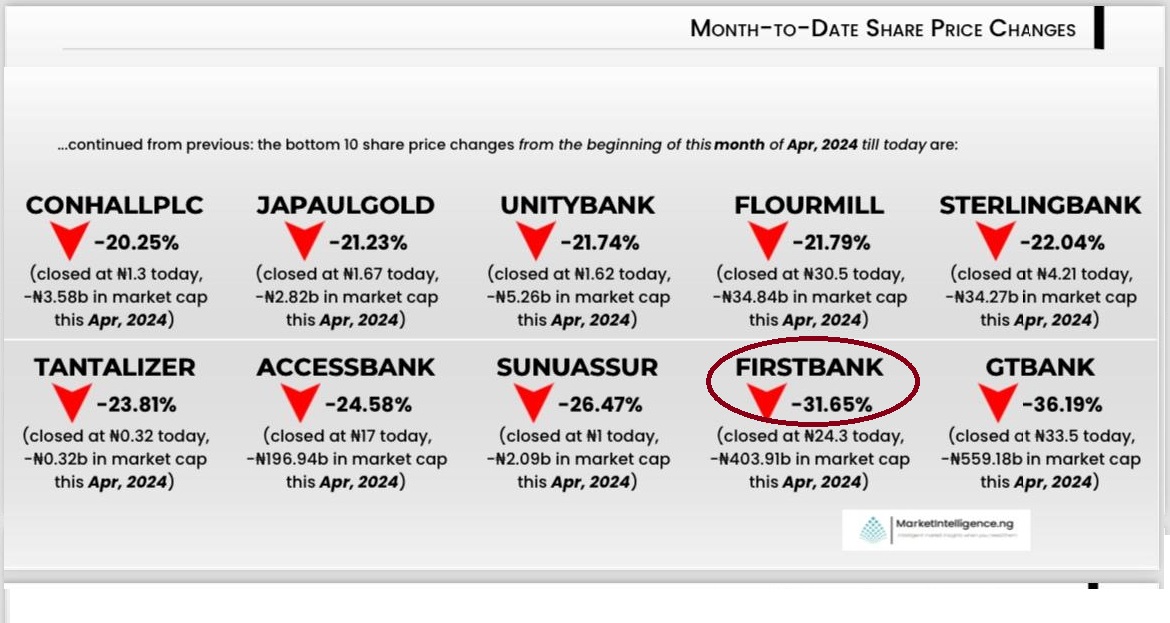
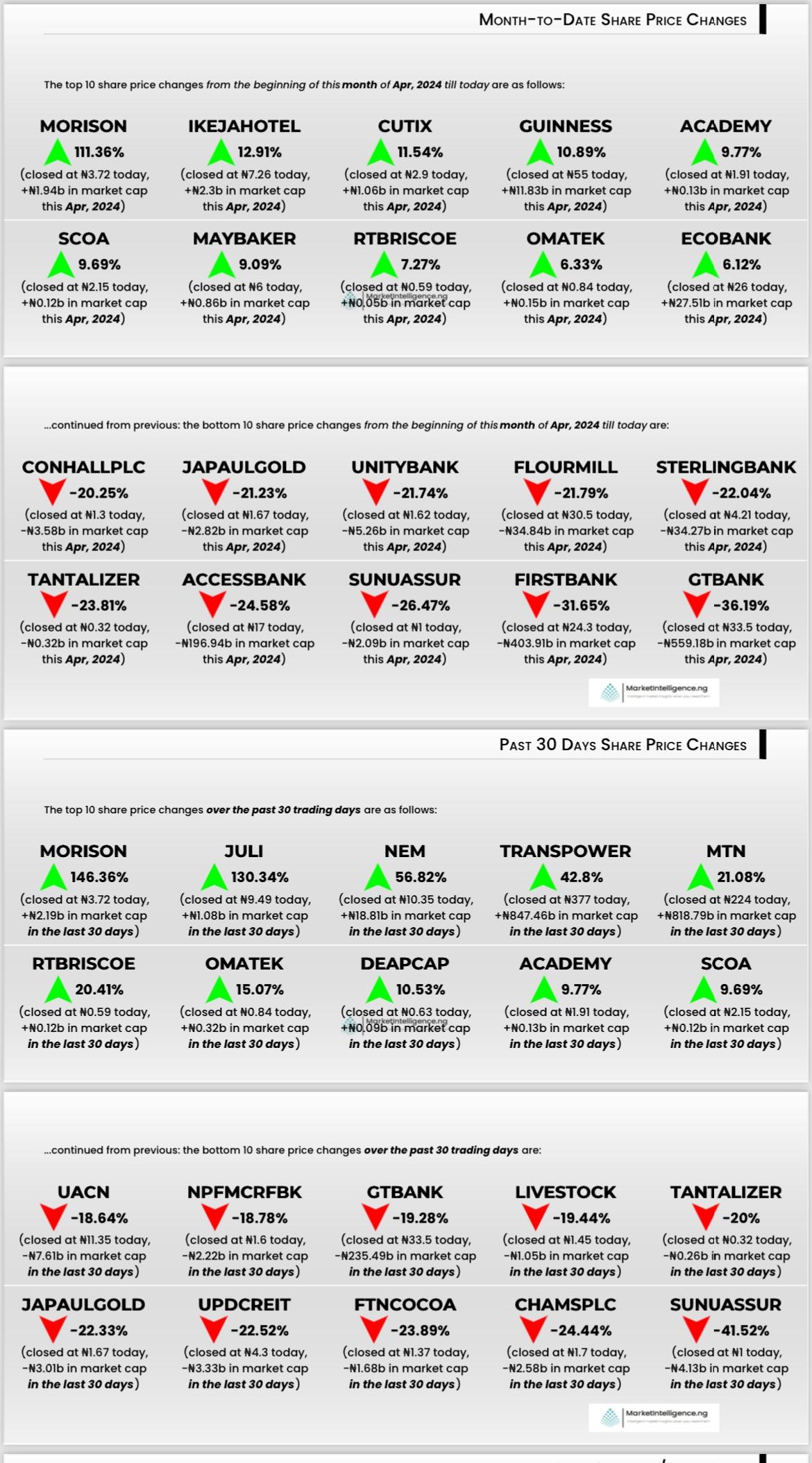
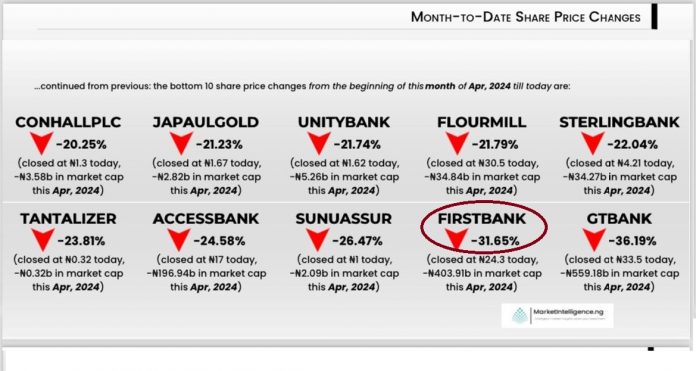
Since I dropped my note -”Bank Recapitalization In Nigeria Could Make Capital Inefficient Through Exclusion Of Retained Earnings “  on April 1, 2024, this is how some banks in Nigeria have performed (full report on click). I ended my April 1 2024 piece with a call: “I agree, this is a village boy, but I want someone to educate me why the retained earnings cannot be used for this playbook.” 

Needless to add that no one explained that to my satisfaction. But today, investors have explained, and the report is a massive trauma on the valuations of banks in the Nigerian stock exchange (NGX). You can also extrapolate that the exit of FirstBank CEO could be linked to the loss of 31% of the company value since April 1, 2024!

My concern was also what investors saw: you do not punish existing investors because you want some “foreign investors” in London, New York, etc to come. Today, they have made way, and in the process, causing problems for the banks.

It is arrogant to tell investors that you cannot get dividends and the retained earnings cannot be used for recapitalization. In other words, they get nothing for their risks even as they’re being diluted!

Comment On Feed

Comment 1: Prof. Ndubuisi Ekekwe Though I am not an economist by profession, but with the little I learned about it, I will specifically state here that the implementation of the apex bank policy, particularly in the banking sector recapitalization, had profound implications for existing investors, notably in diluting their holdings and hindering the retention of earnings within the system. By restricting the use of bank profits as part of the paid-up capital requirements, the policy effectively marginalized existing shareholders, compelling them to navigate a landscape seeking foreign investors or new funds, often leading to a diminishment of their wealth and influence in the market.

This departure from conventional economic principles, as exemplified in AO Lawal’s O’Level Economics textbook, where capital is traditionally viewed as a singular entity within the factors of production, underscores a distortion of market equilibrium. Dividing capital into tiers not only deviates from established economic paradigms but also invites scrutiny and aversion from astute investors, particularly in public markets where transparency and stability are paramount.

Ultimately, the policy’s repercussions extend beyond mere financial ramifications…

Comment 2: Prof, you need to think about this like a Central Banker with a Financial Stability mandate. The best form of capital for a bank is Common Equity Tier 1 (CET1) Capital: This is the highest quality capital, consisting mainly of common shares and retained earnings. It is the most effective capital to absorb potential losses. In this case, the CBN decided to back out retained earnings to have an even better quality capital, given it is an accounting form of capital which has been subjected to principle-based assumptions (accounting principles). CBN’s focus is on the best possible capital base in the capitalization drive. It’s all about financial stability. I hope this helps.

Comment 3: Prof, I beg to differ markedly from your position. Using AO Lawal’s textbook published 4 decades ago to measure CBN’s decision in 2024 is rather inappropriate, respectfully. Financial management is not artificial intelligence, a lot is dependent on human factor which is highly dynamic and largely unpredictable. Yes AO Lawal never divided capital into many forms because of what was available then. 25 years ago Venture capital was largely nonexistent globally. Today venture capital is virtually the only source of capital for start ups.

History is the study of change, ironically used as a map for the future. Financial indexes hardly behave like electromagnetic waves whose direction are determined by movement of electrons.

The import of the scenario lies in the objective of what CBN wants to achieve, they need FDI in foreign currency. They should be encouraged to pursue their objective with zest.
If the govt policies are consistent and uncertainties are reduced to the barest minimum, they will succeed, however there is room for error. My take is that the govt should sync their policies with the CBN objective especially in dealing with insecurities.

My Response: There is no capital form you mentioned that was not around when Lawal wrote his book. Yet, you might not have gotten my message. I am simply saying: Naira is Naira, do not start saying this is from London or New York or Umuahia or Kano. If you start doing that, you will offend some people. CBN was doing that when it told banks: you cannot pay dividends, but go and get new investors, and after that you can do that. You know what? Those NEW investors will then partake in the dividends, created months before they joined. Read that piece again…

Why Banking Stocks Continue to Bleed in Nigerian Stock Exchange (NGX)

1

When the Central Bank of Nigeria (CBN) announced the policy of recapitalization of Nigerian banks, I noted that if these banks should go through rights issues, existing shareholders would lose value, as they would be diluted: “Rights issue will increase the number of outstanding shares even though the valuation has remained the same, thereby diluting current shareholders.”

As Nigerian banks begin the playbook on how to raise capital, investors are calibrating the implications of many moves.  In the last few weeks, bank stocks have lost value in the Nigerian Stock Exchange (NGX). We have seen double digit percentage losses for most banks on their valuations.  That is expected: if they plan to dilute, you can get out, with big returns, and then rejoin later. 

For the low-tier banks, there is also going to be an issue of survival. In other words, the pressure will be huge on them to raise funds in a world of the big players.

Furthermore, there is another structural challenge. If banks raise these huge sums, they would be expected to inject them into the economy via loans and other product classes. As that happens, we can see increased inflation in the land. 

So, the monetary policy of the apex bank which has been to curtail inflation via rate increases could be muted as banks release more funds into the economy to stay within standard ratios on loans and broad assets. Largely, investors are modeling that inflation will stay high over the long-term and are making changes on their portfolios.

Full report here (PDF)

That said, if Naira remains STABLE irrespective of the exchange rate with US dollars, global investors will come. The instability of the Naira is more challenging to investors than its actual value in the mid- and long-terms. In the short-term, you focus on the exchange rate, but later, it is about stability. If Nigeria can get through Q3 2024 with a stable Naira, it will begin to rain again, not just for NGX players, but also startups!

Finally Nigeria needs to do all possible to ensure all the banks survive. Merging them does not really serve customers at the bottom that much, even as they support corporations which need banks with more capacities for loans. When Hallmark Bank, Citizens Bank and other regional banks folded in the Southeast, I have not seen replacements in what they were doing. So, my point is that we still need “small” commercial banks as their services remain catalytic.

How Digital Burnout is Depleting the Productivity of Remote Workers

0
Virtual event or meeting has gone mainstream, benefiting Zoom

The prevalence of remote work comes with a lot of benefits and a lot of challenges, too. One critical challenge that has recently come to the fore is Digital Burnout.

What is digital burnout?

Do you know how people get burned out at work? Well, it is similar, but this time, it is particular to digital tools.

The World Health Organization (WHO) 2019 defined burnout as “a syndrome conceptualized as resulting from chronic workplace stress that has not been successfully managed,” they add that it can affect a person’s health.

The WHO added that burned-out individuals have “feelings of energy depletion or exhaustion, increased mental distance from one’s job, or feelings of negativism or cynicism related to one’s job and reduced professional efficacy.”

Working from home has significantly increased the frequency and the way people use digital tools. They use it for communication – to send messages to colleagues and bosses. They use it for social reasons – like checking on a colleague, even outside work hours. These tools are also used for meetings and conferences, for preparing and turning in reports, and even for preparing to-do lists and scheduling things to be done.

Succinctly put, there is a tool or tools for everything you do at work. From social interactions to all forms of internal and external communications, technology is indispensable now. But it is also fast, leading to digital burnout among remote work staff.

This started as far back as the Coronavirus pandemic lockdown when, after working for months from home, people started complaining of burnout. Some might have questioned the reason for the burnout, seeing as they were working from home, but we now understand it as digital burnout.

A 2019 Workplace Productivity Report showed that 87% of American office workers spent an average of seven hours a day staring at screens, and more than half of 1057 people reported fatigue or depression stemming from digital overload.

There is the fact that they intrude on our time, of course, especially when you are about to have a shower and you get a notification on your Teams app showing you that your boss has just initiated a meeting outside official work hours. But this is just one part of all that digital burnout entails.

Common symptoms of digital burnout

Fatigue or reduced energy/motivation

If you feel constantly tired, even at the start of a new work day, it might indicate that you are experiencing digital burnout. Often, this will happen alongside other symptoms.

Insomnia, headaches, and muscle pain

This mostly follows the stress, and you get less sleep, both in quality and quantity. Headaches and muscle pains can also accompany it, and if a medical check shows nothing is wrong with your health, you may be dealing with digital burnout.

Forgetfulness and inability to concentrate

With the constant beeps of notifications, emails, phone calls, conference meetings, and reminders, it could become hard to concentrate on a single task, and you would find yourself forgetting details.

Decline in Performance

Once you are dealing with the other symptoms, performance first stagnates and then naturally begins to decline.

Anxiety, Depression, and Frustration

What to do about digital burnout?

The first thing to do is take a leave. Don’t wait till you get to the point where you mentally disengage from the job. Take a week’s leave or two from work. Ensure it’s a clean break, not where you are on leave but still working. Turn off all notifications and emails, and take a break from all your gadgets. If you notice a staff is experiencing a digital burnout, have them take a break.

Create boundaries and be strict with them. There is no point working remotely if it means working all around the clock. Have definite hours for work, and if you have to go outside of these hours now and then, it is cool. But you can’t be on call at all hours and every day of the week.

Work-life balance is necessary, too. It is okay to work remotely, but make sure you are not sitting inside your house all the days of the week. Once you finish work, stroll, see a friend, or garden at the back of the house. Whatever it is, do something that does not involve a digital device, and for context, television is a digital device.

If you are an employer, you should encourage your employees to do this regularly.