DD
MM
YYYY

PAGES

DD
MM
YYYY

spot_img

PAGES

Home Blog Page 3456

As Huawei Rises, It Is Looking Like US Scored Own-Goals Against US Big Tech in China

0

Do not wake up a sleeping tiger. Yes, the United States has scored an own-goal by making China’s Huawei to decouple from America, and in the process restructured and redesigned its business. Before the big sanctions, Huawei depended on many American firms. They made money from Huawei and Huawei used  their technologies to make money – call it win-win, the benefits of globalization to a large extent.

Post-sanctions, Huawei was forced to return to the basics. And now it is  back. Its HarmonyOS is expected to eclipse Google’s Android within months. As that was happening, it is destroying Apple iPhone: “Apple’s grapple with sales decline and Huawei’s accelerating resurgence in China’s market marks the Chinese telecom giant’s growing defiance of the US sanctions. The analysts estimate that Huawei will ship approximately 64 million smartphones worldwide in 2024 – up substantially from the estimated less than 35 million shipped in 2023.”

Be wise, do not motivate your competitor! Do not inspire your competitor. Because a tiger can roar…If Apple loses China, you can blame the US government for making it easier for Huawei to create everything to the extent that its product prices are now lower, as it has replaced more expensive US raw materials/inputs/components. And it may not stop in China because everyone wants a great deal across the world.

Apple’s iPhone Sales Plummet 30% in China Amid Pressure from Huawei

Crypto could create a new generation of wealthy individuals

0

The rise of cryptocurrencies has been one of the most remarkable phenomena of the 21st century. From Bitcoin to Ethereum, from Dogecoin to NFTs, crypto has captured the imagination and the wallets of millions of people around the world. But what does this mean for the future of work and society?

One possible scenario is that crypto could create a new generation of wealthy and independent individuals who have no need or desire to participate in the traditional labor market. This generation could be Gen Z, the cohort born between 1997 and 2012, who are currently entering adulthood and making their first financial decisions.

Gen Z is already known for being tech-savvy, socially conscious, and entrepreneurial. They are also more likely to be interested in and invested in crypto than older generations. According to a survey by Gemini, a crypto exchange platform, 27% of Gen Z respondents said they owned or were interested in owning crypto, compared to 21% of millennials, 15% of Gen X, and 9% of baby boomers.

Crypto could offer Gen Z a way to achieve financial freedom and autonomy without having to rely on traditional institutions or employers. Crypto could also allow them to express their creativity and values through various forms of digital art and activism.

For example, some Gen Z artists have used NFTs (non-fungible tokens) to sell their original works online and support social causes. Some Gen Z activists have used crypto to fundraise for humanitarian crises or environmental issues.

If crypto becomes a dominant form of wealth and influence in the future, Gen Z could opt out of the conventional workforce and pursue their own passions and interests. This could leave millennials, the generation born between 1981 and 1996, as the main contributors to the economy and society.

Millennials are already facing many challenges, such as student debt, stagnant wages, rising living costs, and climate change. They may have to shoulder even more responsibilities and burdens if Gen Z decides to withdraw from the system.

Of course, this scenario is speculative and based on many assumptions. Crypto is still a volatile and uncertain domain, with many regulatory, technical, and ethical hurdles to overcome. Gen Z is not a monolithic group, and many of them may still prefer or need to work in traditional sectors or industries. Millennials are not doomed or helpless, and they may also benefit from or adapt to the crypto revolution.

However, it is worth considering how crypto could reshape the intergenerational dynamics and expectations in the coming years. Crypto could create new opportunities and challenges for both Gen Z and millennials, as well as for society at large. Crypto could also redefine what it means to work, create, and live in the digital age.

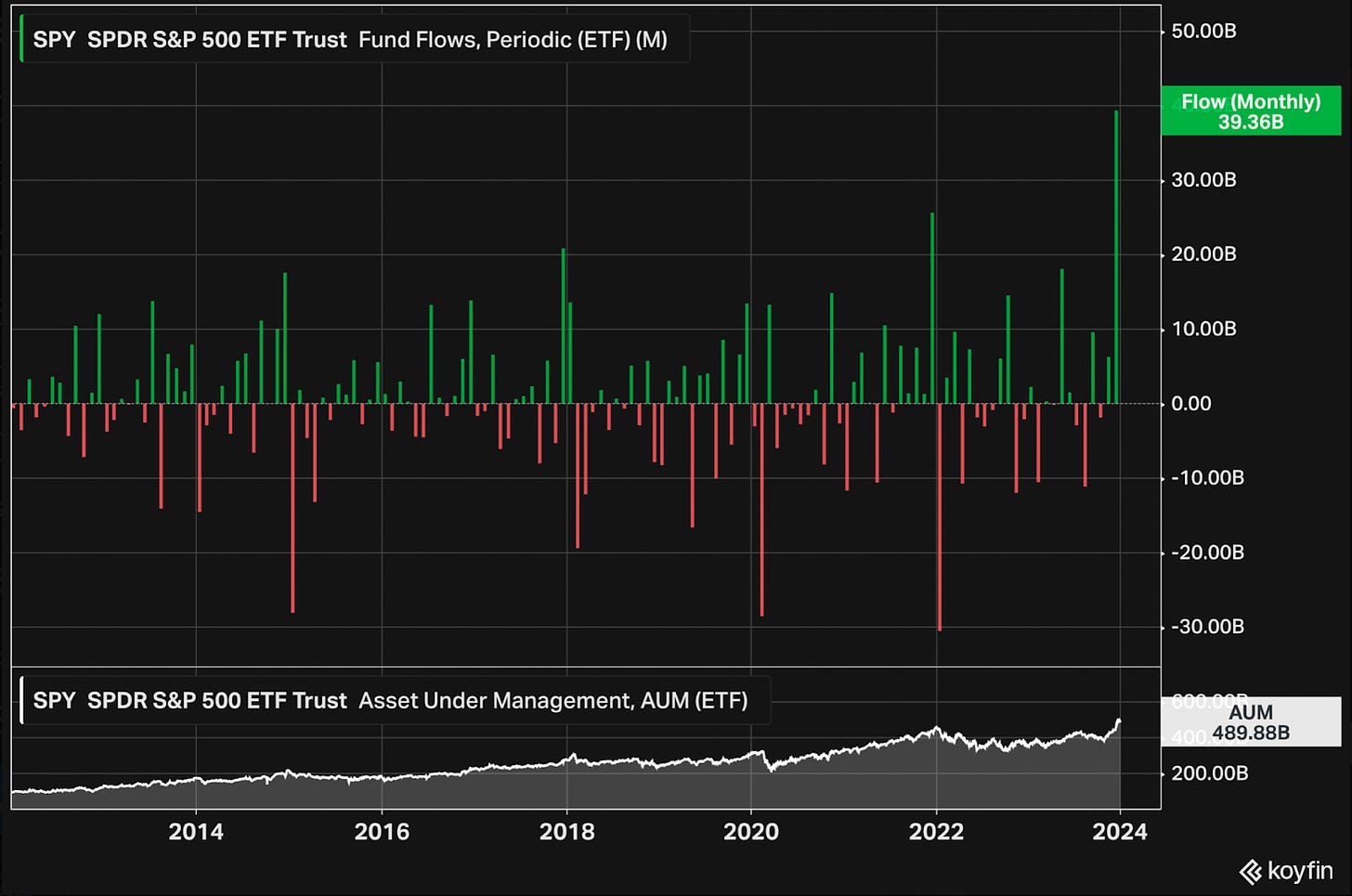
At $39.4B, SPY S&P 500 ETF had its biggest inflows

Meanwhile, the SPY S&P 500 ETF, which tracks the performance of the 500 largest US companies, saw a massive surge of inflows in the last quarter of 2023, reaching $39.4 billion. This is the highest level of quarterly inflows for the fund since its inception in 1993, according to data from ETF.com.

What drove this unprecedented demand for the SPY ETF? There are several possible factors behind this trend, such as:

The strong recovery of the US economy from the pandemic-induced recession, boosted by fiscal stimulus, vaccine rollouts and consumer spending. The resilience of the US stock market, which outperformed most other regions in 2023, despite facing challenges such as inflation, supply chain disruptions and geopolitical tensions.

The popularity of the SPY ETF among retail investors, who have increased their participation in the market through online platforms and apps. The SPY ETF offers a simple and low-cost way to gain exposure to the broad US equity market, with a diversified portfolio of high-quality companies.

The attractiveness of the SPY ETF as a core holding for institutional investors, who use it as a benchmark, a hedging tool or a tactical allocation. The SPY ETF has a high liquidity and a low tracking error, making it easy to trade and manage.

The SPY ETF has been one of the most successful and influential investment products in history, with over $400 billion in assets under management as of December 2023. It has delivered an average annual return of 10.6% since its inception, outperforming the S&P 500 index by 0.2% per year. It has also been a catalyst for the growth and innovation of the ETF industry, which now offers thousands of funds covering various asset classes, sectors, themes and strategies.

As we enter 2022, the outlook for the SPY ETF remains positive, as the US economy is expected to continue its expansion and the US stock market is likely to benefit from strong earnings growth, favorable valuations and supportive monetary policy. However, investors should also be aware of the potential risks and challenges that could affect the performance of the fund, such as:

The uncertainty around the trajectory and impact of the Omicron variant of Covid-19, which could pose a threat to public health and economic activity. The possibility of higher interest rates and tighter monetary policy from the Federal Reserve, which could weigh on market sentiment and valuations.

The escalation of geopolitical conflicts and trade disputes, especially between the US and China, which could disrupt global supply chains and markets. The increased volatility and competition in the ETF space, which could erode the market share and profitability of the SPY ETF.

The SPY S&P 500 ETF is a remarkable fund that has delivered consistent returns and value to its investors over the past three decades. It is a testament to the power and efficiency of passive investing, which aims to capture the long-term growth potential of the US equity market.

However, as with any investment, it is important to monitor its performance and risk profile regularly, and to adjust one’s portfolio allocation accordingly. The SPY ETF is not a buy-and-forget product, but rather a dynamic and flexible tool that can help investors achieve their financial goals.

EtherScan Acquires SolScan as Michael Saylor plans to sell $215M in MSTR

1

Etherscan, the leading blockchain explorer and analytics platform for Ethereum, has announced that it has acquired SolScan, the most popular explorer for Solana, in a deal worth $50 million. This is the first major acquisition in the blockchain space that involves two different platforms, and it signals a new era of interoperability and collaboration.

Etherscan and SolScan have been working together since 2023, when they launched a cross-chain bridge that allows users to seamlessly transfer assets and data between Ethereum and Solana. The bridge has facilitated over $10 billion worth of transactions and enabled new use cases such as decentralized finance, gaming, and NFTs.

The acquisition will allow Etherscan and SolScan to leverage their respective strengths and resources to provide a more comprehensive and user-friendly service for both developers and users. Etherscan will integrate SolScan’s features and data into its platform, while SolScan will benefit from Etherscan’s security, scalability, and reliability. The two explorers will also work on developing new tools and solutions for the emerging blockchain ecosystem.

Etherscan’s founder and CEO, Matthew Tan, said: “We are thrilled to welcome SolScan into the Etherscan family. SolScan has been a pioneer and innovator in the Solana space, and we share a common vision of building a more open, transparent, and inclusive blockchain world. Together, we will be able to offer a more holistic and integrated experience for our users across multiple chains.”

SolScan’s co-founder and CTO, said: “We are honored to join forces with Etherscan, the most trusted and respected explorer in the industry. Etherscan has been an inspiration and a partner for us since day one, and we are excited to continue our journey with them. By combining our expertise and technology, we will be able to deliver more value and innovation to the blockchain community.”

In a surprising move, Michael Saylor, the CEO of MicroStrategy, announced that he will sell 315,000 shares of his company worth $215 million to buy more Bitcoin personally. This decision comes after MicroStrategy has already accumulated more than 120,000 Bitcoins as part of its corporate treasury strategy.

Saylor explained his rationale in a blog post, saying that he believes Bitcoin is the best store of value and hedge against inflation in the current economic environment. He also said that he is confident in the future growth and innovation of MicroStrategy, and that he will continue to lead the company as its largest shareholder.

According to Saylor, selling some of his shares does not reflect any change in his long-term vision or commitment to MicroStrategy. He said that he is simply reallocating some of his personal wealth to Bitcoin, which he considers to be a superior asset class. He also said that he will not sell any more shares for at least one year, and that he will donate 10% of the proceeds to charitable causes.

Saylor’s announcement has sparked mixed reactions in the crypto community. Some praised him for his boldness and conviction in Bitcoin, while others criticized him for diluting the value of MicroStrategy and creating a conflict of interest. Some also questioned the timing and legality of his move, as it coincides with a recent SEC investigation into MicroStrategy’s Bitcoin purchases.

Regardless of the opinions, Saylor’s move is undoubtedly a significant event in the history of Bitcoin and corporate adoption. It shows that Saylor is willing to put his money where his mouth is, and that he is not afraid to take risks and challenge the status quo. It also shows that Bitcoin is becoming more attractive and mainstream as an alternative investment for individuals and institutions alike.

Ethereum core devs chart an ambitious 2024

Meanwhile, Ethereum, the second-largest cryptocurrency by market capitalization, has been undergoing a series of upgrades and innovations in the past few years. The most notable ones are the transition from proof-of-work to proof-of-stake consensus mechanism, the implementation of sharding and rollups to improve scalability and efficiency, and the introduction of new features and standards to enhance interoperability and usability.

However, the Ethereum core developers are not resting on their laurels. They have a bold vision for the future of the network, and they are working hard to make it a reality. In this blog post, we will introduce you to two of the most influential and active core devs in the Ethereum community: Dencun and Pralectra. We will also explore their plans and projects for 2024, which promise to bring Ethereum to new heights of innovation and adoption.

Dencun: The mastermind behind EIP-1559 and EIP-3675

Dencun is a pseudonymous developer who has been contributing to Ethereum since 2017. He is best known for proposing and leading the development of two of the most impactful Ethereum Improvement Proposals (EIPs) in recent history: EIP-1559 and EIP-3675.

EIP-1559, which was activated in August 2021, introduced a new fee mechanism that dynamically adjusts the gas price based on network demand and burns a portion of the fees, creating a deflationary pressure on ETH supply. EIP-3675, which was implemented in December 2021, finalized the transition from proof-of-work to proof-of-stake by merging the Ethereum mainnet with the Beacon Chain, the backbone of the new consensus protocol.

Both EIPs have been widely praised by the Ethereum community for improving the security, sustainability, and user experience of the network. They have also boosted the value proposition of ETH as an asset, as evidenced by its strong performance in the market.

Dencun is not done yet. He is currently working on several projects that aim to further enhance Ethereum’s capabilities and competitiveness. One of them is EIP-4488, which proposes to reduce the gas cost of call data, the data that is passed to smart contracts when they are executed. This would lower the barriers for developers and users to deploy and interact with complex applications on Ethereum, such as decentralized exchanges, lending platforms, gaming dapps, and more.

Another project that Dencun is involved in is EIP-6484, which suggests introducing a new opcode called BASEFEE that would allow smart contracts to access the current base fee of the network. This would enable new possibilities for fee management and optimization, such as fee abstraction, fee delegation, fee rebates, and more.

Pralectra: The pioneer of zk-SNARKs and zk-rollups

Pralectra is another pseudonymous developer who has been working on Ethereum since 2018. She is a leading expert and innovator in the field of zero-knowledge proofs (ZKPs), a cryptographic technique that allows users to prove that they know some information without revealing it.

Pralectra has been instrumental in bringing ZKPs to Ethereum, both at the protocol and application levels. She is one of the main contributors to EIP-1962, which added support for various ZKP primitives to the Ethereum virtual machine (EVM), enabling developers to use them in their smart contracts. She is also one of the co-founders and core developers of ZKSync, one of the most popular and advanced zk-rollup solutions on Ethereum.

ZKSync is a layer-2 scaling platform that uses ZKPs to compress and verify transactions off-chain, while maintaining security guarantees from the mainnet. ZKSync can process thousands of transactions per second with minimal fees and latency, while supporting smart contracts, token transfers, NFTs, and more.

Pralectra is constantly pushing the boundaries of ZKPs and zk-rollups on Ethereum. She is currently working on ZKSync 2.0, which aims to bring full EVM compatibility and programmability to zk-rollups, allowing any existing or future dapp to run on ZKSync with zero friction or compromise. She is also working on ZKPorter, a new scaling technique that combines zk-rollups with data availability sampling, resulting in an exponential increase in throughput and a significant decrease in cost. ZKSync 2.0 and ZKPorter are expected to launch in 2024, marking a new era of scalability and privacy for Ethereum.

Dencun and Pralectra are just two examples of the many talented and dedicated core developers who are making Ethereum better every day. They represent the ethos and vision of Ethereum: a decentralized, open-source, community-driven platform that strives for innovation and excellence.

As we enter 2024, we are excited to see what Dencun, Pralectra, and the rest of the Ethereum core devs will bring to the table. We are confident that they will continue to surprise and delight us with their groundbreaking ideas and implementations. We are proud to support and celebrate their work, and we invite you to join us in following their progress and achievements.

Court Orders Nigeria to Pay Godwin Emefiele N100m Over Rights Violations

0

A ruling by the High Court of the Federal Capital Territory, Maitama, has ordered the Federal Government to compensate the embattled former Governor of the Central Bank of Nigeria, Mr. Godwin Emefiele, with a hefty sum of N100 million.

The ruling, delivered by Justice Olukayode Adeniyi, condemned the prolonged detention of Emefiele by security agencies without trial, deeming it both illegal and unconstitutional.

This judgment found the actions of the Federal Government and its agencies to egregiously infringe upon Emefiele’s fundamental rights enshrined in the 1999 Constitution. Moreover, the court issued a restraining order against the Federal Government and its agents, prohibiting any re-arrest or detention of Emefiele without a valid court order.

The genesis of this legal battle emerged from a fundamental rights enforcement suit initiated by the former CBN boss, challenging the legality of his extended detention in the custody of the Department of State Services (DSS). Emefiele, in his lawsuit, sought damages totaling N1 billion as redress for the rights violation.

Story Background

Emefiele’s legal ordeal commenced with his suspension by President Bola Tinubu on June 9, which subsequently escalated when the Department of State Services (DSS) rearrested him in July 2023. The dramatic arrest followed a confrontation with Correctional Services officers subsequent to a bail grant by a Federal High Court in Lagos.

Late last year, Emefiele was granted bail at the sum of N20 million by the Lagos court. Justice Nicholas Oweibo, presiding over the case, affirmed that the charges against Emefiele were bailable offenses but ordered his remand at the correctional center until the bail conditions were met.

Facing charges related to illegal possession of a firearm and ammunition at the Federal High Court in Lagos and corruption charges in Abuja, the DSS later withdrew the charges. The Director of Public Prosecutions cited emerging facts necessitating further investigation as grounds for the withdrawal.

Despite the withdrawal of charges, Emefiele remained in custody and was subsequently transferred to the Economic and Financial Crimes Commission (EFCC). There, he faced a six-count charge for alleged involvement in procurement fraud. Although granted bail worth N300 million, stringent conditions, including producing two Abuja-resident sureties with property within the Maitama District, delayed his release until December 23, culminating in about 34 days spent at Kuje prison.

Presently, Emefiele confronts allegations of economic crimes, fraud, and breach of public trust. A report by Special Investigator Jim Obazee, appointed by President Tinubu, has leveled accusations of financial misconduct against Emefiele during his tenure as CBN governor.

These successive detentions and legal battles have marked a tumultuous period for the former apex bank chief.

Africa’s Leading Startup Ecosystems, The ‘Big Four’, Attracted 87% of Funding in The Region in 2023

0
Fund, money cash dollar

Recent report have revealed that Africa’s leading startup ecosystem the ‘big four’ which comprise South Africa, Kenya, Nigeria, and Egypt, attracted 87% of funding in the region, their largest share since 2019.

These regions were home to 71% (357 out of 500) of the start-ups who raised $100k or more on the continent last year.

Despite the 36% decline in fundraising in 2023, down from the $5 billion recorded in 2022, marking the lowest figure since 2020 ($2.1 billion), the big four nations continued to shine.

In terms of funds raised by region, the report showed that North Africa captured the largest share with 33.67% of the total funds raised, followed by East Africa (26.22%), Southern Africa (19.94%), West Africa (17.89%), and Central Africa (1.92%)

By sector, fintech start-ups remain the best-funded nuggets in Africa, accounting for 45% of total financing raised last year.

Here is How Each Country in the ‘Big Four’ Performed

Kenya

With just under $800m raised in 2023, Kenya shot up to the first position, after it attracted the most funding, 28% of the continent’s total. While it suffered a decline (-25% YoY), its share of Eastern Africa’s funding grew from 86% in 2022 to 91% in 2023. 93 start-ups raised $100k or more during the period (19% of Africa’s total).

Egypt

In Egypt, there were 48 such ventures raising $100k+ in 2023, the lowest number out of the Big Four. But thanks to a YoY decline (-20%) it was enough for the country to claim the second spot.

Egypt’s share of North African funding grew substantially from 72% in 2022 to 95% in 2023 (+23pp, by far the strongest progression), due both to the magnitude of MNT-Halan’s fundraising, and Algeria and Tunisia’s inability to repeat their strong 2022 performance.

South Africa

South Africa’s share of regional funding remains the highest at 97%. The 70 start-ups who raised $100k or more in the country cumulated $600m in funding i.e. 21% of the continent’s total. South Africa was the only one of the Big Four not to see its total funding shrink between 2022 and 2023 (+8% YoY).

Nigeria

Nigeria is reported to be the country where the most dramatic change happened in 2023. While the country still claimed the highest number of start-ups to raise $100k or more on the continent), the amount they raised was divided by 3 YoY (-67%) to reach $410m, compared to $1.2b in 2022, and $1.7b in 2021.

As a result, its share of Western African funding continued to drop to reach 68%, down from 85% in 2021, and 77% in 2022. This marked the lowest regional share of any Big Four market since 2019.

According to investors, the ‘Big Four’ have continued to remain the regions with the highest funding because their markets include talent, existing innovation, infrastructures that need disruption, and the deepness of technology infrastructure which covers telecommunications, mobile money penetration, government alliances, and clear regulations.