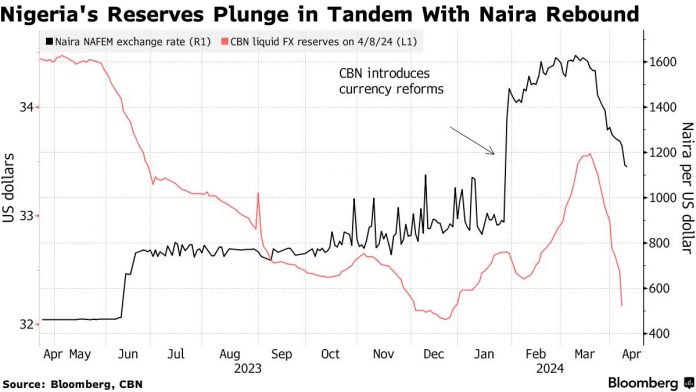
Plot the exchange rate of Naira against time. Plot the foreign reserves of Nigeria against time. This is what you get. Is that statistically significant to deduce that the recent strengthening of the Naira was not done naturally, but has a connection to the depletion of the foreign reserves?
Of course, you can argue that the reserve is there to strengthen the Naira, and if using it has worked well to strengthen Naira, that should be celebrated. So, it comes down to how our leaders communicate. Yes, they can celebrate this by articulating a position, instead of fighting data. A suggestion…
“Fellow Citizens, I have used some reserves to strengthen the Naira, and I expect this policy to be sustained over the next 12 months. This will help us stabilize the FX market and bring stability for our manufacturing companies which need imported raw materials to produce. With a strengthened and stable Naira, the government will have the window to focus on catalytic projects we have for the nation. We expect this policy to cost $10 billion.
“Sure, we understand your concerns on what happens after we pause the policy. Let me tell you that by then, we will attain equilibrium in our local manufacturing through initiatives 1, 2, and 3 which are expected to boost local manufacturing output by 15%. Also, even though we will burn $10b for this current policy, a stable and strengthened Naira will unlock $50 billion in FDI within 12 months.
“Our banks are expected to hit the market for more funds. A stable Naira will help them outperform, and that will help the nation. No investor would like to invest if Naira is not curtailed within an investable range. Through Project 2, 3, and 5, the Naira will attain an organic equilibrium in 12 months and we’re looking at N750/$. Project 2 will provide solar bulk storage facilities in 774 LGAs in Nigeria, to reduce food waste, and that will boost overall supply of food, and cut down on the demand of USD for food imports. The disintermediation will reduce pressure on Naira by N120/$.
“Project 3 will task all LGAs to make 100 hectares available for mini cities across Nigeria where people in diasporas could be given lands to build for free. That will bring more than $300 billion over three years. “Project 5….” as this can go on.
Summary: do not waste time arguing over data, rather, communicate on a higher purpose and secure Naira’s future.
Comment on Feed
Comment: Ndubuisi Ekekwe like I wrote in one of your earlier post, please come back by 1st week in May with this graph. All figures for other months were captured as at month end why pick this in the middle? The CBN Governor has said that the reduction in the reserve is due to routine payment of FG’s obligations so let us at least give him that benefit of doubt.
My Response: Unless they have modified the 2024 national budget, my understanding is that debt servicing and debt payment are not modeled to come from the foreign reserves: “Nigeria’s 2024 budget includes 30% of spending on debt servicing, which is N8.25 trillion. The budget is projected to be N27.5 trillion, with 18.3 trillion in revenue, and a budget deficit of N9.18 trillion. The budget will be funded by borrowing, asset sales, and loans from multilateral creditors, such as the World Bank and the African Development Bank.”
What is happening here is this: Nigeria does not want to do Ways and Means (asking CBN to give the government money in Naira), but wants to “borrow” from the foreign reserves. So, unlike the last government which went for more CBN printing, it seems now we are focusing on using the reserves to pay for debts. That is legal, but making it look like there is no correlation between borrowing money from AfDB (to support the Naira) and using foreign reserves to service the associated interest, on Naira performance, is not real.
Finally, “ routine payments of FG’s obligations” are usually budgeted. If that was the case, such could have been noted what was paid.
Comment 1A: Ndubuisi Ekekwe I usually refrain from commenting on controversial ‘opaque’ matters, but in this case, a little light has been thrown. Actually, the country CAN and DOES service debt from external reserves, but that debt is FOREIGN DEBT! It is budgeted for, yes, but the budget is in Naira and You have to pay in USD. As a matter of fact, there are obligations due CBN to some Nigerian Banks in USD that should have been taken from reserves this year, but they have kicked the can down the road by issuing them high coupon bonds in lieu. My point is DEBT CAN BE PAID FROM RESERVES! Secondly, I see your chart and what you’re driving at by plotting the time series of reserves and exchange rate. It would be a classic mistake (rookie mistake amongst Economists) to mistake CORELLATION FOR CAUSATION. The pattern you see might just be out of a spurious corellation (not saying it is.) But when you tell folks to conclude via a statistical significance of same corellation to corroborate your assertion, one wonders to what tests of statistical significance you refer, it’s not nit-picking, it actually matters when you’re making definitive statements. I believe we have to take the CBN Governor’s explanation for now, howbeit with a pinch of salt!
My Response: I am not disputing the CBN position and I am not saying that foreign reserves cannot be spent. That money is there to be spent on something. My position is arguing that spending it has no relationship to the strengthening of Naira. You build the reserves to spend it. And they’re spending it.
“Actually, the country CAN and DOES service debt from external reserves, but that debt is FOREIGN DEBT!” As I noted, I was referring specifically to the 2024 budget which was billed to actually boost and increase the foreign reserves. The government has made the case that it is actively working to “boost” the reserves. So, seeing it drawing from it was my confusion.
Finally, your position on the Bloomberg’s economists’ chart would have been more powerful if you have one that disputes their correlation. For the fact you cannot dispute it, we can assume that it stands. Economics is a social science (not natural philosophy). So, your position could hold, but this one could also hold since this is not physics. That is why it is a democracy, and we can debate. Yet, I did not create the plot. Thanks as always, we learn whenever you make time to comment here. Thanks
Plot the exchange rate of Naira against time. Plot the foreign reserves of Nigeria against time. This is what you get. Is that statistically significant to deduce that the recent strengthening of the Naira was not done naturally, but has a connection to the depletion of the… pic.twitter.com/WDVdIgwIrQ
— Ndubuisi Ekekwe (@ndekekwe) April 17, 2024