DD
MM
YYYY

PAGES

DD
MM
YYYY

spot_img

PAGES

Home Blog Page 3476

Financialization of Nigeria – The Species of Bureaux de Change and POS Agents

1

Great feedback on the post on how we financialized Nigeria without the making things components and put the nation on an economic descent. Even a senator sent a note to a village boy with “…my staff forwarded your post to me. We will look into this”. Good People, I told the senator that Nigeria has made Naira a “commodity” which can be bought and sold like any product since people pay fees with POS (post of sale) agents during withdrawals and deposits. Simply, because of our institutional deficiencies, we’ve created a business sector to “tax” the Naira by non-government agents.

Let us continue the financialization of Nigeria conversation. I have noted that between 1989 and 1993, Nigerian financialized its economy.  Nigeria has not recovered from what happened in those four years. Let me add another vector to what we have already discussed. It was in 1989 that Nigeria introduced Bureaux de Change (BDC), creating a meaningless financial institutional category that was mainly designed to “tax” the citizens.

Simply, like the POS business which has turned Naira into a “commodity”, enabling the buying and selling of Naira, BDC and POS share the same genes.

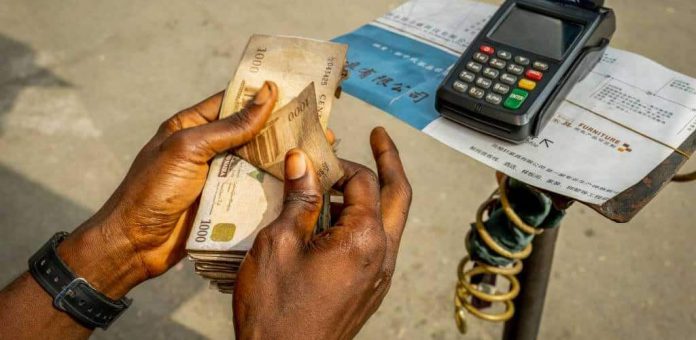
Yes, I want N10,000 and you can take N100 if you can give me this money as a POS agent.  I want to deposit N20,000, please this N500 is my fee. Magically, Naira is now a commodity where to withdraw or deposit, someone has to pay a fee. When you model that the central bank noted that more than 90% of cash in circulation is outside the banking sector, and a big chunk goes through this POS system, you will agree that it is indeed a great sector. Under that system, how do you convince a young man to start a poultry business when he can insert himself with a POS merchant in the village market to tax the citizens? 

That is financialization which is possible because Nigeria has not given banks an ultimatum to reach all local governments and wards to be called national banks, 15 years upon licensing. Because we have allowed banks to operate where they can make profits and avoid where they cannot, we then shifted the “losses” to the citizens.

If this village boy is to be a decision maker, I will give all national banks in Nigeria to be present in all local government areas. We do not want to see those huge profits when Ovim people do not have a decent banking product there!

BDC like the POS offer marginal production value and are products of a financialized Nigeria. But while POS is focusing on Naira, BDC is an international vector. Yes, BDC plays with the national currency, and with that vector, Nigeria created a business sector which can only thrive on the volatility of the Naira! So, more volatility, better gain.  (People who invented POS did it to help in payment of goods and services, not for selling and buying currencies.)

Just like that, we created Naira billionaires for doing largely nothing but get USD from the central bank and sell to the citizens! Tufiakwa! And in a system where that happens, why do you need to create a soap business or start a farming business? In other words, if volatility brings economic gains, why do you think people will not work towards creating it?

Our banks cannot be allowed to choose where they operate to declare huge profits; they should be pushed to go rural, spend the profits, but over time, they will deliver value to themselves and the economy. That will ensure we reduce the POS agent “tax” in our economy.

Also, we need to pay attention if it is time to make everything aspect of BDC operations 100% digitized. In other words, any operator receiving funds from the central bank will get it in a digital form, and the ones in airports or ports must be better regulated with higher accountability. Yet, over time, what BDCs do must be folded into what banks do.

And let me add that POS and BDC have united in Nigeria as you can also engage POS agents when doing your thing with BDCs. In those cases, Nigeria introduced two layers which offer marginal value (and remain necessary because we have not fixed foundational things).


Craig Wright did not invent Bitcoin, Satoshi Nakamoto DID

0

Bitcoin, the first decentralized digital currency, has been surrounded by mystery since its inception. The true identity of its creator, known by the pseudonym Satoshi Nakamoto, remains one of the most intriguing puzzles in the tech world. Over the years, several individuals have been speculated to be the real Satoshi, with one of the most controversial figures being Craig Steven Wright.

Wright, an Australian computer scientist and businessman, has made multiple public claims to be the main part of the team that created Bitcoin and to be the person behind the pseudonym Satoshi Nakamoto. These assertions have been met with skepticism and have been widely disputed by the media and the cryptocurrency community. The debate over Wright’s claims intensified when, in March 2024, the British High Court ruled that Wright is not Nakamoto.

The controversy around Wright’s claims is not just a matter of curiosity but also has significant legal and financial implications. In 2016, Wright was involved in a court case where he claimed to keep a cache of Bitcoin worth billions of dollars. The jury’s decision allowed Wright to retain these assets, although he was ordered to pay $100 million for intellectual property infringement to his late partner’s company.

Despite the legal battles and the claims, the crypto community has not accepted Wright as the creator of Bitcoin. Investigations and reports have raised concerns about the possibility of an elaborate hoax. The lack of conclusive evidence and the refusal to provide irrefutable proof have left many doubting Wright’s narrative.

The question of who created Bitcoin is more than just a quest for the truth about an individual’s identity. It is a reflection of the very nature of the cryptocurrency itself—decentralized, anonymous, and open-source. The ongoing debate about Wright’s claims serves as a reminder of the core values of the Bitcoin community and the importance of transparency and trust in the digital age.

A series of court rulings have cast doubt on the authenticity of documents presented by Wright to support his assertion of being Satoshi Nakamoto. A judge has described the evidence as forgeries created on a “grand scale,” undermining Wright’s claims. The Crypto Open Patent Alliance (COPA) pursued legal action to challenge Wright’s claims, seeking a negative declaration that he is not the pseudonymous author Satoshi Nakamoto.

The implications of these legal proceedings extend beyond the personal claims of Wright. They touch upon the broader principles of open-source development and the collaborative nature of the cryptocurrency community. The court’s findings affirm the community’s commitment to transparency and truth, ensuring that the foundational ethos of Bitcoin remains intact.

What is clear, however, is the enduring legacy of Bitcoin as a transformative financial technology, one that continues to evolve and inspire innovation across the globe. The debate over its origins serves as a reminder of the importance of integrity and honesty in the digital age.

As the saga continues, the crypto world watches on, waiting for the day the true Satoshi Nakamoto steps forward, or perhaps, prefers to remain forever unknown, leaving the legacy of Bitcoin to speak for itself. For now, the mystery endures, and Craig Steven Wright’s role in the history of Bitcoin remains a topic of intense discussion and speculation.

Nigerian Government Takes State Governors to Supreme Court Over Local Government Autonomy

0

In a landmark legal and political development, the Federal Government has filed a lawsuit against the 36 state governors of Nigeria at the Supreme Court, seeking to enforce full autonomy for local government councils as the third tier of government.

The Attorney General of the Federation (AGF) and Minister of Justice, Prince Lateef Fagbemi, SAN, initiated the suit, marked SC/CV/343/2024, in a bid to curtail what he describes as the unconstitutional interference by state governors in local government affairs.

The AGF is requesting the Supreme Court to issue an order prohibiting state governors from the “unilateral, arbitrary and unlawful dissolution of democratically elected local government councils.” He argues that such actions contravene constitutional provisions that guarantee local government autonomy.

The suit also calls for an order mandating that funds allocated to local governments from the Federation Account be directly channeled to them, bypassing the controversial joint accounts managed by state governors. This direct funding is seen as crucial to ensuring the financial independence and effective functioning of local governments as envisaged by the 1999 Constitution.

Additionally, the AGF seeks an order stopping governors from constituting caretaker committees to run the affairs of local governments, arguing that this practice violates the constitutionally recognized democratic councils. He also requests an injunction restraining the governors, their agents, and privies from receiving, spending, or tampering with funds released from the Federation Account for the benefit of local governments when no democratically elected local government councils are in place.

The suit is predicated on 27 grounds, emphasizing that the Nigerian Federation, created by the 1999 Constitution, recognizes federal, state, and local governments as three tiers, each drawing funds for their operations from the Federation Account. The Constitution mandates a democratically elected local government system and does not provide for any other form of governance at this level.

The AGF contends that state governors have failed to establish democratically elected local government systems, even where no state of emergency has been declared to justify the suspension of democratic institutions.

“All efforts to make the governors comply with the dictates of the 1999 Constitution in terms of putting in place a democratically elected local government system have not yielded any result,” the AGF stated. “To continue to disburse funds from the Federation Account to governors for non-existing democratically elected local governments is to undermine the sanctity of the 1999 Constitution.”

The AGF has asked the Supreme Court to invoke Sections 1, 4, 5, 7, and 14 of the Constitution to declare that state governors and state houses of assembly are obligated to ensure a democratic system at the local government level. He also seeks a declaration that governors cannot lawfully dissolve democratically elected local government councils.

While the push for local government autonomy is viewed by some as a potential catalyst for good governance, it has also sparked concerns about the risk of increased corruption. Economist Kalu Ajah provided critical insight into the historical and practical challenges of local government administration in Nigeria.

“LGAs were primarily created by the military as a way to get oil money, not to develop rural areas,” Ajah explained. “Oil cash in Nigeria is shared via LGAs, so if I want a state to get more oil money, I (as a General) arbitrarily increase the number of LGAs that state has.”

He highlighted the disparity between Kano, which has 44 LGAs, and Lagos, with a larger population but only 20 LGAs.

Ajah suggested that for local government autonomy to be effective, funding should be based on performance metrics rather than direct allocations.

“LGAs should not receive direct FAAC funds but rather grants based on the actualization of HDI goals,” he proposed. “For example, the LGA gets a direct cash payment for every child who graduates from primary education. Same for immunization or reduction in waterborne illnesses.”

He added: “Simply paying cash to LGAs because they are LGAs is the most significant waste of wealth that has occurred in Nigeria.

“You can’t reform LGAs without reforming the premise of their creation.”

The Supreme Court has scheduled the hearing of the suit for May 30, setting the stage for a landmark decision that could reshape the governance structure at the local level in Nigeria. The outcome of this legal battle will have far-reaching implications for the balance of power between the federal and state governments and the future of local governance.

This legal confrontation, which highlights the ongoing faceoff between different tiers of government in Nigeria, raises critical questions about the best ways to achieve effective and accountable local governance in the country.

Nigeria’s Letter of Credit Payments Drops by 63% in Q1 2024

0

Nigeria’s letter of credit payments has plummeted by 63% in the first quarter of 2024 compared to the same period in the previous year, according to international payments data from the Central Bank of Nigeria (CBN). 

A letter of credit (LOC) is a document issued by a bank or financial institution that guarantees a buyer will pay a seller on time and in full for goods or services. LOCs are often used in international trade to protect both buyers and sellers, and can help businesses win new clients in foreign markets

The total payments via official channels for Q1 2024 amounted to $204.47 million, a significant shortfall of $344.75 million compared to $549.22 million in Q1 2023.

This steep decline underscores the challenges the country faces in its international trade and financial transactions, reflecting broader economic difficulties emanating from foreign exchange shortages.

Payment Breakdown

In Q1 2023, January recorded payments of $107.78 million, followed by an increase in February to $171.95 million. March 2023 saw the highest payments for the quarter, totaling $269.49 million. However, the situation in Q1 2024 presents a stark contrast. January 2024 recorded significantly lower payments of $58.33 million. February saw an increase to $102.6 million, still far below the corresponding month in 2023. The trend continued downward in March 2024, with payments dropping to $43.54 million.

Other details 

A letter of credit is a mode of payment for the importation of visible goods. As requested by the customer, the bank promises in writing to pay the exporter a certain sum within a certain time frame in return for goods, provided the customer supplies the proper paperwork.

Earlier, the CBN extended the timeline for the issuance of letters of credit from 24 hours to five working days as the country continues to struggle with foreign exchange scarcity. The approved 2020 service charter of the CBN stipulated a 24-hour timeline for the issuance and management of letters of credit. 

However, the newly approved 2023 service charter extended this to five working days. This change likely reflects the ongoing difficulties in accessing foreign currency, which in turn hindered the ability of businesses to open letters of credit.

Towards the end of Q1 2024, Nigeria’s foreign exchange (FX) reserves depleted significantly. CBN Governor Yemi Cardoso explained that the decreasing reserves were primarily due to debt repayments and other standard financial obligations rather than efforts to defend the naira.

During this period, the CBN started selling dollars to Bureau De Change operators (BDCs) in February 2024 and made another sale in March but reduced the allocation by 50% and sold FX at a rate of N1,251/$1. Additionally, Nigeria spent about $1.12 billion on foreign debt service payments, marking a 39.7% increase.

Implications for the Economy

The 63% reduction in letters of credit could have several implications for Nigeria’s economy. Letters of credit are a crucial component of international trade, assuring exporters they will receive payment. A sharp decline in such payments could indicate decreased import activity, possibly due to foreign exchange shortages, stricter import regulations, or other economic constraints. 

This decline can lead to reduced availability of imported goods, impacting various sectors of the economy, including manufacturing and retail, which rely on imported materials and products.

The situation also highlights the broader economic challenges Nigeria faces, including foreign exchange scarcity, rising debt obligations, and pressures on the national currency. 

Moving forward, business leaders have noted that the ability of Nigeria to stabilize its foreign exchange reserves and improve access to international financial instruments like letters of credit will be crucial in supporting its trade and economic growth. 

The recent policy measures and economic strategies implemented by the CBN and the federal government are expected to play a vital role in addressing these challenges and fostering a more robust economic environment. 

Immutable X Price Predictions and the Potential of 5thScape – From Projections to Profits

0

The Immutable X crypto project stands out from the crowd as a promising investment option in the crypto world that goes through constant ups and downs. In this article, we provide an in-depth prediction of the IMX token’s price, giving you valuable advice if you want to invest in this project. Our analysis will help you decide whether it is a good time to invest in the IMX token or if you should hold your horses for a while and wait for the right time to invest. Additionally, we will explore another potential investment option, the 5thScape project, which has been making the rounds on the internet this year.

Can the 5thScape project, despite being a new entrant, beat the odds and become a more promising investment opportunity than Immutable X? We will explore both projects’ native token utility and understand how they differ from each other.

Unlocking the Future: A Look at Potential Price Paths for IMX

Immutable X is an NFT trading project based on Ethereum’s blockchain technology. At the moment, it is addressing issues that are typically related to traditional NFT marketplaces, which include limited scalability and high fees. The project tackles these two persisting issues with its own Layer-2 solution.

Based on our analysis, Immutable X’s price forecast is bullish, predicting a jump of 228.5% to $7.85 by June 26th, 2024. While technical indicators suggest a neutral sentiment, the Fear & Greed Index indicates Greed (74). Over the past 30 days, Immutable X has seen 15 green days, i.e. positive days (50%) with its token’s price volatility of 7.04%.

Immutable X (IMX) vs. 5thScape (5SCAPE) – Which Holds More Potential?

The Immutable X platform is focused on developing a platform designed explicitly for Web3 games. It addresses common issues in these games, such as limited player control over in-game items. With Immutable X, players can own their in-game items as real assets using NFTs (non-fungible tokens). This eliminates the frustration of losing virtual items when you stop playing a game. Its technology tackles slow transactions and high fees but faces competition from similar projects.

The IMX token service has a less-than-exciting purpose. Thiss native token of the Immutable X platform only secures the blockchain technology that the platform runs on. It is also used to reward the traders and marketplaces that support the Immutable X network.

>>Click Here to Visit 5thScape Presale Page

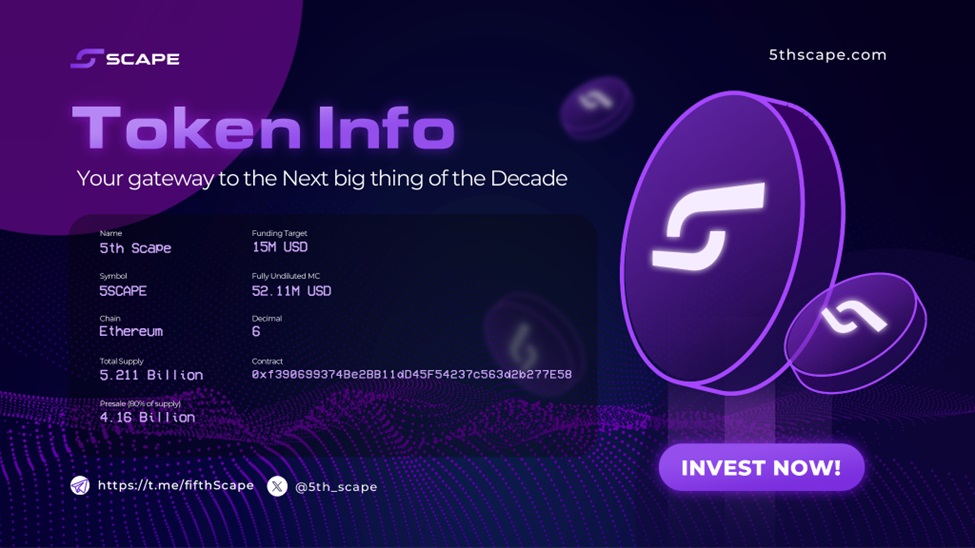
On the other hand, 5thScape has created a unique niche. It is a VR content hub that uses blockchain technology to offer a vast library of VR experiences. It has everything in an immersive setting, from movies and games to educational content. The native token of 5thScape, 5SCAPE, holds a broader use case as it is a golden ticket to explore the 5thScape’s VR universe. 5SCAPE token holders can access the vast library of 5thScape for a heavenly entertainment experience. Additionally, various staking opportunities come with this token.

So, IMX is a solid option if you are looking for a hot NFT marketplace. But if you crave unique VR experiences and want to be part of a growing VR community, the 5SCAPE token might be the more promising choice due to its platform’s established position in this innovative field.

Know 5thScape – Unlocking New Worlds: 5thScape’s Vision for VR Entertainment

As mentioned earlier, 5thScape offers a vast and ever-expanding VR library beyond games. Here, one can dive deep into immersive VR movies, educational content that makes learning engaging, and the latest addition to its library—the exhilarating Cage of Conquest MMA fighter game available on MetaQuest.

Everything within the 5thScape platform, from the content library to exciting games, requires the 5SCAPE token as your access ticket.

However, the VR experience continues. To truly feel like you have stepped into another world, 5thScape offers a range of physical VR accessories designed for seamless integration with its online platform. These include the innovative SwiftScape VR Chair for ultimate comfort and the Ultra HD VR Headset for stunningly high-resolution visuals, ensuring you are fully immersed in the virtual scene.

With VR technology rapidly setting its foothold across multiple markets, 5thScape’s comprehensive VR experience positions it as a leader. This makes it a dream destination for VR enthusiasts. With a continuously growing user base, the value of the 5SCAPE token, which fuels this entire ecosystem, is likely to increase, matching the unparalleled growth of VR technology.

Why 5thScape (5SCAPE) Might Be a Bolder Investment Than Immutable X (IMX)

While Immutable X (IMX) offers a compelling solution for NFT ownership in web3 games, 5thScape (5SCAPE) presents a potentially more groundbreaking opportunity. Here’s a breakdown of why 5thScape might be the stronger investment!

The key difference lies in market position. Immutable X faces competition from a growing pool of similar NFT marketplaces.  5thScape, however, carves a unique niche in the booming VR entertainment market. Its VR content hub offers a vast library of experiences (movies, games, education), while Immutable X limits itself to NFT content.

Furthermore, the adoption of Virtual Reality (VR) technology is rapidly increasing, driving user growth for platforms like 5thScape. This expanding user base creates a strong foundation for the 5SCAPE token’s value. Although the NFT market holds promise, its long-term trajectory remains to be seen.

The utility of the tokens also differs. The IMX token facilitates NFT trading on the Immutable X platform. The 5SCAPE token, however, serves as a gateway to the entire 5thScape ecosystem. Users need 5SCAPE to access the VR content library, creating direct demand for the token and potentially driving its value.

Finally, 5thScape is a leader in VR content built on blockchain. This first-mover advantage could solidify its position in developing VR entertainment, attracting users and developers before competitors catch up.

Final Thoughts on 5thScape – A Promising Player in VR

While Immutable X offers a promising solution for NFT ownership in web3 games, with our analysis suggesting a potential price surge, 5thScape might be a more future-proof option for savvy investors. Unlike IMX, which faces competition in the crowded NFT marketplace, 5thScape has created its prime position in the rapidly growing VR entertainment sector. Its diverse VR library offers experiences beyond games, creating a distinct value proposition.

Not to mention, the adoption of VR technology is skyrocketing, driving user bases for platforms like 5thScape. This expanding user base creates a strong foundation for the 5SCAPE token’s value, potentially surpassing the long-term trajectory of the NFT market. Additionally, the IMX token primarily facilitates NFT trading, whereas the 5SCAPE token acts as a gateway to the entire 5thScape ecosystem. It serves more utility than the IMX token.

Ultimately, both IMX and 5thScape represent exciting ventures with significant potential. IMX offers a familiar NFT solution with a chance of high returns, while 5thScape presents a lucrative opportunity in the surging VR entertainment space.

Further fueling its appeal, 5SCAPE has witnessed a massive price increase since its first presale round, reflecting growing demand for the token. This momentum suggests a strong debut on exchanges, making it one to watch for long-term investors.