DD
MM
YYYY

PAGES

DD
MM
YYYY

spot_img

PAGES

Home Blog Page 3486

Gambaryan Denies Being Binance’s Agent in Nigeria as Binance Establishes its first Board of Directors

0

The scheduled arraignment of a Binance executive has been postponed, marking a significant development in the ongoing legal proceedings involving the global cryptocurrency platform. The Economic and Financial Crimes Commission (EFCC) was unable to proceed with the arraignment of Tigran Gambaryan, who has denied being an agent for Binance. This case has drawn considerable attention due to the implications it holds for the cryptocurrency industry and regulatory practices.

The EFCC’s inability to arraign Gambaryan has raised questions about the complexities of cross-border regulatory enforcement and the challenges faced by national agencies in prosecuting cases within the rapidly evolving digital currency space. The postponement of the arraignment to April 8 indicates the legal intricacies and procedural hurdles that can arise in such high-profile cases.

Gambaryan’s denial of his role as an agent for Binance adds another layer to the narrative, suggesting potential disputes over jurisdictional authority and the interpretation of international law. The situation underscores the need for clear regulatory frameworks and international cooperation in overseeing cryptocurrency operations, which often transcend national boundaries.

The case against Binance and its officials, including Gambaryan, revolves around allegations of money laundering and tax evasion. These are serious charges that reflect the broader concerns of governments worldwide as they grapple with the integration of cryptocurrency markets into their legal and financial systems.

Consequently, Binance has taken a significant step towards strengthening its corporate governance by establishing its first board of directors. This move comes at a pivotal moment for the company, which has faced intense scrutiny from regulators worldwide.

The newly appointed board is chaired by Gabriel Abed, who brings a wealth of experience as Barbados’ former ambassador to the United Arab Emirates. The board comprises a mix of Binance executives and independent members, reflecting a blend of insider knowledge and external perspectives.

This strategic decision by Binance could be seen as an effort to enhance its regulatory compliance and operational transparency. The formation of a board is a common practice in the corporate world, signaling a maturation of the company’s governance structures. It is particularly noteworthy for a decentralized entity like Binance, which has operated without a formal board since its inception.

Despite this significant development, Binance continues to operate without a global headquarters. This unconventional approach aligns with the borderless nature of cryptocurrency but has raised questions about regulatory oversight and operational jurisdiction. The lack of a physical headquarters has been a point of contention with regulators, who often seek a central point of accountability.

The establishment of the board is expected to provide a more structured governance framework, which could help Binance navigate the complex regulatory landscape of the cryptocurrency market. With the appointment of seasoned professionals and industry experts, the board is poised to guide the company through its next phase of growth and development.

As the cryptocurrency market continues to evolve, Binance’s decision to form a board of directors may set a precedent for other companies in the space. It reflects a growing recognition of the need for robust governance mechanisms in the decentralized finance (DeFi) sector. This development could mark the beginning of a new era for Binance and the broader cryptocurrency industry, one where increased accountability and transparency become the norm.

As the world watches how this case unfolds, it serves as a reminder of the delicate balance that must be struck between innovation in the financial sector and the enforcement of laws designed to protect the integrity of economic systems and prevent illicit activities. The outcome of this case could have far-reaching consequences for the cryptocurrency industry, potentially influencing future regulatory approaches and the operational practices of platforms like Binance.

For now, the postponement of the arraignment is a pivotal moment, providing all parties involved with additional time to prepare their cases and strategies. It also offers an opportunity for reflection on the part of regulators, industry participants, and observers alike on the best path forward in navigating the complex intersection of technology, finance, and law.

PayPal Customers in United States will be able to process International Payments

1

In a significant move for the financial technology industry, PayPal has announced the introduction of a service that will allow U.S. customers to utilize a stablecoin, specifically the company’s PYUSD, for international payments. This development is poised to revolutionize the way cross-border transactions are conducted, offering a seamless and cost-effective alternative to traditional methods.

Stablecoins, digital currencies pegged to stable assets like the U.S. dollar, have emerged as a promising solution to the volatility often associated with cryptocurrencies. PayPal’s PYUSD, fully backed by U.S. dollar deposits and short-term U.S. treasuries, provides a reliable and transparent medium for international money transfers. The integration of PYUSD into PayPal’s existing international payments service, Xoom, enables users to convert PYUSD to USD and send funds to recipients in approximately 160 countries without incurring transaction fees.

This initiative by PayPal reflects a broader trend in the financial sector towards embracing digital currencies and blockchain technology. By leveraging the stability and efficiency of stablecoins, PayPal aims to reduce the global average cost of sending money internationally, which, according to a World Bank report, stands at just over 6% for a $200 transaction. The move is not only a testament to PayPal’s innovative spirit but also aligns with the company’s goal of driving mainstream adoption of cryptocurrencies.

PayPal’s foray into stablecoin-based international payments is a response to the growing demand for digital currency solutions that can offer both security and convenience. The PYUSD stablecoin, launched last year, is designed to bridge the gap between fiat and digital currencies, providing a stable instrument that is both digitally native and easily connected to fiat currency like the U.S. dollar.

As an ERC-20 token issued on the Ethereum blockchain, PayPal USD (PYUSD) is accessible to a vast community of external developers, wallets, and web3 applications. It can be easily adopted by exchanges and deployed to power experiences within the PayPal ecosystem. The stablecoin is set to reduce friction for in-experience payments in virtual environments, facilitate fast value transfers, support remittances, and enable direct flows to developers and creators.

PayPal’s strategic move into stablecoin-based international payments is indicative of the company’s commitment to responsible innovation and compliance. It also underscores the potential of fully backed, regulated stablecoins to transform payments in web3 and digitally native environments. As the stablecoin market heats up, PayPal’s initiative could very well set a new standard for international money transfers, making them more accessible, efficient, and cost-effective for users around the globe.

World’s First DAG-Chain, BlockDAG Raises $13.2m Presale & 20,000x ROI Potential Beyond TRX and EOS Gains

0

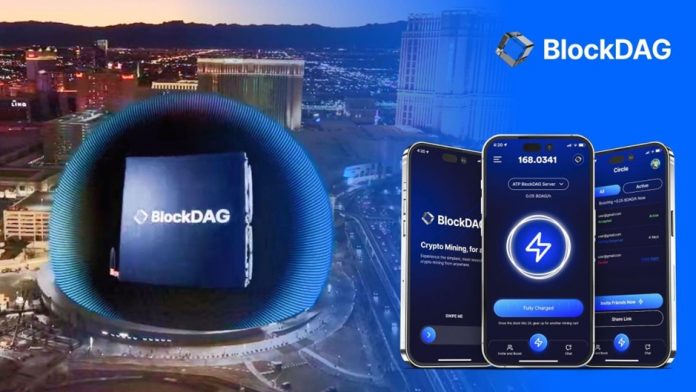
BlockDAG, the world’s first DAG-chain, has made an incredible entrance into the crypto sphere, raising an impressive $13.2 million in its presale. This feat shows strong investor confidence and market interest. The pioneering platform is setting a new standard with its audacious promise of a 20,000x return on investment, casting a long shadow over the gains of well-known cryptocurrencies like TRX and EOS.

As BlockDAG charts a course into unexplored territories of blockchain technology, its unique approach and bold financial projections position it as a beacon for future-oriented investors, redefining expectations and possibilities in the cryptocurrency arena.

TRX’s Resilience Amidst Bearish Trends

Amid a broader downturn in the crypto sphere, Tron (TRX) has demonstrated resilience despite its trajectory being marred by a bearish trend. Over the past month, TRX has experienced a notable decline of approximately 13.79%, with its current trading value standing at $0.1213 and a market capitalization of $10.6 billion, securing its position as the 16th largest cryptocurrency.

A noteworthy aspect of Tron’s strategy lies in its deflationary monetary policy, evidenced by the recent incineration of over 9.6 million TRX tokens, which aims to augment the currency’s scarcity and potential value. Despite navigating technical obstacles amidst bearish conditions, Tron sustains trader interest, with its market direction contingent on resistance levels and broader trends.

Deciphering EOS Crypto’s Price Volatility

EOS crypto finds itself in a pivotal phase, grappling with the prospects of both gains and setbacks. The cryptocurrency’s value has exhibited fluctuations, with an observable intraday dip to $1.0922. Technical indicators hint at a bearish outlook, as both the MACD and RSI signal diminished momentum, potentially paving the way for further price declines.

EOS faces challenges in surmounting resistance at $1.35, raising apprehensions regarding its ability to stage a rebound. However, a shift in market sentiment could propel EOS beyond these obstacles towards the coveted thresholds of $1.350 and $1.500, spotlighting its pivotal position amidst prevailing market trends and investor sentiments.

Envisioning a $10 Valuation: BlockDAG’s Ascent and 20,000x ROI Prospect

BlockDAG, an innovator in blockchain evolution, promises more than just revolutionary technology; it presents an unparalleled opportunity for investors seeking exponential returns. With the recent launch of its whitepaper v2, BlockDAG introduces a game-changing solution boasting unparalleled security, scalability, and efficiency in micropayments.

Leveraging a protocol employing a Directed Acyclic Graph (DAG) for block arrangement, BlockDAG enhances transaction capacity and throughput, fueling its upward trajectory. Projections indicate a remarkable ascent to $10 by 2025, with the real allure lying in its potential ROI, forecasted to reach a staggering 20,000x return on investment. Moreover, the BlockDAG crypto payment card epitomises the convergence of top-trending crypto technologies with everyday financial transactions, facilitating seamless conversion from cryptocurrency to fiat and exemplifying a significant stride towards mainstream adoption of digital currencies.

BlockDAG defies expectations, surpassing an impressive presale milestone of $13.2 million and distributing 6.4 billion coins, all while promising an astounding 20,000x potential. Priced attractively at $0.0035 per coin in batch 7, BlockDAG entices investors with lucrative returns and revolutionises income diversification and mining experiences. With over 4319 miners sold, BlockDAG solidifies its position as a leading bullish crypto, poised to reshape the cryptocurrency landscape.

The Last Call

As TRX and EOS contend with market dynamics, BlockDAG emerges as the trending crypto with innovative potential amidst uncertainty. With unparalleled security, scalability, and the promise of an extraordinary 20,000x ROI, BlockDAG leads the charge towards a decentralised future and gains momentum with its recent whitepaper launch. Positioned to redefine the crypto landscape, BlockDAG offers investors a transformative journey into digital finance.


Invest In BlockDAG

Website: https://blockdag.network

Presale: https://purchase.blockdag.network

Telegram: https://t.me/blockDAGnetworkOfficial

Apple to Lay Off Over 600 Employees Due to Scrapped EV Project

0
An Apple logo is seen at the entrance of an Apple Store in downtown Brussels, Belgium March 10, 2016. REUTERS/Yves Herman/File Photo

American multinational corporation and technology company Apple, has reportedly announced plans to cut more than 600 jobs after it abandoned its electric vehicle (EV) project.

According to a filing report with the state of California titled “Worker Adjustment and Retraining Notification”, 614 employees were notified in March that they would lose their jobs, effective May 27, 2024.

Part of the filing reads,

WARN protects employees, their families, and communities by requiring employers to give a 60-day notice to the affected employees and both state and local representatives before a plant closing or mass layoff. Advance notice provides employees and their families time to transition and adjust to the potential loss of employment, time to seek alternative jobs and, if necessary, time to obtain skills training or retraining to successfully compete in the job market.”

The recent job cuts at Apple is coming after the company had avoided mass layoffs in recent years, unlike other firms which have cut hundreds of thousands of jobs since the pandemic. Recall that in May last year, Apple’s boss Tim Cook told CNBC that layoffs would be a last resort.

Although the filing did not specify which projects the laid-off employees were working on, Bloomberg reports that most of the affected employees were working at buildings related to its canceled car projects, while others were working at a facility for its next-generation screen development.

The filing comes weeks after Apple canceled a long running project to build an electric vehicles in a team called the special projects group. In a decision that stunned both employees and industry observers, Apple Inc. announced the termination of its decade-long pursuit to develop an electric car, a project dubbed Project Titan, signaling the end of one of the company’s most ambitious endeavors to date.

Reports of Apple’s ambition to build a car first surfaced in 2014 after the company recruited automotive engineers and other talent from auto companies. While there was little public information about Apple’s plans, the company operated a program with autonomous Apple-owned cars equipped with sensors and safety drivers cruising around the San Francisco Bay/Area.

Apple’s car project was part of an internal effort to look for technologies the company could develop with huge potential markets, as some of its smartphone rivals have also invested heavily in car manufacturing.

For instance, Xiaomi, the third-largest seller of smartphones worldwide in February, unveiled its long-awaited electric vehicle, as it bets big on sales, targeting 20 million users.

Apple’s decision to abandon the project comes at a time when major automakers are reevaluating their investments in electric vehicles, and amid increased scrutiny on autonomous vehicle projects.

The Cupertino giant entry into the automotive industry was also seen as a possible boon to its bottorn line, giving it a new source of revenue to help bolster agajrist stagnating hardware sales and regulatory threats to its services business.

In a brutal quarter for the tech industry, Apple has just become the latest company to carry out layoffs. More than 600 employees in California are being affected by the tech giant’s first major cut since the pandemic, according to state filings. A number of the affected workers appear to have been assigned to the recently nixed Apple screen and car projects, Bloomberg reports. Many tech companies have been slashing their workforces after going on hiring sprees during the pandemic; earlier this week, Amazon announced hundreds of cuts in its cloud computing division.

Nvidia to Establish $200m AI Center in Indonesia Amid Southeast Asia Expansion

0

American multinational technology corporation Nvidia, has unveiled plans to establish a $200 million Artificial Intelligence (AI) Center in Indonesia.

The AI-focused tech company’s presence in Indonesia, signals a broader push into Southeast Asia, driven by the increasing demand for data, fueled by the region’s expanding digital economy.

According to Indonesia’s communication minister Budi Arie Setiadi, he disclosed that Nvidia will partner with telecommunications firm Indosat Ooredoo Hutchison for the project, which is expected to bolster local telecommunications infrastructure and digital talent.

Last month, Indosat announced it was ready to integrate Nvidia’s Blackwell GPU architecture into its infrastructure to propel Indonesia into a brand-new era of sovereign artificial intelligence (AI) and technological advancement.

Vikram Sinha, President Director and Chief Executive Officer of Indosat Ooredoo Hutchison, stated that the integration of Nvidia Blackwell products into its infrastructure underscores the company’s commitment to technological advancement and national sovereignty.

With Nvidia’s latest plan to establish a $200 million AI Center in Indonesia, the tech giant has continued to deepen its presence in SouthEast Asia with strategic partnerships, signaling a significant investment in the region’s burgeoning tech landscape.

In February 2024, Singtel a Singapore Telecommunications company, collaborated with NVIDIA to deploy artificial intelligence capabilities in its data centers across Southeast Asia.

Singtel disclosed that the initiative would provide businesses in the region with access to Nvidia’s cutting-edge AI computing power this year, without the need for clients to invest in and manage their own expensive data center infrastructure.

Notably, Southeast Asia has proven to be a major revenue driver for Nvidia. A U.S. Securities and Exchange Commission filing last year showed that about 15% or $2.7 billion of the company’s revenue for the quarter ended October came from Singapore.

In 2023, a report revealed that Singapore accounted for a whopping 15% ($ 2.7 billion) of Nvidia’s revenue for the third quarter (Q3) of 2023, which ended in October. Revenue from the island country in SouthEast Asia, in the third quarter, soared by 404%, from the $562 million in revenue recorded in the same period a year ago.

Singapore trailed behind the United States (34.77%), Taiwan (23.91%), and China (22.24%) in Nvidia’s third-quarter sales rankings.

In Southeast Asia specifically, spending on AI solutions is predicted to increase from US$174 million in 2022 to US$646 million in 2026. The market for this tech is projected to have an annual growth rate of 40.8% from 2021 to 2026.

The adoption of AI platforms in the region is primarily driven by the need to improve employee productivity, accelerate new product introductions, and enhance risk management capabilities.