DD
MM
YYYY

PAGES

DD
MM
YYYY

spot_img

PAGES

Home Blog Page 3490

A (Web 3) content ‘wish list’. My appeal to ‘Content Creators’ for 2024.

0

I am not the world.

Whether my readership matters to content creators is subject to many variables. So what I am writing about here is a ‘wish list’ for 2024. It isn’t a ‘demand’

I am not in a position to make demands.

But here, I am outlining the things I wish can change in web 3 (Social Media Based) content creation in 2024:

Advice to new enthusiasts trying to ‘preach’ what Blockchain, Web3, NFTs, Metaverse (Non Exhaustive List) are.

The volume of products intending to market as ‘Web3’ began to scale from 2020, so we are now close to four years down the road. While there are always new people ‘coming of age’, the mass ‘listening’ market has already become educated, with only the residual technophobe component, gaining awareness more slowly.

People relatively new to writing in the space should avoid these topics, unless they are practicing engineers, technical product owners, project managers, product technical writers, or are a seasoned migrant from some other aspect of industrial journalism.

There are way too many people nuanced in the technicalities and nomenclature, who, while they don’t always agree, are often very strong on the facts that support their perceptions of ecosystem models.

Those not wishing to suffer from Imposter Syndrome should not write like Imposters.

Instead, better to ‘shadow author’ news content from the Apex online crypto ‘rags’, focusing on business and market aspects rather than defining technical fundamentals, and allow the primary content to do the ‘heavy lifting’

I expect greater things from experienced content creators in 2024 – 

In the online world, editorial content hardly exists any more. ‘Advertorial’ seems to rule, and all the best things in Web 3 that are happening are never going to get enough exposure, because the Apex virtual ‘rags’ will only print what they get paid to print.

What I can’t understand is why freelance unpaid social media content creators frequently just summarise or plagiarize what those ‘rags’ carry though…

It isn’t the web3 news for the week, or breaking news because those apex rags say it is… they’ve been paid for that.

I spend about 20 minutes every day reading what the rags have to say, so its not helping me when others regurgitate it.

By echoing the Apex rags, platform based voices are just adding extra volume to what those rags got paid to do, and getting nothing in return besides some modest SM metrics.

If serious content creators want to grow notoriety in online platforms, they would be better unearthing rough diamond content and be their sole voice.

Tell more of the stories that completely fly under Cointelegraph or Decrypt radar , and I will be happier.

Adopt the Web 3.0 approach to personality coverage.

In the eras leading up to the data ‘Silos’ – (Google, MS, Apple, X, Amazon, Meta etc), unless there was something really bad that happened, as personalities, big business people were never ‘news’. Years could go by with no mention of the CEO from Chevrolet, United Biscuits, Citi Bank, British Steel, TATA or Bharti Airtel.

Then the age of the Silos came, and whether it be Gates, Bezos, Musk, Zuck, Ma, Jobs and many others, if they scratched their nose, somebody wrote about it.

Then Web 3 came, and the start of that was undoubtedly Bitcoin, still the largest market cap cryptocurrency by some margin.

Not only did Bitcoin lay down a marker for the whole industry to follow, it’s founder, Satoshi Nakamoto also set down a marker for a new approach to media coverage of Web 3.0 personalities.

From all the coverage of SBF, Changpeng Zhao, and pseudo counterparts like Gary Gensler, Elizabeth Warren and Christine Lagarde , we would be excused for thinking we have awoken from a dream in which the phrase ‘web3’ was mentioned and now it is the cold light of day.

Cryptowriters need to move with the times. Just as the volume of news covering Satoshi Nakamoto so should be the coverage of lesser mortals  – ‘Less is more’

Crypto writers talk about ‘Silo’ platforms more than they talk about Web 3 ones.

Web 3.0 is intended to promote a decentralized internet where users should have greater control and ownership over their data, yet crypto journalists are clinging to the SM Silos with dear life.

It should go without saying then, that if someone claims to be a web 3 content creator, they should be an advocate for it as well.

It shouldn’t be ‘Heck yeah, I’ll write about it cos I can’t think of anything better to do, but yeh don’t really expect me to believe in it, do you?’

So you would expect web3 journalists, to be early adopters… to be the ones that go there first, long before mainstream adoption.

There are many Web 3 platforms out there.

Mastodon, Entre, Audius, Minds, Diamond App, Chingari, DTube, Twetch, Akasha, and Diaspora are just a sample.

But I see when so called Web 3 ‘content creators’ create polls here, they will feature Silo Platforms like LinkedIn, X, and maybe Instagram, Threads, Facebook, Telegram or Tik Tok…

They will hardly even mention the ‘half way house’ – Discord.

How can anybody claim to be a Web 3 content creator and not recognise that ANY… NOT EVEN ONE… Web 3 Social Media platform exists when doing a poll? Content creators are expected to be at the forefront of raising awareness in their field, not following what others are doing.

Binary Arguments, Thesis, or Comparisons

I hope to see less binary arguments in 2024

‘Those of us in the technology community, sit in the midst of a conflict between our binary heritage and a relativistic world we partly helped to create. As such, we have a responsibility to avoid letting the increasingly complex discussions about the impact of the digital revolution become one of comparing extremes. Our binary underpinning has shown, through the huge diversity of the way technology is used, that this is a world composed of shades of grey, not simply of black and white.

We see examples of this every day. “Is social media a good thing or a bad thing?”… It’s the same with artificial intelligence, with big data, with the impact of mobile phones on children. In Einstein’s shadow, technology has enabled almost infinite nuance, yet it is so often reduced to existing on opposing ends of what is in reality a spectrum.’ – Bryan Glick

Bitcoin v $USD

LinkedIn v X

EVM Compatible Networks v Solana

Too much binary.

Hopefully 2024 will see Content creators approach Web3 with more spectrum level comparisons. A horse race has to be more than two horses!

So – Writers for Web 3 and Crypto please listen to my wishes!

9ja Cosmos is here…

Get your .9jacom and .9javerse Web 3 domains  for $2 at:

.9jacom Domains

.9javerse Domains

Visit 9ja Cosmos LinkedIn Page

Visit 9ja Cosmos Website

Preview our Sino Amazon/Sinosignia releases

Dogecoin (DOGE) price leads holders to switch to Solana (SOL) and Everlodge (ELDG) ahead of bull market

0

Despite crypto market growth slowing down, Dogecoin’s value has remained relatively strong. The project’s value has increased by 17.70% in the last 30 days, and now Dogecoin could rise to $0.1. However, further analysis shows that the project could be in trouble. Dogecoin miners are selling their reserves, and whales are turning their Dogecoin into fiat. As a result, holders are now switching to Solana and Everlodge, which are expected to offer better returns.

Could Miner Action Be Bad News For Dogecoin?

At the time of writing, Dogecoin was trading at $0.09238. Its daily trading volume was half a billion, and most indicators look strong. However, miner activity suggests that Dogecoin growth may have peaked for 2023.

Recent data from IntoTheBlock indicates that Dogecoin miners have been offloading their reserves. In total, over 240 million DOGE (around $25 million) has been sold. According to analysts, this suggests that miners could be selling to cash out at Dogecoin’s peak. Further data on crypto whales shows that $41.5 million worth of DOGE was sold for fiat, implying that Dogecoin’s recent bull run could be ending.

Solana Bull Run Continues To Shock The Market

Solana was one of the best-performing cryptocurrencies in Q4. Its value increased by over 270%, and Solana’s daily trading volume has consistently passed over 2 billion. With its current trajectory remaining bullish, experts believe that Solana could continue to rise throughout December.

Solana recently hit a yearly high of $79.6, though has since declined slightly to $74.90. Despite this decrease, Solana is still up by 25% over the last month, and as a result, the altcoin remains extremely popular.

However, further chart analysis suggests that Solana could soon face a correction. Daily price movement shows that Solana is stuck between two converging trendlines. This rising wedge pattern often triggers a price rally before a correction. As a result, investors who buy soon may still be able to profit before Solana’s value declines.

Everlodge Could Challenge Top Altcoins In 2024

As confidence in Dogecoin falls, investors are looking for new ways to grow their portfolios. One new project that offers a number of opportunities is Everlodge. This exciting new altcoin is on track to offer returns of 280% during its presale, and experts believe its value could rise up to 35x upon release.

Everlodge is a unique project that lets investors buy equity in travel properties. This market is currently difficult to penetrate, being surrounded by red tape, high start-up costs, and location limitations. Everlodge removes all of these barriers.

Instead of using traditional routes, investors can sign up to Everlodge, search for properties they like, and start investing. For each investment they make, users will buy an NFT representing equity in a property. They will generate an income based on how much they own, in addition to how much the property makes. For example, if they own 20% of a luxury villa that makes $10,000 a month, the investor will generate $2,000 monthly.

Though not yet released, Everlodge has received significant attention from investors, and experts believe it could revolutionize one of the world’s largest industries. In addition to its marketplace, Everlodge will also offer a launchpad for property developments, as well as a private members club and free stays at properties for ELDG token holders.

This diverse world of opportunity is on track to become a big hit in 2024. Currently, ELDG tokens can be purchased for just $0.027, though will soon increase to $0.029 as stage eight of the Everlodge presale sells out.

Visit Everlodge

South Korea is Making crypto and Other Asset Holdings of Public Officials Available

0

The public will soon have access to the crypto and other asset holdings of nearly 6,000 public officials in South Korea, thanks to a new law that aims to enhance transparency and accountability.

The law, which was passed by the National Assembly in October, requires public officials above a certain rank to disclose their assets, including cryptocurrencies, stocks, bonds, real estate and other valuable items. The law also imposes penalties for false or incomplete disclosures, such as fines, dismissal or imprisonment.

The main purpose of the law is to prevent corruption and conflicts of interest among public officials, especially those who are involved in policymaking or supervision of the financial sector. The law also reflects the growing importance of cryptocurrencies in South Korea, which has one of the largest crypto markets in the world.

According to a recent survey by the Korea Institute of Public Finance, about 10% of South Koreans own some form of cryptocurrency, and the average amount held by each individual is about $6,000.

The law is expected to take effect in March 2024, after a six-month grace period for public officials to prepare their disclosures. The disclosures will be made available to the public through an online portal operated by the Anti-Corruption and Civil Rights Commission.

The public will be able to search for the asset holdings of specific public officials or browse by categories such as agency, rank or type of asset. The public will also be able to report any suspected violations or discrepancies through the portal.

One of the key features of the law is the strict enforcement of the disclosure requirements and the sanctions for non-compliance. According to the law, public officials who fail to disclose their assets or provide false or misleading information will face fines ranging from 10 million won ($8,400) to 100 million won ($84,000), depending on the value of the undisclosed assets.

In addition, public officials who intentionally conceal or transfer their assets to evade disclosure will face dismissal from their positions or imprisonment for up to five years.

The law specifies how the penalties will be imposed and enforced by different authorities depending on the type and level of public officials. For example, the president, prime minister, ministers and heads of central administrative agencies will be subject to the review and decision of the Anti-Corruption and Civil Rights Commission.

The members of the National Assembly will be subject to the review and decision of the Ethics Committee of the National Assembly. The judges and prosecutors will be subject to the review and decision of their respective disciplinary committees. The local government heads and council members will be subject to the review and decision of their respective audit committees.

The law has been welcomed by many civil society groups and experts as a positive step towards improving transparency and trust in the public sector. However, some critics have raised concerns about the potential risks of exposing personal information and violating privacy rights of public officials.

Some also argue that the law may not be effective in curbing corruption, as some public officials may find ways to hide or transfer their assets to avoid disclosure. Therefore, it is important that the law is implemented and enforced properly, and that the public uses the information responsibly and constructively.

Barry Silbert resigns as Grayscale chairman amid MicroStrategy acquiring 14,620 additional Bitcoins

0

Barry Silbert, the founder and CEO of Digital Currency Group (DCG), has announced his decision to step down as the chairman of Grayscale Investments, the largest digital asset manager in the world. Silbert will remain as the CEO of DCG, which is the parent company of Grayscale and other crypto-related businesses.

Silbert’s resignation comes at a critical time for Grayscale, as the U.S. Securities and Exchange Commission (SEC) is expected to make a ruling on its application for a spot Bitcoin ETF in the coming weeks. Grayscale has been trying to convert its flagship product, the Grayscale Bitcoin Trust (GBTC), into an ETF since 2016, but has faced regulatory hurdles and competition from other ETF providers.

In a blog post, Silbert said that he was leaving the chairmanship role to focus on his vision for DCG and to support Grayscale’s new leadership team. He also expressed his confidence in Grayscale’s future and its ability to offer innovative products and services to investors.

“I am incredibly proud of what we have built at Grayscale and the role we have played in bringing digital assets to the mainstream. I have full faith in the Grayscale team and their ability to execute on our mission of increasing access and exposure to this emerging asset class,” Silbert wrote.

He added that he will continue to be involved in Grayscale’s strategic direction and will remain as a board member and a shareholder. He also thanked the Grayscale community for their trust and support over the years.

Silbert’s successor as the chairman of Grayscale will be Michael Sonnenshein, who has been the CEO of Grayscale since January 2021. Sonnenshein has been with Grayscale since 2014 and has played a key role in growing its assets under management from $60 million to over $50 billion.

Sonnenshein said that he was honored to take on the chairmanship role and praised Silbert for his vision and leadership. He also said that he was looking forward to working with Silbert and the rest of the DCG team to advance the adoption of digital assets.

“Barry is a pioneer and a visionary in the digital asset space, and I am grateful for his mentorship and guidance over the years. He has built an incredible legacy at Grayscale and DCG, and I am excited to continue working with him to bring more innovation and value to our industry,” Sonnenshein said.

MicroStrategy buys additionally 14,620 BTC.

MicroStrategy, a leading business intelligence and software company, announced today that it has purchased 14,620 more bitcoins for approximately $615.7 million in cash. The company said that the average price of the acquired bitcoins was $42,110 per coin, inclusive of fees and expenses.

This latest acquisition brings MicroStrategy’s total holdings of bitcoin to 142,054 bitcoins, which it bought for $3.16 billion at an average price of $22,268 per bitcoin. The company has been one of the most vocal and active proponents of bitcoin as a store of value and a hedge against inflation.

In a press release, MicroStrategy’s CEO Michael Saylor said: “We continue to believe that bitcoin is the world’s best and most widely adopted digital asset. The acquisition of additional bitcoins announced today reaffirms our belief in the long-term potential of the bitcoin network and its ability to serve as a reliable store of value for investors and corporations around the globe.”

MicroStrategy also revealed that it intends to sell up to $1 billion worth of its class A common stock from time to time to raise additional funds for buying more bitcoins. The company said that it will use the net proceeds from the stock offering for general corporate purposes, including the acquisition of additional bitcoins.

The company’s aggressive strategy of accumulating bitcoins has attracted both praise and criticism from the crypto community and the wider market. Some analysts have applauded MicroStrategy for its visionary and bold move to embrace bitcoin as a superior asset class, while others have questioned its risk management and diversification policies.

MicroStrategy’s stock price has closely followed the fluctuations of bitcoin’s price in recent months, as investors see the company as a proxy for gaining exposure to the cryptocurrency. As of December 27, 2023, MicroStrategy’s stock was trading at $1,234.56, up 12.34% from the previous day. Bitcoin’s price was also up 10.45% at $44,567.89, according to CoinMarketCap.

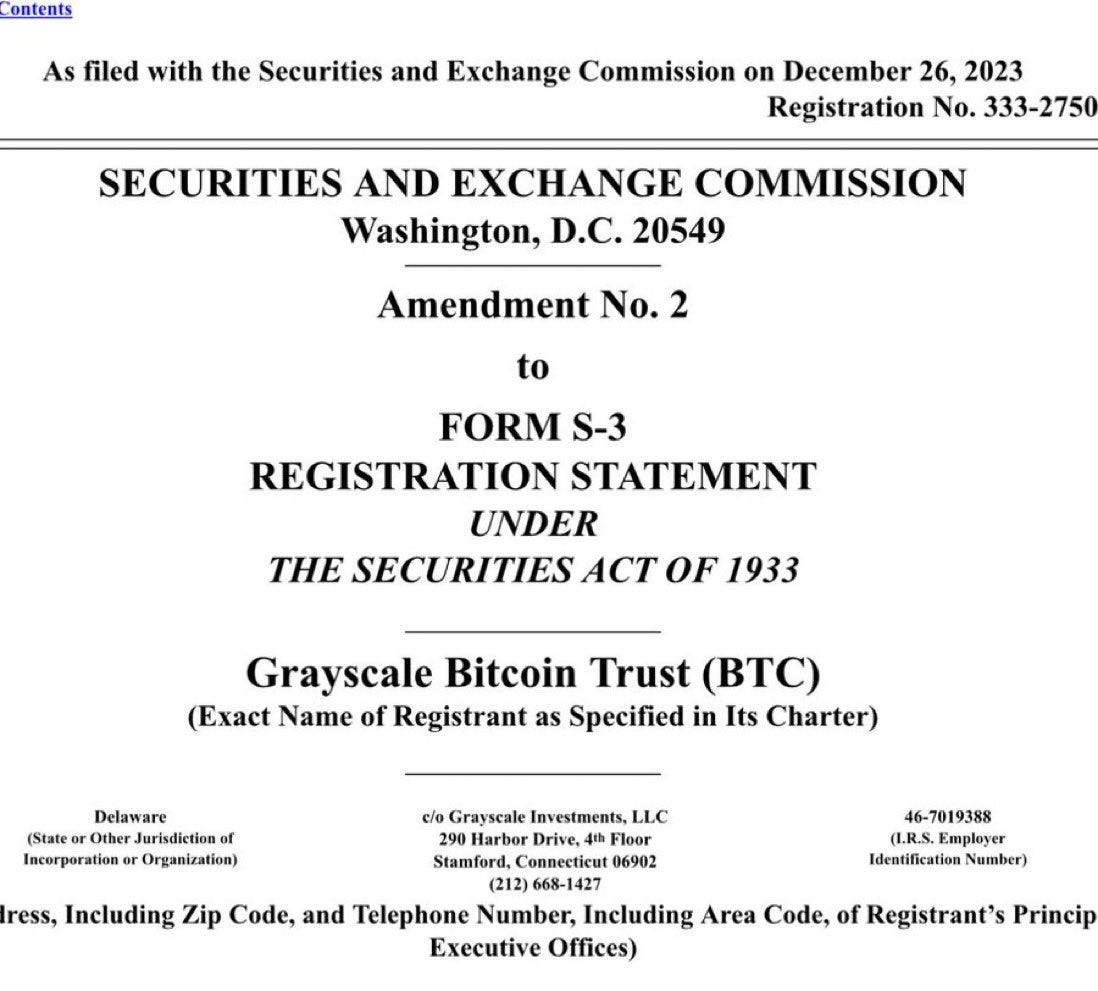
Grayscale just filed another update to its Bitcoin ETF application S-3

Meanwhile, Grayscale, the world’s largest digital asset manager, has submitted another update to its Bitcoin ETF application with the U.S. Securities and Exchange Commission (SEC). The latest filing, dated December 22, 2023, is an amendment to the Form S-3 registration statement that Grayscale initially filed in March 2023.

The amendment includes several changes to the proposed Bitcoin ETF, such as:

Updating the name of the fund from Grayscale Bitcoin Trust (GBTC) to Grayscale Bitcoin ETF (GBTC-ETF). Adding a new section on the risks associated with investing in the fund, such as market volatility, regulatory uncertainty, cyberattacks, and tax implications. Providing more details on the fund’s investment objective, strategy, fees, expenses, and performance history.

Clarifying that the fund will use a third-party custodian to hold its bitcoin assets and that the custodian will be subject to periodic audits by an independent auditor. Stating that the fund will seek to track the performance of the Bloomberg Galaxy Bitcoin Index (BGCI), a market capitalization-weighted index that measures the performance of bitcoin across various trading venues.

Explaining that the fund will trade on the NYSE Arca exchange under the ticker symbol GBTC-ETF and that its shares will be redeemable for bitcoin at the end of each trading day.

Grayscale’s latest filing comes amid growing anticipation for a Bitcoin ETF approval in the U.S., as several other firms have also submitted their applications to the SEC. However, the regulator has yet to approve any Bitcoin ETFs, citing concerns over market manipulation, investor protection, and valuation.

Grayscale’s CEO Michael Sonnenshein said in a statement that the firm is “committed to converting GBTC into an ETF” and that it is “working closely with regulators and our service providers to prepare for this important milestone”. He added that Grayscale believes that a Bitcoin ETF “will provide investors with greater access, transparency, and liquidity” in the bitcoin market.

Grayscale currently manages over $40 billion in assets across its various crypto products, with GBTC being its flagship offering. GBTC holds over 650,000 bitcoins, representing more than 3% of the total supply. GBTC shares trade at a premium or discount to the net asset value (NAV) of the underlying bitcoin, depending on the supply and demand dynamics in the market.

A Bitcoin ETF would eliminate this discrepancy and allow investors to buy and sell shares at their fair value. It would also reduce the fees and complexity associated with buying and storing bitcoin directly. Moreover, a Bitcoin ETF would attract more institutional and retail investors to the crypto space, potentially boosting the adoption and price of bitcoin.

New York Times Files Lawsuit Against Microsoft And OpenAI, Alleging Copyright Infringement

0

American-based daily newspaper company New York Times (NYT), has taken legal action, by suing Microsoft and OpenAI, the developer of ChatGPT, for allege copyright infringement.

The lawsuit which was filed in US District Court New York, claims that the generative AI tools that Microsoft and OpenAI have created, rely on large language models, or LLM, that were built by copying and using million of The Time’s copyrighted new articles, reviews, opinion pieces, amongst others.

Part of the lawsuit reads,

“While defendants engaged in widescale copying from many sources, they gave Times content particular emphasis when building their LLMs revealing a preference that recognizes the value of those works. Through Microsoft’s Bing Chat (recently rebranded as “Copilot”) and OpenAl’s ChatGPT, defendants seek to free-ride on The Times’s massive investment in its journalism by using it to build substitutive products without permission or payment.

“Powered by LLMs containing copies of Times content, Defendants’ GenAl tools can generate output that recites Times content verbatim, closely summarizes it, and mimics its expressive style, as demonstrated by scores of examples, including multiple pieces included as exhibits in the suit. These tools also wrongly attribute false information to The Times.

By providing Times content without The Times’s permission or authorization, Defendants’ tools undermine and damage The Times’s relationship with its readers and deprive The Times of subscription, licensing, advertising, and affiliate revenue. If the Times and other news organizations cannot produce and protect their independent journalism, there will be vacuum that no computer or artificial intelligence can fill. Less journalism will be produced, and the cost to society will be enormous”.

The suit however does not include a monetary demand, but insist that defendants should be held responsible for billions of dollars in statutory and actual damages related to the unlawful copying and use of The Time’s uniquely valuable works.

The Times claims that for months, it has attempted to reach out to both companies for an agreement, but it has so far been unsuccessful.

As AI boom continue to spread across industries, media organizations have spent the past few years analysizing and examining the legal, financial and journalistic implications of this technology. Some news outlets have reportedly reached agreements to some of these AI companies for the use of their work.

It is important to note that lately, AI firms have come under fire for allegedly infringing on copyrights. On June 29, 2023, Two U.S. authors sued OpenAI in San Francisco federal court, claiming in a lawsuit that the company misused their works to train its popular generative artificial-intelligence system ChatGPT.

In the wake of this, The New York Times hired an editorial director of artificial intelligence initiatives, as media organizations look to leverage artificial intelligence in the newsroom and experiment with the technology, while still grappling with ethical choices to protect public trust.