DD
MM
YYYY

PAGES

DD
MM
YYYY

spot_img

PAGES

Home Blog Page 3493

Biggest Winners and Flops in Business – 2023

0

As the year 2023 comes to an end, it’s time to look back at some of the biggest winners and flops of the past 12 months. We’ll review some of the most notable successes and failures in various fields, such as business, entertainment, sports, politics and science.

Let’s start with the winners.

One of the most impressive achievements of 2023 was the launch of the first crewed mission to Mars by SpaceX, the private space company founded by Elon Musk. The mission, named Starship 1, carried four astronauts to the red planet, where they landed safely and began exploring the surface. The mission was hailed as a historic milestone for humanity and a triumph for SpaceX, which beat its rivals NASA and Blue Origin in the race to Mars.

Another winner of 2023 was Netflix, the streaming giant that continued to dominate the entertainment industry with its original content and acquisitions. Netflix produced some of the most popular shows and movies of the year, such as Stranger Things season 4, The Witcher season 2, The Crown season 6 and Dune part 2. Netflix also acquired several major studios and franchises, such as MGM, Paramount and Star Wars, expanding its library and reach.

A third winner of 2023 was Tesla, the electric car maker that also belongs to Elon Musk. Tesla achieved record sales and profits in 2023, thanks to its innovative products and services, such as the Model Y SUV, the Cybertruck pickup truck, the Full Self-Driving software and the Tesla Network ride-sharing platform. Tesla also became the most valuable car company in the world, surpassing Toyota, Volkswagen and General Motors.

Now let’s move on to the flops.

One of the biggest disappointments of 2023 was Facebook, the social media behemoth that faced a series of scandals and controversies throughout the year. Facebook was accused of spreading misinformation, hate speech and fake news on its platform, as well as violating users’ privacy and data rights. Facebook also faced antitrust lawsuits from several governments and regulators, who sought to break up its monopoly and curb its power.

Another flop of 2023 was TikTok, the viral video app that lost its popularity and relevance in the face of new competitors and challenges. TikTok suffered from a decline in user engagement and growth, as well as a loss of trust and credibility among its creators and advertisers. TikTok also faced bans and restrictions in several countries, such as India, Australia and Brazil, due to security and censorship concerns.

A third flop of 2023 was Boeing, the aerospace giant that failed to recover from its previous crises and setbacks. Boeing continued to struggle with technical issues and delays in its flagship products, such as the 737 MAX jetliner, the 787 Dreamliner plane and the Starliner spacecraft. Boeing also lost market share and contracts to its rival Airbus, which outperformed it in terms of innovation and quality.

These are just some of the examples of the biggest winners and flops of 2023. Of course, there are many more stories and events that shaped this year, both good and bad. What do you think? Who were your winners and flops of 2023? Let us know in the comments below.

Nigeria Crypto Ban Removal: Crypto Usage Poised For Significant Growth in Nigeria in 2024 – Yellow Card

0

Pan-African crypto exchange platform, Yellow Card, has predicted that the year 2024 is expected to bring about a notable increase in cryptocurrency usage in Nigeria, following the Central Bank of Nigeria (CBN) removal of ban on crypto trading.

In a chat with Nairametrics, the Chief Data Protection Officer and Vice President of Legal, Commercial, and Product at Yellow Card, Lasbery Oludimu disclosed that the removal of the ban signifies a shift in perception towards cryptocurrencies among the general public and traditional institutions in Nigeria.

He further added that the new directive from the CBN would spur more collaboration with traditional financial institutions to explore opportunities within the crypto space, paving the way for greater integration and collaboration between traditional finance and digital assets.

Speaking on Yellow Card plan following the removal of the ban on crypto trading, he said,

With the new policy fostering a regulated environment, Yellow Card anticipates a surge in user adoption and engagement in the coming months. The clarity provided by the regulatory framework instills trust and confidence among users, attracting more individuals and businesses into the crypto space. Based on this, we aim to provide accessible avenues for participation in the formal financial sector, especially in regions with limited traditional banking infrastructure, thereby driving increased user activity and growth on our platform.”

Yellow Card is open to engaging constructively with regulators and policymakers, providing insights and expertise to assist in formulating inclusive and effective regulations. Collaborative efforts can create a balanced regulatory framework that encourages innovation, safeguards user interests, and fosters sustainable growth within the digital finance sector”, he added.

It is interesting to note that Yellow Card is actively pursuing a license in Nigeria, in the wake of CBN’s removal of the ban on crypto trading. This move was disclosed by the exchange director and product manager, Ogochukwu Umeokafor, during an interview with Bloomberg.

Yellow Card is the largest cryptocurrency exchange on the African continent. Operating across 16 countries, the crypto exchange is a financial services company that offers a remarkable platform for easy cross-border payments powered by crypto, and an API suite for companies to on-and-off-ramp anyone on the continent and abroad.

In 2022, the company announced its Series B fundraising of $40M, bringing total funds raised to $57 million, the most capital raised by any African cryptocurrency company.

Also in September 2023, Yellow Card in a significant move towards expanding cryptocurrency accessibility in Nigeria, joined forces with MoonPay, a global leader in the cryptocurrency ecosystem, to streamline and enhance the crypto purchasing experience for Nigerians by leveraging local bank transfers.

Navigating the Storm: Exploring Safe Haven Currency Pairs That Deliver High Returns During Crisis

0

In times of economic uncertainty, the concept of a safe haven becomes crucial for investors and traders alike. The quest for stability often leads to the exploration of safe haven currencies, which have historically proven to maintain or increase their value during market turmoil. This article delves into the intricacies of these currencies, particularly focusing on the Japanese Yen and other considered safe haven currencies.

Safe Haven Currency: A Shield Against Market Turbulence

The term “safe haven currency” is often synonymous with stability in the midst of market turbulence. A currency achieves this status due to various factors, including a stable political system, low inflation, and strong liquidity. Among these, the Japanese Yen (JPY) and the Swiss Franc (CHF) are prominent examples. Their countries’ stable finances and political stability play a pivotal role in their appeal. For instance, the Swiss National Bank has maintained a reputation for safeguarding the Swiss Franc’s value, even during economic difficulties.

When investors sell risky assets, they often flock to safe haven assets like these currencies. The Japanese Yen’s safe haven status, for instance, is bolstered by Japan’s reputation as a low volatility capital market. Meanwhile, the Swiss Franc benefits from Switzerland’s secure political system and status as one of the world’s reserve currencies.

The Role of the Japanese Yen and Swiss Franc in Currency Markets

As we delve deeper into the realm of safe haven currencies, the Japanese Yen and Swiss Franc emerge as key players. Their distinct characteristics and responses to market volatility set them apart. The following table provides a snapshot of their unique features and performance in times of economic stress:

Currency Features Contributing to Safe Haven Status Recent Performance in Market Volatility
Japanese Yen (JPY) Stable political system, low interest rates, strong international trade Often increases in value during global risk-off sentiment
Swiss Franc (CHF) Stable economy, policy of negative interest rates to protect exports, strong financial reserves Consistently retains value during market crashes

The Japanese Yen and the Swiss Franc have shown remarkable resilience in past years, especially during financial crises. The Yen, for example, is seen as the only true safe haven in the Asian currency markets, often reacting differently to economic data than other currencies. The Swiss Franc, on the other hand, is heavily dependent on the policies of the Swiss National Bank, which has occasionally adopted negative interest rates to maintain currency stability.

Understanding the Dynamics of Safe Haven Currencies

When considering safe haven currencies, it’s essential to recognize that these currencies react differently to various factors, including economic growth, global economy trends, and political events; staying updated with a Forex news calendar can provide invaluable insights into these market shifts. For instance, during times of market turbulence, the Swiss Franc and Japanese Yen have historically seen an increase in value. This trend is partly due to the perception of these currencies as lower-risk options compared to others.

The Intricacies of Safe Haven Currency Pairs

  1. USD/JPY: The US Dollar and Japanese Yen pair is a classic example of a safe haven currency pair. The dollar’s role as a global reserve currency and the yen’s safe haven status make this pair particularly appealing.
  2. EUR/CHF: The Euro and Swiss Franc pair reflects the relationship between the European Union’s economic stability and Switzerland’s strong financial sector.
  3. AUD/JPY: The Australian Dollar and Japanese Yen pair offer insights into risk sentiment in the Asian-Pacific region, with the yen often acting as a safe haven during regional instabilities.

These pairs exemplify how investors tend to gravitate towards currencies like the Japanese Yen and Swiss Franc in times of uncertainty. The stability offered by these currencies, along with their strong liquidity and lower risk profiles, make them attractive options for hedging against market instability.

The Swiss Franc: A Beacon of Stability

The Swiss Franc’s reputation as a safe haven currency is not accidental. It stems from Switzerland’s stable political system, robust economy, and the Swiss National Bank’s policies aimed at maintaining currency stability. The Franc’s low volatility and the nation’s strong economic fundamentals, including its position in international trade and stable finances, contribute to its status. This makes the Swiss Franc a go-to currency for many investors during economic downturns.

The Enduring Appeal of the Japanese Yen

The Japanese Yen holds a unique position as a considered safe haven currency. Japan’s economic strength, combined with its role in global trade, underpins the yen’s appeal. Furthermore, the Bank of Japan’s policies, aimed at maintaining low inflation and supporting economic growth, have reinforced the yen’s safe haven status. This has led to the Japanese Yen JPY being a preferred choice for many investors, especially in times of global economic uncertainty.

Safe haven currencies like the Japanese Yen and Swiss Franc play a vital role in the global financial landscape, offering a semblance of security in an otherwise volatile environment. Their ability to retain or increase value during times of market instability makes them crucial components of a diversified investment strategy. As the financial world continues to evolve, the importance of these currencies in mitigating risk cannot be overstated.

The Role of the US Dollar as a Premier Safe Haven Currency

Among the pantheon of safe haven currencies, the US Dollar (USD) stands out as a predominant choice. As the world’s reserve currency, the dollar’s appeal is multifaceted, especially noticeable during a financial crisis. Investors often seek the safety of the dollar, especially during global risk-off sentiment and financial crises. The strength of the dollar, issued by the US Treasury, is underpinned by the economic and political stability of its issuing country, the United States, making it a fully reliable safe haven for investors worldwide.

The dollar’s role in this capacity is not just about its stability; it’s also about liquidity. In times of market volatility, the ability to quickly and efficiently convert assets into US dollars, a form of cash, is paramount, and the US Dollar excels in this aspect. This liquidity, coupled with the sheer size of the US economy, ensures that the dollar remains a preferred choice for safe haven investments.

Diversifying with Other Safe Haven Currencies

While the US Dollar is often the go-to among safe havens, investors seek the stability of other safe haven currencies, playing a crucial role in diversifying risk. Within the European Union, the Euro, backed by the collective economic strength of its member countries, stands strong despite some having the highest government debt. Government bonds and treasury bills in these stable, developed economies are considered safe haven investments, much like the US Dollar.

Moreover, the strategy to adopt negative interest rates in some of these countries has further increased the appeal of their currencies as safe havens. Investors seeking to hedge against currency risk often find solace in the diverse array of safe haven currencies available, each offering unique benefits and protections against different types of market turbulence.

The Impact on Japanese Businesses and the Global Economy

Japanese businesses, deeply integrated into the fabric of international trade, often react to fluctuations in the Yen’s value. The tendency to sell Yen, expected to retain value during economic stress, and its potential to increase in value in times of uncertainty are key factors influencing these businesses. The interplay between the Yen and other currencies, especially the US Dollar, reflects the dynamic nature of the global economy.

This relationship is not just limited to the Yen and the Dollar. The interactions among various safe havens – be it currencies, government bonds, or other financial instruments – offer a complex but critical understanding of how different economies and their currencies can provide stability in an otherwise unpredictable financial landscape.

‘FOMO’ is in a phrase book, followed by ‘FOOLS ERRAND’ and ‘FRAUD VICTIM’

0

There is a lot of talk of ‘Bull Run’, and all the ‘experts’ that lost money in the last so called ‘Crypto Bull Run’ are now all talking up a Bull Run.

This is mostly because they somehow feel by doing a variation of what they did last time… (just dressed up differently), they are somehow entitled to ‘not’ lose money, because of their ‘vast experience’.

But here is the thing… being a veteran going back to war, doesn’t make someone any more invincible, because bombs that drop don’t decide, oh, I must avoid that OG, cos they are a veteran.

And when you walk into the minefield, the mines have got a whole load smarter. They self re-position on the fly. Yeah, its a minefield… there is a whole new token war out there about to heat up.

So make the same mistakes again, just in different ways if you want. Don’t forget I told you so..

Since I did my explanation of the Handshake Blockchain, it’s ended up getting me back more DM questions than I seem to have answered. So I’m going to start with giving a scalar notion on risk. Then I will state some things in response to those DMs.

Risk is a multi-faceted concept based on 1. Enduring Value Potential, 2. Security from Hackers or Internal Fraud and 3. Threat from regulatory and other sovereign authorities.

I’ve never had a strong dislike for different regulatory authorities and the personalities in them as some people have. The weaknesses centralization brings can happen through ownership as much as it can through architecture design.

So my take is if the US SEC (or other authorities) can, and do take a core service down, then its also prone to hack and fraud, and wasn’t really ‘web 3’ to begin with.

I’m going to try to stay away from brand architectures as examples, because their fans are worse than the followers of flawed politicians. The more flawed they become, the louder the echo chamber of fandom gets. Some figure if they shout loud enough, a bull will keep running long enough for them to recover previous losses.

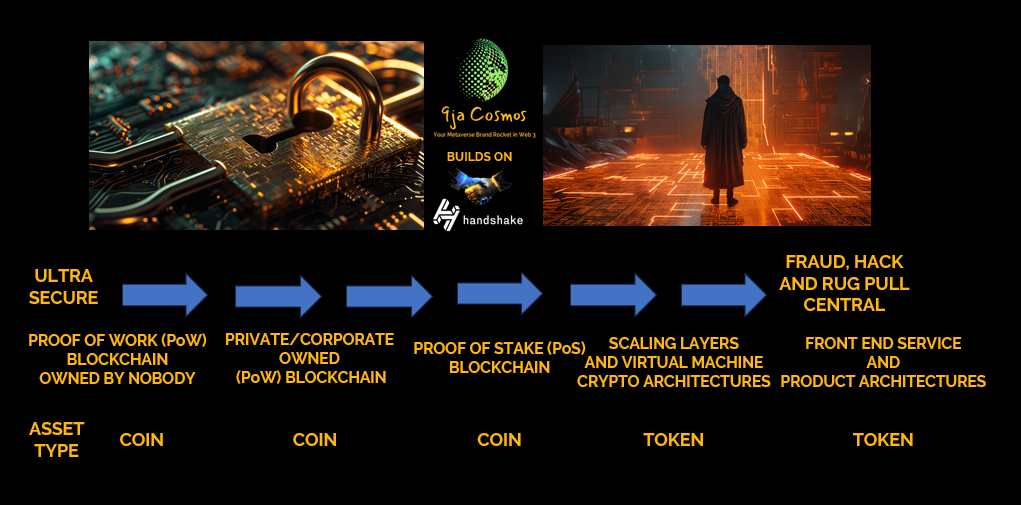
So what we see, is a spectrum. Risk increases from left to right. When purely speculating, with no real interest in product or long term store of value, then there can be some chance for massive gains at the extreme right end of the spectrum. It is however, also highly risky.

When tokens off ‘last mile’ architectures run several layers deep, the token holder has a cumulative risk based on everything in the ‘supply chain’.

For example, if a hypothetical  ‘Parrot Network’ is an EVM compatible off Ethereum, and somebody builds a product architecture off Parrot, named ‘Joey’ and issues a ‘Joey Token’, the ‘Joey’ architecture carries it’s own vulnerabilities, those of Parrot Network, and those of Ethereum. If ‘Parrot’ has cross-chain bridges to other networks, there may be vulnerabilities there as well.

So, every front-end network isn’t in the same boat. Sentiment is a big element for speculators. Some will be tempted to take big risks for short term gains, where there is no enduring value, and try to get out quickly. They don’t care about architecture stability.

Those looking for serious long term value in NFAs (Non Fungible Assets), should probably pay at least as much attention to the tokenization model as they do to the nature of the product, and avoid architectures like ‘Joey’.

So, on Handshake – Unfortunately for me, HNS (The Handshake Coin) is probably going to continue to rise. I’ve a lot invested in (illiquid) ecosystem assets, so not a lot of flexibility to buy coin. The more it rises, the more expensive it will get to work on, building products.

Here are the good things I can say about the coin:

  1. The most enduring store of value in crypto world will be limited supply tokenomics on a Proof of Work blockchain that nobody owns – eg Bitcoin. But this is also what Handshake is.

  2. Even when big business gets into mining, there is still enough small ones to ensure no prejudice against a specific asset holder. Validators (PoS) can be controlled by owners or regulators such as the SEC. Off chain crypto architectures and project tokens – even more risk.

  3. It helps if on top of being a PoW owned by nobody, the blockchain has things actively being built on it. Besides 9ja Cosmos , Handshake has Kyokan, Bob Wallet, Varo, Niami, Namebase, Eskimo Software, Wallet Inc. and others.

  4. Pedigree that stood the test of time – Handshake was built over 2018/19 between people that started up Lightning on Bitcoin, and co-wrote a whitepaper with Vitalik Buterin. It’s recovered to about 3.5x of its all time low in 2.5 months.

  5. Builders are transparent about building on Handshake, even though improvement in Handshake price doesn’t even help them. 9ja Cosmos isn’t the only business willing to speak well of it.  On EVM compatible structures, business owners, such as the hypothetical ‘Joey’ only talk about their products and seem reluctant to say anything about their architectural dependencies. This seems indicative of a lack of confidence in their underlying build layers and there’s already been cases of ‘jumping around’ between EVM compatibles and Solana as anchors.

  6. Much has been made of the affordability on EVM Compatibles that will come next month from the implementation of EIP-4844 (Danksharding). The impact will vary from network to network. Some transaction types on some networks are expected to fall to about $0.023. However, HNS would have to rise to about 20 cents for transaction costs to reach even the cheapest of those benefiting from EIP-4844 and that is unlikely to happen before interested builders get their core developments done cheaper. Handshake blockchain is also profoundly more secure than EIP-4844 enabled networks will become.

  7. With ETFs being granted licences, they are likely to suck a lot of liquidity from Bitcoin, and form a cabal to control the Bitcoin market, creating fabricated peaks and troughs, as they are already experienced with equities and commodities.  Handshake is the closest alternative by design if this happens, and smaller investors start looking for somewhere else.

9ja Cosmos is here…

Get your .9jacom and .9javerse Web 3 domains  for $2 at:

.9jacom Domains

.9javerse Domains

Visit 9ja Cosmos LinkedIn Page

Visit 9ja Cosmos Website

Preview our Sino Amazon/Sinosignia releases

Breach Of Contract For Performance In The Nigerian Showbiz Industry; Rights, Remedies For Show Organizers.

0

The festive period is always the busiest time of the year for those in showbiz; they usually call it their “season”. It inadvertently is also the period where show promoters and event organizers get into scuffles and lock their horns with entertainers over breach of performance contract by the entertainers which usually goes in the form of the promoter engaging and paying an entertainer to come perform at an event and the entertainer failing to turn up or show up for the show over some flimsy excuses. 

Since the beginning of December I have had clients who are show promoters brief me and complain about how they engaged and paid a particular entertainer and they signed an agreement of performance but after collecting money, the entertainer refused to show up. 

In October, the promoters of “Warri Again”, locked their horns in a legal battle with Davido after paying Davido a whopping sum of 100,000 USD to come and perform at the event and Davido didn’t show up. The case is currently in court. Mr Jollof since yesterday has been all over social media platforms calling out entertainers he paid to perform at his event but failed to show up after calling his money. 

Sometimes when promoters or show organizers use a particular famous entertainer to headline a show and promote the show, numerous people buy tickets to the event just because that particular entertainer will be performing and when the entertainer fails to show up after the promoter has promoted that the person will the performing, the promoter is forced to refund money for tickets, the show promoter can even be sued by the attendees of the event, the promoter also loses goodwill before the public eyes; the promoter is been seen as a liar and investors may not want to deal with him again this is why it is very disastrous to every show promoter when a particular entertainer does not show up for an event after they have engaged him or her. 

It sounds ridiculous when an entertainer arrogantly claims to have refunded the money back to the promoter after failing to show up for the show thinking that refunding the money will exculpate them from the legal liabilities for failing to show up for the event; they are ignorant of the fact that refunding the money is the easiest part, the goodwill and the emotional distress the promoter experienced by the disappointment still gives the promoter the legal right to commence legal action against the entertainer for damages even when the performance fee has been fully refunded.

An entertainment contract or a performance agreement is like every other business transaction contract and should be treated as such. The contract bestows responsibilities and expectations on both parties going into the contract; both the performer and the organizer or promoter and every party in the contract is expected to live up to those responsibilities as highlighted in the contract. If any of the parties fails to keep his or her own part, the aggrieved party is entitled to sue for compensation and damages. 

As highlighted in all major contracts for performance, the primary responsibility the contract bestows on the entertainer or performer is for the performer to show up on time on the date of the event and perform for the duration of time which can be in minutes or hours as indicated in the contract, anything other than that, the entertainer risks getting sued for breach of contract by the show organizer. 

The only two instances when an entertainer can refuse or fail to show up after being paid or after agreeing (be it in word or on paper) to be available for a show without attracting any legal consequences is when the failure on the part of the performer is facilitated by an act of God (force majeure), i.e. a reason or reasons which is beyond the control of the performer and the second instance where an entertainer may fail to show up and won’t be held to ransom is when his failure to perform or attend the show is facilitated by the show promoter or organizer; ie maybe the show was canceled or the venue, date or time was changed without adequate notification to the entertainer or that the organization structure or the necessary equipment is not in place for the performer to perform which may include lack of proper performance equipment, lack of maximum security for the entertainer etc; in this case, the entertainer has the right to even sue the promoter for compensation. In every other instance aside from these two instances, no matter what, an entertainer is expected to show up and perform his part of the contract as has been agreed otherwise he can be sued for damages by the organizers of the event. 

Entertainers and performers; musicians, comedians, MCs, dancers, hypemen etc should learn to adopt the attitude of professionalism towards their craft; an entertainer being notorious for always failing to show up or showing up late after being paid is never a good tag for any person in the showbiz. Promoters on the other hand should learn to engage a lawyer to draft a proper agreement of performance contract before engaging any entertainer for service. The contract will contain clauses that will highlight the responsibilities of the entertainers and compensatory damages for the promoter if the entertainer fails to fulfil the responsibilities.