DD
MM
YYYY

PAGES

DD
MM
YYYY

spot_img

PAGES

Home Blog Page 351

Deepening Personal Economy by Growing Personal Equity!

0

Great comment on the piece where I noted that capital wins money: “This distinction—money measures capital, but isn’t capital—is what most salaried people never grasp until it’s too late. Labor expires. Capital compounds. That’s the game. But here’s the harder reality: telling someone earning N150k monthly to “elevate money to capital” sounds great in theory but brutal in practice. When survival consumes 90% of income, capital formation feels like luxury advice. So Prof, what’s the actual minimum threshold someone needs to cross before they can start converting money into capital? Because for most Nigerians, the bottleneck isn’t knowledge—it’s cash flow.”

My Response: For someone earning N150,000 monthly, the idea of capital formation can sound challenging. But capital is not limited to stocks or real estate. Yes, the real capital formation begins with personal equity which I have identified in our Tekedia Mini-MBA  Personal Economy series as the foundational capital for professionals.

After course on Logic & Philosophy in FUT Owerri, another memorable course was a 3rd year course with a component that was branded “Engineer Turns Manager”. The professor explained engineering from the lens of executing strategic objectives. He then went deeper to while if you do not get that engineering management right, even engineering technical excellence will fade. Sure, that was for a Corporate Economy and or a National Economy. Nothing was taught throughout the program for Ndubuisi’s Personal Economy.

I conceptualized the framework of Personal Economy, and my conclusion is that building Personal Equity is the ultimate pillar for enduring capital. And we can do that even when we have limited resources.

For this person, when you spend N20,000 to learn how to style wigs to sell to the diasporas via Instagram or Facebook, that is capital formation at work. That enterprise is your own, no matter how small, and depending on your efforts, it can accumulate value. Simply, you are converting money into a capability that expands your earning base because enterprises are organic systems which can grow and scale. Skills, relationships, tools, and education are all derivatives of capital. They transform effort into SCALABLE value, deepening Personal Economy by growing personal equity!

Nine Years, Forty-Two Battles: How Nigeria’s “No Work, No Pay” Policy Targets Education Workers Most

0

Over the past nine years, education workers in Nigeria have been the main targets of the “No Work, No Pay” policy as both federal and state governments use it to curb frequent strikes and enforce discipline across the public sector. A review of documented applications between 2016 and 2025 by our analyst shows that nearly four out of every ten times the policy was applied, it affected teachers, lecturers, and other education sector staff.

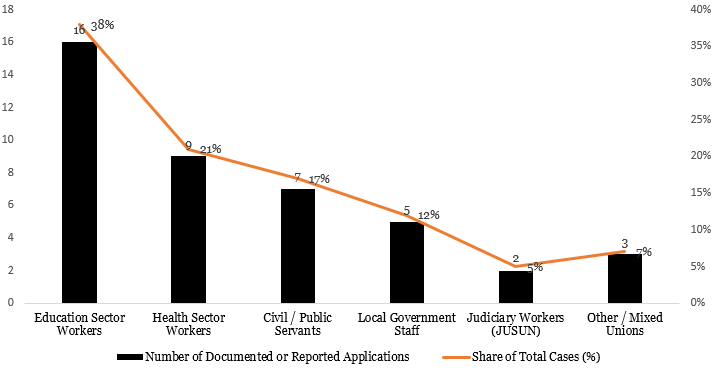
Our analysis reveals that governments at both levels invoked the controversial policy 42 times within the period. Education workers accounted for 16 of those cases, representing about 38 percent of total applications. The health sector followed with nine instances, or 21 percent, while civil servants faced the policy seven times. Local government workers were targeted in five cases, and judiciary workers twice.

At the federal level, the policy became most visible in 2022 when the Academic Staff Union of Universities (ASUU) embarked on an eight-month strike. The federal government insisted on enforcing “No Work, No Pay,” a stance that later extended to polytechnic lecturers and college workers in subsequent years. The Federal Ministry of Labour argued that the measure was a legal deterrent against indefinite strikes that disrupt essential services. However, unions maintained that it was punitive and ignored the root causes of industrial actions such as poor funding and unmet agreements.

The Federal Capital Territory, though under federal administration, also recorded its own cases. Between 2022 and 2024, education and area council workers faced salary suspensions after prolonged strikes. The FCT Administration justified its actions as necessary to restore work discipline in the public education system, which has struggled with frequent disruptions.

Across the states, the picture is consistent. In Oyo, the policy was applied to teachers and civil servants during the 2018 strikes, while Kaduna used it in 2021 against teachers and state workers after a confrontation between the government and the Nigeria Labour Congress. Lagos and Kano enforced it against teachers between 2022 and 2025, while Ekiti and Anambra applied it to health workers during salary disputes. Rivers, Cross River, and Abia had isolated cases involving local government and judiciary staff.

Although 14 other states had occasional mentions of the policy, particularly during teachers’ or nurses’ strikes, most did not sustain implementation due to political pressures or negotiations that followed. The data shows that while state governments invoke the policy rhetorically, only a few follow through with full enforcement.

Exhibit 1: Aggregate Frequency by Worker Type (National Overview, 2016–2025)
Source: Nigerian Newspapers, 2016-2025; Official Documents from Governments and Labour Unions, 2016-2025

The frequent application in the education sector reflects the ongoing tensions between government fiscal management and public sector unionism. Teachers and lecturers, who form some of the largest organised unions in Nigeria, often strike to demand wage reviews, improved funding, or better working conditions. For the government, the “No Work, No Pay” rule has become a tool to manage financial exposure during protracted industrial actions.

In practice, the policy’s implementation has been uneven. While federal authorities enforced it rigidly against ASUU in 2022, other unions in health and local government sectors later received partial payments after negotiations. In some states, the policy was reversed following public outcry, especially when it affected essential service providers like nurses and teachers.

The frequency data also suggests that enforcement is more common in politically stable or reform-driven states such as Lagos, Kaduna, and Oyo. These states tend to emphasize administrative discipline and budget accountability. In contrast, states with weaker fiscal positions often delay or suspend salary payments regardless of strike actions, making the “No Work, No Pay” rule less effective or even redundant.

Experts note that the selective application of the policy undermines its credibility. Labour analysts argue that its effectiveness depends on government transparency and consistency. They point out that in many cases, strikes arise from unpaid wages or unimplemented agreements, which makes punishing workers for not working during such periods ethically questionable.

Despite the controversies, both federal and state governments appear committed to keeping the policy in their industrial relations toolkit. In 2025, some states, including Lagos and the FCT, reaffirmed their readiness to invoke it against any worker unions that disrupt public services.

The data underscores a broader issue in Nigeria’s labour relations. While “No Work, No Pay” seeks to discourage strikes, it has also deepened mistrust between workers and the government. Education workers remain the most targeted, yet they continue to play a central role in demanding reforms and accountability. The trend suggests that unless structural challenges in public funding and wage management are addressed, the policy will remain a recurring feature of Nigeria’s industrial landscape

FLOKI Roars, Bonk Explodes, But It’s BullZilla That’s Becoming the Top Meme Coin to Buy Right Now

0

FLOKI and Bonk present attractive opportunities. BullZilla ($BZIL) is quickly climbing the ranks as one of the top meme coins to buy right now. With its presale phase currently ongoing and over $880k raised, BullZilla is attracting attention for its innovative features and its growth potential. What sets BullZilla apart is its unique Roar Burn Mechanism, a deflationary feature that makes the token scarcer and more valuable with every milestone it reaches. As meme coins continue to gain momentum, BullZilla presents an exciting alternative that could deliver high returns for early investors.

FLOKI and Bonk are emerging as two of the top contenders. FLOKI, inspired by Elon Musk’s beloved dog, has captured the hearts of meme lovers and crypto investors alike, showing remarkable growth and community engagement. Trading at $0.00007352, FLOKI’s latest 9.79% price increase within 24 hours only adds to its appeal. On the other hand, Bonk, the community-driven coin, has captured attention with a staggering 14.47% price jump, currently trading at $0.00001557. These coins are part of a new generation of meme tokens that bring fun and excitement to the crypto world, but are they the best options for investors right now?

BullZilla: A New Era in Meme Coin Investments

BullZilla ($BZIL) is not just another meme coin; it is an investment opportunity that comes with a well-thought-out strategy and a clear roadmap. Currently priced at $0.0001524, the BullZilla project has already raised over $880k during its presale, attracting more than 2,900 holders. The growing interest in the token can be attributed to its Roar Burn Mechanism, which reduces the total supply of tokens, making each $BZIL token scarcer and increasing its value. The more BullZilla progresses through its milestones, the more tokens are burned, which naturally leads to higher demand and a potential price surge.

The BullZilla presale offers a unique chance for investors to buy early at a low price before the full-scale launch. With its community-driven approach, BullZilla is set to benefit from a Roar Surge, where the burning of tokens triggers an excitement wave within the community, further enhancing the token’s value. For those looking to secure a position in the next big meme coin, BullZilla stands out for its clear investment strategy and sustainable growth model. Additionally, its investment scenario makes it a top pick for those seeking significant returns as it moves closer to full launch.

How to Buy BullZilla Coins: One of the Top Meme Coin Presales in 2025

Investing in BullZilla is a straightforward process that anyone can follow with ease. To get started, first set up a Web3 wallet such as MetaMask or Trust Wallet. These wallets will allow you to interact with the BullZilla presale site. Next, you’ll need to buy Ethereum (ETH) from an exchange like Binance or Coinbase and transfer it to your wallet. Once your wallet is set up and funded, head over to the official BullZilla presale site.

Connect your wallet to the site, and then swap ETH for $BZIL. Choose the amount of $BZIL you want to purchase, confirm the transaction, and your allocation will be secured immediately. The tokens will be claimable once the presale completes. Given that the current presale price is still below market value, now is the ideal time to invest in BullZilla before the price surges when the project officially launches.

Investment Scenario: $2000 in BullZilla Presale

If you were to invest $2,000 in BullZilla at its current presale price of $0.0001524, here’s what the potential ROI could look like: Number of tokens purchased: 13,142,000 $BZIL

As the BullZilla presale progresses and prices increase, your initial investment could see a significant return once the project is fully launched. Given the growing community and the Roar Burn Mechanism, the scarcity of $BZIL tokens is expected to increase, driving the price upward.
FLOKI: The Viking-Inspired Coin with Massive Growth Potential

FLOKI has been one of the most talked-about meme coins in recent times, especially following its 9.79% increase in just 24 hours. This surge isn’t just a short-term pump; it’s the culmination of strategic community-building and the development of an evolving ecosystem. Currently trading at $0.00007352, FLOKI has gained significant traction in the decentralized finance (DeFi) space, appealing to a wide range of investors. The coin’s growth can be attributed to its Viking-inspired branding, strong community involvement, and an increasing number of use cases within the Floki Inu ecosystem.

One notable aspect that makes FLOKI stand out is its real-world applications. Unlike many other meme coins, FLOKI has been working to establish itself as more than just a fun investment vehicle. With partnerships in NFT projects and DeFi ecosystems, it’s steadily evolving into a versatile asset. Investors are also keeping an eye on its roaring community and viral marketing tactics, which contribute to its growing popularity. For those looking to invest in one of the top meme coins to buy right now, FLOKI presents an interesting option with its strong upward momentum.

Bonk: The Coin That Refuses to Be Ignored

Next on the list is Bonk, a meme coin that has taken the crypto world by surprise. After its meteoric rise of 14.47% in just 24 hours, the Bonk token has attracted significant attention from the broader crypto community. Trading at $0.00001557, Bonk is known for being a community-driven coin with explosive price action. While its growth has been somewhat volatile, its ability to bounce back time and again proves the resilience of its community.

Bonk’s decentralized nature, coupled with a fun and engaging community, makes it an exciting prospect for meme coin lovers. The coin’s popularity surged with social media trends, and it continues to attract attention due to its low price entry point and potential for rapid growth. Investors who are early to recognize the potential of Bonk have witnessed impressive returns. However, as with any meme coin, price volatility remains a key risk factor. Despite these risks, Bonk remains one of the top meme coins to buy right now for those willing to take on some risk for the potential of significant returns.

Conclusion: Find the Top Meme Coin Presales in 2025?

FLOKI and Bonk continue to make waves in the crypto market, and BullZilla emerges as a strong contender in the race. With its innovative features, including the Roar Burn Mechanism, and a presale that has already raised over $880k, BullZilla presents a top meme coin to buy right now for investors looking to capitalize on the growing demand for meme coins. Both FLOKI and Bonk have proven themselves as viable investments with strong community support, but BullZilla offers a unique proposition that sets it apart from the pack.

For those interested in meme coins, now is the time to pay attention to BullZilla ($BZIL). Its presale is already gaining traction, and the Roar Burn Mechanism promises to drive its value higher as the project progresses. By purchasing BullZilla at its presale price, investors are positioning themselves for potentially substantial returns. The cryptocurrency landscape is filled with opportunities, and BullZilla is one to watch for those seeking the top meme coin presales in 2025.

For More Information:

BZIL Official Website

Join BZIL Telegram Channel

Follow BZIL on X  (Formerly Twitter)

Frequently Asked Questions

What makes BullZilla different from other meme coins?

BullZilla incorporates a Roar Burn Mechanism that reduces supply over time, which naturally increases the token’s value.

How can I participate in BullZilla’s presale?

You can participate by setting up a Web3 wallet, buying Ethereum (ETH), and swapping it for $BZIL on the presale portal.

Is BullZilla a good investment?

BullZilla’s ROI potential and scarcity-driven price appreciation make it a promising investment, especially for those getting in early.

How does the Roar Burn Mechanism work?

The Roar Burn Mechanism burns a portion of tokens each time BullZilla reaches a milestone, increasing scarcity and driving up token value.

What is the current presale stage of BullZilla?

BullZilla is currently in Stage 6 (Full Send!), with over $880k raised and 2,900+ token holders.

Glossary

  • Meme Coin: A cryptocurrency inspired by a meme or social trend, often used as a joke or community project.
  • Presale: The period in which tokens are sold at a discount before the official launch.
  • Roar Burn Mechanism: A deflationary mechanism where tokens are burned to reduce supply and increase value.
  • Ethereum (ETH): A popular cryptocurrency used for transactions and smart contracts.
  • Web3 Wallet: A wallet used to interact with decentralized applications on the blockchain.

ALT TEXT

Top meme coins to buy right now, BullZilla presale, BullZilla ($BZIL) crypto presale, BullZilla meme coin presale, ROI potential, FLOKI, Bonk, Roar Burn Mechanism, $BZIL, presale, cryptocurrency investment, presale stage, $BZIL presale, token scarcity, community-driven coin, investment opportunities, decentralized finance (DeFi), Ethereum wallet, Web3 wallet.

Disclaimer

BullZilla ($BZIL) presents an exciting investment opportunity in the meme coin market. With its ongoing presale, the project has already raised over $880k, offering early investors a chance to buy at a discounted price. The presale process is simple: set up a Web3 wallet, purchase Ethereum (ETH), visit the presale site, and swap ETH for $BZIL. BullZilla’s unique Roar Burn Mechanism adds significant value by decreasing token supply, driving scarcity, and increasing demand. As the project progresses, its potential for substantial returns grows, making it one of the top meme coins to buy right now.

Slack Tests AI-Powered Upgrade to Slackbot, Turning It Into a Personalized Digital Assistant

0

Slack is testing a major update that transforms its well-known Slackbot from a basic reminder tool into a full-fledged AI-powered assistant, capable of performing complex, personalized tasks across workplace communications.

The revamped Slackbot, announced by Rob Seaman, Slack’s Chief Product Officer at Salesforce, marks one of the company’s most ambitious AI rollouts to date.

“Slackbot today is fairly rudimentary,” Seaman told The Verge. “But what we’ve done is we’ve actually rebuilt it from the ground up as a personalized AI companion.”

The update is currently in pilot testing within Salesforce, Slack’s parent company, where more than 70,000 employees are already using it. The company plans to make it widely available to all users by the end of the year.

From Simple Reminders to Smart Workflows

Until now, Slackbot has functioned mainly as a tool for delivering reminders, notifications, and simple automated messages. But with the new AI-driven version, Slackbot is becoming a context-aware digital assistant designed to help teams navigate increasingly complex workspaces.

The updated Slackbot can now:

  • Summarize and organize project updates and messages from multiple channels.
  • Create tailored work plans, such as product launch schedules or content campaigns.
  • Search for information using natural language, making it easier to locate files and messages even without specific keywords.
  • Coordinate meetings by integrating directly with Microsoft Outlook and Google Calendar.

In one internal demo, Slack showcased how the AI Slackbot could compile data from various channels to build a product launch plan within Slack’s Canvas feature. It could also help craft a social media campaign using a company’s specific tone and brand language — something that previously required multiple tools or manual input.

Personalized and Privacy-Protected

Slack is positioning the AI Slackbot as a personalized assistant that learns from the user’s workspace context — such as messages, files, and recent activity — but with strict data controls in place.

According to Seaman, all AI features operate through Amazon Web Services’ Virtual Private Cloud (VPC), ensuring that no user data leaves Slack’s firewall and that none of the information is used to train AI models.

“Meaning that no data leaves the firewall, no data is used in the training of the models at all,” Seaman emphasized, addressing one of the major privacy concerns surrounding generative AI in corporate environments.

Slack also clarified that companies can opt out of using the new AI Slackbot if they choose, but individual users within a participating company cannot disable it independently.

How It Works

The upgraded Slackbot will appear as an icon next to the search bar in the Slack interface. Clicking it opens a DM-style panel on the right side of the screen, where users can type natural-language prompts such as:

  • “What are my priorities for today?”
  • “Find the latest updates on the product launch.”
  • “Show me the document that Jay shared in our last meeting.”

The assistant will then draw on the user’s Slack workspace — including conversations, files, and shared resources — to produce contextual results, eliminating the need for time-consuming manual searches.

This update builds on Slack’s growing lineup of AI-enabled productivity tools, which already include thread and channel summarization, auto-generated meeting notes, and real-time translation of company jargon.

“We’ll keep putting those little touches there where they make sense, to save users a click,” Seaman said. The new Slackbot, he added, is meant to blend seamlessly into daily workflows, reducing the friction between users and the information they need.

Existing Slackbot features, such as custom commands and automated messages, will remain intact. The goal, Seaman explained, is to expand capabilities without disrupting familiar workflows.

Rising Competition in Workplace AI

Slack’s move comes as AI assistants are rapidly becoming the new battleground among productivity platforms. Microsoft has begun embedding its Copilot AI across Teams and Office 365, while Google has integrated its Gemini assistant into Workspace apps like Gmail and Docs.

Slack is now betting that employees will prefer a conversational approach to handling everyday tasks,
by transforming Slackbot into an AI assistant that sits natively inside the messaging platform, without toggling between multiple applications.

Some believe the change could also reinforce Salesforce’s broader AI ambitions, as the company seeks to integrate Slack more tightly into its Einstein AI ecosystem.

For now, the pilot remains limited, but Slack says user feedback from Salesforce’s internal rollout has been “very positive.” The company believes the AI Slackbot will significantly reduce information overload — one of the most common pain points in large organizations using Slack.

If successful, the upgrade could redefine how workers interact with corporate information systems, transforming Slack from a chat hub into a dynamic productivity engine.

OpenAI Partners with Broadcom to Build Custom AI Chips, Expanding Its Push to Reduce Reliance on Nvidia

0

Artificial intelligence leader OpenAI has announced a major partnership with Broadcom to design and produce its own computer chips, in a move that underscores the company’s growing ambition to control every layer of the AI supply chain and reduce dependence on Nvidia’s dominant hardware.

The partnership, revealed Monday, will enable OpenAI to develop and deploy up to 10 gigawatts of custom AI accelerators, a massive amount of computing capacity roughly equivalent to the output of ten nuclear reactors. The project aims to power the company’s sprawling AI data centers that support products such as ChatGPT and Sora, and advance OpenAI’s long-term goal of creating superintelligent AI systems.

In a statement, OpenAI said that building its own chips allows it to “embed what it’s learned from developing frontier models and products directly into the hardware, unlocking new levels of capability and intelligence.”

Under the deal, Broadcom will be responsible for deploying racks of custom-built hardware beginning in the second half of 2026, with full rollout expected to be completed by the end of 2029, according to details shared in the announcement.

OpenAI co-founder and CEO Sam Altman described the collaboration as a foundational step toward ensuring the company has the infrastructure it needs to sustain its rapid pace of innovation.

Part of a Wider Infrastructure Strategy

The Broadcom deal follows OpenAI’s six-gigawatt partnership with AMD and a 10-gigawatt deal with Nvidia, both announced earlier this year. Collectively, these agreements represent one of the most aggressive infrastructure buildouts in the AI industry, reflecting OpenAI’s intent to diversify its chip supply and secure guaranteed access to the computing power required to train and deploy massive AI models.

These arrangements became possible only after OpenAI modified its exclusive cloud computing agreement with Microsoft, which had previously limited its flexibility in sourcing compute from other vendors.

The move also places OpenAI alongside major technology firms such as Meta, Google, and Microsoft, all of which are investing heavily in custom AI chips to alleviate dependence on Nvidia’s graphics processing units (GPUs), which have become the gold standard for AI workloads.

Analysts say the push toward in-house chip design is both a strategic and economic response to the global shortage of AI chips, which has constrained supply chains and driven up costs. Though custom silicon projects have not yet threatened Nvidia’s market dominance, they have significantly benefited companies like Broadcom, which designs specialized components for AI systems.

Market Reaction

Investors welcomed the news, sending Broadcom shares up 9% on Monday, rebounding from a market selloff last Friday. Shares of other chipmakers also saw modest gains as optimism returned to semiconductor markets amid easing U.S.-China trade tensions.

Over the weekend, President Donald Trump sought to ease concerns about escalating geopolitical frictions with Beijing, writing on Truth Social that it “will all be fine,” in reference to trade talks and supply chain stability.

The timing of OpenAI’s Broadcom deal reflects broader efforts across the U.S. tech industry to fortify chip manufacturing alliances and secure long-term supply resilience in the face of unpredictable global dynamics.

However, OpenAI’s decision to move into chip design marks a strategic milestone that could reshape the economics of AI development. The company gains the ability to tailor chip architecture to the unique demands of its AI models by vertically integrating its hardware stack, potentially improving performance efficiency while cutting operational costs.

The 10-gigawatt infrastructure target places OpenAI’s ambitions on par with some of the world’s largest cloud operators. Analysts note that such capacity could support next-generation multimodal systems and large-scale simulation environments central to OpenAI’s pursuit of artificial general intelligence (AGI).

While Nvidia remains the undisputed leader in AI computing, the combined effect of OpenAI’s deals with AMD, Nvidia, and now Broadcom signals a new phase of diversification that may, over time, dilute Nvidia’s market control.

As the race for computing power accelerates, AI infrastructure has rapidly become one of the most lucrative segments of the technology industry, with smaller chip design firms and data center specialists also benefiting from the surge in demand.

The partnership with Broadcom, for OpenAI, is not just about building chips; it is about building independence, ensuring that the next generation of AI innovation will not be limited by the availability of hardware.