DD
MM
YYYY

PAGES

DD
MM
YYYY

spot_img

PAGES

Home Blog Page 352

Broadcom Confirms OpenAI Is Not Its Mystery $10bn Customer Despite Major AI Chip Partnership

0

In what appears to clarify weeks of speculation across the semiconductor industry, Charlie Kawwas, president of Broadcom’s Semiconductor Solutions Group, has confirmed that OpenAI is not the mystery $10 billion customer that Broadcom referenced during its September earnings call.

Kawwas made the clarification on Monday during a joint appearance with OpenAI President Greg Brockman on CNBC’s “Squawk on the Street.” The two executives discussed their newly announced partnership to jointly build and deploy 10 gigawatts of custom artificial intelligence accelerators — a project that analysts had widely assumed made OpenAI the unidentified mega-client in Broadcom’s order books.

“I would love to take a $10 billion [purchase order] from my good friend Greg,” Kawwas said on air. “He has not given me that PO yet.”

The comment came just hours after the companies officially announced a long-term plan to develop and deploy a new class of AI infrastructure designed specifically for OpenAI’s frontier models, confirming months of collaboration rumors between the two firms.

Broadcom did not immediately respond to CNBC’s follow-up request for comment on Kawwas’s statement.

A Partnership Built for AI Scale

OpenAI’s collaboration with Broadcom represents one of the most ambitious infrastructure initiatives in the AI sector, aiming to create a custom line of chips optimized for training and inference at massive scale. The two companies said they will begin deploying racks of these accelerators by late 2026, with full completion of the 10-gigawatt deployment expected by 2029.

“By building our own chip, we can embed what we’ve learned from creating frontier models and products directly into the hardware, unlocking new levels of capability and intelligence,” Brockman said in a statement.

The move is part of OpenAI’s rapid expansion of compute infrastructure to keep up with demand from its ChatGPT platform and enterprise products, which now serve hundreds of millions of users globally.

Broadcom’s Mystery Customer Still Unknown

During Broadcom’s September earnings call, CEO Hock Tan disclosed that a fourth large customer — alongside Google, Meta, and ByteDance — had placed a $10 billion order for custom AI chips. The revelation immediately sparked speculation among analysts and investors, with many pointing to OpenAI as the likely client due to its aggressive data center buildout.

However, Kawwas’s confirmation on Monday effectively rules out OpenAI, leaving the identity of the mystery customer unknown.

Broadcom has not disclosed the client’s name, citing confidentiality agreements, but analysts have suggested potential candidates, including Amazon Web Services, Oracle, or Tesla’s xAI project — all of which are investing heavily in AI compute infrastructure.

The order, according to Tan, will significantly boost Broadcom’s AI revenue forecast for next year, with shipments of the new custom chips expected to begin in 2026.

OpenAI’s Infrastructure Blitz

OpenAI’s infrastructure expansion has been nothing short of aggressive. Over the past few months, the company has struck multi-billion-dollar agreements with major chipmakers, including Advanced Micro Devices (AMD), Nvidia, and CoreWeave — all part of an effort to diversify and secure long-term compute supply.

The startup, now valued at $500 billion, is working to scale up capacity in anticipation of its next-generation AI models. These deals have made OpenAI one of the largest buyers of GPUs and AI accelerators globally, rivalling hyperscalers such as Google and Amazon in chip procurement.

Its partnership with AMD, for instance, involves deploying six gigawatts of Instinct GPUs over multiple hardware generations, while the deal with CoreWeave focuses on providing cloud infrastructure optimized for OpenAI’s workloads.

Broadcom’s custom chip collaboration, therefore, fits squarely into OpenAI’s broader strategy of building proprietary hardware systems that could eventually reduce its dependence on traditional suppliers like Nvidia.

Broadcom’s Expanding AI Footprint

For Broadcom, the deal with OpenAI cements its growing role in the AI semiconductor ecosystem — an area historically dominated by Nvidia. The company designs and manufactures high-performance custom chips used by some of the largest tech firms, including Google’s Tensor Processing Units (TPUs) and Meta’s AI servers.

Broadcom’s AI-related revenue has grown sharply, and CEO Hock Tan recently forecast that AI chip sales could exceed $10 billion in 2025, accounting for nearly a quarter of the company’s semiconductor revenue.

Still, the firm’s decision not to name its fourth major customer has kept analysts guessing. Some speculate the client could be a nontraditional tech player developing in-house AI capabilities, or even a government-backed initiative seeking long-term chip supply security.

A Race to Control AI Hardware

The partnership between OpenAI and Broadcom underscores a broader industry trend, where AI companies are increasingly moving toward designing their own chips to optimize performance, efficiency, and cost.

Rival firms have followed similar paths. Google developed its own Tensor chips for AI and cloud computing, Amazon built its Trainium and Inferentia chips for AWS, and Meta announced plans earlier this year to deploy its custom Meta Training and Inference Accelerator (MTIA) chips across data centers.

OpenAI has joined that elite circle — a move analysts believe will give it a competitive advantage as AI workloads grow exponentially.

As Kawwas and Brockman appeared side-by-side on CNBC, their comments made clear that while OpenAI may not be Broadcom’s secret $10 billion customer, the two companies are forging one of the most significant partnerships in the AI chip race.


The Bitcoin Whale’s Latest Short Position, A Bearish Bet Amid Recovery

0

The mysterious Bitcoin whale—widely speculated to be a savvy trader with possible insider edges—has indeed ramped up its bearish stance on BTC.

A Bitcoin OG original gangster whale, who accumulated 86,000 BTC in 2011 when BTC was ~$0.78, opened a massive $1.1B short position on BTC and ETH via Hyperliquid just 30 minutes before Trump’s 100% tariff announcement on Chinese imports.

The market plunged, allowing the whale to close 90% of the BTC short and the full ETH short, pocketing ~$192M in realized profits in one day. This entity still holds ~49,634 BTC worth $5.43B.

This entity, which netted approximately $192 million in profits by shorting Bitcoin and Ethereum just minutes before President Trump’s October 10, 2025, announcement of 100% tariffs on Chinese imports triggering a 17% BTC crash and $19.5 billion in market-wide liquidations, has now added significant leverage to its playbook.

Closely with reports from October 12, 2025, detailing this whale’s fresh $160 million short on the decentralized perpetuals exchange Hyperliquid—though some on-chain trackers and social buzz peg the incremental add at around $46 million to an existing position, pushing the total active BTC short exposure to $209 million.

The variance might stem from how positions are aggregated across leverage layers or wallets, but the core narrative holds. The whale deployed $160 million in fresh capital for a 10x leveraged BTC short, equivalent to ~1,300 BTC at current prices $123,000/BTC as of October 13.

This builds on prior shorts, bringing the cumulative active position to ~$209 million notional value— a hefty bet against any near-term rally. The position faces wipeout if BTC surges above ~$125,500 per Hyperliquid’s mechanics, which is just ~2% above spot levels today.

Unrealized profits sit at ~$3.5 million so far, as BTC hovers in the $120k–$123k range post-crash recovery. A deeper pullback to $110k could flip this to $20M+ gains, echoing the whale’s tariff-timed windfall.

This isn’t the whale’s first rodeo. On October 8–9, it liquidated 3,000 BTC for $364 million in USDC at ~$121k/BTC, then flipped proceeds into $1.1 billion in leveraged shorts across BTC $753M notional, 10x and ETH ~$353M, 12x on Hyperliquid and Binance—mere hours before the tariff tweetstorm.

The crash liquidated 1.66 million traders and depegged assets like USDE and BNSOL, but this whale emerged unscathed, closing most positions for that $192M haul. Was it luck, algorithmic precision, or something more? Blockchain sleuths point to wallet “0x5D2F” active on Hyperliquid as a prime suspect, with ties to exchange insiders like ex-exec Garrett Jin.

X is ablaze with copycat calls and liquidation hunts—posts from influencers like @lookonchain and @RoundtableSpace highlight the drama, with some eyeing a “weekend pump” to torch the position.

At 10x leverage, this screams conviction in downside—perhaps anticipating tariff fallout, Fed signals, or ETF outflows. BTC’s 17% drop exposed over-leverage; another leg down could cascade $10B+ in fresh liquidations.

Bulls note the whale’s vulnerability—a 2–3% spike (e.g., to $127k) liquidates it outright, potentially fueling a short squeeze. On-chain data shows mixed whale flows: some accumulating 53k+ BTC in Q3, hinting at long-term faith.

Crypto’s reeling from the crash, but inflows hit $5.9B in early October ETFs. Watch for rotation into ETH up 9% post-crash or altcoins. If this is your thesis or a trade idea, tread lightly—whales like this thrive on chaos, but markets love to humble them.

A 140,000x return on original holdings, plus $192M cashed out in hours. Speculation abounds about insider ties due to the timing—on-chain analyst Maartunn noted potential U.S. government connections from the whale’s early days.

The whale reopened a $163M BTC short at 10x leverage now up to 20x, totaling $210M exposure on 1,823 BTC. Entry: $116,812; $120,993; Unrealized Profit: $3.5M–$3.8M. Community buzz calls this an “insider whale,” with X posts questioning if it’s Eric Trump as an unverified rumor.

Deepening Personal Economy by Growing Personal Equity!

0

Great comment on the piece where I noted that capital wins money: “This distinction—money measures capital, but isn’t capital—is what most salaried people never grasp until it’s too late. Labor expires. Capital compounds. That’s the game. But here’s the harder reality: telling someone earning N150k monthly to “elevate money to capital” sounds great in theory but brutal in practice. When survival consumes 90% of income, capital formation feels like luxury advice. So Prof, what’s the actual minimum threshold someone needs to cross before they can start converting money into capital? Because for most Nigerians, the bottleneck isn’t knowledge—it’s cash flow.”

My Response: For someone earning N150,000 monthly, the idea of capital formation can sound challenging. But capital is not limited to stocks or real estate. Yes, the real capital formation begins with personal equity which I have identified in our Tekedia Mini-MBA  Personal Economy series as the foundational capital for professionals.

After course on Logic & Philosophy in FUT Owerri, another memorable course was a 3rd year course with a component that was branded “Engineer Turns Manager”. The professor explained engineering from the lens of executing strategic objectives. He then went deeper to while if you do not get that engineering management right, even engineering technical excellence will fade. Sure, that was for a Corporate Economy and or a National Economy. Nothing was taught throughout the program for Ndubuisi’s Personal Economy.

I conceptualized the framework of Personal Economy, and my conclusion is that building Personal Equity is the ultimate pillar for enduring capital. And we can do that even when we have limited resources.

For this person, when you spend N20,000 to learn how to style wigs to sell to the diasporas via Instagram or Facebook, that is capital formation at work. That enterprise is your own, no matter how small, and depending on your efforts, it can accumulate value. Simply, you are converting money into a capability that expands your earning base because enterprises are organic systems which can grow and scale. Skills, relationships, tools, and education are all derivatives of capital. They transform effort into SCALABLE value, deepening Personal Economy by growing personal equity!

Nine Years, Forty-Two Battles: How Nigeria’s “No Work, No Pay” Policy Targets Education Workers Most

0

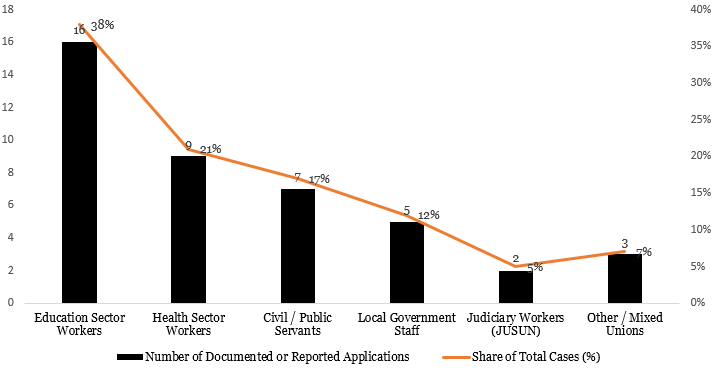
Over the past nine years, education workers in Nigeria have been the main targets of the “No Work, No Pay” policy as both federal and state governments use it to curb frequent strikes and enforce discipline across the public sector. A review of documented applications between 2016 and 2025 by our analyst shows that nearly four out of every ten times the policy was applied, it affected teachers, lecturers, and other education sector staff.

Our analysis reveals that governments at both levels invoked the controversial policy 42 times within the period. Education workers accounted for 16 of those cases, representing about 38 percent of total applications. The health sector followed with nine instances, or 21 percent, while civil servants faced the policy seven times. Local government workers were targeted in five cases, and judiciary workers twice.

At the federal level, the policy became most visible in 2022 when the Academic Staff Union of Universities (ASUU) embarked on an eight-month strike. The federal government insisted on enforcing “No Work, No Pay,” a stance that later extended to polytechnic lecturers and college workers in subsequent years. The Federal Ministry of Labour argued that the measure was a legal deterrent against indefinite strikes that disrupt essential services. However, unions maintained that it was punitive and ignored the root causes of industrial actions such as poor funding and unmet agreements.

The Federal Capital Territory, though under federal administration, also recorded its own cases. Between 2022 and 2024, education and area council workers faced salary suspensions after prolonged strikes. The FCT Administration justified its actions as necessary to restore work discipline in the public education system, which has struggled with frequent disruptions.

Across the states, the picture is consistent. In Oyo, the policy was applied to teachers and civil servants during the 2018 strikes, while Kaduna used it in 2021 against teachers and state workers after a confrontation between the government and the Nigeria Labour Congress. Lagos and Kano enforced it against teachers between 2022 and 2025, while Ekiti and Anambra applied it to health workers during salary disputes. Rivers, Cross River, and Abia had isolated cases involving local government and judiciary staff.

Although 14 other states had occasional mentions of the policy, particularly during teachers’ or nurses’ strikes, most did not sustain implementation due to political pressures or negotiations that followed. The data shows that while state governments invoke the policy rhetorically, only a few follow through with full enforcement.

Exhibit 1: Aggregate Frequency by Worker Type (National Overview, 2016–2025)
Source: Nigerian Newspapers, 2016-2025; Official Documents from Governments and Labour Unions, 2016-2025

The frequent application in the education sector reflects the ongoing tensions between government fiscal management and public sector unionism. Teachers and lecturers, who form some of the largest organised unions in Nigeria, often strike to demand wage reviews, improved funding, or better working conditions. For the government, the “No Work, No Pay” rule has become a tool to manage financial exposure during protracted industrial actions.

In practice, the policy’s implementation has been uneven. While federal authorities enforced it rigidly against ASUU in 2022, other unions in health and local government sectors later received partial payments after negotiations. In some states, the policy was reversed following public outcry, especially when it affected essential service providers like nurses and teachers.

The frequency data also suggests that enforcement is more common in politically stable or reform-driven states such as Lagos, Kaduna, and Oyo. These states tend to emphasize administrative discipline and budget accountability. In contrast, states with weaker fiscal positions often delay or suspend salary payments regardless of strike actions, making the “No Work, No Pay” rule less effective or even redundant.

Experts note that the selective application of the policy undermines its credibility. Labour analysts argue that its effectiveness depends on government transparency and consistency. They point out that in many cases, strikes arise from unpaid wages or unimplemented agreements, which makes punishing workers for not working during such periods ethically questionable.

Despite the controversies, both federal and state governments appear committed to keeping the policy in their industrial relations toolkit. In 2025, some states, including Lagos and the FCT, reaffirmed their readiness to invoke it against any worker unions that disrupt public services.

The data underscores a broader issue in Nigeria’s labour relations. While “No Work, No Pay” seeks to discourage strikes, it has also deepened mistrust between workers and the government. Education workers remain the most targeted, yet they continue to play a central role in demanding reforms and accountability. The trend suggests that unless structural challenges in public funding and wage management are addressed, the policy will remain a recurring feature of Nigeria’s industrial landscape

FLOKI Roars, Bonk Explodes, But It’s BullZilla That’s Becoming the Top Meme Coin to Buy Right Now

0

FLOKI and Bonk present attractive opportunities. BullZilla ($BZIL) is quickly climbing the ranks as one of the top meme coins to buy right now. With its presale phase currently ongoing and over $880k raised, BullZilla is attracting attention for its innovative features and its growth potential. What sets BullZilla apart is its unique Roar Burn Mechanism, a deflationary feature that makes the token scarcer and more valuable with every milestone it reaches. As meme coins continue to gain momentum, BullZilla presents an exciting alternative that could deliver high returns for early investors.

FLOKI and Bonk are emerging as two of the top contenders. FLOKI, inspired by Elon Musk’s beloved dog, has captured the hearts of meme lovers and crypto investors alike, showing remarkable growth and community engagement. Trading at $0.00007352, FLOKI’s latest 9.79% price increase within 24 hours only adds to its appeal. On the other hand, Bonk, the community-driven coin, has captured attention with a staggering 14.47% price jump, currently trading at $0.00001557. These coins are part of a new generation of meme tokens that bring fun and excitement to the crypto world, but are they the best options for investors right now?

BullZilla: A New Era in Meme Coin Investments

BullZilla ($BZIL) is not just another meme coin; it is an investment opportunity that comes with a well-thought-out strategy and a clear roadmap. Currently priced at $0.0001524, the BullZilla project has already raised over $880k during its presale, attracting more than 2,900 holders. The growing interest in the token can be attributed to its Roar Burn Mechanism, which reduces the total supply of tokens, making each $BZIL token scarcer and increasing its value. The more BullZilla progresses through its milestones, the more tokens are burned, which naturally leads to higher demand and a potential price surge.

The BullZilla presale offers a unique chance for investors to buy early at a low price before the full-scale launch. With its community-driven approach, BullZilla is set to benefit from a Roar Surge, where the burning of tokens triggers an excitement wave within the community, further enhancing the token’s value. For those looking to secure a position in the next big meme coin, BullZilla stands out for its clear investment strategy and sustainable growth model. Additionally, its investment scenario makes it a top pick for those seeking significant returns as it moves closer to full launch.

How to Buy BullZilla Coins: One of the Top Meme Coin Presales in 2025

Investing in BullZilla is a straightforward process that anyone can follow with ease. To get started, first set up a Web3 wallet such as MetaMask or Trust Wallet. These wallets will allow you to interact with the BullZilla presale site. Next, you’ll need to buy Ethereum (ETH) from an exchange like Binance or Coinbase and transfer it to your wallet. Once your wallet is set up and funded, head over to the official BullZilla presale site.

Connect your wallet to the site, and then swap ETH for $BZIL. Choose the amount of $BZIL you want to purchase, confirm the transaction, and your allocation will be secured immediately. The tokens will be claimable once the presale completes. Given that the current presale price is still below market value, now is the ideal time to invest in BullZilla before the price surges when the project officially launches.

Investment Scenario: $2000 in BullZilla Presale

If you were to invest $2,000 in BullZilla at its current presale price of $0.0001524, here’s what the potential ROI could look like: Number of tokens purchased: 13,142,000 $BZIL

As the BullZilla presale progresses and prices increase, your initial investment could see a significant return once the project is fully launched. Given the growing community and the Roar Burn Mechanism, the scarcity of $BZIL tokens is expected to increase, driving the price upward.

FLOKI: The Viking-Inspired Coin with Massive Growth Potential

FLOKI has been one of the most talked-about meme coins in recent times, especially following its 9.79% increase in just 24 hours. This surge isn’t just a short-term pump; it’s the culmination of strategic community-building and the development of an evolving ecosystem. Currently trading at $0.00007352, FLOKI has gained significant traction in the decentralized finance (DeFi) space, appealing to a wide range of investors. The coin’s growth can be attributed to its Viking-inspired branding, strong community involvement, and an increasing number of use cases within the Floki Inu ecosystem.

One notable aspect that makes FLOKI stand out is its real-world applications. Unlike many other meme coins, FLOKI has been working to establish itself as more than just a fun investment vehicle. With partnerships in NFT projects and DeFi ecosystems, it’s steadily evolving into a versatile asset. Investors are also keeping an eye on its roaring community and viral marketing tactics, which contribute to its growing popularity. For those looking to invest in one of the top meme coins to buy right now, FLOKI presents an interesting option with its strong upward momentum.

Bonk: The Coin That Refuses to Be Ignored

Next on the list is Bonk, a meme coin that has taken the crypto world by surprise. After its meteoric rise of 14.47% in just 24 hours, the Bonk token has attracted significant attention from the broader crypto community. Trading at $0.00001557, Bonk is known for being a community-driven coin with explosive price action. While its growth has been somewhat volatile, its ability to bounce back time and again proves the resilience of its community.

Bonk’s decentralized nature, coupled with a fun and engaging community, makes it an exciting prospect for meme coin lovers. The coin’s popularity surged with social media trends, and it continues to attract attention due to its low price entry point and potential for rapid growth. Investors who are early to recognize the potential of Bonk have witnessed impressive returns. However, as with any meme coin, price volatility remains a key risk factor. Despite these risks, Bonk remains one of the top meme coins to buy right now for those willing to take on some risk for the potential of significant returns.

Conclusion: Find the Top Meme Coin Presales in 2025?

FLOKI and Bonk continue to make waves in the crypto market, and BullZilla emerges as a strong contender in the race. With its innovative features, including the Roar Burn Mechanism, and a presale that has already raised over $880k, BullZilla presents a top meme coin to buy right now for investors looking to capitalize on the growing demand for meme coins. Both FLOKI and Bonk have proven themselves as viable investments with strong community support, but BullZilla offers a unique proposition that sets it apart from the pack.

For those interested in meme coins, now is the time to pay attention to BullZilla ($BZIL). Its presale is already gaining traction, and the Roar Burn Mechanism promises to drive its value higher as the project progresses. By purchasing BullZilla at its presale price, investors are positioning themselves for potentially substantial returns. The cryptocurrency landscape is filled with opportunities, and BullZilla is one to watch for those seeking the top meme coin presales in 2025.

For More Information:

BZIL Official Website

Join BZIL Telegram Channel

Follow BZIL on X  (Formerly Twitter)

Frequently Asked Questions

What makes BullZilla different from other meme coins?

BullZilla incorporates a Roar Burn Mechanism that reduces supply over time, which naturally increases the token’s value.

How can I participate in BullZilla’s presale?

You can participate by setting up a Web3 wallet, buying Ethereum (ETH), and swapping it for $BZIL on the presale portal.

Is BullZilla a good investment?

BullZilla’s ROI potential and scarcity-driven price appreciation make it a promising investment, especially for those getting in early.

How does the Roar Burn Mechanism work?

The Roar Burn Mechanism burns a portion of tokens each time BullZilla reaches a milestone, increasing scarcity and driving up token value.

What is the current presale stage of BullZilla?

BullZilla is currently in Stage 6 (Full Send!), with over $880k raised and 2,900+ token holders.

Glossary

  • Meme Coin: A cryptocurrency inspired by a meme or social trend, often used as a joke or community project.
  • Presale: The period in which tokens are sold at a discount before the official launch.
  • Roar Burn Mechanism: A deflationary mechanism where tokens are burned to reduce supply and increase value.
  • Ethereum (ETH): A popular cryptocurrency used for transactions and smart contracts.
  • Web3 Wallet: A wallet used to interact with decentralized applications on the blockchain.

ALT TEXT

Top meme coins to buy right now, BullZilla presale, BullZilla ($BZIL) crypto presale, BullZilla meme coin presale, ROI potential, FLOKI, Bonk, Roar Burn Mechanism, $BZIL, presale, cryptocurrency investment, presale stage, $BZIL presale, token scarcity, community-driven coin, investment opportunities, decentralized finance (DeFi), Ethereum wallet, Web3 wallet.

Disclaimer

BullZilla ($BZIL) presents an exciting investment opportunity in the meme coin market. With its ongoing presale, the project has already raised over $880k, offering early investors a chance to buy at a discounted price. The presale process is simple: set up a Web3 wallet, purchase Ethereum (ETH), visit the presale site, and swap ETH for $BZIL. BullZilla’s unique Roar Burn Mechanism adds significant value by decreasing token supply, driving scarcity, and increasing demand. As the project progresses, its potential for substantial returns grows, making it one of the top meme coins to buy right now.