DD
MM
YYYY

PAGES

DD
MM
YYYY

spot_img

PAGES

Home Blog Page 3525

Amazon concludes $4 billion investment in AI Startup Anthropic, Its Largest Venture Investment

0

Deepening our commitment to advancing generative AI, today we have an update on the announcement we made to invest up to $4 billion in Anthropic for a minority ownership position in the company. Last September, we made an initial investment of $1.25 billion. Today, we made our additional $2.75 billion investment, bringing our total investment in Anthropic to $4 billion – Amazon statement.

In a move that signals Amazon’s determination to compete in the artificial intelligence (AI) race, the e-commerce giant has announced its largest outside investment to date, pouring $2.75 billion into Anthropic, a San Francisco-based startup renowned for its groundbreaking work in generative AI.

This investment comes amid the AI buzz that has seen tech giants unveiling their own chatbots and investing in general AI, spurring the rapidly emerging industry.

Anthropic, recognized as a frontrunner in generative AI, has been making waves with its innovative products, particularly its foundation model and chatbot Claude, which directly compete with industry giants like OpenAI and ChatGPT. The infusion of capital from Amazon marks the second tranche of funding in a partnership that began with an initial $1.25 billion investment in September, per CNBC.

According to sources close to the deal, Amazon will maintain a minority stake in Anthropic, refraining from securing a board seat in the company, CNBC reported. The investment was structured based on Anthropic’s last valuation, which stood at a substantial $18.4 billion, highlighting the confidence both parties have in the startup’s potential.

Over the past year, Anthropic has been on a fundraising spree, closing five significant deals totaling approximately $7.3 billion. With Amazon’s latest injection of capital, the total investment in Anthropic exceeds a staggering $10 billion, firmly establishing the startup as a major player in the AI arena.

Founded by former executives and employees of OpenAI, Anthropic has quickly risen to prominence, posing a formidable challenge to established industry leaders.

The announcement of Amazon’s investment comes hot on the heels of Anthropic’s unveiling of Claude 3, its most advanced suite of AI models yet. Claiming superior performance to OpenAI’s GPT-4 and Google’s Gemini Ultra on industry benchmark tests, Anthropic’s latest offering underscores the company’s relentless pursuit of innovation and excellence.

In response to the news, Swami Sivasubramanian, vice president of data and AI at Amazon Web Services (AWS), expressed enthusiasm about the strategic collaboration.

“Generative AI is poised to be the most transformational technology of our time, and we believe our strategic collaboration with Anthropic will further improve our customers’ experiences, and look forward to what’s next,” he said.

Amazon’s significant investment in Anthropic mirrors a broader trend among cloud providers, who are aggressively investing in AI capabilities to maintain their competitive advantage. This move also reflects the intense competition within the tech industry, where companies vie for dominance in emerging fields like AI.

The partnership between Amazon and Anthropic is characterized by mutual benefits, with Anthropic committing to utilizing AWS as its primary cloud provider and leveraging Amazon’s cutting-edge chips for training, building, and deploying its AI models. Amazon’s foray into designing its own chips further underscores its commitment to innovation and staying ahead of the curve.

While Amazon’s investment in Anthropic marks a milestone in the AI industry, it also raises questions about the potential risks associated with increasingly complex AI models. Recent incidents, such as Google’s decision to take its AI image generator offline due to inaccuracies and questionable responses, highlight the challenges inherent in deploying advanced AI technologies.

Despite these challenges, Anthropic remains optimistic about the future of generative AI, underlining its commitment to developing safe and capable models.

“Of course no model is perfect, and I think that’s a very important thing to say upfront,” Anthropic co-founder Daniela Amodei told CNBC earlier this month. “We’ve tried very diligently to make these models the intersection of as capable and as safe as possible. Of course there are going to be places where the model still makes something up from time to time.”

Amazon’s venture into AI investment extends beyond Anthropic, with previous significant investments including electric vehicle maker Rivian. These strategic partnerships underscore Amazon’s multifaceted approach to innovation, leveraging external expertise to drive growth and maintain its competitive edge.

However, such investments have drawn scrutiny from regulators, particularly regarding the potential for anticompetitive behavior and revenue manipulation. The Federal Trade Commission (FTC) has launched an inquiry into AI investments and partnerships between major tech companies and startups, signaling increased regulatory scrutiny in this rapidly evolving space.

Despite regulatory challenges, Amazon’s investment in Anthropic reaffirms its commitment to leading the AI race and underscores the pivotal role of startups in driving innovation in the tech industry.
Peaq secures $15M in funding to expand its DePIN Ecosystem, as NEAR Protocol’s Leap into Multichain Transactions

0

In the ever-evolving landscape of blockchain technology, a significant development has emerged with Peaq’s recent funding success. The Layer-1 blockchain platform has secured a substantial $15 million in funding to bolster its Decentralized Physical Infrastructure Networks (DePIN), marking a pivotal moment in the integration of blockchain technology with physical infrastructure.

This strategic move by Peaq is set to revolutionize the way we perceive and interact with blockchain ecosystems. By raising $15 million in a funding round led by Generative Ventures and Borderless Capital, Peaq is poised to expand its DePIN ecosystem, which is already hosting over 20 networks. This expansion is not just a growth in numbers, but a leap towards a future where blockchain serves as the backbone for a myriad of real-world applications.

DePINs are essentially decentralized versions of traditional cloud services like Amazon Web Services (AWS) or Google Cloud. They enable projects to build physical infrastructure networks without the need to purchase and operate their own equipment. This innovative approach could democratize access to infrastructure, allowing smaller players to compete on a level playing field with established giants.

The implications of such an ecosystem are vast. With a projected market value of $3.5 trillion by 2028, as estimated by crypto market data provider Messari, DePINs could become a cornerstone of the global economy. This funding round, which precedes Peaq’s mainnet launch and the listing of the PEAQ token, is a testament to the confidence investors have in the platform’s potential to drive the Economy of Things.

Peaq’s Modular DePIN Functions and Software Development Kit (SDK) are expected to receive a significant boost from the funding. These tools are crucial for enabling teams to rapidly build and deploy projects on the Peaq blockchain, thereby accelerating the adoption of DePINs. The grant program supported by Peaq further incentivizes innovation and development within the ecosystem.

The journey of Peaq and its DePIN ecosystem is a clear indicator of the maturing blockchain industry. It reflects a shift from speculative ventures to tangible, infrastructure-based applications that have the potential to reshape industries. As we look towards the future, the spring of 2024 may well be remembered as the moment when the web transitioned from the virtual to the physical, powered by blockchain technology.

The growth of Peaq’s DePIN ecosystem signals a shift towards a more collaborative and open approach to building physical infrastructure networks. As more projects join the ecosystem, the possibilities for innovation and impact are boundless. The future of decentralized infrastructure looks bright, and Peaq’s DePIN ecosystem is at the forefront of this transformative movement. For more details on these projects and their contributions to the DePIN ecosystem, further exploration is encouraged.

For those interested in the intricate details of Peaq’s funding and the broader implications for the DePIN ecosystem, further information can be found through the provided references. The unfolding narrative of Peaq’s journey is not just a story of technological advancement but a glimpse into the future of decentralized infrastructure. As Peaq prepares for its mainnet launch, the industry watches with anticipation, ready to witness the full potential of DePINs unfold.

NEAR Protocol’s Leap into Multichain Transactions

In a groundbreaking development, the NEAR Foundation has announced the launch of a new feature that allows users to conduct multichain transactions from a single NEAR account. This innovative step, known as Chain Signatures, is poised to revolutionize the way users interact with multiple blockchains, simplifying the process and enhancing the user experience in the decentralized finance (DeFi) space.

The NEAR Protocol, a layer-1 blockchain known for its scalability and user-friendly approach, has been at the forefront of addressing the complexities of blockchain interoperability. With the introduction of Chain Signatures, NEAR users can now sign transactions across various blockchains without the need to manage multiple wallets or accounts. This not only streamlines the transaction process but also opens up new possibilities for DeFi applications.

Chain Signatures leverage a decentralized multi-party computation (MPC) network, secured by NEAR’s validators, to enable this cross-chain functionality. The feature is a testament to NEAR’s commitment to its “chain abstraction” initiative, which aims to remove the technical barriers that often hinder mainstream adoption of blockchain technology.

The implications of this launch are significant for the entire blockchain ecosystem. For one, it allows for seamless interaction with different blockchains, including Ethereum, Cosmos, Dogecoin, Bitcoin, and XRP Ledger, with future support planned for Solana, The Open Network, Polkadot, and others. This means that users can now manage their digital assets across these platforms more efficiently, without the need for bridging tokens or dealing with the intricacies of different blockchain protocols.

Moreover, the Chain Signatures feature includes a “Multichain Gas Relayer,” which eliminates the need for the native gas token of another chain during transactions. Users can cover gas fees using NEAR or NEP-141 tokens across any supported chain, further simplifying the user experience.

The NEAR token has seen a significant increase in value over the past few months, reflecting the positive market response to these technological advancements. The protocol’s focus on user experience and developer-friendly environment has contributed to this upward trend, showcasing the potential of NEAR’s technology in driving the next wave of blockchain innovation.

As the NEAR Protocol continues to push the boundaries of what’s possible in the blockchain space, the launch of Chain Signatures marks a pivotal moment in its journey. It represents a step towards a more interconnected and accessible blockchain ecosystem, where the complexities of cross-chain transactions become a thing of the past.

The NEAR Foundation’s vision of a simplified, user-centric blockchain experience is coming to fruition, and the crypto community is taking notice. With Chain Signatures now operational on NEAR’s testnet and a mainnet rollout expected by early May, the future looks bright for NEAR and the broader blockchain landscape.

For developers, this means the ability to create DeFi products that utilize assets from other chains without the need to bridge these assets, opening up a world of possibilities for innovation and collaboration. For users, it translates to a more streamlined and hassle-free experience in managing their digital assets.

The NEAR Protocol’s multichain transaction feature is not just a technical achievement; it’s a step towards realizing the full potential of blockchain technology. As the ecosystem continues to evolve, NEAR’s Chain Signatures could very well be the catalyst for a new era of blockchain interoperability and user engagement.

SEC’s $2B Fine on Ripple and Future of Cryptocurrency Regulation

0

The cryptocurrency world has been closely watching the legal battle between Ripple Labs and the U.S. Securities and Exchange Commission (SEC), which has taken a dramatic turn with the SEC seeking a staggering $2 billion fine from Ripple. This development is a significant moment in the ongoing debate over the regulation of digital assets and their classification.

The case centers around the SEC’s allegations that Ripple conducted unregistered securities offerings by selling XRP, its native digital currency, to institutional investors. Ripple, known for its payment protocol that aims to facilitate faster and more affordable cross-border transactions, has been under scrutiny for its XRP sales practices, which the SEC claims violated federal securities laws.

The Ripple vs. SEC lawsuit, a pivotal case for the cryptocurrency industry, has seen significant developments recently. The case, which began in December 2020, revolves around the SEC’s allegations that Ripple Labs conducted unregistered securities offerings through the sale of XRP. Ripple Labs has maintained that XRP is a currency rather than a security, which would exempt it from such regulations.

The legal dispute has raised critical questions about the nature of cryptocurrencies and whether they should be classified as securities, which would subject them to stricter regulatory oversight. The outcome of this case could set a precedent for how other digital assets are treated by regulatory bodies in the United States and globally.

Ripple’s defense has been robust, challenging the SEC’s stance and advocating for a clear regulatory framework that distinguishes cryptocurrencies from traditional securities. The company argues that XRP is a currency and not a security, and thus should not be subject to the same regulations that govern stocks and bonds.

As of the latest updates, the legal battle has entered its third calendar year and is approaching a conclusion. Ripple’s legal team has been buoyed by a judge’s ruling against the SEC in a separate case involving the Binance (BNB) crypto exchange, which they believe could positively impact their case. Moreover, Ripple’s Chief Legal Officer, Stuart Alderoty, has expressed confidence in ultimately prevailing against the SEC’s claims.

The implications of the SEC’s proposed fine are far-reaching. A penalty of this magnitude could not only affect Ripple’s operations and financial health but also send shockwaves through the cryptocurrency market, potentially influencing investor confidence and the valuation of digital assets.

As the legal proceedings continue, the cryptocurrency community is left to ponder the future of digital asset regulation. Will this case bring about much-needed clarity, or will it further complicate the already complex regulatory landscape? The answers to these questions will undoubtedly shape the evolution of the cryptocurrency industry for years to come.

For more detailed information on the case and its implications, you can refer to the analysis by attorney Jeremy Hogan, or read the latest updates on the SEC’s actions against Ripple. The full extent of the SEC’s claims and Ripple’s response can also be found in recent articles covering the lawsuit.

The outcome of this lawsuit is eagerly anticipated by the cryptocurrency community, as it could influence the regulatory approach to digital assets in the United States and potentially worldwide. The final ruling, expected sometime this year, will have far-reaching implications for the industry, affecting not only Ripple’s operations but also the broader interpretation of digital assets under securities law.

BlockDAG’s Mobile Mining Breakthrough Sets the Stage for Optimism and STX Crypto to Soars

0

STX crypto surges amidst a sluggish market, buoyed by ecosystem enhancements and investor optimism. The Optimism (OP) price hints at gains despite potential sell-offs and challenging resistances.

BlockDAG’s entry revolutionises cryptocurrency mining. Its presale success indicates a promising future for ASIC miners, blending innovation with robust investment opportunities and setting a new benchmark in blockchain technology.

STX Crypto Positioned for Solid April Performance

STX, the cryptocurrency powering the Stacks network, impressively surged by 30% despite the sluggish crypto market. This significant uptick is attributed to anticipation of the upcoming Nakamoto Upgrade and several ecosystem developments. Notable advancements include additions to the Dharma Automated Market Maker and a partnership to enhance interoperability between Stacks and other blockchains.

Investor interest is rising, evidenced by StackingDAO surpassing the $100 million mark, showcasing growing confidence in Stacks’ potential within the DeFi space on Bitcoin. These milestones position STX crypto for potentially solid performance as April approaches.

Balancing Optimism with Caution

The Optimism (OP) price recently surged by 10%, indicating a potential for further gains. Despite nearing a golden cross on the 4-hour timeframe, bearish pressures exist due to the Market Value to Realized Value (MVRV) ratio entering a danger zone, suggesting a likelihood of short-term profit-taking.

OP faces solid resistance at $3.87 and $4.65, challenging a 20% rally. However, a golden cross observed could signal a bullish trend reversal, potentially driving prices higher if the bearish thesis is invalidated.

Investor Confidence Soars: BlockDAG Among Safest Crypto Presale Bets

BlockDAG’s market debut has set the cryptocurrency world abuzz, showcasing its impressive presale success and innovative mining solutions that solidify its stance as the cryptocurrency to watch in 2024. The project’s presale momentum is strong, with the price per coin escalating by 50% to $0.003 in its fifth batch, amassing close to $9.7 million.

This remarkable start hints at a forecasted 5,000x return on investment, drawing investors to the 5.21 billion BDAG coins already sold. BlockDAG introduces a novel hybrid consensus mechanism that combines Directed Acyclic Graphs (DAG) with Proof-of-Work (PoW), aiming to enhance transaction speeds while addressing scalability, decentralisation, and security concerns.

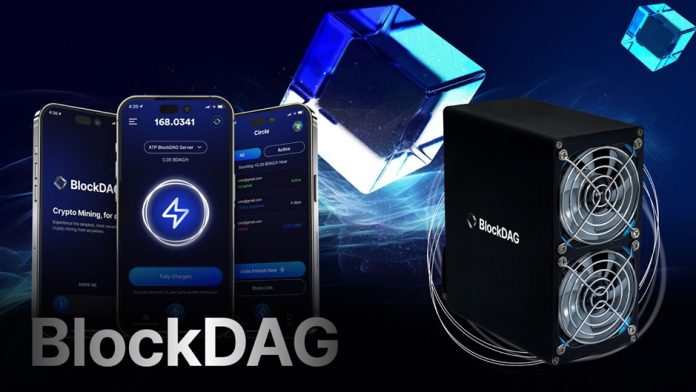
This innovative approach has generated significant investor interest, with presale price increments indicating confidence in exponential returns. Importantly, BlockDAG has opened new avenues for miners, from Mobile Mining to deploying ASIC miners and developing heavy-duty X series mining rigs. These initiatives cater to a broad spectrum of investment appetites, from the casual to the industrial scale, underscoring BlockDAG’s comprehensive mining strategy.

With ambitious plans, including a future coin valuation of $10 by 2025-30 and a strategic investment of $600 million, BlockDAG aims to redefine the blockchain space. Its projections, such as the potential 10,000x return on investment and achieving $100 million in liquidity post-coin launch, demonstrate its commitment to becoming a dominant force in the cryptocurrency market.

By introducing a crypto payment card and creating an ecosystem that supports ASIC miners and offers significant community incentives, such as a $2 million shared giveaway, BlockDAG is lowering investment barriers and fostering a strong community. This strategy marks BlockDAG’s entry into the market and positions it as a revolutionary force, promising to redefine blockchain technology and offer ASIC miners a golden opportunity.

BlockDAG’s Potential Plan To Reach The $600 Million

STX crypto, riding a 30% surge, exemplifies the vibrant potential in the sluggish crypto market, fueled by ecosystem upgrades and investor enthusiasm. Concurrently, Optimism (OP) price hints at growth with a 10% jump despite potential short-term profit-taking risks. The scene broadens with BlockDAG’s entry, revolutionising mining with ASIC miners and a hybrid consensus model, promising enhanced scalability and security.

Furthermore, BlockDAG’s commitment to strengthening the mining ecosystem by developing ASIC miners and high-performance X series rigs offers a promising avenue for miners.

Join BlockDAG Now!

Website: https://blockdag.network

Presale: https://purchase.blockdag.network

Telegram: https://t.me/blockDAGnetworkOfficial

Discord: https://discord.gg/Q7BxghMVyu

Nvidia Set to Face Stiff Competition as Rival Firms Group to Build Suite of AI-Powered Software Tools

0

American multinational corporation and technology company Nvidia, is poised to encounter fierce competition as a consortium of rival companies have collaborated to construct a suite of AI-powered software tools.

According to a report from Reuters, tech giants which include Qualcomm, Google, and Intel have grouped in a consortium named the UXL Foundation to build a suite of software and tools that will be able to power multiple types of AI accelerator chips.

The software, an open-source project built initially using Intel technology, aims to make computer code run on any machine, regardless of what chip and hardware powers it.

This collaboration signals a strategic effort by competing companies to leverage their collective strengths and expertise in artificial intelligence to challenge Nvidia’s dominant position. By joining forces, these firms can combine their research, development, and technological capabilities to create innovative solutions that rival Nvidia’s offerings.

With more than 4 million global developers relying on Nvidia’s CUDA software platform to build AI and other apps, these companies are trying to create their own version of CUDA software, that will see developers tempted to try out other chips, particularly at a time when supply constraints have ravaged Nvidia and others.

Senior Director and Head of AI and ML Product Management at Qualcomm Vinesh Sukumar disclosed to Reuters that the consortium was showing developers how to migrate out from an Nvidia platform. The consortium technology remains underwork, with technical details not expected to be nailed down until the end of the year.

Known for its dominance in AI chips, Nvidia has also fortified its market position through its CUDA software platform, crucial for AI and app development.

No other firm has benefited from the boom in artificial intelligence (AI) as much as Nvidia. Since January 2023 the chipmaker’s share price has surged by almost 450%.

Nvidia earned its $2.2 trillion market cap by producing artificial intelligence chips that have become the lifeblood powering the new era of generative AI developers from startups to Microsoft, OpenAI, and Google parent Alphabet. More than 4 million global developers rely on Nvidia’s CUDA software platform to build AI and other apps.

While the company has established itself as a leader in AI hardware with its GPUs (Graphics Processing Units), there are speculations that the rise of competing software solutions could disrupt its market dominance and reshape the competitive landscape.

It is interesting to note that the interest in unseating Nvidia through a potential weakness in software has ramped up since last year, with several companies and startups developing their AI-powered software chips.

For Nvidia, the prospect of facing intensified competition necessitates a strategic response. The company may need to invest further in research and development to maintain its technological edge, enhance its software offerings, and differentiate itself from competitors.

When asked about the open source and venture-funded software efforts to break Nvidia’s AI dominance, Nvidia executive Ian Buck said in a statement: “The world is getting accelerated. New ideas in accelerated computing are coming from all across the ecosystem, and that will help advance AI and the scope of what accelerated computing can achieve.”

Nvidia whose chip technology dominates in data centers used to create artificial intelligence (AI) software, announced new products to help the personal computer industry lure consumers with “AI PCs”.

Despite the intensified rivalry, the company is well-positioned to continue to be a leader in the AI hardware market for many years to come. The company’s strong track record of innovation, its strong ecosystem, and its large and growing customer base give it a significant advantage over its competitors. However, the company will need to continue to innovate and adapt to the changing nature of AI to maintain its dominance.

At the GTC 2024, an annual conference held by Nvidia, the company said it wants to become the “TSMC for AI” as it expands beyond hardware and taps into software services.

Nvidia, CEO Jensen Huang unveiled a series of platforms and tools that will make it easier for developers to custom-build and deploy their own AI products based on pre-built AI models by Nvidia.

Most analysts expect that Nvidia, which controls more than 95% of the market for specialist AI chips, will continue to grow at a blistering pace for the foreseeable future.

As demand for generative AI services continues to grow, with the AI chip market projected to more than double by 2027, to roughly $140 billion, it is evident that chips will be the next big battleground for AI supremacy.