DD
MM
YYYY

PAGES

DD
MM
YYYY

spot_img

PAGES

Home Blog Page 3549

Aspire to be a #Leader And Lead Others to Success [video]

0

In companies and nations, when great leaders emerge, SUCCESS comes. It requires someone with a vision and a plan. Yet, that leader needs people to execute any mission – and s/he must inspire and motivate those people to play along, knowing that in some cases, they may not even know the full execution template.

But as things progress, one by one, all the people will begin to attain heights HIGHER than their individual imaginations, because a leader has built structures and platforms which elevate them. 1+1 = 11, not 2, in this place!

The leader as the captain of the company or nation has the special policy tools (the rope, the hammer, etc) which are the things others do not have, even as they contribute. Riding on the strength of the people, the leader uses the tools(here, the rope, anchor) to elevate all to success.

A great leader makes you feel important in his/her presence, because you are needed for success to happen. A bad manager presents himself or herself, making it clear that you do not matter, and sustained success rarely happens. Aspire to be a #leader! And may the world experience the RISE of All, not just a FEW, as leaders with visions emerge.

Trade costs in Nigeria and Ethiopia are Five Times Higher than those in the US – World Bank

0

In a recent publication titled Africa Pulse, the World Bank highlighted the significant disparity in trade costs between Nigeria, Ethiopia, and the United States, attributing it to a multitude of factors including insecurity, transportation costs, topography, and poor road infrastructure.

According to the report, trade costs in Nigeria and Ethiopia are four to five times higher than those in the United States, which has profound implications for market integration and economic development across Africa.

The World Bank noted the detrimental effects of market distortions, which result in price discrepancies for imported food and non-food products, indicating a lack of market integration within African economies.

The report stated, “Similarly, access to product markets is constrained, which prevents firms and farms from scaling up their production. In particular, the lack of connectivity and market integration means that markets are segmented, allowing firms or farms with market power to capture benefits, contributing to income inequality.”

“Studies from the Africa region consistently find spatial differences in prices of imported goods (food and non-food) as well as nontraded agricultural staples, indicating that markets are not well-integrated, and the retail prices of products are affected by distance.

“For instance, trade costs are four to five times higher in Ethiopia and Nigeria than in the United States, due to poor road infrastructure, low competition in the transportation sector, topography,” the report continued.

Moreover, the high trade costs in Nigeria and Ethiopia discourage exports, leading African producers to prioritize local markets over international trade. This preference for domestic sales further perpetuates market segmentation and inhibits the expansion of African businesses on the global stage.

The report further noted, “The consequences of these distortions include the preference of African producers to sell locally rather than export. Furthermore, frictions in the labour markets across Africa are as a result of high transport cost, elevated cost of screening workers and lack of information on labour opportunities.”

In addition to trade costs, the World Bank highlighted frictions in labor markets across Africa, which are exacerbated by high transport costs, elevated screening costs for workers, and a lack of information on labor opportunities. These challenges hinder labor mobility and contribute to unemployment and underemployment in the region.

The report also noted the role of state involvement in creating barriers to trade competition and investment across Africa. Regulatory frameworks often favor big players in the market, allowing them to set prices above market rates to the detriment of consumers, small competitors, and workers.

It stated, “Global analysis of World Bank and Organization for Economic Co-operation and Development indicators of product market regulations suggest that barriers to competition in product markets tend to be higher in African countries, due to a high degree of state involvement in markets, legal and administrative barriers to entrepreneurship, as well as barriers to trade and investment.”

The implications weigh heavily on economic growth

Findings show that the implications of high trade costs, market distortions, and regulatory barriers on economic growth in Nigeria, Ethiopia, and other African countries are multifaceted and profound. These factors have been noted to hinder the development and expansion of industries, limit market integration, stifle innovation, and perpetuate income inequality.

Below are some noted key implications:

Reduced Competitiveness: High trade costs and market distortions make it more expensive for businesses to import and export goods, reducing their competitiveness in the global market. This limits the growth potential of industries and stifles economic diversification efforts.

Limited Market Integration: Market segmentation resulting from trade costs and distortions prevents firms from accessing larger markets and scaling up their production. This lack of market integration limits economies of scale and efficiency gains, constraining overall economic growth.

Income Inequality: Market distortions, particularly those that benefit large players at the expense of smaller competitors, contribute to income inequality. By allowing dominant firms to set prices above market rates, market distortions exacerbate disparities in income distribution, undermining social cohesion and economic stability.

Reduced Investment and Innovation: Regulatory barriers and market distortions discourage investment and innovation by creating uncertainty and limiting opportunities for small businesses and entrepreneurs. This stifles entrepreneurship and inhibits the development of new industries and technologies that could drive economic growth.

Limited Export Potential: High trade costs and market distortions discourage exports, as African producers often prioritize local markets due to the challenges associated with international trade. This limits foreign exchange earnings and reduces opportunities for economic diversification through export-led growth strategies.

Impeded Labor Market Efficiency: Frictions in labor markets resulting from high transport costs and limited information on labor opportunities contribute to unemployment and underemployment. This inefficiency hampers overall productivity and economic growth by restricting labor mobility and hindering the matching of workers with suitable employment opportunities.

BlockDAG’s 20,000x ROI Projection & 3-Month Sell-Out Prospect Confine InQubeta & Cardano to the Rear

0

BlockDAG‘s dramatic rise in the crypto realm is sending shivers through the industry’s spine, with a projected 20,000x return on investment (ROI) and the tantalising prospect of a sell-out within a mere three months. This impressive feat positions BlockDAG as a frontrunner and relegates competitors like InQubeta and Cardano to the background. While InQubeta garners attention with its presale enthusiasm and Cardano makes strides in eco-conscious policies, BlockDAG’s $15.3 million presale milestone is a testament to its unparalleled potential.

The buzz surrounding BlockDAG’s innovative technology, strategic vision, and market positioning is drawing unprecedented interest from investors and enthusiasts alike. As the crypto landscape evolves, BlockDAG has become a symbol of innovation and trust, offering a transformative journey in the digital asset space. Investors seeking to capitalize on the next big wave in cryptocurrency are increasingly turning to BlockDAG as the epitome of growth, innovation, and potential in the blockchain revolution.

InQubeta’s Presale Momentum

InQubeta’s presale has ignited fervent enthusiasm within the crypto community, drawing substantial investments and attracting holders of prominent tokens like Solana and Floki. Surpassing $12.8 million in early funding, InQubeta’s pioneering platform emerges as a magnet for investors seeking groundbreaking opportunities in the crypto space. Its allure lies in its innovative approach and potential to redefine traditional paradigms, offering a gateway to explore new avenues of value creation and growth. With its strong momentum and community support, InQubeta sets itself apart as a promising contender in the competitive world of cryptocurrency investments.

Cardano’s Eco-Friendly Initiative

Cardano sets a significant precedent with its Sustainability Policy, which integrates environmental consciousness into its blockchain framework. This initiative underscores Cardano’s commitment to harmonizing technological innovation with environmental responsibility, presenting a blueprint for future eco-friendly cryptocurrencies. It prioritises sustainability and aims to reduce its carbon footprint and minimise environmental impact, aligning with broader efforts towards achieving ecological sustainability in the blockchain industry. This approach demonstrates Cardano’s dedication to addressing environmental concerns and sets a positive example for other blockchain projects.

BlockDAG’s Trailblazing Presale Feat

BlockDAG’s presale journey has been nothing short of extraordinary, amassing over $15.3 million in funding and selling more than 7 billion coins. Progressing into Batch 8 with coins priced at $0.0045 each, BlockDAG’s trajectory points towards a promising future. Projections of a 20,000x ROI spark dreams of ushering in the next wave of crypto millionaires.

At the core of BlockDAG’s appeal lies its fusion of blockchain reliability with DAG’s speed, setting a new standard in distributed ledger technology. With transaction speeds surpassing traditional blockchains and a user-centric design, BlockDAG transcends being a mere cryptocurrency; it emerges as a revolutionary platform poised to redefine digital transactions.

With an ambitious target to achieve a $600 million market cap by 2024, BlockDAG’s roadmap underscores its dedication to innovation and market leadership. This clear, actionable plan instils confidence in investors and positions BlockDAG as a trailblazer in the blockchain revolution, aiming to set new industry benchmarks.

The Final Call

In the quest for the most promising crypto of 2024, BlockDAG shines brightly with its remarkable presale success, innovative technology, and bold market forecasts. While InQubeta and Cardano bring their unique strengths to the table, BlockDAG’s blend of technological prowess and investor confidence propels it to the forefront of potential crypto frontrunners.

Amidst the dynamic crypto arena, BlockDAG offers a compelling narrative of growth, innovation, and potential, inviting investors to join a transformative journey in the digital asset space.

Invest In BlockDAG

Website: https://blockdag.network

Presale: https://purchase.blockdag.network

Telegram: https://t.me/blockDAGnetworkOfficial

Discord: https://discord.gg/Q7BxghMVyu

Bitcoin Halving Fosters Bullish Sentiment as Price of The Cryptocurrency Surges

0

The upcoming Bitcoin halving event which is expected to occur in April 2024 has fostered a bullish sentiment as the price of Bitcoin surged to the $72k price before retracing back to $69k price.

According to Bloomberg, the event which is considered as one of the most eagerly anticipated in the crypto market has driven up the price of the digital asset.

Bitcoin has seen a 50 percent increase in value this year, despite experiencing a decline from its all-time high of $73,798 on March 14th. The surge is attributed to the approval of ETFs by the US Securities and Exchange Commission (SEC) in January this year.

Reports reveal that Bitcoin miners are accumulating rather than liquidating their holdings as they anticipate a bullish market. This expectation of price increase has potentially driven prices higher.

It is understood that Bitcoin Halving events is historically heralded by a significant price increase, attributed to reduced supply and heightened scarcity. Past events have ushered in a bull run in prices, due to the reduction in supply.

However, several analysts have warned against overly simplistic expectations of post-halving price surges, pointing out that Bitcoin’s price trajectory over the past 15 years has been shaped by a myriad of external factors such as monetary policies, economic trends, the stock market, etc.

Co-founder and former CEO of crypto exchange BitMEX and the chief investment officer at Maelstrom, Arthur Hayes said Bitcoin will probably face selling pressure in the days before and after the mining-reward halving due April 20, a supposedly bullish event.

He wrote via a blog post,

“The narrative of the halving being positive for crypto prices is well entrenched. When most market participants agree on a certain outcome, the opposite usually occurs. That is why I believe Bitcoin and crypto prices in general will slump around the halving.

“Given that the halving occurs at a time when dollar liquidity is tighter than usual, it will add propellant to a raging firesale of crypto assets. The timing of the halving adds further weight to my decision to abstain from trading until May”.

Also, several other analysts have argued that the supply slowdown is priced in and the market could correct following the halving event. They predict that the crypto market is expected to go through volatility amid the halving event, urging investors to remain vigilant and closely monitor the digital asset.

In a bid to mitigate risk, reports reveal that professional traders are turning to options strategies. This approach allows for leveraging positions with a relatively small upfront deposit, sidestepping the direct risk of liquidation prevalent in futures markets.

The Best Asset Class for Investment is Investing in Companies, 50 Year Data Shows

0

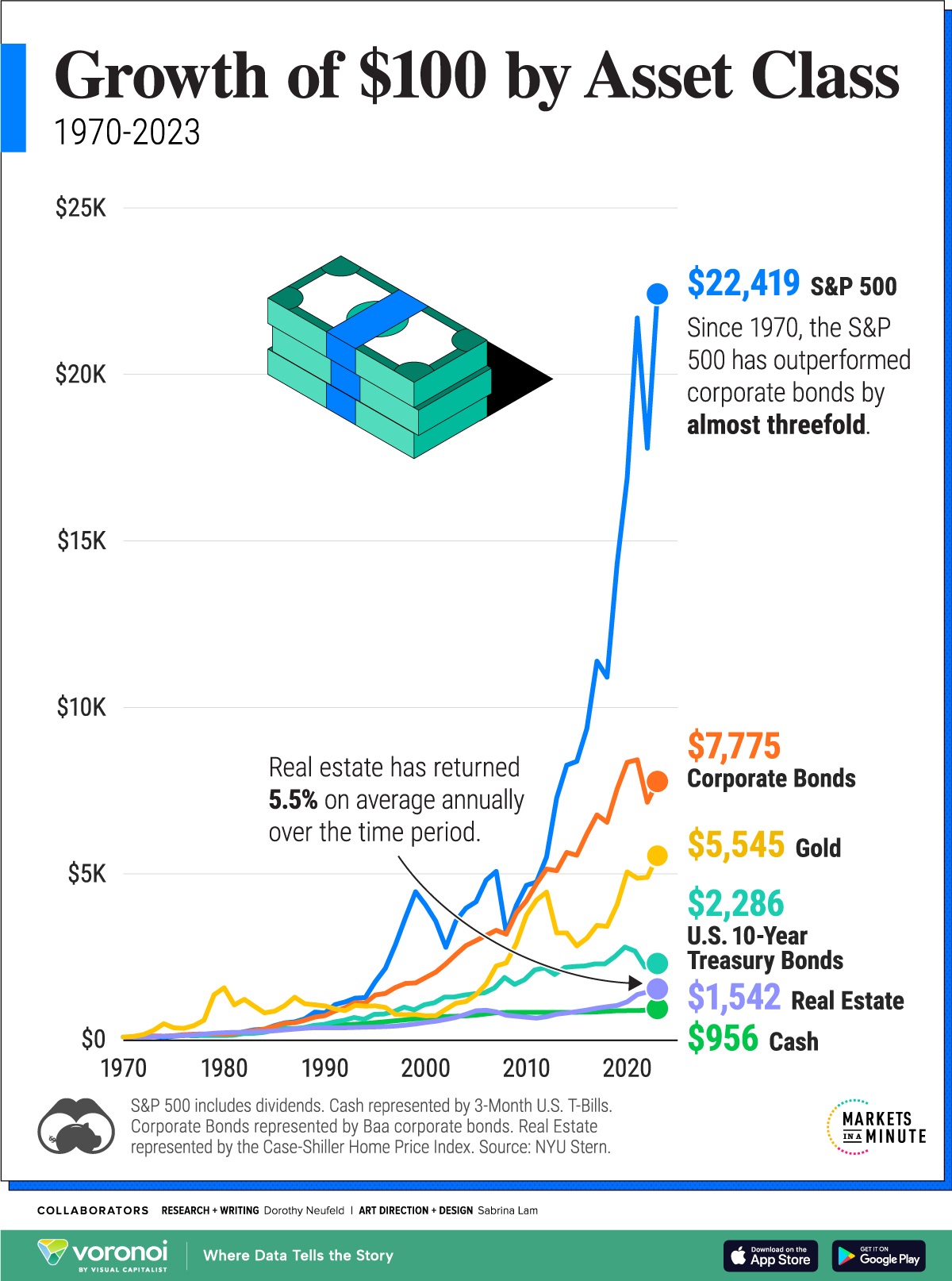
Nothing has made people richer than investing in companies!  Why? Companies are like living organizations which have mutative capabilities to adjust better than other asset classes. In other words, since companies are part of the dynamic economic system, they can adapt far better than gold, real estate, bonds, etc to deliver better value to investors. This plot shows the growth of $100 by asset class over the long term.

Comparing Asset Class Returns

Below, we show the returns of a $100 investment across major asset classes—from U.S. stocks to gold—between 1970 and 2023:

Year S&P 500 Corporate
Bonds
Gold U.S. 10-Year
Treasury Bonds
Real Estate Cash
1970 $100 $100 $100 $100 $100 $100
1980 $226 $181 $1,578 $141 $229 $192
1990 $823 $741 $1,033 $477 $374 $431
2000 $4,060 $1,886 $734 $1,067 $536 $682
2010 $4,656 $4,191 $3,760 $1,821 $693 $840
2020 $16,890 $8,349 $5,059 $2,802 $1,155 $891
2023 $22,419 $7,775 $5,545 $2,286 $1,542 $956

Numbers have been rounded. S&P 500 includes dividends. Cash represented by 3-Month U.S. T-Bills. Corporate Bonds represented by Baa corporate bonds. Real Estate represented by the Case-Shiller Home Price Index.

Meanwhile, Nigerian banks are responding to fintechs with vigour: “Habaripay, the fintech subsidiary of Guaranty Trust Holding Company (GTCO), has reported a N2.17 billion post-tax profit year ended December 2023.”   We will see how this battle will unfold in 2024 (we will discount 2023 as that was the year for Nigerian banks).