DD
MM
YYYY

PAGES

DD
MM
YYYY

spot_img

PAGES

Home Blog Page 3572

Javier Milei Confirms He will Shut Down Central Bank of Argentina; Kraken vs SEC and $3.1m Coin Transaction Fees

0

In a shocking announcement, Argentina’s President Javier Milei confirmed that he will shut down the Central Bank of Argentina (BCRA) as part of his radical economic reforms. Milei, who took office in November 2023 after winning a landslide victory on a libertarian platform, said that the BCRA has been a source of inflation, corruption and financial instability for decades and that it is time to end its monopoly on money creation.

Milei’s plan is to replace the BCRA with a free banking system, where private banks and financial institutions can issue their own currencies backed by gold, silver, cryptocurrencies or other assets. He said that this will create a competitive and sound monetary system that will protect the purchasing power of the Argentine people and foster economic growth and development.

The BCRA is the central bank of Argentina, being an autarchic entity that promotes monetary and financial stability, employment and economic development with social equity. It was established in 1935 and has a history of intervening in the exchange rate market to stabilize the economy and currency. It has a 100% state ownership and a presidentially appointed board of directors.

Milei also said that he will abolish all capital controls, currency restrictions and exchange rate regulations that have hampered the free flow of money and trade in Argentina. He said that he will allow the peso to float freely in the market and that he will not intervene to manipulate its value. He said that this will restore confidence in the peso and attract foreign investment and tourism to Argentina.

How will this affect Argentina’s economy?

The effects of Milei’s proposal on Argentina’s economy are hard to predict, as there is no precedent for such a radical change in monetary policy. However, some possible scenarios are:

If the free banking system works as intended, Argentina’s economy could experience a boost in productivity, innovation and competitiveness, as private banks would provide more efficient and diverse financial services to consumers and businesses.

The peso would stabilize and appreciate in value, as it would reflect the market demand and supply of money. Inflation would decrease, as money creation would be limited by the assets backing each currency. Argentina’s economy could become more integrated with the global market, as capital flows would increase, and trade barriers would be eliminated.

If the free banking system fails or faces difficulties, Argentina’s economy could suffer a severe crisis, as private banks would face insolvency, fraud or runs on their currencies. The peso would lose its credibility and value, as it would compete with multiple currencies with different qualities and prices.

Inflation would skyrocket, as money creation would be uncontrolled and unpredictable. Argentina’s economy could become more isolated and vulnerable, as capital flows would decrease and trade disputes would arise.

Milei’s announcement was met with mixed reactions from different sectors of society. Some praised his bold and visionary move, saying that it will liberate Argentina from the tyranny of central banking and usher in a new era of prosperity and freedom. Others criticized his reckless and irresponsible decision, saying that it will plunge Argentina into chaos and hyperinflation and destroy its financial system and economy.

Milei said that he is aware of the risks and challenges of his proposal, but that he is confident that it will succeed and benefit the Argentine people in the long run. He said that he is ready to face any opposition or resistance from the political establishment, the media, the international community or any other group that may try to stop him. He said that he is determined to make Argentina the first country in the world to adopt a free banking system and to prove that it is a viable and superior alternative to central banking.

Kraken VS SEC and $3.1m transaction fees

In a recent statement, Kraken, one of the largest and oldest cryptocurrency exchanges in the world, announced that they are facing a lawsuit from the U.S. Securities and Exchange Commission (SEC) over their alleged violation of securities laws. The SEC claims that Kraken has been offering and selling unregistered securities to U.S. investors, namely certain digital assets that the SEC considers to be investment contracts.

Kraken strongly denies the SEC’s allegations and asserts that they have been complying with all applicable laws and regulations. They argue that the SEC’s approach is inconsistent, unclear, and harmful to the innovation and growth of the crypto industry. They also accuse the SEC of overreaching its authority and imposing its own views on what constitutes a security, without providing clear guidance or due process.

Kraken’s CEO, Jesse Powell, said in a tweet that they will “vigorously defend” themselves against the SEC’s “unfounded and misguided” lawsuit. He also urged the crypto community to stand together and resist the SEC’s attempts to stifle the development of decentralized technologies. He said that Kraken is not afraid of a legal battle and that they have the resources and the resolve to fight for their rights and their customers’ interests.

The lawsuit is the latest in a series of actions that the SEC has taken against crypto companies in recent years. The SEC has sued several other exchanges, such as Coinbase, Bitfinex, and Poloniex, as well as crypto projects, such as Ripple, Telegram, and Kik, for allegedly violating securities laws. The SEC’s stance has been criticized by many in the crypto space as being hostile, arbitrary, and outdated.

The outcome of the lawsuit could have significant implications for the future of crypto regulation in the U.S. and beyond. It could also affect the availability and accessibility of certain digital assets for U.S. investors. Many crypto enthusiasts are hoping that Kraken will prevail in court and set a precedent for a more favorable and sensible regulatory framework for crypto.

Someone paid $3.1m for a single Bitcoin transaction.
Bitcoin, the most popular cryptocurrency in the world, has seen a surge in value and activity in recent months. The price of one bitcoin reached an all-time high of over $68,000 in November 2021, and the network processed more than 300,000 transactions per day on average.

However, not all transactions are equal. Some are more expensive than others, depending on the size, complexity and urgency of the transaction. The fee that a user pays to send a bitcoin transaction is determined by the supply and demand of the network’s limited space. The more congested the network is, the higher the fee.

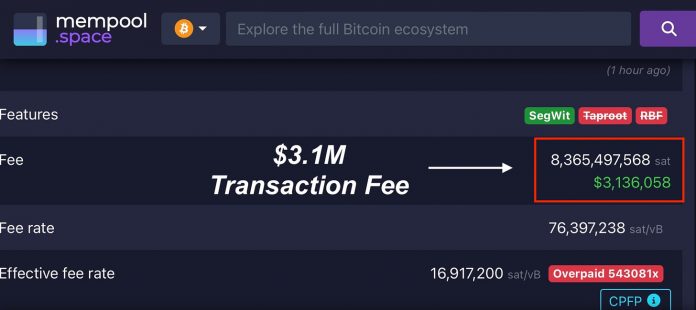
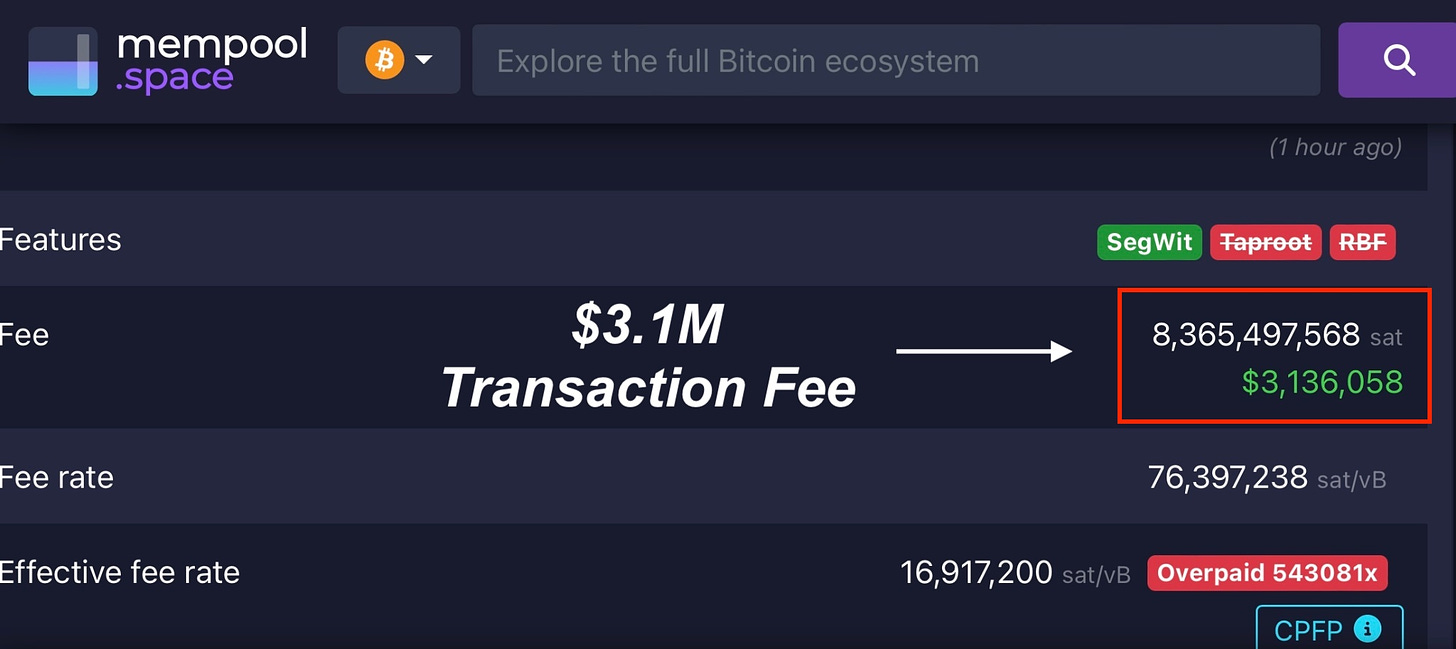
On November 22, 2023, someone paid a staggering $3.1 million for a single bitcoin transaction. This is the highest fee ever paid for a bitcoin transaction, according to blockchain data provider BitInfoCharts. The previous record was $2.3 million, paid in April 2021.

The transaction in question was a complex one, involving 3,490 inputs and 3,490 outputs. Each input and output add to the size of the transaction, which affects the fee. The transaction was also sent with a high priority, meaning that the user wanted it to be confirmed as soon as possible by the network.

The reason for this expensive transaction is not clear. It could be a mistake, a deliberate act of generosity, or a sophisticated operation that required such a large and urgent transaction. Some speculate that it could be related to a ransomware attack, a money laundering scheme, or a tax evasion strategy.

Whatever the motive, this transaction shows the volatility and unpredictability of the bitcoin network. While some users enjoy low fees and fast confirmations, others may have to pay exorbitant amounts or wait for hours or days for their transactions to go through. This poses a challenge for the adoption and usability of bitcoin as a global payment system.


Tokenization of Investment Funds Approved in the UK

0

The UK Financial Conduct Authority (FCA) has recently announced that it has granted permission to a fintech company to launch a platform that will allow investors to buy and sell tokenized shares of investment funds. This is a significant milestone for the adoption of blockchain technology and digital assets in the financial sector.

Tokenization is the process of converting an asset, such as a share, bond, or property, into a digital token that can be stored and transferred on a blockchain network. Tokenization can offer several benefits for investors and fund managers, such as:

Increased liquidity: Tokenized assets can be traded on secondary markets, enabling investors to exit their positions more easily and quickly. Reduced costs: Tokenization can eliminate intermediaries and streamline processes, reducing administrative fees and commissions. Enhanced transparency.

Tokenization can provide real-time information on the performance and holdings of the funds, increasing trust and accountability. Greater access. Tokenization can lower the barriers to entry for investors, allowing them to participate in funds that were previously inaccessible or too expensive.

How does blockchain tokenization work?

Blockchain tokenization is a process of creating a digital representation of an asset on a blockchain network. This allows the asset to be transferred, stored, and verified in a secure and efficient way. Blockchain tokens can represent tangible assets like real estate or art, intangible assets like voting rights or ownership rights, or even identity and data.

Blockchain tokens have several benefits for both users and issuers of the assets.

More liquidity: Tokenizing an asset makes it accessible to a larger market of potential buyers and sellers, who can trade the tokens online and acquire fractional ownership of the asset. This reduces the barriers to entry and exit for investors and lowers the cost of capital for issuers.

More efficiency: Tokenizing an asset eliminates the need for intermediaries and paperwork that are involved in traditional asset transactions. This reduces transaction costs, delays, and errors, and improves transparency and auditability.

More security: Tokenizing an asset enhances its security by using cryptography and distributed ledger technology to ensure the authenticity, integrity, and immutability of the tokens. This prevents fraud, theft, and duplication of the tokens, and protects the rights and interests of the users and issuers.

There are different types of blockchain tokens that serve different purposes and functions. Some of the common types are:

Security tokens: These are tokens that represent regulated financial assets, such as stocks, bonds, or derivatives. Security tokens are subject to securities laws and regulations and require compliance with KYC (know your customer) and AML (anti-money laundering) rules. Security tokens can offer more access, liquidity, and efficiency to traditional financial markets, as well as enable new forms of fundraising and capital formation.

Utility tokens: These are tokens that provide access to a service or a network, such as cloud storage, bandwidth, or computing power. Utility tokens are not intended to be investments or securities, but rather to facilitate the consumption or provision of a specific service or function. Utility tokens can enable new business models and incentivize network participation and growth.

Cryptocurrencies: These are tokening that function as a medium of exchange, a store of value, or a unit of account, such as Bitcoin, Ether, or stablecoins. Cryptocurrencies are usually decentralized and permissionless, meaning that anyone can use them without intermediaries or authorities. Cryptocurrencies can offer more freedom, privacy, and innovation to users, as well as challenge the existing monetary system.

The FCA’s approval of the tokenization platform is a sign of its openness and innovation in regulating emerging technologies. The FCA has been actively engaging with the fintech industry and supporting initiatives such as the Regulatory Sandbox, which allows firms to test new products and services in a controlled environment. The FCA has also issued guidance on cryptoassets and stablecoins, clarifying its regulatory approach and expectations.

The tokenization platform is expected to launch in early 2024, offering investors access to a range of funds from different asset classes and geographies. The platform will use blockchain technology to ensure security, efficiency, and compliance. The platform will also adhere to the FCA’s rules and standards on investor protection, anti-money laundering, and market integrity.

The tokenization of investment funds is a promising development for the UK’s fintech sector and the wider financial industry. It could create new opportunities for investors and fund managers, as well as foster innovation and competition. It could also pave the way for further adoption of blockchain technology and digital assets in other areas of finance, such as banking, insurance, and capital markets.

Blockchain tokenization is a powerful and disruptive technology that has the potential to transform various industries and sectors. By creating digital representations of assets on a blockchain network, tokenization can unlock new opportunities for value creation, exchange, and verification.

It’s Graduation Week at Tekedia Institute; Join Us And Celebrate

0
Graduation week tekedia mini-MBA

Good People, it’s graduation week at Tekedia Institute and Tekedia Mini-MBA edition 12 will conclude this week. It has been a great academic excursion on the mechanics of market systems. Yes, over the last 13 weeks, more than 80 faculty members have led those excursions across different business topics and domains.

We have mastered the fundamental constructs of business, and acquired skills and knowledge from executives in leading global and local companies, on innovation, business growth and operational execution.

For this week’s Live sessions, we will begin with “The Journey to Growth” on Tuesday, to be followed by “The Call to Business Execution” on Thursday. On Saturday, we will have the grand finale with “Unlocking The Era of Opportunity”. Yes, opportunities everywhere; let’s go and unlock them. Zoom links in the Board. I will lead all the sessions this week.

The #knowledge of a people is the #wealth of a people. To our co-learners, graduating this week, you are #ready2lead . To experience our quality and join the next edition of Tekedia Mini-MBA which begins in Feb 2024, go here and register.

Fintech Startup Peloton Technologies Closes $2 Million Seed Funding to Simplify Payments For SMEs

0
Fund, money cash dollar

Canadian-based Fintech startup Peloton has closed a $2 million seed funding to simplify the traditionally complicated workflows faced by Small and Medium Sized Enterprises (SMEs).

Executive Chair of the Board, Peloton Technologies, John Mackinlay, disclosed that the seed will be very instrumental in the company’s acquisition strategy and a strong catalyst to its organic growth initiatives.

In his words,

“We’re thrilled with the response from the private investor community. We have a world-class group of investors with a deep background in payments, banking, risk management, accounting, compliance, IT architecture, and securities law. This capital is instrumental to our acquisition strategy and a catalyst for our organic growth initiatives. It is a precursor to a larger capital raise planned for Q1/Q2 of 2024”.

Peloton’s $2 million seed round is coming weeks after it acquired British Columbia-based payment processing startup, KIS Payments, in October this year. The acquisition of KIS payments expanded Peloton’s client base and sales teams, allowing the startup to rapidly scale the delivery of its innovative service offerings.

Founded in 2011, Peloton Technologies is one of the leading Canadian Fintech providing small and medium-sized enterprises with access to the global market.

The platform hosts what it calls a unified SaaS payments platform that allows users and merchants to process, complete transfers, exchange currency, and store payment data all in one place.

Peloton makes it simple to transfer funds between organizations, make payments to  suppliers, and enables users to deposit and withdraw funds from their financial institutions.

Notably, the Peloton Portal provides an overview of all users accounts with a new and enhanced interface. Everything was redesigned in a way to give them quicker and more intuitive access to their  payment tools.

The portal also offers new reporting tools and better user management for companies, to allow them to provide the right access to each member of their team.

A single Peloton Account can support charging users Amex credit card, sending electronic funds transfers (EFT) and wire transfers, and even handling currency conversations when paying foreign currency invoices. The startup also supports bill payment for payments to government bodies. Support for credit and debit with all major card brands include Visa, Mastercard, American Express, Discover, and JCB.

With rapid growth in their goal, Peloton recently acquired an ISO (Independent Sales Organization) and rolled their merchant services operations into their sales team.

The new investment bolsters Peloton’s growth strategy through the acquisition of additional ISOs. Acquiring ISOs has expanded Peloton’s client base and sales operations, expediting the delivery of their innovative service offerings.

CBN Recapitalization and Implications of $1 trillion GDP target for Nigerian Economy

0

The Central Bank of Nigeria (CBN) has announced a new plan to recapitalize the banking sector in order to support the country’s economic growth and development. The CBN governor, Yemi Cardoso, said that the recapitalization exercise would enable the banks to provide more credit to the productive sectors of the economy and help achieve the target of $1 trillion gross domestic product (GDP) by 2025.

According to Cardoso, the current capital base of the banks, which was set at N25 billion in 2004, is no longer adequate to meet the challenges and opportunities of the 21st century. He said that the CBN would soon release a new circular that would specify the minimum capital requirements for each category of banks, taking into account their size, scope and risk profile.

Capital adequacy is the measure of the financial strength and resilience of a bank or a financial institution. It reflects the ability of the institution to absorb losses and meet its obligations to depositors and creditors. Capital adequacy is also important for maintaining public confidence and promoting financial stability.

CBN current capital base in Nigeria

The CBN has issued various guidelines on the minimum capital requirements and buffers for different categories of banks and financial institutions in Nigeria. These guidelines are based on the Basel III standards, which are the global best practices for banking supervision and regulation.

The Basel III standards aim to improve the quality and quantity of regulatory capital, enhance risk coverage, introduce leverage ratio, liquidity standards and capital buffers. The CBN has adopted these standards with some modifications to suit the Nigerian context.

The CBN has also revised its guidelines on regulatory capital from time to time, in response to changing economic conditions and emerging risks. The latest revision was in September 2021, when the CBN issued the Guidelines on Regulatory Capital for Deposit Money Banks (DMBs).

According to these guidelines, the minimum capital requirements and buffers for DMBs are as follows:

Common Equity Tier 1 (CET1) ratio: 4.5%.

Tier 1 capital ratio: 6%.

Total capital ratio: 10%.

Capital conservation buffer: 2.5%.

Countercyclical buffer: 0 – 2.5%.

Higher loss absorbency for Domestic Systemically Important Banks (D-SIBs): 1 – 3.5%.

The CET1 ratio is the ratio of a bank’s core equity capital to its risk-weighted assets. Core equity capital includes common shares, retained earnings and other reserves. Risk-weighted assets are the total assets of a bank adjusted for their riskiness according to predefined weights.

The Tier 1 capital ratio is the ratio of a bank’s Tier 1 capital to its risk-weighted assets. Tier 1 capital includes CET1 and additional Tier 1 capital. Additional Tier 1 capital includes instruments that are perpetual, non-cumulative, subordinated and have loss absorption features.

The total capital ratio is the ratio of a bank’s total regulatory capital to its risk-weighted assets. Total regulatory capital includes Tier 1 capital and Tier 2 capital. Tier 2 capital includes instruments that are subordinated, have a minimum maturity of five years and have loss absorption features.

The capital conservation buffer is an additional buffer above the minimum capital requirements that banks are required to maintain during normal times. The buffer is designed to ensure that banks have enough capital to absorb losses during periods of stress without breaching the minimum requirements.

The countercyclical buffer is an additional buffer that varies according to the credit cycle. The buffer is designed to mitigate the procyclicality of the banking system, by requiring banks to build up capital during periods of excessive credit growth and release it during periods of credit contraction.

The higher loss absorbency for D-SIBs is an additional buffer that applies to banks that are identified as systemically important for the domestic economy. The buffer is designed to reduce the probability and impact of failure of these banks, by requiring them to hold more capital than other banks.

The CBN has also set different minimum capital requirements for other categories of financial institutions in Nigeria, such as microfinance banks (MFBs), primary mortgage banks (PMBs), non-interest banks (NIBs) and development finance institutions (DFIs).

According to a report by Pulse Nigeria, the minimum capital requirements for MFBs are as follows:

Unit MFBs: N200 million by April 2020 and N250 million by April 2021.

State MFBs: N1 billion by April 2020 and N1.5 billion by April 2021.

National MFBs: N3.5 billion by April 2020 and N5 billion by April 2021.

According to a report by Naija News, the CBN has proposed a new minimum capital requirement of N100 billion for commercial banks with international license, while retaining the existing requirements of N15 billion for regional license and N25 billion for national license.

The CBN monitors and enforces compliance with these minimum capital requirements and buffers through periodic prudential returns, on-site examinations and off-site surveillance. The CBN also imposes sanctions on non-compliant institutions, such as restrictions on dividend payments, lending activities and expansion plans.

The CBN’s guidelines on regulatory capital are aimed at enhancing the soundness and stability of the Nigerian banking system, as well as aligning it with the global best practices. The CBN expects banks and financial institutions to comply with these guidelines and maintain adequate capital at all times.

The CBN governor also said that the recapitalization exercise would be done in a gradual and phased manner, giving the banks enough time to comply with the new standards. He assured the public that the CBN would continue to monitor the financial soundness and stability of the banks and intervene when necessary to protect depositors’ funds and ensure financial system stability.

The recapitalization plan is part of the CBN’s five-year policy thrust, which aims to foster a more inclusive and sustainable economic growth, enhance financial inclusion and access to credit, improve payment system efficiency and security, and strengthen the regulatory and supervisory framework for the banking sector.