DD
MM
YYYY

PAGES

DD
MM
YYYY

spot_img

PAGES

Home Blog Page 3608

$715,000,000 liquidated from the cryptocurrency market since recent ATH (all time high)

0

The cryptocurrency market has experienced a massive sell-off in the past 24 hours, resulting in over $715,000,000 worth of positions being liquidated across various platforms. This is one of the largest liquidation events in recent history, and it has shaken the confidence of many investors and traders.

The main trigger for the liquidation wave was the sudden drop in the price of Bitcoin, the leading cryptocurrency by market capitalization. Bitcoin fell from around $67,000 to below $63,000 in a matter of hours, breaking several key support levels and triggering a cascade of stop-loss orders and margin calls. The sharp decline was likely driven by a combination of factors, including:

Regulatory uncertainty: The crypto industry is facing increased scrutiny and pressure from regulators around the world, who are concerned about the potential risks and challenges posed by the decentralized and unregulated nature of the sector.

Some countries, such as China and India, have taken a hostile stance towards crypto, banning or restricting its use and development. Others, such as the US and the EU, are seeking to impose stricter rules and oversight on crypto activities, such as taxation, reporting, and compliance. These regulatory developments create uncertainty and fear among crypto investors and businesses, who may face legal hurdles or penalties for operating in the space.

Technical issues: The crypto market relies on a complex network of infrastructure and services, such as exchanges, wallets, custodians, miners, and nodes. These components are not immune to technical glitches, hacks, or outages, which can disrupt the normal functioning of the market and cause price fluctuations.

For example, on February 22nd, 2021, a major outage occurred on AWS (Amazon Web Services), a cloud computing platform that hosts many crypto-related websites and applications. This caused several crypto platforms to experience downtime or reduced performance, affecting their users’ ability to access or trade their funds.

Market sentiment: The crypto market is highly influenced by the emotions and expectations of its participants, who often act based on fear or greed rather than rationality or logic. The market is prone to cycles of euphoria and panic, which can create bubbles and crashes.

The recent rally that pushed Bitcoin to new highs above $68,000 was fueled by a wave of optimism and enthusiasm, driven by factors such as institutional adoption, mainstream media attention, and celebrity endorsement.

However, this also created a sense of overconfidence and complacency among some investors, who may have overextended themselves or taken excessive risks. When the market turned bearish, these investors were forced to sell their positions at a loss or face liquidation.

The liquidation event has had significant impacts on the crypto market and its participants. Some of the effects include:

Loss of capital: The most obvious and direct consequence of the liquidation wave is the loss of capital for those who had their positions closed or reduced. According to data from Bybt.com, a crypto derivatives data provider, more than 142,000 traders were liquidated in the past 24 hours, with an average loss of $5,000 per trader. The largest single liquidation order occurred on Huobi exchange, where a Bitcoin position worth $20.6 million was liquidated.

Loss of confidence: The liquidation wave also eroded the confidence and trust of many investors and traders in the crypto market. Some may have lost faith in the long-term viability or potential of crypto as an asset class or a technology.

Others may have felt betrayed or disappointed by the platforms or services they used to access or trade crypto. Some may have experienced psychological distress or trauma from witnessing their portfolios shrink or vanish in a short span of time.

The liquidation wave also deprived many investors and traders of the opportunity to benefit from the future growth or recovery of the crypto market. Some may have missed out on buying low or selling high due to lack of funds, access, or timing. Others may have been deterred from entering or re-entering the market due to fear or uncertainty.

How can investors and traders cope with the liquidation wave and prepare for the future?

Manage your risk: The most important and fundamental rule of investing or trading is to manage your risk properly. This means setting realistic goals and expectations, diversifying your portfolio, using appropriate tools and strategies (such as stop-losses, hedging, etc.), and avoiding over-leveraging or over-trading.

You should also monitor your positions regularly and adjust them according to changing market conditions or your personal circumstances.

Educate yourself: The crypto market is constantly evolving and innovating, offering new opportunities and challenges for its participants. To succeed in this dynamic and competitive environment, you need to educate yourself constantly about the latest trends, developments, and best practices in the industry.

You should also seek to understand the fundamentals and technicalities of the crypto assets and platforms you use or invest in and be aware of the risks and rewards involved.

Seek support: The crypto market can be a lonely and stressful place, especially during times of crisis or turmoil. It can be helpful to seek support from others who share your interests or goals, such as friends, family, mentors, or communities. You can also seek professional help from experts or advisors who can offer you guidance, advice, or assistance in your crypto journey.

The crypto market is not for the faint-hearted. It is a volatile and unpredictable arena, where fortunes can be made or lost in a matter of minutes. However, it is also a fascinating and rewarding space, where innovation and creativity are abundant and where the future is being shaped. By following some of the tips and suggestions above, you can hopefully survive and thrive in the crypto market and enjoy the ride.

Tron Blockchain processes over $2M in fees amid Binance having Transaction glitches on Solana Networks

0

TRON, the blockchain platform that aims to create a decentralized internet, has reached a new milestone in its daily protocol revenue. According to the TRON Foundation, the network generated over $2 million in fees on March 6, 2024, surpassing its previous record of $1.9 million on February 28, 2024.

This achievement reflects the growing adoption and activity of TRON’s ecosystem, which includes various decentralized applications (dApps), decentralized exchanges (DEXs), stablecoins, non-fungible tokens (NFTs), and more. TRON claims to have over 40 million active users and over 2,000 dApps on its platform, making it one of the most popular and vibrant blockchain networks in the world.

One of the main drivers of TRON’s protocol revenue is its native token, TRX, which is used for paying transaction fees, staking, and governance on the network. TRX has also seen a significant increase in its price and market capitalization in the past year, reaching an all-time high of $0.18 on March 5, 2024. At the time of writing, TRX is trading at $0.17, with a market cap of over $12 billion, ranking it as the 12th largest cryptocurrency by CoinMarketCap.

Another factor that contributes to TRON’s protocol revenue is its innovative incentive mechanism, which rewards users for participating in the network. TRON has a daily reward pool of 100 million TRX, which is distributed to users who stake their tokens, vote for super representatives (SRs), and use dApps.

Additionally, TRON has launched several initiatives to attract more developers and users to its platform, such as the TRON Arcade fund, the TRON Accelerator program, and the SUN Network expansion plan.

TRON’s founder and CEO, Justin Sun, expressed his excitement and gratitude for the network’s performance and community support on Twitter. He wrote: “TRON daily protocol revenue hits new time high with $2 million! Thank you to all our users, developers, SRs, and partners for making this possible! TRON is on track to become the most advanced and user-friendly blockchain platform in the world! #TRX #TRON”

TRON’s daily protocol revenue is an important indicator of its network health and value proposition. As more users and developers join the TRON ecosystem, the demand for TRX and the network’s services will increase, leading to higher fees and rewards. This will create a positive feedback loop that will enhance the security, scalability, and innovation of TRON, as well as its competitiveness in the blockchain industry.

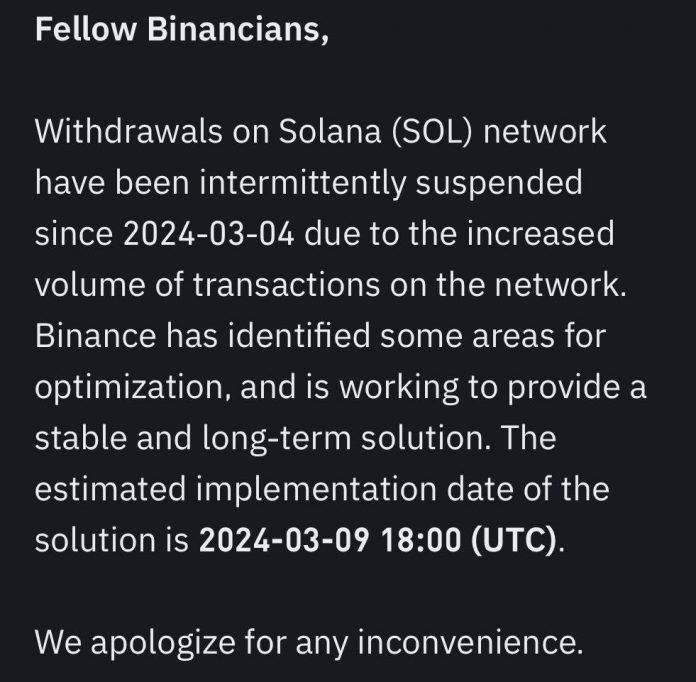
Binance Experiencing Network glitches on Solana transactions.

Binance, one of the largest cryptocurrency exchanges in the world, has announced that it will intermittently suspend withdrawals on the Solana network due to the increased volume of transactions. Solana is a high-performance blockchain that can process up to 50,000 transactions per second, making it one of the fastest and most scalable platforms in the crypto space. However, the recent surge in demand for Solana-based tokens and applications has put a strain on the network, causing delays and congestion.

Binance said in a statement that it is working closely with the Solana team to resolve the issue as soon as possible, and that it will resume withdrawals once the network stabilizes. Binance also advised its users to monitor the status of their transactions on Solana’s official explorer, Solscan, and to contact its customer support if they encounter any problems.

The Solana network has been experiencing unprecedented growth in the past few months, attracting billions of dollars in investments and launching hundreds of projects in various sectors, such as decentralized finance (DeFi), non-fungible tokens (NFTs), gaming, social media, and more.

Solana’s native token, SOL, has also skyrocketed in value, reaching an all-time high of over $200 earlier this week. Solana’s supporters believe that it has the potential to challenge Ethereum, the dominant smart contract platform, by offering faster, cheaper, and more scalable solutions.

Binance apologized for any inconvenience caused by the temporary suspension and thanked its users for their patience and understanding.

What makes us better supervisors at work? [video]

0

What makes us better supervisors at work? Experience, intuition or ability to see the big picture immediately? Watching this video, the lady might have won via experience. And the man possibly had never seen this challenge before.

But that experience must not necessarily be this particular task which is to move all these containers from one location to another? Indeed, the lady scanned the problem, and quickly designed how to execute the tasks, seeing the end right at the beginning, unlike the man.

What they have done is what the mission of firms is all about: who can effectively combine and recombine factors of production to execute tasks towards creating products and services, required to fix the challenges customers have? If you have workers like the lady, you will win your sector, but if you have people like the man, you will possibly go bankrupt.

#TheBigPicture

Southwest N794,000, Southeast N540,000: Nigerian Labor Unions Propose New Minimum Wage Brackets

0

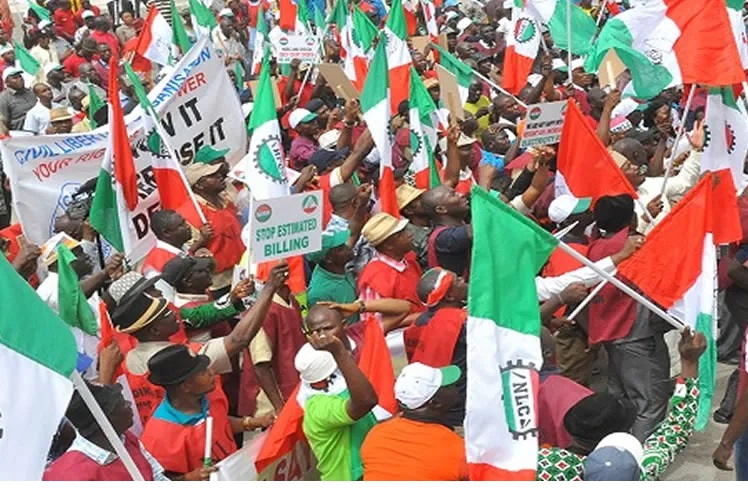
The Nigeria Labour Congress (NLC) has escalated its campaign for a substantial raise in the national minimum wage, with a fervent demand of N794,000 for workers in the Southwest geopolitical zone.

This resolute call was made by Funmi Sessi, the chairperson of the Lagos State chapter of the NLC, as part of the union’s unwavering dedication to improving the livelihoods of Nigerian workers.

“The national minimum wage is an issue that directly affects the livelihood of Nigerian workers. The minimum wage is the baseline level of income that workers are expected to earn and has far-reaching implications for economic growth, inequality, and social welfare,” she said.

Sessi was speaking at a public hearing of the Tripartite Committee on National Minimum Wage in Ikeja, Lagos, where she accentuated the unanimous consensus among South West union members regarding the demand. She asserted that the current minimum wage inadequately supports a decent standard of living, labeling it a “starvation wage.”

Sessi stressed the need for a wage level that corresponds with economic realities and secures the well-being of workers.

She noted that the proposed minimum wage encompasses various essential expenses, encompassing food, housing, and other basic needs, providing a detailed breakdown, illustrating how escalating food prices necessitate a significant wage increase.

“On the issue of food, with the recent increase in the cost of food items, each person will have to spend about N1,000 on breakfast, lunch, and dinner because a scoop of cooked rice is now N400. So if we have to eat two scoops of rice with a small piece of meat, which is now N200, that’s about N1,000.

“For breakfast, lunch, and dinner, if we had a total of these for each member of a family of six, that is about N3,000 per day. This is N3,000 multiplied by six and by 30 days, making about N540,000 for feeding. This is what we are asking the Federal Government.

“On housing and rent, we are asking for N200,000 per month, which amounts to about N2.4m less N100,000 for N2.5m when you want to rent decent housing within Lagos metropolis and likewise other states in the southwest region. After the removal of the subsidy, it’s like the landlord association held a meeting to increase house rent across the region. We are asking for N200,000 per month for housing,” she said.

Nevertheless, the proposal encounters resistance from certain quarters, including from Osun State Governor Ademola Adeleke, who stressed the importance of realistic and sustainable minimum wage negotiations at the state level. Adeleke highlighted the diverse financial capacities of states and urged for flexibility in setting wages based on each state’s resources.

Meanwhile, during the Southeast zonal hearing organized by the Tripartite Committee on National Minimum Wage on Thursday in Enugu, the Southeast chapter of the NLC and the Trade Union Congress (TUC) advanced their proposals, with NLC proposing N540,000 and TUC advocating for N447,000 as the new minimum wage for workers in the region. Fabian Nwigbo, the chairman of the NLC in Enugu, noted the erosion of the 2019 minimum wage value due to inflation, emphasizing the need for a wage increase reflective of current economic realities.

Nwigbo provided a comprehensive breakdown of the proposed wage, considering various expenses such as food, healthcare, education, and clothing.

“For us, we want to propose based on the prices of commodities in Nigeria. In 2019 when we had N30,000 minimum wage, a paint bucket of garri was N280, rice and beans were about N450 each while fuel was N145. This has continued to subsist till today where a liter of fuel is now N750 to N800 depending on the location.

“In the current state, a paint bucket of rice costs over N4000, and garri N2,500. Two two-bedroom flats in Enugu that used to be N250,000-N300,000 are now over N650,000 in the suburbs, and in the city, they stand at N1.2 million yearly.

“Everything is moving up except the salary paid to civil servants. We are praying the leadership of this country to consider the pains and sufferings of the Nigeria workers and citizens and give us something that is close to what we can use to survive,” he appealed.

Nwigbo stated that compared to the minimum wages in West African countries, Nigerian workers are the least paid, harping on the need for periodic wage reviews, and urged swift implementation across all states to alleviate workers’ hardships.

Echoing similar sentiments, Ben Asogwa, chairman of the TUC in Enugu, aligned with the NLC’s proposal, stressing the urgency of wage increments and the repercussions for non-compliant governors.

Expressing disappointment over the absence of representatives from civil societies and the Nigeria Union of Pensioners, Tommy Etim, chairman of the event and deputy national president of TUC, highlighted the significance of broader stakeholder involvement in wage deliberations.

The demand for wage increments extends beyond the South West and South East regions, with proposals from other geopolitical zones reaching similar heights. For instance, the South-South region seeks N850,000, North West proposes N485,000, and the Federal Capital Territory (FCT) suggests N709,000 as the new minimum wage.

As Nigeria’s economic realities bite harder, the well-being of Nigerian workers depends so much on these negotiations. Their outcome will significantly impact the lives of millions of workers across the country, shaping the economic future of the Nigerian labor market.

SEC Nigeria to Conduct Nationwide Investor Clinics to Tackle Unclaimed Dividends

0
SEC Nigeria

In a move aimed at addressing investor concerns and bolstering participation in the capital market, the Securities and Exchange Commission (SEC) has unveiled plans to host a series of investor clinics across various regions of Nigeria throughout 2024.

This initiative comes in the wake of a highly successful three-day investor clinic held recently in Yobe State, organized jointly by the SEC and the Gombe State Investment and Property Development Company.

The forthcoming clinics are designed to address critical issues surrounding unclaimed dividends and related matters. Danladi Mohammed, head of the SEC’s Zonal Office in Kano, noted the significance of these clinics in educating investors about the advantages of e-dividend registration, the dematerialization of share certificates, and the direct cash settlement system.

According to Mohammed, the clinics aim to empower investors with the knowledge necessary to effectively manage their investments and mitigate the substantial levels of unclaimed dividends, which reportedly amounted to N190 billion as of August 2023.

A statement from the SEC emphasized the importance of the initiative as a key step towards reducing the prevalence of unclaimed dividends, particularly in regions where investor awareness and participation may be lacking. The Capital Market Development Master Plan 2015–2025 underscores the vital role of such initiatives in ensuring that investors can rightfully claim their dues.

“According to the Director General [Lamido Yuguda], the core mandate of the Commission is to regulate and develop the capital market of Nigeria to be at par with its counterparts in other jurisdictions in all ramifications and the Commission is not resting on its oars to achieving and sustaining that mission. The Commission will embark on a series of investor clinics in 2024 in all the regions of the federation to provide the platforms for investors to reap the benefits of investing in the Capital Market,” the statement said.

Yuguda reaffirmed the Commission’s commitment to regulating and developing Nigeria’s capital market to meet international standards. He stressed the significance of investor engagement and outlined various strategies and measures in place to address the escalating issue of unclaimed dividends.

Recent developments have further highlighted the SEC’s dedication to enhancing the capital market’s contribution to national development. With President Bola Tinubu assuming office, the SEC has reiterated the market’s preparedness to support infrastructure development.

Yuguda expressed confidence in the Nigerian Capital Market’s capacity to facilitate capital mobilization through both domestic savings and foreign capital inflows, positioning it as a critical facilitator of the nation’s infrastructure objectives.

The upcoming series of investor clinics slated for 2024 are expected to offer tangible solutions to investors. By directly addressing the issue of unclaimed dividends, these clinics aim to restore investor trust and stimulate greater participation in the market.

The SEC’s nationwide investor clinics are designed to tackle longstanding challenges within the capital market. By educating investors and providing practical solutions, these initiatives seek not only to reduce unclaimed dividends but also to invigorate broader market participation, ultimately contributing to the overall development of the Nigerian economy.