DD
MM
YYYY

PAGES

DD
MM
YYYY

spot_img

PAGES

Home Blog Page 3609

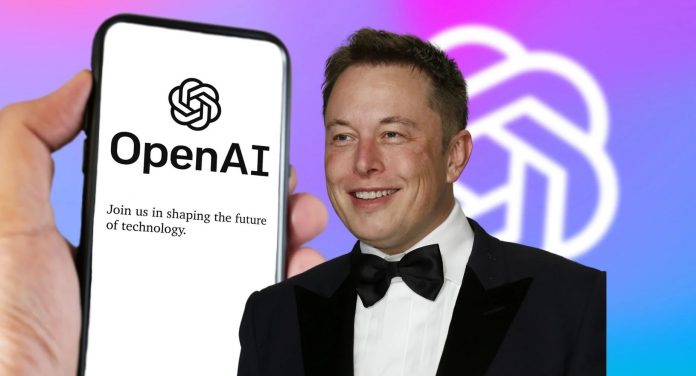
Does Elon Musk Deserve Equity in Profit-making OpenAI?

0

If you gave someone money to start a non-profit and that person later converts the organization into a for-profit one. Even if you agree on that conversion, do you expect that organization to give you equity in that for-profit firm? And if that is the case, what would be the fair equity percentage? Yes, would it be based at the time the money was given or what the company is worth now?

As Elon Musk and OpenAI battle, I can tell you where Musk is going: OpenAI for-profit business, convert my original donation to equity, and send me my share certificate. Musk does not need to win any case for that to be the final outcome when we remember that kids who attended Mark Zuckerberg’s university dorm meeting as he envisioned Facebook were settled for contributing to Facebook even though they did not drop out with Mark, to build it. Yes, that Musk played along for the non-profit to for-profit transmutation does not mean his original donation should not give him equity.

If you see it differently, please let me know why you think Musk does not deserve a fair share of this profit-making OpenAI. Lawyers in the house, please help…

In March 2024, Elon Musk, a co-founder of OpenAI, sued the company and its CEO, Sam Altman. Musk’s lawsuit claims that OpenAI has breached their founding agreement to develop AI for the benefit of humanity by partnering with Microsoft and stopping much of its internal research. Musk also claims that OpenAI has become a “closed-source de facto subsidiary” of Microsoft that is focused on making money instead of benefitting humanity.

In his lawsuit, Musk says he invested millions in the AI lab on “false promises” that it would be nonprofit and open-source. He also claims that the arrangement goes against a founding agreement and 2015 certification of incorporation that OpenAI established with Musk.

OpenAI has responded to Musk’s lawsuit by releasing his emails and firing back at all the claims. OpenAI says that Musk wanted a majority of the equity, initial board control and to be chief executive of OpenAI.

Debacles between Elon Musk and OpenAI have taken a new turn

0

OpenAI, the artificial intelligence research organization co-founded by Elon Musk, has revealed some details about its early history and relationship with the billionaire entrepreneur. In a blog post published on Thursday, OpenAI said that Musk had proposed to become the CEO of the company and merge it with his electric car maker Tesla in 2017, but the idea was rejected by the board of directors.

The relationship between Elon Musk and OpenAI, the research organization he co-founded in 2015, has been fraught with debacles and controversies. In this blog post, we will examine some of the major events that have strained the ties between the visionary entrepreneur and the ambitious non-profit.

According to OpenAI, Musk made the offer after he stepped down from the board of directors in February 2017, citing potential conflicts of interest with his other ventures. He remained a donor and adviser to the organization, which was launched in 2015 with the goal of creating and ensuring the safe and beneficial use of artificial general intelligence (AGI), a hypothetical form of AI that can perform any intellectual task that humans can.

OpenAI said that Musk’s proposal was motivated by his vision of creating a “neural lace”, a brain-computer interface that would allow humans to communicate with and control machines. He believed that OpenAI could help him achieve this goal faster and more ethically than other AI companies.

He also thought that merging OpenAI with Tesla would create synergies and economies of scale, as both entities were working on similar problems such as computer vision, natural language processing, and reinforcement learning.

However, the board of directors of OpenAI, which included prominent figures such as LinkedIn co-founder Reid Hoffman, Y Combinator president Sam Altman, and MIT professor Max Tegmark, decided to decline Musk’s offer.

They argued that OpenAI’s mission of creating and sharing AGI for the common good was incompatible with Tesla’s for-profit business model and competitive strategy. They also feared that Musk’s involvement as CEO would expose OpenAI to more regulatory and public scrutiny, as well as potential conflicts with his other ventures such as SpaceX and Neuralink.

One of the first signs of trouble came in 2018, when Musk announced that he was leaving the board of OpenAI, citing a potential conflict of interest with his other ventures, such as Tesla and Neuralink. He remained a donor and advisor, but his influence on the direction and vision of OpenAI was diminished.

Another source of tension was the development of GPT-3, the massive language model that can generate coherent and diverse texts on almost any topic. Musk had been vocal about his concerns over the dangers of artificial intelligence, especially superintelligent systems that could surpass human capabilities and goals. He warned that OpenAI should be careful not to create something that could harm humanity or be misused by malicious actors.

However, OpenAI seemed to have a different view on how to handle GPT-3 and its successors. In 2019, it announced that it would form a for-profit entity, OpenAI LP, to raise funds and commercialize its technology, while still maintaining a non-profit parent company. This move was criticized by some as a betrayal of its original mission to ensure that AI is aligned with human values and widely accessible.

In 2020, OpenAI released an API for accessing GPT-3 and its variants, allowing selected developers and researchers to build applications using the powerful model. However, it also imposed strict terms and conditions on how the API could be used, reserving the right to terminate or suspend access for any reason. Moreover, it decided not to open-source the code or data of GPT-3, citing safety and ethical issues.

OpenAI said that it shared this information to provide more transparency and context about its origins and evolution. It also said that it maintained a cordial and collaborative relationship with Musk, who continued to support its work and vision. It added that it respected Musk’s views and contributions to the field of AI, even when they differed from its own.

Bitcoin Price Rebounds After Massive Long Liquidation Since Last Year

0

The price of the leading crypto asset, Bitcoin has retraced back to the upside, after a massive short liquidation across the crypto market.

In a report from the derivative market data provider CoinGlass, Bitcoin witnessed its largest long liquidation event since last year. The statistics showed that over 24 hours, the total liquidations amounted to $1.16 billion, with long position liquidations accounting for $880.35 million and short positions for $278.15 million.

Meanwhile, a top crypto analyst who caught last year’s crypto breakout believes Bitcoin has entered uncharted waters and that big pullbacks are opportunities for long-term holders.

According to Coin Metrics, Bitcoin was last higher by 7.9% at $67.283.54, while Ethereum soared more than 13% to $3,872.56, its highest level since January 2021.

On Tuesday, Bitcoin reached a new high, its first since November 2021, at $69173. It had been pushing higher for weeks up 55% over the past month and tumbled shortly around the $66k price after notching the new high.

This digital asset has no doubt hit a new milestone of adoption after the US SEC approved the launch of ETFs in the traditional market. This led to a massive inflow of ETFs from investors, which has greatly contributed to the Bitcoin price rally from Late January.

From a swing low of $38555, the BTC price surged to its current trading price of $66298, accounting for 72% growth in six weeks. Currently, the Bitcoin market cap stands at $1.3 Trillion projecting an intraday loss of 1.27%.

The Bitcoin price is expected to ride a pre-halving rally, as it may face near-term resistances at $69000, followed by $72000.

With the 4th BTC halving scheduled for April 2024, investors are anticipating a protracted bull run in the coming months. This might be the biggest rally Bitcoin has seen, and there is room for the token to surge much higher, according to the co-founder of stablecoin Tether, William Quigley.

According to Quigley, he noted that if history is any guide, the token could surged massively by 350% higher from where it stands.  

“I’m not predicting this, I’m just saying if you apply historical patterns, it would suggest bitcoin being in excess of $300,000 at the peak of this next bull market,” he said in a CNBC interview.

Also, serial entrepreneur and author of “Rich Dad Poor Dad”, Robert Kiyosaki, has predicted the price of Bitcoin to surge by $300k this year.

He wrote on his X handle,

“BITCOIN  on fire. The biggest mistake you can make is to procrastinate. Important to start, even if only for $500. Next stop $300,000 per BC in 2024”.

Although the unpredictable nature of crypto assets makes it difficult to forecast, however, Bitcoin halvings have historically culminated in a bullish surge for the coin.

CBN Signs MoU With Financial Platform Gluwa to Promote The Adoption of eNaira in Nigeria

0

The Central Bank of Nigeria (CBN), has signed a Memorandum of Understanding (MoU) with blockchain technology platform, Gluwa to increase the adoption of Nigeria’s digital currency, the eNaira.

As an agent partner of CBN, Gluwa will integrate its Credal technology into the eNaira platform, to enable the creation of credit reputations for unbanked users thus furthering financial inclusion. The credit profiles created will be accessible across borders and increase the CBDC’s effectiveness.

This partnership core objective is to harness the power of blockchain technology to enhance financial inclusion, improve eNaira functionality and foster financial innovation.

Gluwa disclosed that it will roll out plans for improving eNaira’s utility over the course of 2024 with the CBN aim to make eNaira a beacon example of CBDCs by transforming it into a dependable, meaningful currency for its users.

The partnership between Gluwa and the CBN will focus on the following;

Simplifying Fintech Lending – Enabling fintech lenders to expedite the loan origination process by facilitating direct eNaira transfers to customers, thereby enhancing the speed and efficiency of services provided.

Authenticating Transactions – Establishing the eNaira as the definitive record for all loan transactions conducted by fintech partners, ensuring accuracy and transparency in financial operations and credit scoring.

User Authentication – Implementing a robust authentication mechanism utilizing asymmetric encryption with private/public keys, to offer users a secure, private, and regulatory-compliant way of accessing financial services.

CBN’s partnership with Gluwa is the latest of many attempts by the apex bank to boost the adoption of the eNaira. Since the launch of the digital currency in October 2021, a month after launch, the eNaira picked up 500,000 wallet downloads and seemed set for success.

However, the CBDC failed to live up to expectations. It took 10 months to hit $10 million in transaction value and only 1.4 million transactions in May 2023. In the same month of 2023, the International Monetary Fund (IMF) said 98.5 percent of eNaira wallets have never been used.

The IMF explained that the downloaded wallets recorded low transactions, while some have not been active except for the initial surge it recorded shortly after it was launched. It added that the average number of eNaira transactions weekly was carried out only by 1.5 percent of downloaded wallets.

The fund further noted that the eNaira’s potential in financial inclusion requires a strategy to set the right relationship with mobile money, given the former’s potential to either complement or substitute the latter.

Also, Stakeholders in Nigeria advised the Central Bank of Nigeria (CBN) to collaborate with fintech companies to aid the adoption of eNaira. 

Fast-forward to February 2024, reports disclosed that the value of eNaira in circulation rose by 302 percent in nine months to N10.26 billion at the end of September reflecting increased adoption of Africa’s Central Bank Digital Currency.

The upsurge in the value of the eNaira in circulation follows additional measures implemented by the CBN to boost adoption and usage among members of the banking public.

These include the introduction of the Enhanced USSD service channel which targets feature phone users and allows Nigerians  to open an eNaira wallet and conduct transactions by simply dialing *997 from their mobile phones

According to sources close to the apex bank, the upsurge in eNaira adoption was driven by transactions via the USSD channels. It was gathered that the volume and value of eNaira transactions via the USSD channel rose year-on-year, YoY by 92.95 percent and 120.93 percent in 9M’23 respectively while the number of merchants accepting eNaira also rose 11.97 percent during the same period.

Egyptian Pound Suffers major pullbacks, plummeting 60% in 24 hours

0

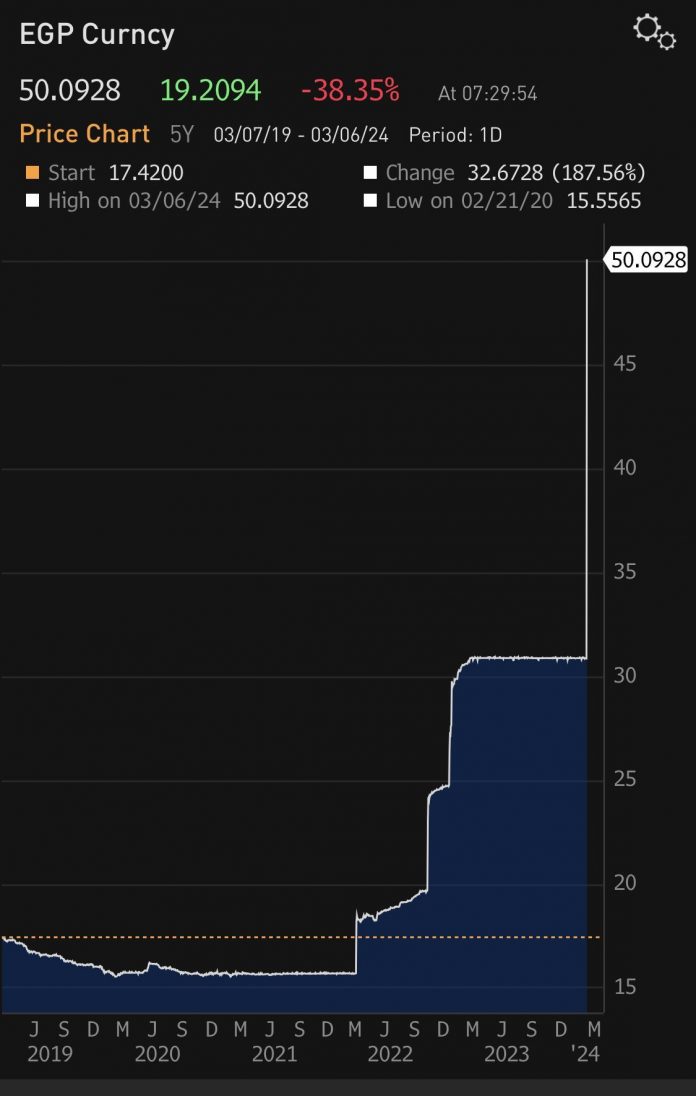
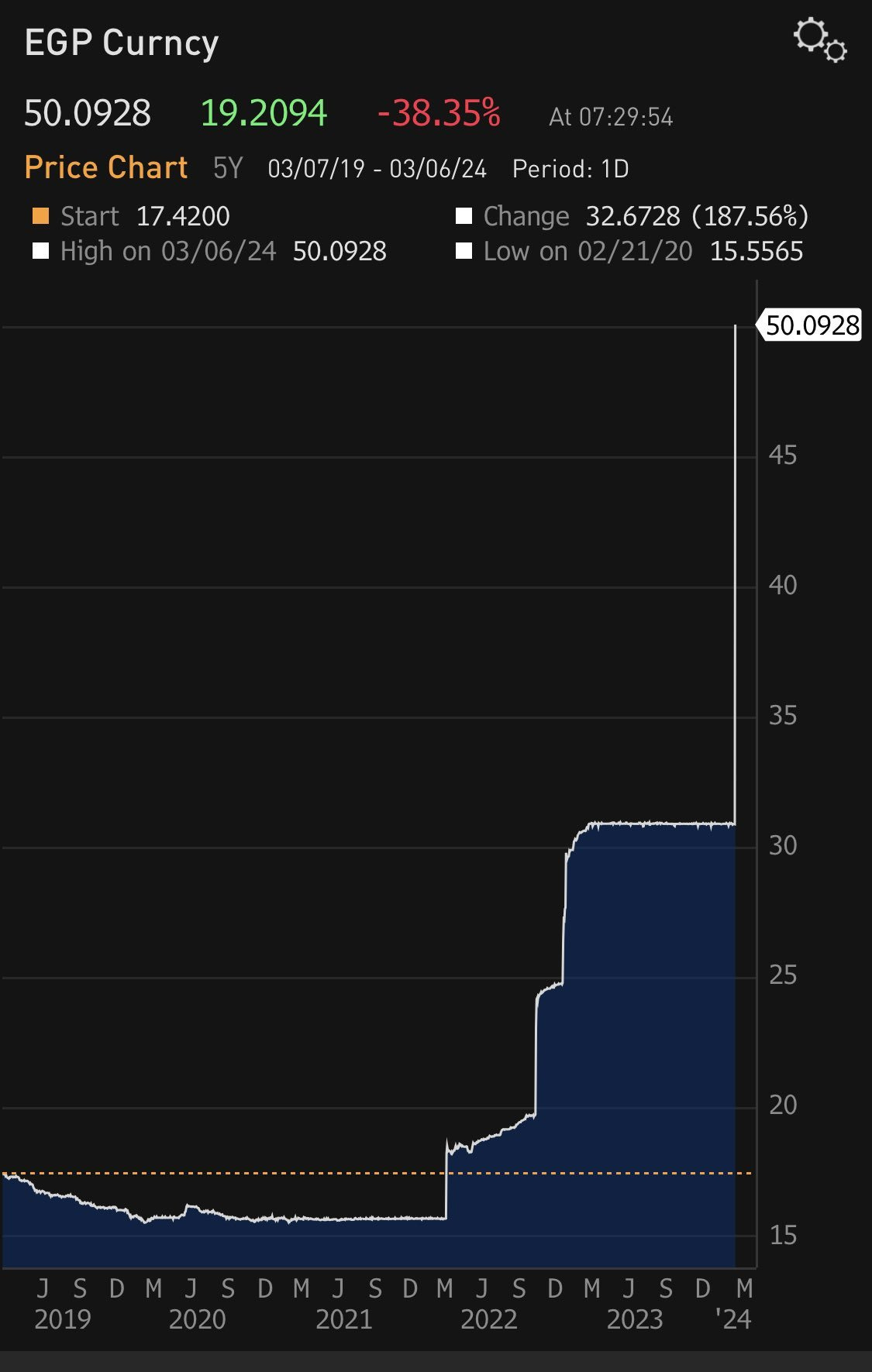
The Egyptian Pound has devalued 60% in the last 24 hours, plunging the country into a deep economic crisis. This unprecedented drop in the currency’s value is the result of several factors, including political instability, social unrest, foreign debt, and the global pandemic.

The political situation in Egypt has been volatile since the 2011 revolution that toppled the long-time dictator Hosni Mubarak. Since then, the country has witnessed several changes of government, military coups, and violent clashes between different factions. The current president, Abdel Fattah el-Sisi, has faced criticism for his authoritarian rule, human rights violations, and suppression of dissent.

His legitimacy has been challenged by various opposition groups, some of which have resorted to armed resistance. The lack of political stability and security has deterred foreign investors and tourists, who are vital sources of income for the Egyptian economy.

The social unrest in Egypt has also contributed to the currency crisis. The population of Egypt is over 100 million, making it the most populous country in the Arab world. However, many Egyptians suffer from poverty, unemployment, inflation, and poor public services.

The pandemic has exacerbated these problems, as the government has struggled to contain the spread of the virus and provide adequate health care and social support. The frustration and anger of the people have erupted in frequent protests and riots, which have disrupted the normal functioning of the economy and damaged public infrastructure.

The foreign debt of Egypt is another factor that has weakened the pound. Egypt owes about $130 billion to various creditors, including the International Monetary Fund (IMF), the World Bank, and several countries. The debt burden has increased over the years due to high interest rates, low growth rates, and currency depreciation.
The government has tried to secure more loans and grants from its allies, such as Saudi Arabia and the United Arab Emirates, but these have come with strings attached, such as implementing unpopular austerity measures and reforms. The debt crisis has reduced the confidence of the international community in the Egyptian economy and its ability to repay its obligations.

The global pandemic has also played a role in the currency collapse. The pandemic has affected the world economy in unprecedented ways, causing a slowdown in trade, tourism, remittances, and oil prices. These are all important sources of revenue for Egypt, which relies heavily on its external sector.

The pandemic has also increased the demand for hard currencies, such as the US dollar and the euro, as people seek to preserve their wealth and savings. The supply of these currencies in Egypt has been limited due to the restrictions on travel and transactions imposed by various countries. This has created a shortage of foreign exchange in the Egyptian market, leading to a sharp rise in the exchange rate of the pound.

The devaluation of the pound has had severe consequences for the Egyptian economy and society. It has increased the cost of living for millions of Egyptians, who have to pay more for imported goods and services, such as food, fuel, medicine, and education. It has also eroded the purchasing power of their incomes and savings, which are mostly denominated in pounds.

It has reduced the competitiveness of Egyptian exports in international markets, as they become more expensive for foreign buyers. It has also increased the risk of inflation and hyperinflation, as prices spiral out of control due to rising demand and shrinking supply.

The currency crisis requires urgent action from both the government and the international community. The government needs to restore political stability and security in the country by engaging in dialogue with its opponents and addressing their legitimate grievances. It also needs to implement economic reforms that can boost growth, diversify revenue sources, reduce debt, and attract foreign investment.

The international community needs to support Egypt with financial assistance that can help it overcome its liquidity problems and stabilize its exchange rate. It also needs to ease its trade barriers and travel restrictions that have hampered Egypt’s external sector.

The Egyptian pound is not only a symbol of national sovereignty and pride, but also a key determinant of economic well-being and social welfare. Its devaluation is a serious challenge that threatens to undermine the progress and development of Egypt. However, it is also an opportunity to rethink and reshape its economic model and policies in a way that can foster more resilience, sustainability, and inclusiveness.