DD
MM
YYYY

PAGES

DD
MM
YYYY

spot_img

PAGES

Home Blog Page 3622

US AGs allege SEC overstepped on Kraken’s Lawsuit, Hong Kong SFC Issues Warning on BitForex

1

A group of state attorneys general has filed a brief in support of Kraken, the cryptocurrency exchange that is facing a lawsuit from the Securities and Exchange Commission (SEC) over its alleged unregistered offering of digital assets.

The brief, submitted by 21 state AGs led by Texas Attorney General Ken Paxton, argues that the SEC has exceeded its statutory authority and violated the principles of federalism by attempting to regulate cryptocurrencies as securities.

The state AGs claim that cryptocurrencies are not securities, but rather commodities or currencies that fall under the jurisdiction of other federal and state agencies, such as the Commodity Futures Trading Commission (CFTC) or the Treasury Department.

They also contend that the SEC’s lawsuit against Kraken is an example of “regulation by enforcement”, which creates uncertainty and confusion for market participants and stifles innovation in the emerging crypto industry.

The brief states:

The SEC’s enforcement action against Kraken is not only legally flawed, but also represents a dangerous overreach that threatens to undermine the constitutional balance between federal and state authority. The SEC’s attempt to regulate cryptocurrencies as securities is contrary to Congress’s intent, the SEC’s own regulations, and decades of judicial precedent.

Moreover, the SEC’s aggressive and inconsistent enforcement actions create uncertainty and deter innovation in a field that offers immense potential for economic growth, social development, and individual freedom.

The state AGs urge the court to dismiss the SEC’s complaint against Kraken and to affirm the primacy of state regulation over cryptocurrencies.

Kraken, which is based in San Francisco, was sued by the SEC in April 2021 for allegedly raising over $1.3 billion through the sale of digital tokens that the SEC deemed to be securities. Kraken has denied the allegations and argued that its tokens are not securities, but rather utility tokens that provide access to its platform and services.

Kraken’s CEO Jesse Powell has welcomed the support from the state AGs and expressed his hope that the case will set a precedent for the crypto industry.

He tweeted:

I’m grateful for the leadership of KenPaxtonTX and 20 other state AGs in standing up for crypto innovation and state sovereignty. This case is bigger than Kraken. It’s about the future of crypto and who gets to decide it: the people or unelected bureaucrats.

IRS’s hires two crypto Natives on its Digital asset Team

The Internal Revenue Service (IRS) has recently announced the addition of two new members to its team of digital currency experts. Joining the team are Sulolit “Raj” Mukherjee, the former global head of tax at Consensys, and Seth Wilks, the former vice president of government relations at crypto tax software firm TaxBit who have both been working in the crypto industry for over a decade and have extensive knowledge and experience in the field.

According to a LinkedIn post, Mukherjee and Wilks have been long-time industry colleagues and friends. IRS Commissioner Danny Werfel noted in a press release reviewed by Blockworks that the digital asset space was an “evolving sector” with major tax administration implications.

They are not only well-known figures in the crypto community, but also long-time colleagues and friends. They have collaborated on several projects and initiatives related to digital currency regulation, compliance, education, and innovation. They have also been vocal advocates for the adoption and integration of crypto technologies in various sectors and industries.

According to the IRS, the duo will play key roles in developing and implementing the agency’s strategy and policies regarding the taxation and oversight of crypto transactions. They will also provide guidance and support to other IRS divisions and offices, as well as external stakeholders, on crypto-related matters.

The IRS has been ramping up its efforts to address the challenges and opportunities posed by the growing use and popularity of digital currencies. In recent years, the agency has issued guidance, updated forms, launched enforcement actions, and partnered with other agencies and organizations to enhance its understanding and capabilities in this area.

The hiring is seen as a positive sign by many in the crypto industry, who hope that their expertise and perspective will help the IRS adopt a more balanced and nuanced approach to crypto taxation and regulation. Some also hope that their presence will foster more dialogue and collaboration between the IRS and the crypto community, leading to more clarity, fairness, and innovation in the field.

Hong Kong SFC issues warning against crypto exchange, BitForex

Meanwhile, the Securities and Futures Commission (SFC) of Hong Kong has issued a warning against BitForex, a cryptocurrency exchange platform that claims to be licensed in the city. The SFC stated that BitForex is not authorized to offer any regulated activities in Hong Kong and advised investors to exercise caution when dealing with the platform.

According to the SFC’s website, BitForex is not registered as a licensed corporation or an associated entity of a licensed corporation under the Securities and Futures Ordinance (SFO). The SFC also noted that BitForex’s purported address in Hong Kong does not exist, and that its website does not provide any contact details for its Hong Kong office.

The SFC warned that unlicensed platforms may not have adequate systems to safeguard client assets and may operate outside the legal and regulatory framework that governs the securities and futures markets in Hong Kong. Investors who trade on such platforms may not be protected by the SFC’s investor compensation fund, which covers losses arising from defaults by intermediaries licensed by the SFC.

The SFC urged investors to check the SFC’s Public Register of Licensed Persons and Registered Institutions before engaging in any investment activities, and to report any suspected scams or frauds to the SFC or the police.

BitForex is one of the many cryptocurrency platforms that have been targeted by regulators around the world in recent months, as authorities seek to crack down on illicit activities and protect investors from potential risks.

In September 2021, China banned all cryptocurrency transactions and mining activities, while the UK’s Financial Conduct Authority (FCA) banned Binance, the world’s largest crypto exchange, from operating in the country without proper authorization. The US Securities and Exchange Commission (SEC) has also filed lawsuits against several crypto platforms, including Ripple and Coinbase, for allegedly violating securities laws.

BitForex has not responded to the SFC’s warning or commented on the allegations of fraud. On February 23, 2024, BitForex went offline after $57 million was reportedly withdrawn from the exchange’s hot wallets. Users have reported difficulties accessing their accounts and withdrawing their funds since then.

The SFC has requested the Hong Kong Police Force to block access to BitForex’s website links and social media pages to prevent further potential fraud and protect investors.

The SFC has issued a warning to the public about the risks of dealing with BitForex and has instructed the Hong Kong Police Force to block access to its website links and social media pages.

The SFC stated that BitForex is not licensed or registered to conduct any regulated activities in Hong Kong and that it has received numerous complaints from investors who have lost money or encountered difficulties in withdrawing their funds from the platform.

The SFC also alleged that BitForex has made false or misleading representations on its website, such as claiming to have a high level of security, liquidity and compliance. The SFC urged investors to exercise caution and avoid any transactions with BitForex or any other unregulated cryptocurrency platforms.

The SFC also reminded investors to check the SFC’s website for a list of licensed or registered entities before engaging in any investment activities. The SFC’s action against BitForex is part of its ongoing efforts to combat illegal and fraudulent activities in the cryptocurrency market and to protect the interests of investors in Hong Kong.

Bitcoin market cap surpasses $1.3 trillion

0

In a historic milestone, the total market capitalization of Bitcoin has exceeded $1.3 trillion, making it the ninth-largest asset in the world by market value. This means that Bitcoin is now worth more than some of the most influential companies in the world, such as Facebook, Tesla, and Amazon.

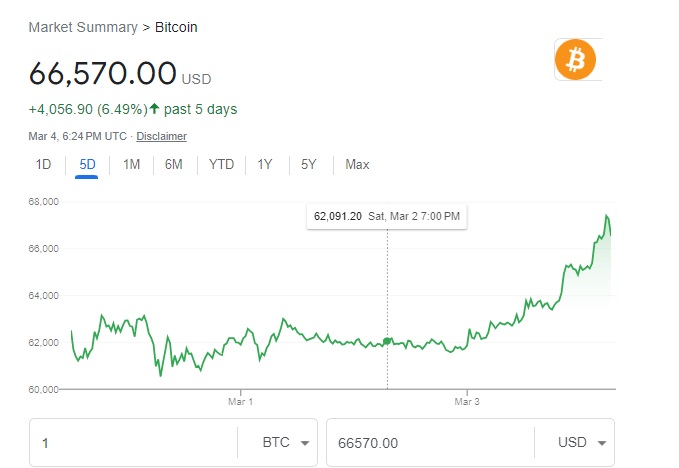
Bitcoin crosses $66,000 per coin; it is not only breaking new records but also breaking new grounds.

Bitcoin’s remarkable rise has been driven by several factors, including increased institutional adoption, growing public awareness, and favorable regulatory developments. Some of the recent events that have boosted Bitcoin’s momentum include:

The launch of the first Bitcoin exchange-traded fund (ETF) in Canada, which attracted over $400 million in assets under management in its first week of trading.

The announcement by Tesla that it had purchased $1.5 billion worth of Bitcoin and would accept it as a form of payment for its products. The endorsement of Bitcoin by prominent figures such as Elon Musk, Jack Dorsey, and Michael Saylor, who have expressed their support and confidence in the cryptocurrency. The adoption of Bitcoin as a legal tender by El Salvador, which became the first country in the world to do so.

These events have demonstrated that Bitcoin is not only a viable store of value, but also a medium of exchange and a unit of account. Bitcoin has proven its resilience and innovation in the face of challenges and uncertainties, such as the Covid-19 pandemic, the halving event, and the network upgrades.

As Bitcoin continues to grow and mature, it is expected to attract more investors, users, and developers, who will contribute to its further development and adoption. Bitcoin has the potential to revolutionize the global financial system and create a more inclusive, transparent, and efficient economy for everyone.

Bitcoin crosses $66,000 per BTC.

The cryptocurrency market has witnessed a historic milestone as Bitcoin, the leading digital asset by market capitalization, has crossed the $66,000 mark for the first time ever. This comes after months of anticipation and speculation following the launch of the first Spot Bitcoin exchange-traded fund (ETF) in the US in January 2024.

The Bitcoin ETF, which trades under the ticker BITO, allows investors to gain exposure to the price movements of Bitcoin without having to buy or store the actual coins. The ETF tracks the performance of a basket of Bitcoin futures contracts traded on the Chicago Mercantile Exchange (CME). The ETF has attracted over $1 billion in assets under management in its first week of trading, signaling a strong demand for Bitcoin exposure among institutional and retail investors.

The surge in Bitcoin price also coincides with a positive sentiment in the broader crypto space, as several other major coins have also reached new all-time highs in recent days. Ethereum, the second-largest cryptocurrency by market cap, has surpassed $3,500, while Solana, Cardano, Binance Coin, and Polkadot have also recorded impressive gains.

The bullish momentum in the crypto market is driven by several factors, including the growing adoption of blockchain technology and decentralized applications (DApps) across various industries, the increasing innovation and competition among crypto projects and platforms, and the rising awareness and acceptance of digital assets among regulators, policymakers, and consumers.

As Bitcoin crosses $66,000 per coin, many analysts and experts are predicting that it could reach even higher levels in the near future. Some of the factors that could support further growth include:

The increasing scarcity of Bitcoin supply, as more than 18.8 million out of the total 21 million coins have already been mined, and many of them are lost or locked up in long-term holdings.

The growing network effect of Bitcoin, as more users, merchants, and institutions adopt it as a store of value, medium of exchange, and unit of account. The improving security and resilience of the Bitcoin network, as more miners and nodes participate in validating transactions and securing the ledger.

The expanding innovation and development in the Bitcoin ecosystem, as more developers and entrepreneurs create new products and services that enhance the functionality and usability of Bitcoin. The rising interest and involvement of institutional investors, such as hedge funds, pension funds, endowments, and corporations, who are looking for alternative assets to diversify their portfolios and hedge against inflation and currency devaluation.

Bitcoin has come a long way since its inception in 2009, when it was worth less than a cent. It has overcome numerous challenges and obstacles, such as technical glitches, regulatory uncertainty, security breaches, market volatility, and fierce competition. It has proven its resilience and adaptability in the face of changing economic and social conditions. It has emerged as a global phenomenon that transcends borders, cultures, and ideologies.

Bitcoin is not just a currency or a technology. It is a social movement that represents a paradigm shift in how we perceive and interact with money and value. It is a vision of a more open, inclusive, and decentralized world where everyone can participate and benefit from the digital economy.

As Bitcoin crosses $66,000 per coin, it is not only breaking new records but also breaking new grounds. It is opening new possibilities and opportunities for individuals, businesses, and societies. It is challenging the status quo and inspiring change. It is showing us that the future of money is not only digital but also democratic.

The future of Blockchain and AI is not what you’ve heard

0

Blockchain and AI are two of the most popular buzzwords in the tech industry today. But what can they really do for each other? And how can they work together to create value and innovation?

Blockchain is a distributed ledger technology that enables secure and transparent transactions among multiple parties, without the need for intermediaries or central authorities. It can also support smart contracts, which are self-executing agreements that encode the rules and logic of a transaction.

AI is a broad term that encompasses various technologies that enable machines to perform tasks that normally require human intelligence, such as learning, reasoning, decision making, and natural language processing.

Some of the common claims about the synergy between blockchain and AI are:

Blockchain can provide trust, security, and privacy for AI data and models, which are often sensitive and proprietary. Blockchain can enable decentralized and collaborative AI, where multiple agents can share data and resources, and collectively learn from each other.

Blockchain can incentivize and reward AI participants, such as data providers, model developers, and validators, using tokens or cryptocurrencies. Blockchain can enhance the explainability and accountability of AI, by recording the provenance and audit trail of data and models and enabling verifiable claims and outcomes.

While these claims are not entirely false, they are also not as straightforward or easy as they sound. There are many technical and practical challenges that need to be addressed before blockchain and AI can truly integrate and complement each other.

Some of these challenges are:

Blockchain is not a silver bullet for AI data quality and security. While blockchain can ensure the integrity and immutability of data transactions, it cannot guarantee the accuracy or validity of the data itself.

Moreover, storing large amounts of data on a blockchain is costly and inefficient, due to its limited scalability and throughput. Therefore, blockchain may not be suitable for high-volume or high-frequency AI applications that require fast and frequent data access and processing.

Blockchain is not a magic wand for AI decentralization and collaboration. While blockchain can enable peer-to-peer communication and coordination among multiple AI agents, it cannot solve the fundamental issues of trust, alignment, and coordination that arise in multi-agent systems.

For example, how can we ensure that the agents have compatible goals and incentives? How can we prevent malicious or faulty agents from compromising the system? How can we handle conflicts or disputes among agents? These are complex problems that require sophisticated mechanisms and protocols beyond blockchain.

Blockchain is not a panacea for AI incentivization and reward. While blockchain can facilitate value exchange and distribution among AI participants, it cannot determine the optimal or fair allocation of rewards or costs.

For example, how can we measure the value or contribution of each participant? How can we balance the trade-offs between efficiency and equity? How can we prevent free-riding or cheating behaviors? These are challenging questions that require careful design and evaluation of economic models and incentive schemes.

Blockchain is not a guarantee for AI explainability and accountability. While blockchain can provide transparency and traceability for AI data and models, it cannot ensure the interpretability or understandability of the underlying logic or reasoning. Moreover, blockchain cannot enforce or verify the compliance or correctness of AI outcomes or actions.

For example, how can we ensure that the AI models are fair, ethical, or legal? How can we hold the AI agents responsible or liable for their decisions or actions? These are difficult issues that require rigorous standards and regulations.

Therefore, while blockchain and AI have great potential to work together to create value and innovation, they also have significant limitations and challenges that need to be overcome. Blockchain is not a one-size-fits-all solution for AI problems, nor is AI a plug-and-play component for blockchain applications. They are both complex and evolving technologies that require careful analysis and design to suit different contexts and objectives.

Bitcoin ETFs now hold nearly 4% of all Bitcoins

0

The demand for bitcoin exchange-traded funds (ETFs) is growing rapidly, as more investors seek exposure to the leading cryptocurrency without having to deal with the complexities of storing and managing it. According to data from CryptoCompare, bitcoin ETFs now hold nearly 4% of the total supply of bitcoin, up from less than 1% a year ago.

Bitcoin ETFs are funds that track the price of bitcoin and trade on regulated stock exchanges. They offer investors a convenient way to gain exposure to bitcoin without having to buy, sell, or custody the digital asset themselves. Bitcoin ETFs also provide more liquidity, transparency, and regulatory oversight than other types of bitcoin products, such as trusts or futures.

The first bitcoin ETF was launched in Canada in February 2021, and since then, several more have followed suit. As of March 2024, there are 12 bitcoin ETFs available in Canada and in the US, with a combined market capitalization of over $40 billion. The largest one is the Purpose Bitcoin ETF (BTCC), which holds over 200,000 bitcoins, or about 1% of the total supply.

In the US, the first bitcoin ETF was approved by the Securities and Exchange Commission (SEC) in October 2023, after years of rejections and delays. The ProShares Bitcoin Strategy ETF (BITO) debuted on the New York Stock Exchange (NYSE) with a record-breaking $1 billion in assets under management on its first day of trading.

Since then, four more bitcoin ETFs have been launched in the US, with a total market capitalization of over $30 billion. The largest one is the VanEck Bitcoin Trust (XBTF), which holds over 150,000 bitcoins, or about 0.8% of the total supply.

Other countries that have approved or are considering approving bitcoin ETFs include Brazil, Australia, Germany, Switzerland, and Japan. The global market for bitcoin ETFs is expected to grow even further as more investors and institutions embrace the cryptocurrency as a legitimate asset class.

Bitcoin ETFs have several advantages for both investors and the bitcoin ecosystem. For investors, bitcoin ETFs offer a simple and cost-effective way to access the cryptocurrency market without having to deal with technical issues such as wallets, keys, or exchanges.

Bitcoin ETFs also reduce the risk of theft, hacking, or loss of funds that can occur with direct ownership of bitcoin. Additionally, bitcoin ETFs provide more tax efficiency and diversification benefits than other forms of bitcoin investment.

For the bitcoin ecosystem, bitcoin ETFs increase the demand and adoption of the cryptocurrency, as they attract more mainstream and institutional investors who may otherwise be reluctant or unable to invest in bitcoin directly. Bitcoin ETFs also help to reduce the volatility and improve the liquidity of the bitcoin market, as they create more stable and consistent sources of buying and selling pressure.

Furthermore, bitcoin ETFs enhance the legitimacy and credibility of bitcoin as an asset class, as they bring more regulatory oversight and compliance standards to the industry.

Bitcoin ETFs are not without their drawbacks, however. Some critics argue that bitcoin ETFs dilute the original vision and value proposition of bitcoin as a decentralized and censorship-resistant form of money that does not rely on intermediaries or authorities.

By investing in bitcoin ETFs instead of holding bitcoin directly, investors give up some of their control and sovereignty over their funds and expose themselves to counterparty risk and potential regulatory interference.

Moreover, some skeptics question whether bitcoin ETFs actually contribute to the security and sustainability of the bitcoin network, as they do not necessarily increase the number of nodes or miners that validate transactions and secure the network.

Despite these challenges, bitcoin ETFs are likely to continue to grow in popularity and adoption as more investors seek exposure to the cryptocurrency market. Bitcoin ETFs now hold nearly 4% of all bitcoins — and they’re not slowing down.

US national debt increases by $1 trillion every 100 days!

0

The US national debt is a topic that has been widely discussed and debated in recent years, especially as it continues to grow at an alarming rate. According to the latest data from the US Treasury Department, the national debt stood at $29.1 trillion as of February 28, 2024, an increase of $4.8 trillion since the start of the fiscal year on October 1, 2023. This means that the US national debt increases by $1 trillion every 100 days, or about $10 billion per day.

What are the causes and consequences of this massive debt accumulation? How does it affect the economy, the government, and the citizens of the US? And what can be done to address this looming fiscal challenge? These are some of the questions that we will explore in this blog post, using data and analysis from various sources.

The causes of the US national debt

The US national debt is the sum of two components: the public debt and the intragovernmental debt. The public debt is the amount that the federal government owes to external entities, such as foreign governments, corporations, individuals, and institutions. The intragovernmental debt is the amount that the federal government owes to itself, such as to various trust funds and accounts that are dedicated to specific programs, such as Social Security, Medicare, and military pensions.

The main cause of the increase in the public debt is the gap between the federal government’s revenues and expenditures, also known as the budget deficit. When the government spends more than it collects in taxes and other sources of income, it has to borrow money from the public to finance its activities. The budget deficit can be influenced by various factors, such as economic conditions, policy decisions, and unexpected events.

For example, in fiscal year 2020, which ended on September 30, 2020, the US government recorded a record-high budget deficit of $3.1 trillion, or 14.9% of GDP. This was largely due to the unprecedented fiscal stimulus measures that were enacted in response to the COVID-19 pandemic, which increased government spending by $2.6 trillion and reduced government revenues by $0.5 trillion. In contrast, in fiscal year 2019, which ended on September 30, 2019, the budget deficit was $0.98 trillion, or 4.6% of GDP.

The main cause of the increase in the intragovernmental debt is the accumulation of surpluses in some of the trust funds and accounts that are part of the federal budget. When these programs collect more in taxes and other income than they spend on benefits and services, they lend their excess funds to the Treasury Department in exchange for special securities that earn interest. These securities are counted as part of the intragovernmental debt.

For example, in fiscal year 2020, the Social Security program collected $1.06 trillion in payroll taxes and other income and spent $1.05 trillion on benefits and administration, resulting in a surplus of $0.01 trillion. This surplus was invested in Treasury securities that increased the intragovernmental debt by $0.01 trillion.

In contrast, in fiscal year 2019, the Social Security program collected $1.04 trillion in payroll taxes and other income and spent $1.04 trillion on benefits and administration, resulting in a balance of zero.