DD
MM
YYYY

PAGES

DD
MM
YYYY

spot_img

PAGES

Home Blog Page 3679

There is more money in Africa than Outside Africa

0

This may sound like a surprising or even absurd statement, but it is true. Africa’s total financial wealth is estimated at $41 trillion, while the rest of the world’s wealth is $39 trillion. How is this possible, you may ask?

The answer lies in the concept of illicit financial flows (IFFs), which are defined as “money illegally earned, transferred or used”. IFFs include tax evasion, money laundering, corruption, smuggling, and other criminal activities. According to UNCTAD, Africa loses about $89 billion per year due to IFFs, which is equivalent to 3.7% of its GDP. This means that more money is leaving Africa than entering it through official channels.

Africa is a continent of immense wealth and potential. According to a recent report by the African Development Bank, Africa’s total financial wealth is estimated at $41 trillion, which surpasses the rest of the world’s wealth of $39 trillion. This means that Africa has more resources and assets than any other region in the world, and that it has the opportunity to leverage them for its own development and prosperity.

However, this wealth is not evenly distributed or utilized across the continent. The report also reveals that only 20% of Africa’s wealth is held by Africans themselves, while the rest is owned by foreign investors, multinationals, and governments. Moreover, much of Africa’s wealth is locked in natural resources, such as oil, gas, minerals, and land, which are often exploited by external actors without benefiting the local communities or the environment. As a result, Africa faces many challenges, such as poverty, inequality, unemployment, conflict, and climate change.

The impact of IFFs on Africa’s development is devastating. IFFs deprive African governments of much-needed revenues to invest in public services, infrastructure, education, health, and social protection. IFFs also undermine the rule of law, governance, and democracy, as they create incentives for corruption and violence. IFFs also distort the structure and composition of African economies, as they favor sectors that are easy to conceal and transfer, such as extractive industries, over sectors that are more productive and inclusive, such as manufacturing and agriculture.

IFFs also affect African economies in various ways. For instance:

IFFs reduce the domestic savings and investment rates, which are essential for economic growth and diversification. IFFs increase the dependence on external financing, which exposes African countries to external shocks and debt crises. IFFs erode the tax base and distort the allocation of public resources, which affects the quality and quantity of public goods and services. IFFs create an unfair competition between formal and informal sectors, which discourages innovation and entrepreneurship. IFFs encourage capital flight and brain drain, which deprives African countries of human and financial capital.

Some examples of IFFs are:

The Panama Papers, which revealed how wealthy individuals and corporations used offshore entities to hide their assets and avoid taxes. The Niger Delta oil theft, which involves the illegal extraction and export of crude oil by armed groups and criminal networks. The gold smuggling in Zimbabwe, which deprives the government of millions of dollars in royalties and taxes. The timber trafficking in Madagascar, which threatens the biodiversity and livelihoods of local communities.

What can be done to stop this massive hemorrhage of resources from Africa? UNCTAD proposes a comprehensive and coordinated approach that involves both source and destination countries of IFFs. Some of the measures include:

Strengthening national and regional capacities to prevent, detect, and prosecute IFFs. Improving transparency and accountability in the management of natural resources. Enhancing international cooperation and exchange of information on tax matters. Closing loopholes and gaps in the global financial system that facilitate IFFs. Promoting fair and equitable trade and investment policies that benefit African countries. Supporting African countries in recovering and repatriating stolen assets.

These strategies require strong political will, collective action, and partnership among all stakeholders, including African governments, civil society, private sector, diaspora, and development partners. By harnessing its wealth for its own development, Africa can achieve its vision of a prosperous, peaceful, and integrated continent. By tackling the challenge of IFFs, Africa can unleash its full potential and achieve its development goals. There is more money in Africa than outside Africa, but it needs to stay in Africa for the benefit of its people.


Nigeria Needs A Leader To Shake Things Up!

1

I woke up this morning and Trump was on my mind. As I think of Trump and his second pursuit of the US presidency, Nigeria’s judiciary flashed through me. Across human history, no nation has EVER developed better than its legal system because the legal system drives the regime of property rights upon which wealth, commerce and markets stand upon.

In a speech before the Nigerian Society of Engineers last week, I made the point that if you look over 2,000 years of GDP, across nations, you cannot point to any country which advanced faster than its legal system. In other words, despite all the efforts to train and develop better engineers, for an innovation-economy to emerge, you still need to have a system which respects  property rights, because that unlocks capital needed to combine factors of production into products and services.

You are a civil engineer and you have constructed a house. Then one bad person came and planted a grenade inside that house. And when he detonated it, the house crashed killing some residents. You are sued and convicted for bad work. You appealed, but lost. Then at the Supreme Court of Nigeria phase, your legal team was able to find a video which showed the planting of that grenade just hours before the explosion. But unfortunately for you, the Court does not allow you to introduce new evidence at this phase. With that, the conviction stands, and you are going to be locked up forever. Is that justice?

As I think of Trump, I imagine a Nigerian-equivalent who can challenge our current ordinances. Why can’t a higher court allow the introduction of new evidence? Sure, I am not a Trump voter (did not vote for him), but over the last few months, I tend to appreciate some of his views. Nigeria needs someone to shake things up because the ways some of our systems work will never allow PROGRESS.

Comment on Feed

In the UK, Nigeria benefitted with new evidence. “Putting into perspective the recent judgement in favour of Nigeria in the P&ID case in UK. The applleat court relied on new evidence provided by Nigeria counsels which were not presented to the lower court hence the judgement of 2017 was in favour of P&ID. In the appeal, Nigeria counsels submitted fresh evidence to prove there were corrupt practices which the trial judge relied upon to give his judgement saving Nigeria from payment of $11 billion.” – Charles Ochike

Largely, if this was a case in Nigeria, would our Supreme Court have allowed the introduction of the new evidence? Here, we are celebrating our win over P&ID because the UK Judge applied a principle which we may not even give to litigants in our land, easily.

Comment 1: What if Nigerian engineers (NSE) and business owners also take interest and lessons in law, and get to function in the legal system, doubling as legal luminaires?

Could this inject agility into the precincts of the system and the collective mode of reasoning?

My Response: That will not solve the problem since they will still operate on the current system. Having an engineer-turn-lawyer will not change the hypothetical case of the civil engineer I described above. The issue is not the players but the PROCESS and SYSTEM.

Comment 2: Such video would likely have been admitted by the Supreme Court as evidence as the video in the context of your phantom case, would meet the “special circumstances” requirement of the Supreme Court.

Of course your post and the phantom question was in relation to the Supreme Court’s non admission of the famour “Chicago deposition” with respect to the ruling of the Nigerian Presidential Election Petition Tribunal. Equating straightforward election petition issues to a phantom criminal matter seems rather far-fetched and an attempt to (again) mislead your young readers.

Lastly, every profession, including the engineering profession, and now finance profession that you belong to or practice, has its rules which are/should be well known by those in the profession. The Supreme Court’s rules on non-admittance of “fresh evidence” is a long standing rule that those who filed for the admission of the Chicago deposition are very well aware of.

There is certainly a need to shake many things up in the Judiciary. But it cannot be on faulty grounds like faulting the SC on its correct decision not to admit the Chicago deposition. The speech by rtd SCJ Dattijo, is a good place to start shaking things up at the highest level of the judiciary.

My Response: Leave politics out of this so that we can have a debate. I have tried to leave it out. Let us focus on the broad system and not what happened with Atiku and Tinubu. You wrote “The Supreme Court’s rules on non-admittance of “fresh evidence” is a long standing rule”. Why can’t someone provide evidence when it is available and do you think that is justice if that is the norm?

I am trying to understand why SC should not welcome new evidence. The US system does and how is the Nigerian system better?

Comment 3: I agree with you 100% except for the idea of imagining a Nigerian-equivalent of Trump. That personality will further deepen our problems as a nation. We need an individual with excellent character strength that can challenge our current ordinances like you rightly stated.

My Response: You need someone who does not take himself or herself seriously. Nigeria won the P & ID case in the UK with new evidence, but our legal system does not typically allow that. A gentle person may not fix the mess. Trump is not my type of guy and  I do think he does not care that much about certain things; Nigeria needs someone like him as our systems are supremely terrible!

Comment 4: As a matter of fact, there is no appellant court anywhere in the world that admits any evidence that existed when the initial case was being decided (

My Response: “As a matter of fact, there is no appellant court anywhere in the world that admits any evidence that existed when the initial case was being decided” P&ID vs Nigeria in the UK. That Nigeria had corrupt workers existed before the 2017 decision. But when that was presented later in the appeal, the judge included that new evidence to give Nigeria victory. Of course, we the commoners may be wrong in our understanding. The Court voided the old verdict because P&ID did not disclose that it corrupted some Nigerians.

My Response:Just make your point without personal attack. I never like how you write here. You can write without personal attack to me. You show so much bitterness and unhappiness when you comment here. Why not educate us and stop always attaching me and my tribe? Nigeria won a case over $11B because new evidence was allowed in UK, but in Nigeria that is not always possible. I am asking which is better?

Again, this is not about Atiku, Tinubu, etc. I have no interest in that. I want evidence on a broad matter of the law.

Reviewing Nvidia’s Stock Performance

0

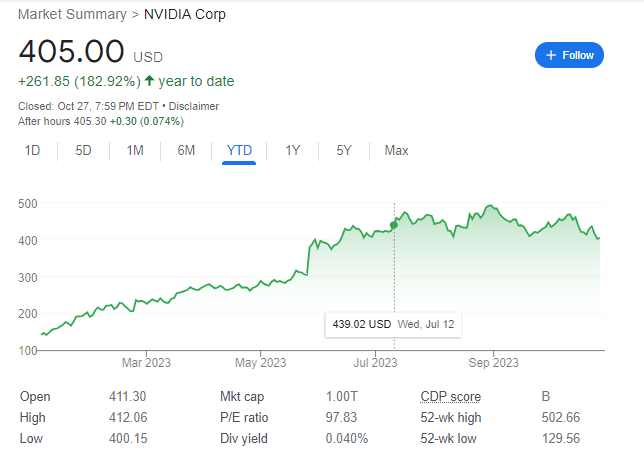
NVIDIA Corporation (NASDAQ: NVDA) is one of the leading developers of graphics processing units (GPUs) and artificial intelligence (AI) chips. The company has been enjoying strong growth and profitability in recent years, driven by the increasing demand for its products in various markets, such as gaming, data centers, automotive, and professional visualization.

NVIDIA’s stock has been on a remarkable rally since the beginning of 2022, reaching an all-time high of $502.66 on August 31, 2023. The stock has gained more than 300% in the past year, outperforming the S&P 500 index, which rose by about 25% in the same period.

The stock’s impressive performance reflects NVIDIA’s strong revenue and earnings growth, as well as its expanding market share and leadership position in the GPU and AI segments. NVIDIA has also benefited from several positive catalysts, such as:

The launch of its GeForce RTX 30 series of GPUs, which offer superior performance and ray tracing capabilities for gaming and content creation. The acquisition of Arm Holdings, a leading provider of chip designs and architectures, which is expected to enhance NVIDIA’s product portfolio and innovation capabilities. The introduction of its Grace CPU, an Arm-based processor designed for high-performance computing and AI applications.

The development of its Omniverse platform, a cloud-based collaboration tool that enables real-time simulation and rendering of 3D environments. The expansion of its data center networking solutions, such as BlueField DPU and DOCA software stack, which enable faster and more secure data processing and management.

NVIDIA’s financial results have been impressive in the past year, reflecting its strong sales growth across all its segments. In the second quarter of fiscal 2024 (ended July 31, 2023), NVIDIA reported revenue of $13.51 billion, up 101.48% year-over-year and beating analysts’ estimates of $12.55 billion. The company’s net income was $6.19 billion, up 843.29% year-over-year and surpassing analysts’ expectations of $5.41 billion. The company’s earnings per share (EPS) was $2.70, up 429.41% year-over-year and exceeding analysts’ projections of $2.34.

The company’s revenue growth was driven by strong demand for its GPUs and AI chips in gaming, data center, automotive, and professional visualization markets. The company’s gaming segment revenue was $6.76 billion, up 85% year-over-year, driven by the popularity of its GeForce RTX 30 series GPUs and GeForce NOW cloud gaming service. The company’s data center segment revenue was $4.63 billion, up 123% year-over-year, driven by the adoption of its Ampere architecture GPUs and BlueField DPUs for AI, cloud computing, and edge computing applications.

The company’s automotive segment revenue was $212 million, up 37% year-over-year, driven by the growth of its DRIVE platform for autonomous driving and infotainment systems. The company’s professional visualization segment revenue was $519 million, up 156% year-over-year, driven by the demand for its RTX A-series GPUs and Omniverse platform for content creation and collaboration.

The company’s net income growth was driven by its revenue growth, as well as its improved gross margin and operating margin. The company’s gross margin was 65%, up from 58% a year ago, reflecting its higher-value product mix and lower costs. The company’s operating margin was 49%, up from 25% a year ago, reflecting its operating leverage and cost discipline.

NVIDIA has several competitive advantages that enable it to maintain its leadership position in the GPU and AI markets. Some of these advantages are:

Its strong brand recognition and reputation for delivering high-quality products that offer superior performance and features. Its loyal customer base and large developer ecosystem that support its products and platforms. Its continuous innovation and R&D investments that enable it to introduce new products and technologies that address the evolving needs of its customers.

Its strategic partnerships and acquisitions that enhance its product portfolio and capabilities. Its diversified revenue streams that reduce its dependence on any single market or customer.

NVIDIA has a bright future ahead, as it continues to benefit from the secular trends that drive the demand for its products and services. Some of these trends are. The growth of gaming as a mainstream form of entertainment and social interaction, especially among younger generations.

The proliferation of AI and machine learning applications across various industries and domains, such as healthcare, education, retail, and manufacturing.

The emergence of new computing paradigms, such as cloud computing, edge computing, and quantum computing, that require high-performance and energy-efficient processors.

The development of new technologies and use cases, such as virtual reality, augmented reality, 5G, and autonomous vehicles, that create new opportunities for immersive and interactive experiences.

NVIDIA is well-positioned to capitalize on these trends, as it has a strong product pipeline and roadmap that address the current and future needs of its customers. Some of the products and technologies that NVIDIA is working on are:

Its GeForce RTX 40 series of GPUs, which are expected to offer higher performance and efficiency than the current generation of GPUs.

Its Arm-based PC chips, which are expected to rival Intel’s dominant position in the PC processor market.

Its Grace CPU, which is expected to compete with AMD’s EPYC CPU in the high-performance computing and AI market.

Its Omniverse Enterprise platform, which is expected to enable large-scale collaboration and simulation across multiple industries and domains.

Its BlueField 3 DPU, which is expected to offer faster and more secure data processing and management for cloud and edge computing applications.

NVIDIA faces several challenges that could limit its growth potential and profitability in the future. Some of these challenges are:

The intense competition from its rivals, such as AMD, Intel, Qualcomm, and Xilinx, who are also developing and launching new products and technologies that compete with NVIDIA’s offerings. The regulatory hurdles and antitrust concerns that could delay or prevent its acquisition of Arm Holdings, which is a key strategic move for NVIDIA’s future growth. The supply chain constraints and chip shortages that could affect its production capacity and delivery schedules, as well as increase its costs and prices.

The geopolitical tensions and trade disputes that could affect its access to certain markets and customers, especially in China, which is a major source of revenue for NVIDIA. The cyclical nature of some of its markets, such as gaming and automotive, that could cause fluctuations in its demand and revenue.

NVIDIA is a leading developer of GPUs and AI chips that has been delivering strong growth and profitability in the past year. The company has several competitive advantages that enable it to maintain its leadership position in the GPU and AI markets.

The company also has a bright future ahead, as it continues to benefit from the secular trends that drive the demand for its products and services. However, the company also faces several challenges that could limit its growth potential and profitability in the future. Therefore, investors should be aware of the risks and uncertainties involved in investing in NVIDIA’s stock.

Coinbase and Binance Regulatory Tussle

0

Coinbase, the leading cryptocurrency exchange in the US, has filed a new brief in its ongoing lawsuit with the Securities and Exchange Commission (SEC), accusing the regulator of overstepping its authority and violating due process.

The brief, which was submitted on October 27, 2023, is a response to the SEC’s motion to dismiss Coinbase’s complaint, which was filed in September 2023. The complaint challenged the SEC’s decision to threaten Coinbase with legal action if it launched a lending program that would allow users to earn interest on their crypto holdings.

Coinbase argues that the SEC’s decision was arbitrary and capricious, and that it violated the Administrative Procedure Act (APA), which governs how federal agencies make rules and regulations. Coinbase claims that the SEC failed to provide any clear guidance on how it determines whether a crypto product is a security or not, and that it applied a different standard to Coinbase than to other platforms that offer similar products.

Coinbase also asserts that the SEC violated its constitutional rights by depriving it of due process and equal protection under the law. Coinbase says that the SEC did not give it a fair opportunity to respond to its allegations, and that it discriminated against Coinbase by singling it out for enforcement action without any rational basis.

Coinbase concludes its brief by asking the court to deny the SEC’s motion to dismiss, and to grant Coinbase’s motion for a preliminary injunction, which would prevent the SEC from taking any action against Coinbase until the case is resolved.

Coinbase’s lawsuit is one of the most high-profile legal battles in the crypto industry, as it could have significant implications for the future of crypto regulation in the US. The case is being closely watched by other crypto companies, investors, and lawmakers, who are eager to see how the court will rule on the complex and controversial issues involved.

Binance has set up trading platform in Hong Kong to apply for a license.

Binance, one of the world’s largest cryptocurrency exchanges, has announced that it has established a trading platform in Hong Kong to apply for a license under the new regulatory framework. The move is part of Binance’s efforts to comply with the local laws and regulations, and to enhance its global presence and legitimacy.

Hong Kong has recently introduced a new licensing regime for crypto exchanges, which requires them to obtain approval from the Securities and Futures Commission (SFC) before operating in the city. The SFC has stated that it will only grant licenses to platforms that offer trading services for professional investors, and that comply with anti-money laundering and counter-terrorism financing rules.

Binance’s Hong Kong platform, which is expected to launch in the first quarter of 2024, will cater to professional investors only, and will offer a range of crypto products, including spot, futures, options, and margin trading. Binance said that it will also implement robust security measures, risk management systems, and governance structures to ensure the safety and integrity of its platform.

Binance’s CEO, Changpeng Zhao, said that the Hong Kong platform is a strategic step for Binance to expand its global footprint and to serve the needs of its customers in different markets. He added that Binance is committed to working with regulators and industry partners to foster innovation and growth in the crypto space.

“We are excited to launch our Hong Kong platform, which will provide a regulated and compliant environment for crypto trading in one of the world’s leading financial hubs. We believe that Hong Kong has a lot of potential to become a major crypto market, and we look forward to contributing to its development and prosperity,” Zhao said.

Binance’s Hong Kong platform is the latest addition to its growing network of regional platforms, which include Binance US, Binance Singapore, Binance UK, Binance Australia, and Binance Jersey. Binance said that it will continue to explore new opportunities and partnerships to offer more localized and tailored services to its users around the world.

4 Top Tips for Making Money By Investing In Cryptocurrency

0

Cryptocurrency has evolved over the past decade from a perceived fad to a lasting financial asset. The market is now renowned for its accessibility and potential for online earnings, with terms like ‘crypto millionaires’ and ‘crypto bros’ becoming common vernacular. As cryptocurrency continues its shift into mainstream finance, many individuals are looking to capitalize on its wealth-building opportunities.

The cryptocurrency market boasts a plethora of avenues for financial gain, including investment, active trading, and staking. In this article, we will explore various strategies for profiting from cryptocurrency and introduce promising projects like the Scorpion Casino Token that hold the potential for impressive returns.

Here Are Top 4 Tips To Ensure Crypto Success:

1.   Participate in Crypto Presales

Cryptocurrency presales present an enticing opportunity for substantial earnings. However, it’s crucial to exercise caution as not all presales are created equal, and the market is rife with pump-and-dump meme coins. To maximize your returns, seek projects with potential, longevity, and utility.

The Scorpion Casino Token, for instance, has garnered substantial attention. Functioning as a global Crypto Casino and Sports Betting platform, it generates daily revenue while enhancing the $SCORP Token through a comprehensive daily Buy-Back, Burn, and Reward System. This robust ecosystem has naturally attracted crypto investors and whales.

2.   Explore Staking

Staking involves investing in cryptocurrency by locking a specific amount of coins in your wallet for a predetermined duration. In return, your crypto holdings generate passive income, with the interest earned contingent upon the cryptocurrency type and the quantity staked.

3.   Adopt the Buy and Hold Strategy

The ‘buy the dip’ strategy entails acquiring cryptocurrencies from an exchange when prices dip and selling them at a later date for potential profits. Coins like Bitcoin, Ethereum, and Dogecoin experience daily price fluctuations, offering opportunities for strategic buying and selling.

4.   Earn Interest

Cryptocurrency investments offer a chance to accrue interest through ‘yield farming.’ By lending your cryptocurrency to a platform, you receive interest payments. This method, while associated with some risk, provides a means of generating passive income based on the platform and the cryptocurrency lent.

One More Thing Before You Go…

Successful cryptocurrency investors invest time in thorough project research. Examining Twitter pages, websites, whitepapers, and other sources is essential for gauging a project’s potential. For example, projects like the Scorpion Casino Token offer extensive information on their website and social media channels, serving as positive indicators of their legitimacy and potential.


For more information;

Presale: https://presale.scorpion.casino/

Twitter: https://twitter.com/ScorpionCasino

Telegram: https://t.me/scorpioncasino_official