DD
MM
YYYY

PAGES

DD
MM
YYYY

spot_img

PAGES

Home Blog Page 3684

Tinubu Institutes Economic Advisory Committee made up of Dangote, Otedola, Elumelu, others

0

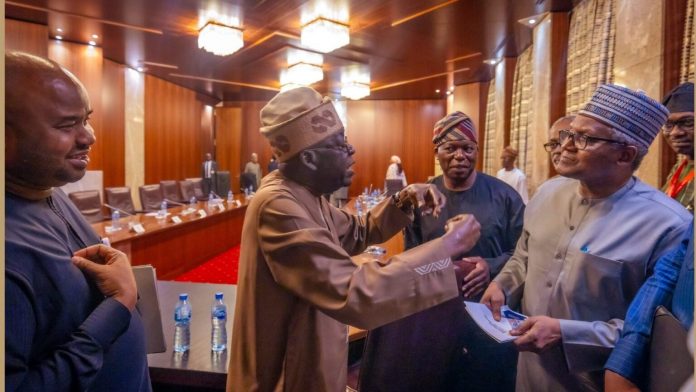
In light of Nigeria’s troubled economy, President Tinubu on Sunday convened a high-level meeting at the State House in Abuja, where he set up a Tripartite Economic Advisory Committee.

The move comes amid calls for comprehensive strategies to address the nation’s degenerating economic downturn.

The meeting brought together a diverse array of stakeholders, including prominent business leaders, governors, and representatives from various sectors. Among those in attendance were renowned figures such as Aliko Dangote, Femi Otedola, Amina Maina (VP NESG), Boye Olusanya (Flour Mills), Segun Ajayi-Kadir (DG MAN), Tony Elumelu, Bismarck Rewane, and Samala Zubairu (AFC).

Others were Innocent Chukwuma (Innoson), Jubril Adewale Tinubu, Governor Soludo of Anambra State, Governor Dapo Abiodun of Ogun State, CBN Governor, Olayemi Cardoso, Kola Adeshina, Abdulkabir Aliu and Abdul Samad Rabiu (BUA).

This broad representation is said to represent the collective effort required to tackle Nigeria’s multifaceted economic challenges effectively.

In his opening remarks, President Tinubu emphasized the government’s commitment to finding solutions, acknowledging that while they may not have all the answers, they were determined to take decisive action. He stressed the importance of collaborative efforts in formulating economic policies that would benefit all Nigerians, particularly the most vulnerable segments of society.

“We are not saying that we have all the answers. But we will not be blamed for not trying. We assure Nigerians that we will do our best to get our Marshall plan in place and fashion out the best economic future for this country

“We’re looking for additional efforts that might help the downtrodden Nigerians and we will provide that hope and reassurance that economic recovery is on its way.

“Let’s look at what we’re doing right and what we’re doing wrong to bring life back to the economy. As I said, many times, the people of this country are only the people who we have to please.

“And we are very much concerned from students to mothers and fathers, farmers, the traders and realising that everyone of us will have to fetch water from the same well,” he said.

Aliko Dangote, President of the Dangote Group, commended the comprehensive nature of the discussions during the meeting. He highlighted the critical issues addressed, including economic stability, food security, and national security.

Dangote expressed confidence in Nigeria’s ability to overcome these challenges, particularly with the establishment of the Economic Advisory Committee.

“I think we had a very, very good meeting and what we discussed is generally about the economy, food security and security of the nation,” he said.

“We discussed everything in detail. There the Economic Presidential Advisory Committee, which has been set up and I think this will look at all the issues and address them, coming from job creation, and food security, coming from also reflect the economy.

“So, all these things that have been discussed in detail. I can’t give you all the details right now, but we are hopeful and we’re a great nation. We have what it takes to turn around the economy and we’re going to do that.”

Abdulsamad Rabiu, Chairman of BUA Cement, echoed Dangote’s sentiments, emphasizing the importance of addressing the foreign exchange rate. He praised the efforts of the Central Bank of Nigeria (CBN) in stabilizing the exchange rate and expressed optimism about the future trajectory of the economy.

“We discussed on how to bring the foreign exchange rate down because we all know that what is happening as regards the foreign exchange is artificial, it is manipulative and thank God the CBN is doing quite a lot.

“Now, the exchange rate has come down from N1800 to maybe 1600 and N1500 now, and as you all know, everything in Nigeria is indexed to the foreign exchange, especially when it comes to stuff that we import into the country,” he said.

Tony Elumelu, Chairman of Heirs Group, expressed enthusiasm and optimism about the outcomes of the meeting. He stressed the need to implement decisions made during the consultations to stimulate economic growth and alleviate poverty effectively.

“I believe that implementing the decisions we arrived at today will propel our economy and help alleviate the poverty in the land, help create employment and help put food on table,” he said.

Anambra State Governor Charles Soludo highlighted the collaborative nature of the meeting, noting the collective responsibility of all Nigerians in contributing to the nation’s economic resurgence. He said there is a need for unity, determination, and patriotic fervor in overcoming current challenges.

On his part, Ogun State Governor Dapo Abiodun reassured the public of the government’s commitment to providing immediate relief measures while awaiting the implementation of broader fiscal and monetary policies. He emphasized the importance of collaborative efforts between the federal government and state governments to alleviate the impact of economic challenges on citizens.

The meeting concluded with a sense of cautious optimism about the prospects of revitalizing Nigeria’s economy and improving the livelihoods of its citizens. With broad-based stakeholder engagement and a commitment to swift action, members of the Economic Advisory Committee believe that Tinubu’s proactive approach to economic challenges will usher in a brighter economic future for Nigeria.
BlockDAG Sees Whales Jump in for 5000x Profits as BNB and Kelexo Gains

0

Binance Coin (BNB) and Kelexo are notable players in cryptocurrencies, but BlockDAG Coin (BDAG) shines as a promising alternative. While BNB has surged to $360, propelled by Binance’s strong Proof-of-Reserve and impressive growth in net holdings, BlockDAG’s innovative approach stands out. Utilizing Directed Acyclic Graph (DAG) and Proof-of-Work (PoW), BlockDAG Coin ensures scalability and security, appealing to tech enthusiasts seeking cutting-edge solutions.

With a successful presale, BlockDAG has garnered significant community support, highlighting its potential profitability. Investors eyeing the future can anticipate substantial returns; with a trading price of $0.0015 in the Batch 2 presale and a promising roadmap, BlockDAG has seen crypto whales flock into the project for potential 5000x gains.

BNB Hits $360: Binance’s Stronghold

Binance’s recent Proof-of-Reserve showed growth in net holdings, positively impacting BNB’s price, which surpassed $390. The 15th release noted increased user and exchange balances compared to the prior month, particularly in Bitcoin and Ethereum. CoinMarketCap’s analysis highlighted Binance’s dominance in trading volume and website visits. BNB’s bullish trend continued, with its daily chart showing consistent uptrends, reaching approximately $392.

Kelexo: Bridging Borrowers and Lenders in Crypto 

The ongoing Kelexo (KLXO) presale offers a growth opportunity in the cryptocurrency market by introducing a peer-to-peer lending platform. This platform facilitates direct connections between borrowers and lenders, cutting out middlemen and reducing user costs.

Kelexo ensures transparency and security for investors through its fixed supply and audited smart contracts.

BlockDAG Presale: Path to Profitability

BlockDAG Coin emerges as the best altcoins in 2024, offering lucrative investment opportunities backed by innovative technology and a successful presale. Its use of Directed Acyclic Graph (DAG) and Proof-of-Work (PoW) ensures scalability and security, attracting those interested in cutting-edge technology. With a $1 million raise in its Batch 1 presale, BlockDAG demonstrates robust community support and viability, generating excitement among crypto whales attracted by its potential 5000x gains.

Investors can potentially earn 5000x returns upon its official launch, with a current trading price of $0.0015 in the Batch 2 presale. The platform turns out assorted revenue streams, including Coin Investment Strategy and Mobile Mining Convenience, taking special care of various financial backer inclinations and offering a far-reaching way to deal with expanding returns. With a straightforward guide and group certainty, BlockDAG rises as a promising investment choice in the unique digital currency market.

BlockDAG Presale Leads 2024 Altcoin Revolution

While BNB holders and Kelexo present strong cases in the cryptocurrency market, BlockDAG Coin emerges as a standout choice for investors looking for innovation and potential profitability. With its unique use of Directed Acyclic Graph (DAG) and Proof-of-Work (PoW), BlockDAG offers scalability, security, and a robust network.

The success of its presale, coupled with a clear roadmap and diverse income streams, positions BlockDAG as a promising investment option. As the cryptocurrency market continues to evolve, BlockDAG’s commitment to cutting-edge technology and community support sets it apart, making it a compelling choice for investors seeking growth and sustainability.


Join BlockDAG Presale Now:

Website: https://blockdag.network

Presale: https://purchase.blockdag.network

Telegram: https://t.me/blockDAGnetworkOfficial

Discord: https://discord.gg/Q7BxghMVyu

Let’s discuss #Abia and #Nigeria; Invest in Abia

0

Every citizen of the world is an Abian because Abia State is “God’s Own State”, and we’re all children of God (at least for many!). The near-term VISION is to restore the glory of Abia State and make it the #1 State in Nigeria on opportunity, human welfare, and progress. Doing that goes through a MISSION to establish responsive, efficient and accountable governments at the community, local and state levels.

If you are planning to invest in Africa, consider #Abia State, Nigeria. We just have a power plant commissioned, and we do hope that electricity will be available in our largest commercial city, Aba – the Enyimba City. Come over and let Abia power your mission.

How can Abia help you? We want you to invest in God’s Own State? We have got many young people who can explain the promises in Abia State and how Abia will host your projects. We’ve got a responsive, focused and capable state leadership. #InvestInAbia

Ndubuisi Ekekwe – honoured by Abia Elders and State Council as the “2021 Most Outstanding Abia Professional in the Diaspora” and the “2021 Abia Ambassador”. Let’s discuss #Abia and #Nigeria.

Ndubuisi Ekekwe Honoured As “2021 Most Outstanding Abia Professional in the Diaspora” and the “2021 Abia Ambassador”

The Naira Problem Is Not Distribution-Related But Structural, Making Banning Binance, Restricting BDCs, etc Impotent

0

Nigeria remembers Bureau De Change (BDC) operators again: ‘“BDCs may sell foreign currency up to the equivalent of USD10,000 to a customer for school fee once a year. Such fee, which shall be transferred from the BDC’s domiciliary account with a Nigerian bank, shall be paid directly to the school,” the proposed Central Bank of Nigeria (CBN) guideline said. Similarly, the guideline highlighted the imposition of a limit of $5,000 per annum for foreign currency transactions for medical bills abroad.’

Good People, I am not aware of any decent university in the United States which charges $10k per year. In the one I attended, they go for $67,000 yearly. And if you go for Harvard MBA, you could be looking at $75, 000 per year. (These fees are for tuition only.) So, if that is the case, does this policy hold water? Sure – the central bank has to initiate an action.

Things have changed. When I began in FUTO,  the Center of Erosion Studies in the university was manned by Germans, and we had a fair decent number of foreign students. In the Physics department, there were many Cameroonians. But over a series of strikes, the Indians, Nigeriens, Cameroonians, etc all left.

Today, here we are…very unfortunate. Yet, I do not think BDCs are the root cause of this FX paralysis. The root cause is that Nigeria is floating Naira which is a bad policy. We can ban Binance,  restrict BDCs, etc but until we can earn US dollars, the Naira will continue to struggle. The problem we’re having is not distribution-related, but structural, and that means if we close all distribution channels, and refuse to reduce DEMAND (foreign schools, hospitals, toothpicks, etc), the core drivers of the paralysis, the Naira will continue to fade.

Considering everything happening, I propose for Nigeria to remove floating but change FX forward-credit into one which focuses on production-oriented things. For example, instead of giving a company $1m at the official rate to import an equipment,  you ask that company to source funds via, wherever, and when it is imported and confirmed at the Customs, the Central Bank of Nigeria will refund that company the money and debit the Naira. The focus here is to make sure only production-focused imports are supported.

Comment on Feed

Comment 1: School fees and medicals can still be processed through the commercial banks.
Having bdc’s trading in unquantifiable amounts of foreign exchange daily without anyone knowing who is demanding or supplying or what the purpose or source of supply is coming from. Can create a very big distortion in a market that has been liberalized & its also dangerous to the economy.

Lastly, I agree the problem is not only regulating the bdc’s. We have to improve on our productivity e.g export has a nation but creating transparency in the bdc sector is very paramount. Ndubuisi Ekekwe

My Response: Your point noted. Sure – I did not even know that BDCs can help people pay school fees from Nigeria. It seems they have evolved. Typically you expect people to pay via their banks. I wish CBN good luck on this

CBN’s proposed guidelines limit BDCs dollar outflow for Education and Medical Expenses to $10k and $5k annually

Central Bank of Nigeria’s proposed guidelines limit BDCs dollar outflow for Education and Medical Expenses to $10k and $5k annually

0

In a bid to address the challenges in Nigeria’s foreign exchange market, the Central Bank of Nigeria (CBN) has unveiled stringent measures targeting transactions related to overseas education and medical expenses.

These measures, part of the CBN’s revised regulatory guidelines for Bureau De Change (BDC) operators, aim to curb significant outflows of foreign currency and stabilize the value of the Naira.

“BDCs may sell foreign currency up to the equivalent of USD10,000 to a customer for school fee once a year. Such fee, which shall be transferred from the BDC’s domiciliary account with a Nigerian bank, shall be paid directly to the school,” the proposed guideline said.

Similarly, the guideline highlighted the imposition of a limit of $5,000 per annum for foreign currency transactions for medical bills abroad.

“Funds for medical bills will be transferred directly from the BDC’s account to the medical facility,” it explained, adding that it must be supported by comprehensive documentation, including a completed e-Form A, a referral letter from a recognized specialist doctor or hospital in Nigeria, valid travel documents, and a letter from an overseas medical professional detailing the cost of treatment.

Recently, the central bank has announced a series of new guidelines, changing existing rules. CBN governor Yemi Cardoso, said these measures are essential to mitigate the challenges posed by significant outflows for foreign education and medical tourism, which have contributed to the depreciation of the Naira beyond N1,600 in the official market.

The apex bank head said in recent years, approximately $40 billion has been directed towards these sectors. He explained that such massive outflows have exerted immense pressure on the country’s foreign exchange reserves and have contributed to the depreciation of the Naira, impacting the economy at large.

The proposed regulations also affect International Money Transfer Operators (IMTOs), including major entities like Western Union and MoneyGram, restricting their services to inbound transfers with mandatory Naira payouts. Additionally, the issuance of Personal Travel Allowance (PTA) and Business Travel Allowance (BTA) will no longer be in cash but through electronic means.

Analysts anticipate that these measures could have significant implications for Nigerian international students. With the Naira facing substantial devaluation against the dollar, the proposed $10,000 yearly limit for international study fees may present challenges as the BDCs are major source of FX for many international students.

In light of the current exchange rate, $10,000 is nearly equivalent to N18 million. This means that Nigerian students may require more than a year to receive sufficient outbound funds to cover their annual school fees, potentially delaying their education plans and increasing financial burdens.

In response to the proposed regulations, stakeholders have expressed concerns about the potential impact on access to quality education for Nigerian students studying abroad, particularly some students from low-income backgrounds who rely on foreign exchange transactions to fund their education overseas.

While the measures aim to stabilize the Naira, it is believed that they could inadvertently restrict opportunities for educational advancement.

Furthermore, there are concerns regarding the effectiveness of the proposed measures in addressing the root causes of currency depreciation and foreign exchange instability. While these measures may offer temporary relief to the foreign exchange market, experts believe that they do not address underlying economic challenges such as inflation and fiscal deficits.

Against the backdrop of the implications of these measures, stakeholders said there is a need for a balanced approach that ensures the stability of the Naira without compromising access to quality education for Nigerian students. They said comprehensive economic reforms are necessary to ensure long-term stability and sustainable growth.