DD
MM
YYYY

PAGES

DD
MM
YYYY

spot_img

PAGES

Home Blog Page 3686

BlackRock says Spot Bitcoin ETF application still under review by SEC

0

The world’s largest asset manager, BlackRock, has confirmed that its application for a spot Bitcoin ETF is still pending approval from the US Securities and Exchange Commission (SEC). The company filed the application in July, seeking to offer investors exposure to the actual Bitcoin cryptocurrency, rather than futures contracts or other derivatives.

This statement from BlackRock is in regard to the recent article published by Cointelegraph which claimed that the U.S. Securities and Exchange Commission (SEC) had approved the first Bitcoin Spot ETF, issued by iShares. The article, which was quickly deleted, sparked a wave of excitement and confusion among cryptocurrency investors, who rushed to buy Bitcoin in anticipation of a price surge.

However, the article turned out to be fake news, as the SEC has not made any official announcement regarding the approval of any Bitcoin ETF. The false report caused many users to FOMO (fear of missing out) and lose money, as they bought Bitcoin at a high price and then saw it drop shortly after. This incident highlights the importance of verifying the sources and credibility of any news related to cryptocurrency regulation, as well as the risks of acting on emotions rather than rational analysis.

A spot Bitcoin ETF would allow investors to buy and sell shares of a fund that holds Bitcoin as its underlying asset, without having to deal with the technical and security challenges of owning and storing the digital currency directly. This would potentially lower the barriers to entry and increase the liquidity and transparency of the Bitcoin market.

However, the SEC has been reluctant to approve any Bitcoin ETFs, citing concerns over market manipulation, fraud, custody, and investor protection. The regulator has repeatedly delayed or rejected applications from various firms, including VanEck, Valkyrie, and Wisdom Tree. The SEC has also indicated that it prefers Bitcoin futures ETFs over spot ones, as futures are regulated by the Commodity Futures Trading Commission (CFTC) and trade on established exchanges.

BlackRock’s application for a spot Bitcoin ETF is one of the few remaining ones that have not been withdrawn or denied by the SEC. The company’s CEO, Larry Fink, has expressed optimism about the prospects of a Bitcoin ETF, saying that he believes there is a “huge appetite” for crypto among investors. He also said that BlackRock is “very excited” about the potential of blockchain technology and digital assets.

BlackRock is not new to the crypto space, as it already offers some exposure to Bitcoin through its Global Allocation Fund and Digital Assets Fund. The company also holds a stake in MicroStrategy, a business intelligence firm that has become one of the largest corporate holders of Bitcoin. Additionally, BlackRock has hired several experts in crypto and blockchain, such as Rick Rieder, its chief investment officer of global fixed income, and Michael Saylor, its head of digital assets.

According to data from Bybt, more than $50 million worth of Bitcoin short positions were liquidated in less than an hour, as the leading cryptocurrency surged. A spot ETF would also increase the demand and liquidity for Bitcoin, as more institutional and retail investors would have access to the market. A spot ETF would also reduce the premium or discount that often occurs on existing Bitcoin products, such as the Grayscale Bitcoin Trust (GBTC) or the Bitcoin futures contracts.

However, the tweet was based on a misunderstanding of a press release by BlackRock, which announced that it had launched two new funds that would invest in Bitcoin futures, not spot. BlackRock already had exposure to Bitcoin futures through its existing funds, and the new funds were not ETFs, but mutual funds.

The SEC has not approved any spot ETF for Bitcoin or any other cryptocurrency, and has repeatedly expressed its concerns about the market manipulation, fraud, and volatility in the crypto space. The SEC has also delayed its decision on several pending applications for Bitcoin futures ETFs, which are considered more likely to be approved than spot ETFs.

Despite the clarification that the rumor was false, the Bitcoin price did not drop back to its previous levels, but rather consolidated around $27,000/28k. This suggests that the market was already bullish on Bitcoin, and that the rumor was just a catalyst for a breakout.

Some analysts also pointed out that the liquidation of short positions added fuel to the rally, as traders who bet against Bitcoin had to buy back their positions at higher prices to cover their losses. This created a positive feedback loop that pushed the price higher.

The false rumor about BlackRock’s spot ETF approval shows how sensitive and reactive the Bitcoin market is to any news or speculation about institutional adoption and regulation. While a spot ETF would be a major milestone for Bitcoin, it is not a necessary condition for its growth and development.

Bitcoin has already shown its resilience and innovation in the face of regulatory uncertainty and hostility and has attracted many prominent investors and corporations to its network. Bitcoin also has a strong community and culture that supports its vision and values, regardless of external factors.

While BlackRock awaits the SEC’s decision on its spot Bitcoin ETF application, several Bitcoin futures ETFs have already launched in the US market, attracting billions of dollars in inflows. These include the ProShares Bitcoin Strategy ETF (BITO), the Valkyrie Bitcoin Strategy ETF (BTF), and the VanEck Bitcoin Strategy ETF (XBTF). However, some analysts have warned that these products may not accurately reflect the price of Bitcoin, as they are subject to contango and roll costs.

A spot Bitcoin ETF would be a more direct and efficient way to invest in Bitcoin, as it would track the actual price of the cryptocurrency and eliminate the need for intermediaries. However, it remains unclear whether the SEC will ever approve such a product, or what conditions it would impose on it. BlackRock’s application is still under review by the regulator, and no timeline has been given for its approval or rejection.

EU regulator warns of DeFi risks; Upbit obtains initial approval for Digital Asset License in Singapore

0

Have you heard the latest news from the EU? Apparently, they are not so keen on the idea of decentralized finance (DeFi) and its implications for the financial system. In a recent report, the European Securities and Markets Authority (ESMA) warned of the risks and challenges posed by DeFi, especially when it comes to consumer protection, market integrity and financial stability.

One of the main issues that the ESMA raised was the concept of ‘code as law’, which means that the rules and outcomes of DeFi applications are determined by the underlying smart contracts, rather than by human intervention or oversight.

The ESMA argued that this approach could lead to legal uncertainty, operational failures, cyberattacks, fraud and manipulation. They also questioned whether DeFi users are fully aware of the risks and responsibilities involved in using such platforms, and whether they have adequate recourse in case of disputes or losses.

The ESMA also suggested that some DeFi activities may fall under the existing EU regulatory framework, depending on their features and functions. For example, some DeFi tokens may qualify as financial instruments or electronic money, and some DeFi platforms may provide investment services or payment services. Therefore, the ESMA urged DeFi providers to comply with the relevant rules and regulations, and to cooperate with the authorities and supervisors.

This report is not surprising, given that the EU has been taking a cautious and conservative stance on crypto-related matters. However, it also shows that the EU is paying attention to the developments and innovations in the DeFi space, and that it is trying to balance the potential benefits and risks of this emerging sector.

The ESMA acknowledged that DeFi could offer more efficiency, transparency, competition and financial inclusion, but also stressed the need for a level playing field and a sound governance framework.

Coinbase; The approval of a bitcoin spot ETF is partially priced in.

The cryptocurrency market has been anticipating the launch of a bitcoin spot exchange-traded fund (ETF) in the US for a long time. Many experts believe that such a product would boost the adoption and legitimacy of bitcoin as an asset class, as well as attract more institutional and retail investors to the space.

However, the US Securities and Exchange Commission (SEC) has been reluctant to approve any bitcoin spot ETF proposals, citing concerns over market manipulation, investor protection, and regulatory oversight. The SEC has only approved bitcoin futures ETFs so far, which track the price of bitcoin futures contracts rather than the underlying asset itself.

Coinbase, one of the largest and most influential cryptocurrency platforms in the world, has recently shared its view on the prospects of a bitcoin spot ETF in the US. In its Q3 2021 shareholder letter, Coinbase stated that it expects a bitcoin spot ETF to be approved in the US “in the next few years”, but also noted that some of the potential impact of such an approval is already reflected in the current market prices.

“We believe that a bitcoin spot ETF approval in the US is partially priced in, given that several bitcoin futures ETFs have already launched and are trading at a premium to NAV [net asset value],” Coinbase wrote. “We also believe that there is still significant upside potential for a bitcoin spot ETF approval, as it would likely increase retail demand and lower the barriers to entry for many investors who are interested in gaining exposure to bitcoin.”

Coinbase added that it is actively engaging with regulators and policymakers to advocate for a clear and consistent regulatory framework for cryptocurrencies, including a bitcoin spot ETF. The company said that it believes that such a framework would benefit not only Coinbase, but also the entire industry and its customers.

“We continue to work closely with regulators and policymakers to educate them on our industry and our products, and to provide feedback on proposed rules and guidance,” Coinbase wrote. “We believe that constructive dialogue and collaboration are essential to foster innovation and growth in the crypto economy, while also protecting investors and consumers.”

Upbit obtains initial approval for Digital Asset License in Singapore

Upbit, one of the largest cryptocurrency exchanges in South Korea, has announced that it has received a provisional license from the Monetary Authority of Singapore (MAS) to operate as a digital asset service provider in the city-state. This is a significant milestone for Upbit, as it aims to expand its global presence and offer its services to more customers in the rapidly growing Asian market.

According to a press release, Upbit applied for the license under the Payment Services Act (PSA), which regulates the activities of digital payment token (DPT) service providers in Singapore. The PSA requires DPT service providers to comply with various rules and standards, such as anti-money laundering, counter-terrorism financing, cybersecurity, and consumer protection. Upbit said that it has met all the requirements and demonstrated its commitment to operating in a safe and responsible manner.

Upbit is the first major Korean exchange to obtain the license from MAS, which is widely regarded as one of the most progressive and forward-looking regulators in the world. Upbit said that it will leverage its experience and expertise in the Korean market to provide high-quality services to its Singaporean customers, as well as to contribute to the development of the local blockchain ecosystem.

Upbit also said that it plans to launch its Singaporean platform in the first quarter of 2024, after completing the necessary preparations and obtaining the final approval from MAS. The platform will offer a variety of features and functions, such as spot trading, margin trading, staking, lending, and derivatives. Upbit said that it will support multiple fiat currencies, including Singapore dollar, US dollar, and Korean won, as well as over 200 cryptocurrencies.

Upbit’s CEO Lee Seok-woo expressed his gratitude and excitement for receiving the provisional license from MAS. He said: “We are honored and delighted to be recognized by MAS as a trustworthy and reliable digital asset service provider. This is a testament to our efforts and achievements in the Korean market, where we have established ourselves as a leading exchange with a strong reputation and customer base. We look forward to bringing our expertise and innovation to Singapore and serving our customers with the best products and services possible.”

Social finance apps Tomo and New Bitcoin City break above $1 million in TVL

In a remarkable feat of innovation and adoption, two social finance apps have surpassed the $1 million mark in total value locked (TVL) within a week of their launch. Tomo and New Bitcoin City are both decentralized applications (dApps) that leverage blockchain technology to create peer-to-peer lending and borrowing platforms with social features.

Tomo is a dApp that allows users to lend and borrow cryptocurrencies with their friends, family, and trusted contacts. Users can create personalized loan agreements, set interest rates and repayment terms, and chat with their lenders or borrowers within the app.

Tomo also rewards users for timely repayments and referrals with its native token, TOMO, which can be staked to earn passive income or used to access premium features.

New Bitcoin City is a dApp that enables users to create and join virtual communities based on their interests, hobbies, or goals. Users can pool their funds together to invest in various DeFi protocols, such as yield farming, liquidity mining, or NFTs, and share the profits among the members. New Bitcoin City also has a gamified interface that allows users to customize their avatars, explore the city, and interact with other residents.

Both Tomo and New Bitcoin City have attracted a lot of attention and capital from the crypto community, as they offer novel ways to engage with DeFi and socialize with like-minded people. According to DeFi Pulse, Tomo has reached a TVL of $1.2 million, while New Bitcoin City has achieved a TVL of $1.1 million as of October 16, 2023. These numbers are expected to grow as more users discover and join these innovative platforms.

The success of Tomo and New Bitcoin City demonstrates the potential of social finance as a new paradigm for DeFi. By combining financial services with social interactions, these dApps create more value and utility for their users, as well as foster a sense of community and trust among them. Social finance is not only a trend, but a movement that could redefine the future of finance.

FEC Approves Nigeria’s $1.5bn and $80m Loan Requests from World Bank, AfDB

0

Wale Edun, the Minister of Finance and Coordinating Minister of the Economy, has disclosed that the Federal Executive Council (FEC) has given its approval for a $1.58 billion loan request, one day after he confirmed that the federal government was in the process of securing the loan.

The minister explained that the approved loan request consists of two components: $1.5 billion from the World Bank and $80 million from the African Development Bank (AfDB).

He further elaborated that the $1.5 billion from the World Bank will be channeled through the International Development Association (IDA), a branch of the World Bank that extends interest-free loans to low-income nations.

“We also approved today the application for financing from the World Bank. And in particular, the International Development Association which is really the virtually free or zero interest lending arm or financing arm of the World Bank,” he said.

“The total is $1.5 billion. And the background is just as you heard from the Minister of Planning and Budget.”

Edun on Saturday assured that the loan would come with a near-zero interest rate, alleviating concerns about escalating Nigeria’s debt service commitments. He clarified that there would be no negative connotations associated with obtaining World Bank funding to support developmental projects.

Edun noted that the loan request is significant as it arrives at a time when borrowing costs are increasing, primarily due to developed nations hiking interest rates and implementing tighter monetary policies to combat inflation.

“What that means is that interest rates for everybody else, become not just high but very painful, if not on (sic) affordable within that context,” he said.

Edun said the World Bank is willing to lend to Nigeria because of some tough policies made by President Bola Tinubu. This loan is expected to support Nigeria in managing its finances, especially the nearly $7 billion backlog in FX obligations.

He emphasized that the firm measures taken by the government have garnered the backing of multilateral development institutions. Consequently, the World Bank is poised to facilitate $1.5 billion in concessional financing on Nigeria’s behalf. This funding will be both relatively affordable and swiftly disbursed.

Regarding the $80 million loan from the African Development Bank (AfDB), Edun disclosed that it will be allocated for the Ekiti Knowledge Zone (EKZ) project. This initiative aims to equip the youth in Ekiti with crucial technological skills, particularly given the increasing contribution of the technology sector to the nation’s economy.

However, increasing borrowing amid unsustainable public debt stock and dwindling revenue remains a huge concern for Nigerians, especially as the government is believed to be borrowing for consumption. Nigeria is said to be spending more than 90 percent of its revenue on debt servicing currently.

Nigeria’s Federal Executive Council Approves N26tn for 2024 Budget

0

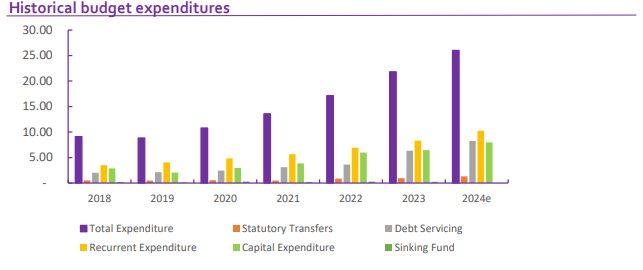
The Federal Executive Council, headed by President Bola Tinubu, has ratified a budgetary benchmark of N26 trillion for the 2024 fiscal year during their meeting on Monday.

Atiku Bagudu, Minister of Budget and National Planning, shared a brief overview of the meeting, which marked the second since Tinubu’s presidency.

Briefing State House correspondents at the end of the FEC, alongside his colleagues from the Ministry of Information and National Orientation, Mohammed Idris, Minister of Finance and Coordinating Minister of Economy, Wale Edun, Works Engr. Dave Umahi, Industry, Trade and Investment, Doris Uzoka-Anite, Labour and Employment, Simon Lalong as well as the Minister of State for Labour, Nkeiruka Onyejecha, Bagudu said Council has approved the 2024-2026 Medium Term Expenditure Framework, MTEF, and Fiscal Strategy Papers, FSP.

The FEC sanctioned the 2024-2026 Medium Term Expenditure Framework (MTEF) and Fiscal Strategy Papers (FSP), as confirmed by Bagudu.

Among the MTEF’s assumptions, the FEC set a crude oil price of $73.96 and an exchange rate of N700 per US dollar.

“Now, it was presented on the background of the commendable measures that have been taken since June in order to restore macroeconomic stability, particularly the deregulation of petroleum prices, for which we maintained that subsidies are gone and indeed the regulation of the foreign exchange market,” Bagudu said.

“So Council deliberated, as well as the implication of this and all measures promised in the renewed hope agenda, consumer credits, mortgages, reversed or dismissed institutions, as well as funding the newly aligned institutional changes, particularly ministries with specific functions that are able to generate growth, so that would be better for our country.

“The council members acknowledge the medium term expenditure framework, and it is agreed that we can go ahead to the next step of consultation and presentation to the National Assembly.”

The executive is expected to present the document to the National Assembly before December 31, 2023, after the ministries and parastatals saddled with the responsibilities of perfecting the budget estimates have done their job, in line with the Fiscal Responsibility Act.

The Fiscal Responsibility Act stipulates that the executive must present the Medium Term Expenditure Framework (MTEF) to the National Assembly before submitting the budget proposal. The MTEF serves as a comprehensive document outlining the medium-term economic outlook for the nation.

However, the N26 trillion budget proposal has been described as unrealistic by many who pointed at the nation’s current economic turmoil. Nigeria’s oil revenue has seen a significant drop in recent years, scuttling the country’s capacity to fund its budget without borrowing. For instance, net earnings from crude oil and gas as at the first quarter of the year stood at N486 billion, while net earnings from solid minerals was N1.99 billion.

Personnel cost at the same period was N978 billion – creating a huge revenue deficit. Against this backdrop, which has fueled calls for cuts in the cost of governance, funding the budget is seen as mission impossible and leaves the government with no other option than to borrow more.

LinkedIn to Lay Off 668 Employees in Another Round of Job Cut

0

LinkedIn has announced its second round of job cuts in 2023, with 668 employees set to be laid off from the company. The layoffs will affect various departments, including engineering, talent, and finance, and amount to over 3% of LinkedIn’s 20,000-strong workforce.

These job cuts are reflective of the broader trend in the technology sector, which has seen tens of thousands of job losses this year due to economic uncertainty.

“Talent changes are a difficult, but necessary and regular part of managing our business,” the company said in a statement.

“While we are adapting our organizational structures and streamlining our decision making, we are continuing to invest in strategic priorities for our future and to ensure we continue to deliver value for our members and customers.”

“We are committed to providing our full support to all impacted employees during this transition and ensuring that they are treated with care and respect.”

LinkedIn generates revenue through advertising sales and subscriptions for recruiting and sales professionals. However, the company has faced challenges such as a slowdown in hiring and a decline in advertising spending, resulting in slower revenue growth.

LinkedIn’s revenue increased by 5% year-on-year in the fourth quarter of its fiscal 2023, down from 10% in the previous quarter.

Microsoft, which owns LinkedIn, has identified these challenges as headwinds for the platform. Despite this, LinkedIn continues to add new members to its extensive community of 950 million users.

This recent round of layoffs follows a previous cut of 716 jobs in May, which focused on sales, operations, and support teams. These cuts are part of LinkedIn’s efforts to streamline its operations and remove layers within the organization to facilitate quicker decision-making.

The recent job cut aligns with the prevailing trend in the technology sector, where numerous companies are substituting employees with artificial intelligence.

Earlier this month, LinkedIn introduced a range of new AI-driven product features, which encompass AI-assisted candidate discovery for recruiters. These features include improvements in natural language searches, reduced emphasis on university qualifications and job titles, as well as prompts on how a job role can be customized to match a candidate’s strengths and limitations, such as location.

LinkedIn has also incorporated AI-powered coaching into its subscriber-only LinkedIn Learning platform and introduced a chatbot service to guide workers through challenging situations or their career development.