DD
MM
YYYY

PAGES

DD
MM
YYYY

spot_img

PAGES

Home Blog Page 370

Predict Shark Launches Prediction Market Parlays Built on Polymarket’s Stack

0

Predict Shark officially rolled out its highly anticipated parlay feature, allowing users to combine multiple prediction market outcomes into single, high-reward bets.

Built on the Polymarket blockchain ecosystem, this update transforms simple yes/no event predictions like election results, sports outcomes, or economic indicators into complex, customizable parlays—similar to sports betting combos but powered by decentralized finance (DeFi) and crowd-sourced probabilities.

Traditional prediction markets like Polymarket let you buy “shares” in outcomes like “Will Team A win?”. Parlays multiply odds across events, potentially turning a $10 stake into 10x+ returns if all legs hit.

Predict Shark’s tool automates the math, showing real-time implied probabilities and potential payouts. Unlike basic sportsbooks, you can mix uncorrelated events—e.g., “US election winner + Fed rate cut + Bitcoin above $100K by EOY”—for diversified exposure without overpaying vig (juice).

Leverages Polymarket’s low-fee structure often under 1% and USDC settlements, making it accessible globally where crypto is legal. No KYC hurdles for most users, unlike fiat platforms like Kalshi.

Prediction Markets Hub launch in September 2025, this fits a broader trend: prediction volumes exploded 300% YoY, driven by 2024’s election cycle and sports integration. Predict Shark positions itself as the “advanced layer” for power users, with tools for backtesting parlay strategies.

Crypto basis risk if USDC fluctuates, though minimal on stablecoins. Relies on Polymarket oracles; rare but check event rules. Fine for non-US users, but US folks should stick to CFTC-approved spots like Kalshi for compliance.

Early buzz on X highlights the “fish quantification” angle—parlays let sharp traders spot over/undervalued legs in real-time, potentially siphoning edge from retail. If you’re into prediction trading, this could be the upgrade your portfolio needs.

By enabling users to chain multiple Polymarket outcomes into leveraged bets with automated odds calculation, Predict Shark bridges the gap between simple binary trades and high-stakes, customizable strategies. This move amplifies several key trends, while introducing fresh risks and opportunities.

Parlays democratize complex betting, letting retail users mimic pro strategies without manual math. This could boost retention, as live odds and real-time adjustments inspired by platforms like PredictBase turn passive predictions into dynamic, session-long experiences—users report 5x more bets per session with in-play elements.

Unlike sportsbooks that limit sharp winners, prediction market parlays reward informed stacking of probabilities. Tools like Predict Shark’s simulator encourage backtesting, fostering a “wisdom of the crowd” edge—markets have historically outperformed polls by aggregating diverse insights.

However, the flip side is amplified losses: a single missed leg wipes out the bet, potentially fueling addiction-like behavior in volatile setups. As one economist noted, parlays enable “safe” yield plays—betting against unlikely outcomes at low risk, beating high-yield savings accounts while hedging portfolios.

For crypto natives, this integrates DeFi seamlessly, using USDC for low-fee, borderless access. Parlays could 10x trading volumes by creating endless micro-bet opportunities, as seen in Kalshi’s 90% sports surge post-parlay intro.

Predict Shark’s DeFi model 2% fees feeding buybacks/burns mirrors broader trends, projecting $1M+ daily volume and deflationary tokenomics for $PREDI-like ecosystems. Traditional sportsbooks like DraftKings lost $7B in market cap after similar features hit prediction platforms, as users migrate for zero-vig, peer-to-peer efficiency.

Expect copycats—Polymarket’s $2B ICE investment signals TradFi integration, while Kalshi eyes prop spreads and AI-driven odds. Predict Shark’s focus on uncorrelated events sets it apart, but scaling parlays demands robust collateral management to avoid microstructure issues like over-collateralization in high-leg bets.

Prediction markets like this lower barriers—no whitepapers needed, just opinions on real events. This could onboard millions of “retail” users during bear markets, turning pop culture and politics into crypto’s intuitive entry point. While Predict Shark operates globally on Polymarket’s blockchain U.S. users face CFTC scrutiny—parlays blur lines between “information markets” and gambling.

Wins like Kalshi’s injunctions open doors, but states decry tax evasion as platforms sidestep sports betting regs. Government insiders are already barred from trading, raising insider trading risks for crypto market makers.

Positively, parlays promote civic engagement—betting on Fed cuts or elections incentivizes informed news consumption. But critics warn of manipulation or jarring divergences, like a 90% market probability clashing with reality, eroding trust in crowd wisdom.

Globally, this could expand to corporate hedging or policy forecasting, but only if platforms prove societal value over addiction risks. From Betting to Information EconomyDisruption of $100B+ Industries: Prediction markets are projected for 100x growth, displacing sportsbooks by offering fairer odds and broader scopes AI tech launches, climate events.

Parlays supercharge this, evolving from “entertainment” to “truth engines”—faster info aggregation than polls, with blockchain ensuring censorship resistance. In crypto downturns, parlays provide uncorrelated yields, relying on real-world events rather than token hype—potentially stabilizing trenches with steady volumes.

This unlocks gamified formats and net-new markets in tech/AI, surfacing collective intelligence in ways polls can’t. By 2030, global in-play volumes could hit $14B, with prediction platforms channeling trillions into efficient, global capital flows.

Predict Shark’s parlays aren’t isolated—they’re fuel for a supercycle where prediction markets eclipse traditional betting, blending finance, AI, and real-world stakes. The upside is massive for savvy users and builders, but sustainability hinges on navigating regs and building antifragile systems.


Applied Digital Shares Soar 16% as Explosive AI Demand Fuels $11bn Lease Expansion and Record Revenue Growth

0

Applied Digital Corp. shares surged 16 percent on Friday after the company reported a powerful first-quarter performance driven by surging demand for artificial intelligence (AI) data centers — a trend rapidly transforming AI infrastructure into one of the most lucrative segments of the global technology industry.

The stock, which has now climbed more than 350 percent this year, reflects investor enthusiasm for smaller infrastructure firms cashing in on the capital boom behind AI development.

The North Dakota-based company posted first-quarter revenue of $64.2 million, up 84 percent year-on-year from $34.85 million, and well ahead of LSEG’s forecast of $50 million. Its net loss narrowed to $18.5 million, or 7 cents per share, compared with a loss of $4.29 million (3 cents per share) a year ago, and better than the 13-cent loss analysts expected.

Applied Digital’s strong quarter underscores how the AI infrastructure race — once dominated by tech giants like Amazon, Microsoft, and Google — is now opening vast opportunities for smaller players building data centers, power systems, and cooling facilities to host AI workloads. Industry estimates show that global hyperscalers are expected to invest around $350 billion in AI infrastructure this year alone, and demand continues to outstrip available capacity.

During the quarter, Applied Digital deepened its partnership with CoreWeave, the New Jersey-based AI cloud computing startup, by adding another 150 megawatts (MW) of capacity to their existing lease agreement announced in June. The expansion brings their total contracted capacity at the company’s Polaris Forge 1 campus in North Dakota to 400 MW, raising the total value of the lease deal from $7 billion to $11 billion.

“With hyperscalers expected to invest approximately $350 billion into AI deployment this year, we believe we are in a prime position to serve as the modern-day picks and shovels of the intelligence era,” said Wes Cummins, CEO of Applied Digital.

The new 150 MW building will join two other large data cell blocks — one of 100 MW and another of 150 MW — on the same campus. Applied Digital said construction on the new facility will begin shortly, while one of the existing buildings is nearing completion.

To meet escalating AI demand, the company has also secured funding from Macquarie Equipment Capital for a second massive campus, Polaris Forge 2, also in North Dakota. The $3 billion project will house two additional 150 MW data centers, bringing Applied Digital’s total contracted capacity to 600 MW across both campuses.

According to the company, the first 200 MW of power from Polaris Forge 2 is expected to come online in 2026, with full capacity expected by 2027.

The company’s rapid expansion mirrors a broader boom in AI-related infrastructure investment worldwide. Data centers tailored for AI training and inference, often requiring several times more power and cooling capacity than traditional cloud centers, have become the backbone of the artificial intelligence economy. With global chip shortages and soaring power demands, companies that can build and operate such specialized facilities are seeing extraordinary growth.

Applied Digital’s transformation reflects that trend. Founded as a blockchain mining infrastructure company, it has successfully repositioned itself as an AI data center operator — pivoting from the volatile cryptocurrency market to the fast-growing AI compute industry. Analysts say that the strategic shift has made Applied one of the top-performing small-cap tech stocks of 2025.

Still, the company remains in a high-spending phase, as it continues to pour capital into construction and equipment procurement. Analysts polled by LSEG expect Applied Digital to post a second-quarter loss of 15 cents per share on revenue of $76 million, reflecting continued investment before its new facilities begin contributing more meaningfully to profit.

The company’s alliance with CoreWeave — a startup backed by Nvidia and valued at over $19 billion — is a cornerstone of that future. The long-term lease commitments provide Applied Digital with a predictable revenue base stretching years ahead, a rarity among smaller infrastructure firms.

Applied Digital’s growth surge also comes as Wall Street grows increasingly bullish on companies enabling the AI supply chain — from chipmakers like Nvidia and AMD to cooling system manufacturers and hyperscale construction contractors. Many analysts now describe data center infrastructure as the “picks and shovels” of the AI revolution, echoing Cummins’ sentiment that these firms are “powering the intelligence economy from the ground up.”

With the AI arms race intensifying and demand for compute capacity continuing to accelerate, Applied Digital’s position as a specialized infrastructure provider appears to be securing it a front-row seat in one of the fastest-expanding and most profitable corners of modern technology.

Apple Shuts Down Its Clips Video Editing App, in an End of an Era for Casual Creators

0

Apple has quietly retired its Clips video editing app, bringing to a close one of its longest-running experiments in short-form video creation.

The app, which launched in 2017, was initially designed to help users create and share quick, expressive videos for social media — a clear nod to the rising influence of platforms like Instagram, Snapchat, and later TikTok.

In a support update published this week, Apple confirmed the app’s discontinuation, stating: “The Clips app is no longer being updated, and will no longer be available for download for new users as of October 10, 2025.”

The app has also been removed from the App Store. However, users who have already downloaded it can continue using it on iOS and iPadOS devices for now.

Over its eight-year lifespan, Clips evolved from a simple, playful video tool into a surprisingly capable editor, offering text overlays, live titles, filters, soundtracks, and even AR-based effects that made use of Apple’s front-facing camera technology. The company added Memoji support, HDR recording, and improved integration with newer iPhones and iPads. But over the past two years, updates had slowed to a trickle, and users had begun to suspect that Apple was winding down support.

The confirmation has left many casual creators reconsidering their workflows. While the app remains functional for those who already have it installed, Apple is urging users to save all videos directly to their Photos library, noting that future iOS updates could eventually render the app incompatible. The support document guides users through exporting projects both with and without effects, ensuring their content isn’t lost once Clips stops working altogether.

For creators who relied on Clips for quick edits and social sharing, the end of the app represents a broader shift in Apple’s priorities. When it debuted, Clips was Apple’s answer to the fast-growing world of user-generated content — a bridge between the simplicity of iMovie and the complex editing suite of Final Cut Pro. But as social platforms like TikTok, Instagram Reels, and YouTube Shorts built powerful native editing tools into their apps, Clips gradually lost relevance.

The move also underscores Apple’s transition toward professional-grade creative tools and system-level editing features. The company has invested heavily in expanding Final Cut Pro for iPad, improving Photos app editing capabilities, and introducing AI-assisted tools across its ecosystem. These changes suggest Apple is now focusing on empowering both professional creators and everyday users within its main apps, rather than maintaining standalone creative tools with limited appeal.

The implications for users are significant. While professionals can turn to Final Cut Pro or iMovie, Clips has filled a unique niche: a free, easy-to-use tool for quick, fun, social-ready videos. Its absence leaves casual creators — particularly younger users — with fewer Apple-native options. Many are likely to migrate to third-party alternatives like CapCut, InShot, or VN Editor, which dominate the short-form editing market and offer deep integration with platforms like TikTok and Instagram.

Apple’s decision may also mark the company’s recognition that social media video editing has moved beyond its ecosystem, as most users now prefer to create and share content directly within apps that already include robust editing tools.

However, Clips will be remembered as one of Apple’s more ambitious consumer-facing experiments — an app that briefly captured the spirit of the short-video era before the market was overtaken by social giants. For those who embraced it early, the shutdown feels like the quiet retirement of a tool that made creative expression accessible to anyone with an iPhone.

Geregu Power Reports N11.151bn Profit, 82% Surge in Q3 Despite Rising Input Costs

0

Geregu Power Plc has posted a strong financial performance for the third quarter of 2025, recording a pre-tax profit of N11.151 billion, an 82.47% year-on-year increase.

The result, while slightly below its internal forecast for the quarter, underscores the company’s resilience amid rising gas and transportation costs that continue to squeeze margins across Nigeria’s power sector.

Combined with its half-year profit of N26.311 billion, Geregu’s nine-month pre-tax profit rose to N37.462 billion, representing a modest 3.31% increase from the same period in 2024. The company’s Q3 revenue grew 37.38% YoY to N43.834 billion, lifting total nine-month revenue to N131.467 billion, which already stands at 96% of its 2024 full-year total.

The company’s latest unaudited interim financial statement, released on Friday, shows that energy sales remain the dominant revenue source, accounting for more than 65% of total revenue. Energy sales climbed 39.7% in the third quarter to N28.76 billion, while capacity charges rose 33% to N15.1 billion, reflecting steady demand and improved operational output from the plant.

However, the company continued to face cost pressures from gas supply and transportation, which together consumed over 65% of revenue during the quarter — up from 58% a year earlier. This led to a 53% jump in cost of sales to N28.58 billion, bringing total cost of sales for the nine months to N78.5 billion.

Despite the increased expenses, Geregu maintained robust profitability. Profit from core operations surged nearly 90% to N12.546 billion, up from N6.604 billion in Q3 2024. Gross profit climbed 30.91% year-on-year to N17.253 billion, while administrative expenses fell 14.91% to N2.163 billion, suggesting improved cost control.

On the balance sheet, total assets grew to N273.152 billion as of September 2025, compared to N243.470 billion at the end of 2024. Trade receivables now account for over 62% of total assets — a reflection of the industry’s persistent liquidity and payment collection challenges. Property, plant, and equipment declined by about 9% to N66.238 billion, representing 24.2% of the company’s assets.

On the equity side, Geregu’s retained earnings rose 7.49% to N55.192 billion, making up about 98% of its N56.413 billion in shareholders’ funds. The company’s total assets are now roughly five times its equity base, signaling strong asset growth backed largely by retained profit rather than new equity injections.

After-tax profit for the quarter stood at N4.917 billion, up 17.74% year-on-year, while earnings per share increased 17.96% to N1.97.

At the close of trading on October 10, 2025, Geregu’s shares traded at N1,141.50 on the Nigerian Exchange, representing a slight 0.74% decline year-to-date.

Geregu’s Profit Points to the Power Sector’s Growing Allure

Geregu Power’s third-quarter results highlight not only its strong fundamentals but also the enduring potential of Nigeria’s underdeveloped but highly profitable power market. Despite being Africa’s fourth-largest economy, Nigeria remains severely energy-deficient, generating about 5,000 megawatts on most days for a population of over 220 million.

This chronic shortfall has created an environment where companies able to generate and supply power efficiently — even on a modest scale — can command significant revenue. Geregu’s performance reflects this dynamic: it has managed to consistently post double-digit profit growth in a sector that remains the backbone of the country’s industrial and economic ambitions.

The company’s pre-tax profit margin of over 25% and after-tax margin of nearly 11% underline its strong operational control and pricing power, despite higher gas costs and grid payment delays. Analysts say such figures demonstrate that the Nigerian power sector, while risky, remains one of the most lucrative infrastructure investments in the country, especially as reforms to boost liquidity and expand private participation progress.

However, the sharp rise in trade receivables points to delays in payments from bulk buyers and government-backed offtakers, a longstanding issue in the sector. Gas supply costs, which make up a large portion of operational expenses, have also been volatile, largely due to currency depreciation and upstream pricing disputes.

Even so, Geregu’s consistent profitability — alongside its growing asset base and sustained operational expansion — suggests the company is well-positioned to benefit from Nigeria’s ongoing drive to stabilize and expand electricity generation.

Raenest Expands to The U.S, Strengthening Its Global Remittance Footprint

0

Raenest, a Nigerian multi-currency platform for Africans that makes managing money across borders easy, has expanded to the United States, marking a significant milestone in its international growth strategy.

The announcement was made by the company’s Co-founder and Chief Executive Officer Victor Alade during the inaugural Raenest Exchange 2025 event held in Lagos. Alade emphasized that the company’s mission remains focused on empowering Africans globally, stating that “this product is for Africans wherever their journey takes them.”

Raenest expansion to the U.S, comes just eight months after the company raised $11 million in Series A funding, which was led by QED Investors with participation from Norrsken22 and follow-on investments from Ventures Platform, P1 Ventures, and Seedstars.

The fintech disclosed plans to use the funds raised to strengthen its presence in Nigeria and Kenya while expanding into the United States and Egypt, which it is now leveraging with its latest entry to a new global market.

Raenest’s entry into the U.S. market places it among an emerging group of Nigerian fintech firms with international aspirations, joining industry leaders like Paga and Moniepoint, which are similarly extending their reach into Europe.

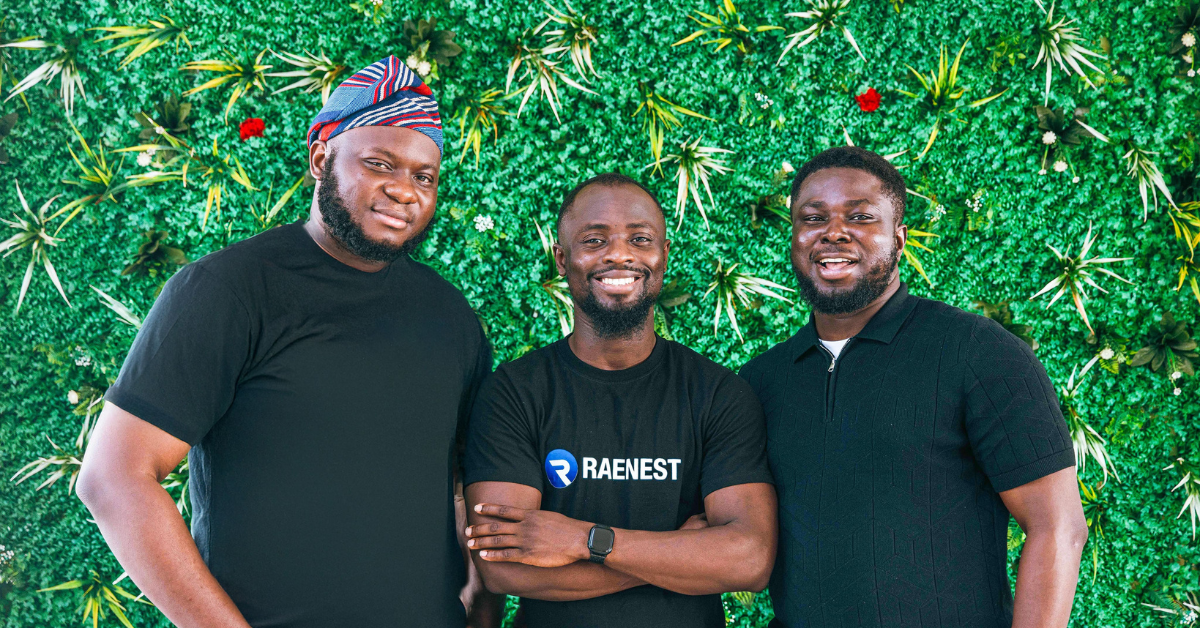
Founded in 2022 by Alade, Sodruldeen Mustapha, and Richard Oyome, the fintech started as an Employer of Record (EOR) before transitioning into a fintech platform focused on modernising global banking for Africans. It helps businesses and freelancers manage international payments effortlessly by offering multi-currency wallets, global bank accounts, and physical and virtual dollar cards. Users can send and receive payments in USD, EUR, and GBP, giving them the flexibility to operate in international markets with ease.

The company runs a consumer-facing app, Geegpay, which enables freelancers and remote workers to receive payments from platforms like Upwork, Fiverr, and Gusto, with features like multi-currency wallets, low-fee conversions, and airtime/data top-ups (saving up to 5% on recharges). The company reports that it now serves over one million customers and has processed more than $2 billion in transactions to date.

Also, Raenest for Business, launched in March 2024, targets enterprises for international remittances, capital raising, and cross-border transactions, filling gaps left by restrictions from competitors like US-based Mercury on African accounts.

Since its launch, the company has attracted over 700,000 users and processed more than $1 billion in payments. It serves over 300 businesses, including Moniepoint, Helium Health, Fez Delivery, and Matta.

Raenest operates in a crowded African fintech space for multi-currency and remittance services, including Afriex, Cleva, Fincra, Grey, Verto, and Leatherback. Its edge lies in EOR integration, low fees, and focus on remote work payments.

The company holds licenses as an International Money Transfer Operator (IMTO) in Nigeria and a Money Services Business (MSB) in Canada, with ongoing efforts for additional jurisdictions.

As part of its goal to evolve into a financial super-app, the fintech unveiled a range of new features at the Lagos event. Among these is the ability for users to receive payments in the USDT stablecoin, which are automatically converted to U.S. dollars. The company has also implemented direct integrations with freelance platforms like Upwork, reducing payment processing times to under an hour. Additionally, Raenest has introduced a new stock trading feature, allowing users to buy and sell shares directly within the platform.

With its latest move into the U.S. market, Raenest is reinforcing its vision of building a seamless global payment ecosystem tailored to the needs of Africa’s digital workforce and entrepreneurs, while positioning itself as a key player in the next phase of fintech globalization.