DD
MM
YYYY

PAGES

DD
MM
YYYY

spot_img

PAGES

Home Blog Page 372

Binance Alpha and Upbit Listings Fuel Massive Pumps for PALU and DOOD, As Uniswap and Aave Drive $600M Surge

0

The crypto market witnessed explosive action as two major exchanges spotlighted emerging altcoins, sending their prices into overdrive.

Binance’s Alpha platform—designed to highlight promising early-stage tokens—added the BNB Chain-based meme coin PALU, while South Korea’s largest exchange, Upbit, announced the listing of DOOD the native token of the Doodles NFT ecosystem on its spot market.

These developments triggered rapid buying frenzies, with both tokens posting triple-digit gains in hours, underscoring the enduring “listing pump” phenomenon in meme and NFT-driven assets.

PALU’s Binance Alpha Boost: PALU, a community-driven meme mascot token inspired by playful Palworld-like creatures and tied to Binance’s ecosystem, caught fire after Binance founder Changpeng Zhao (CZ) reposted fan art featuring a CZ-themed PALU mascot.

The repost, captioned “Who dis? “, went viral and set the stage for the Alpha listing. This pre-listing hype amplified when Binance Alpha officially featured PALU, signaling potential for a full spot listing down the line.

DOOD’s Upbit Debut: DOOD, the utility token powering the Doodles universe—a transmedia NFT project blending art, animation, and AI-driven storytelling—hit Upbit’s KRW and USDT pairs starting at 4:30 PM KST (3:30 AM UTC).

Deposits opened earlier, leading to a classic “Boddari” rush: Korean traders depositing tokens en masse for day-one premium arbitrage. Upbit’s notice specified Solana network support contract, and the listing aligned with Doodles’ recent collabs, like Lil Wayne content and the DreamNet platform launch.

For PALU, 12 wallets scooped up ~$3M post-announcement, per analysts. For DOOD, a whale flipped 1.43B tokens for a $1.7M profit after a 180% spike, highlighting the speculative frenzy.

Both tokens hit new all-time highs (ATHs) on launch day, with market caps ballooning amid 24-hour volumes exceeding $90M combined.

PALU skyrocketed from a $3M cap to $80M+ peak, trading above its 20-day EMA $0.0066 for bullish momentum. Resistance at $0.075 could cap upside, but sustained volume might eye a full Binance spot listing.

DOOD pumped 178% to ATH, with mindshare exploding 395% on X fueled by Upbit news and community hype. Overbought RSI (84.9) signals pullback risks, but NFT sentiment and ETH correlation could push toward $0.02 if it holds $0.00725 support.

Traders are eyeing PALU for “Q4 meme szn” on BNB, with calls for related tokens like $PABU. DOOD’s pump drew praise for its NFT revival, with one post noting “Korean listings still print.” CZ’s nod to BNB memes added fuel, as $BNB itself hit $1,300 ATH. That said, meme/NFT volatility is real—whale dumps and post-listing corrections are common.

Historical patterns show 50-70% retraces after such spikes, so DYOR and manage risk. If these hold key supports, they could ride broader altcoin momentum into late 2025, potentially targeting $0.2 for DOOD and spot-listing glory for PALU.

PALU operates as a fair-launch token with a fixed supply, emphasizing community governance over centralized control. On-chain activity shows robust early adoption. However, holder distribution reveals whale concentration top holders control significant portions, with thin liquidity $5–10M pools vulnerable to swings.

No formal roadmap exists yet, but community proposals float staking rewards up to 31% APY models from similar tokens and DeFi integrations. PALU’s long-term upside stems from its narrative as BNB’s “unofficial mascot,” blending meme virality with ecosystem utility.

BNB’s 2025 roadmap—faster speeds, gasless txs, AI tools—could integrate PALU as collateral in lending/DAOs, boosting utility. PALU as a “grassroots cultural movement” from Binance’s Mid-Autumn Festival mascot, evolving into reusable assets like stickers, GIFs, 3D models.

PALU are high-volatility bets—80%+ retrace post-pump is common. 100% sentiment-driven; no inherent utility like no freeze/mint renounced, unverified LP. Without DeFi/NFT pivots, it risks fading like 90% of 2024 memes.

Overbought RSI (~85) signals pullback to $0.06 support; MACD bullish but fragile. PALU shines as a high-risk, high-reward play with 3–5x upside to $300–500M MC by EOY 2025 if it cements BNB mascot status and adds staking/utility—potentially stabilizing as a “niche blue-chip meme” at $200–500M by 2027.

Uniswap and Aave Drive $600M Surge Through Buybacks and Strong Fundamentals

The decentralized finance sector is experiencing a notable recovery in fee generation, with total revenues reaching approximately $600 million in September 2025. This marks a 76% increase from the 12-month low of $340 million in March 2025, signaling renewed trader interest in established protocols amid a shift toward sustainable tokenomics.

Leading the charge are Uniswap (UNI) and Aave (AAVE), which together accounted for a significant portion of the fees—roughly 25% from Uniswap’s trading activity and 18% from Aave’s lending operations—while embracing buyback mechanisms to return value directly to token holders.

This uptick isn’t just volume-driven hype; it’s rooted in strategic shifts away from the meme-fueled narratives of late 2024 toward revenue-sharing models reminiscent of traditional finance.

Protocols are prioritizing “fundamentals-first” approaches, including:Buybacks and Value Accrual: Aave has implemented a formalized framework since April 2025, allocating surplus revenue—up to $1 million weekly—into regular AAVE token buybacks and ecosystem reserves.

This has helped stabilize and boost the token’s price from an average of $223 to over $260, creating a direct link between protocol usage and holder value.

Uniswap, meanwhile, approved $165 million in foundation funding earlier this year and is preparing a “fee switch” for its upcoming v4 launch on Unichain, which would distribute a portion of trading fees to UNI holders.

Proposals like Aave’s integration of its GHO stablecoin with Uniswap pools could enhance liquidity and fee accrual, potentially increasing GHO circulation by 30% and creating a “flywheel” effect for both ecosystems.

Other protocols like Ethena (ENA), Ether.fi, and Maple are piloting similar buyback and revenue-sharing initiatives, indicating a sector-wide trend to attract institutional capital by emphasizing real financial metrics over virality.

These moves are boosting total value locked (TVL) across DeFi, now approaching a record $219 billion, with Aave’s deposits alone at $74 billion. Ethereum, as the primary chain for these activities, stands to benefit from higher gas fees and utility.

While UNI and AAVE tokens haven’t dramatically outperformed the broader market yet, the fee surge provides a valuation framework beyond speculation: UNI: Up 7.5% in early October to around $8.11, with a 70% cumulative gain since Q2 lows.

TVL remains steady at $4.5 billion across layers, supported by liquidity incentives. Analysts eye a push past $9 if Unichain innovations like sub-second finality gain traction.

AAVE: Rebounded 6.2% to $287.39 recently, breaking key resistance with high volume $1.2 billion surge. Technicals show RSI at 68 and a bullish MACD crossover, targeting $336 short-term and potentially $450 if TVL hits $500 billion in 2025.

Despite the momentum, risks persist: macroeconomic volatility, liquidity fragmentation on Uniswap’s multi-chain setup, and potential dilution from treasury spends could test sustainability.

Importantly, while buybacks mimic equity tactics, DeFi tokens aren’t stocks—they offer governance, utility, and access rights, which add layers to their valuation.

This rebound underscores DeFi’s maturation into a “capital flow engine,” with buybacks fostering long-term alignment. Monitor DAO votes, TVL inflows, and integrations for entry points—fundamentals are back in vogue.
Why are DOGE and TRX Whales Dumping Their Bags for Digitap? Its Cashback Feature is Expected to Drive 35X Gain

0

Whales are changing course. The same wallets that once pushed Dogecoin and Tron into the spotlight are now unloading their bags for something entirely new — Digitap ($TAP). What looks like a quiet rotation could be the start of a major shift.

Dogecoin is losing steam near the $0.25 mark, and Tron is stuck sideways trading under its key averages. But Digitap’s presale is heating up fast. Analysts tracking early rounds say this simple mechanism could set the stage for a 35X move.

In a market where old favorites stall, the smart money is already positioning for the next growth cycle — and Digitap might be the project that lights the fuse.

Whales Are Leaving the Old Coins Behind

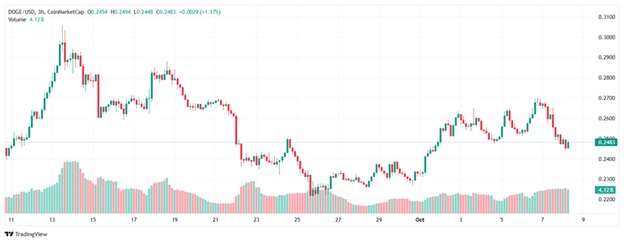
Dogecoin has been volatile again. It trades near $0.25, sitting in a narrow range after weeks of choppy movement. Analysts describe its pattern as an ascending triangle, trading between approximately $0.25 and $0.27. A fall below $0.23 could trigger another pullback.

On-chain data shows whales buying earlier in the cycle, but some of those wallets now seem to be selling into strength. The reason for that is that DOGE has reached a point where upside may slow before the next cycle begins.

Tron (TRX) paints a slightly different picture. The token trades near $0.336, below both its 20-day and 50-day moving averages. This hints at short-term weakness. Still, it continues to find solid long-term support above $0.29, close to its 200-day average.

Source: TradingView/DOGE

Price Prediction: DOGE and TRX Look Tired

Chart watchers see DOGE in a tightening pattern. Its trading volume fell after each short rally, which suggests that new buyers are waiting for a cheaper entry. Key support remains between $0.24 and $0.25. If this zone holds, the price could rebound toward $0.30, but the window for large percentage gains is narrow.

On the other hand, TRX token sits under resistance at around $0.34, which shows near-term weakness. Analysts say the broader setup is strong but slow. They expect sideways consolidation with a chance of mild recovery. In plain terms, the market for TRX looks steady but not exciting.

The current market shows a split: DOGE traders are chasing a possible breakout, while TRX investors face a slow range. In both cases, profits look smaller compared to early-stage projects with real utility.

Digitap: A Low-Cap Gem With Real Utility

Digitap ($TAP) is designed as the world’s first omni-bank token, built on Ethereum. It connects traditional money with crypto in one app that supports cards, global transfers, and merchant tools. The token is not inflationary. It has a fixed supply of 2 billion, locked smart contracts, and no hidden minting.

The project focuses on real financial utility. The $TAP token powers payments, staking, and cashback rewards. Every time users spend through the Digitap system, half of the platform’s profits automatically buy back and burn $TAP tokens. This reduces supply over time. The rest of the profits go into development and community rewards.

Early investors also gain from the staking pool that offers up to 124% APR during presale. Unlike other projects, the rewards do not come from printing new tokens. They come from a fixed pool designed to protect scarcity. This creates long-term stability and encourages holding instead of flipping.

The presale is live, and all tokens are claimable 72 hours after launch. Team tokens remain locked for five years, which shows long-term commitment. At $0.0159, the entry price is low compared to most utility projects at this stage. As the next round lifts the price to $0.0194, the supply curve begins to tighten.

$TAP Price Prediction: Can Digitap Surge Up to 35X?

Market analysts point out that early utility tokens with working cashflow models can produce major multiples once they list on major exchanges. The combination of cashback spending, deflationary burns, and staking rewards builds a self-reinforcing loop. Each new transaction adds pressure to the token supply.

If $TAP adoption grows through 2026, forecasts place mid-term targets between $0.40 and $0.55, which would equal around 25-35X from the current levels. Such returns would put Digitap among the best-performing low-cap gems of the cycle.

The token’s deflationary structure means that price growth is not dependent solely on hype. As more users spend, more tokens get burned. Over time, this makes each remaining token rarer and potentially more valuable. That simple loop — spend, burn, reward — creates ongoing demand without new inflation.

The Best Crypto to Buy Now?

DOGE and TRX helped build the crypto market’s past cycles. They brought humor, accessibility, and large-scale usage. But the next stage looks set to reward projects with utility and fundamentally sound economics. Digitap is built for that future. Its cashback system gives everyday use, and its buyback and burn model offers a clear path to scarcity.

At $0.0159, the $TAP token sits at a stage where risk is limited and upside is magnified. For early investors, a small position could return large multiples if adoption follows the roadmap.

As older tokens move sideways, capital often looks for new growth stories. This time, that story may not come from another meme or DeFi fork. It may come from a financial platform that pays users while reducing its own supply. Digitap seems to be the token that could turn quiet accumulation into a 35X rally.


Discover how Digitap is unifying cash and crypto by checking out their project here:

Presale: https://presale.digitap.app

Website: https://digitap.app

Social: https://linktr.ee/digitap.app

Top Crypto Coins Right Now: ASTER & UNI News Lag Behind BlockDAG’s Awakening Testnet & Live NFT Explorer

0

ASTER whale activity shows big players pulling tokens off exchanges, but concentration risk leaves smaller holders exposed. At the same time, Uniswap (UNI) news is focused on price fighting near support and resistance zones, even as protocol upgrades roll out. Both underline the same problem: users watch charts, but they don’t get much to see or touch. So what if there was a project where NFTs already look and behave like live assets?

BlockDAG’s testnet delivers exactly that with its NFT explorer, showing images, videos, GIFs, transfer records, and full metadata. It feels less like testing and more like using a live marketplace. For anyone scanning lists of the top crypto coins right now, BlockDAG (BDAG) sets itself apart. Unlike other leading crypto coins right now, it offers a visual, usable experience today, not a promise for later.

BlockDAG NFT Explorer: See Every Pixel, Every Transfer

BlockDAG’s Awakening testnet has given creators and collectors something few other networks can match: a full NFT explorer that doesn’t feel like a placeholder. Users can mint tokens, view images, play videos, and even see GIFs directly in the interface. Transfer data and metadata are fully visible too, giving artists, marketplaces, and traders complete transparency. The experience makes testnet NFTs feel like live assets, proving that BlockDAG isn’t just testing code but showcasing what its ecosystem will look like in production.

Adding to the hype is BlockDAG’s limited price of $0.0012 and new TGE code. The “TGE” code allows early access at launch, depending on your rank:

1– 300 Rank: Instant Airdrop

301 – 600 Rank: Airdrop after 30 min

601 – 1000 Rank: Airdrop after 60 min

1001 – 1500 Rank: Airdrop after 2 h

1501 – 2000 Rank: Airdrop after 4 h

2001 – 5000 Rank: Airdrop after 6 h

5001 Rank: Airdrop after 24 h

BlockDAG has raised over $420M, sold nearly 27 billion tokens, and onboarded 312,000+ holders. With a presale price of $0.0012 and a projected listing of $0.05, early buyers see the potential for more than 3,700% ROI. Combine that with 3M+ mobile miners and 20,000+ hardware miners already shipped, and BlockDAG has real traction.

For traders comparing the leading crypto coins right now, the mix of presale scale and a working NFT explorer puts BlockDAG in a different category. It’s not just selling a token; it’s delivering a hands-on experience today that builds confidence for tomorrow.

ASTER Whale Activity and Market Momentum

Recent ASTER whale activity shows a big accumulation, with more than $48M scooped up in just 24 hours and over 6.3M tokens withdrawn from exchanges into private wallets. Together, two large holders now control nearly 130M ASTER, representing almost 8% of supply. This type of buying shows confidence but also raises risk; if whales unload, the impact could be sharp. Reports also highlight that several wallets shifted capital from rivals like HYPE into ASTER, strengthening its short-term momentum. For traders scanning the top crypto coins right now, ASTER has become hard to ignore because its growth is tied to aggressive whale positioning.

On the performance side, ASTER’s open interest has soared from a few million to more than $1.2B, and daily perpetual volume has crossed $24B, surpassing Hyperliquid. TVL nearly tripled to $1.85B, confirming that liquidity is pouring in. Still, the heavy concentration means the ASTER whale activities will decide whether this surge is sustainable or not. For those comparing the leading crypto coins right now, ASTER represents a high-reward but high-risk option, one that delivers big numbers but demands close monitoring.

Uniswap (UNI) News and Trading Outlook

Recent Uniswap (UNI) news shows the token hovering near $7.46, with resistance around $7.49 and support at $7.18. Traders are watching closely because a break below support could send UNI down to the $6.50–$6.80 range, while a successful push higher may open the path toward $7.70. Liquidity is steady, with 24h trading volume between $160M and $340M, keeping UNI in the conversation among large DeFi tokens. The market mood remains cautious, but the setup gives traders both short-term risk and opportunity.

On the fundamentals side, Uniswap (UNI) news has also highlighted the rollout of v4 upgrades, including “hooks” and cross-chain improvements that cut gas fees and allow new liquidity functions. These updates are important for keeping Uniswap competitive as decentralized exchanges continue to grow. With UNI already ranked within the top 30 by market cap, it stays on lists of the top crypto coins right now.

Key Takeaways

The latest ASTER whale activity shows heavy accumulation, with millions pulled off exchanges and concentrated in a few wallets. While this buying fuels strong momentum, it also raises the risk of sharp moves if those whales decide to sell. At the same time, Uniswap (UNI) news highlights a token stuck between support and resistance, with v4 upgrades adding utility, but price action is still uncertain.

BlockDAG, however, is building in another way. Its NFT explorer already lets users mint, track, and view assets with full transparency, while a presale topping $420M points to strong demand. For those comparing top crypto coins right now, BlockDAG offers something unique, real tools to use today, and the potential for outsized returns tomorrow.

Presale: https://purchase.blockdag.network

Website: https://blockdag.network

Telegram: https://t.me/blockDAGnetworkOfficial

Discord: https://discord.gg/Q7BxghMVyu

Whitelist Opening Soon: Zero Knowledge Proof (ZKP) Lets You Prove Without Revealing a Single Detail

0

The next stage of blockchain isn’t about higher token prices or faster transfers, it’s about trust. Traditional blockchains have given us transparency, but that openness comes at a cost: every transaction, every wallet, every data point is exposed for anyone to see.

Zero-Knowledge Proof (ZKP) flips that logic by making it possible to prove authenticity without showing the underlying information. Solvency can be confirmed without balance sheets, identity can be verified without disclosing personal details, and contracts can execute without revealing sensitive logic. With its whitelist opening soon, Zero Knowledge Proof gives early participants the chance to enter a system built on privacy and proof instead of exposure.


The Philosophical Shift – Proving Without Revealing

What makes Zero Knowledge Proof unique isn’t only its technology, it’s the new philosophy it brings to digital trust. For years, the blockchain narrative has centered on transparency as the antidote to corruption. While transparency works for auditability, it also strips away privacy in ways that don’t fit real-world needs. Businesses don’t want competitors reading their transactions, and individuals don’t want their entire financial history published on a ledger.

Zero Knowledge Proof technology changes this relationship. It allows users to prove that something is valid, such as a payment, identity, or asset, without disclosing the details themselves. The concept is simple: show proof of correctness while withholding the data behind it.

  • Finance: Banks can demonstrate solvency without releasing sensitive internal records.
  • Healthcare: Patients can verify medical eligibility without exposing full medical histories.
  • Governance: Voters can cast ballots privately while the system verifies fairness.

This shift reframes blockchain not as a “glass box” but as a “trust engine” that respects confidentiality.


Core Technology Driving the Network

The mechanics of Zero Knowledge Proof rest on a dual foundation: zk-SNARKs and zk-STARKs. zk-SNARKs focus on efficiency, producing small proofs that verify quickly, making them ideal for high-frequency use cases like financial transfers. zk-STARKs, on the other hand, emphasize scalability and transparency while offering resilience against future quantum computing risks.

By combining both systems, Zero Knowledge Proof offers a flexible toolkit: enterprises can prioritize efficiency where speed matters and scale where volume matters. Importantly, this approach ensures the project doesn’t lock itself into one branch of cryptographic innovation.

Additional scaling measures, such as zk-Rollups and recursive proofs, allow thousands of transactions to be verified in compressed form. Parallel computation adds another layer of throughput. These tools collectively remove the bottlenecks that have prevented privacy chains from scaling.

This isn’t just theoretical, Zero Knowledge Proof’s architecture supports tens of thousands of transactions per second while maintaining low costs. That positions the network to handle consumer-scale adoption and enterprise-grade workloads simultaneously.


Real-World Applications Beyond Finance

The power of proving without revealing extends well beyond financial use cases. Zero Knowledge Proof has mapped out a broad ecosystem that shows how cryptography can serve multiple sectors.

  • Healthcare: Hospitals and insurers can process claims with zero-knowledge verifications, ensuring eligibility and compliance without exposing sensitive patient data.
  • Supply Chains: Manufacturers can confirm product authenticity without exposing supplier details or trade secrets.
  • Voting Systems: Ballots can remain private, yet the system can guarantee fairness, preventing fraud or manipulation.
  • Digital Identity: Users can prove compliance with KYC requirements without handing over their personal documents to every platform they use.

The inclusion of shielded smart contracts means applications can be built privately without altering logic transparency. Developers can code in a familiar environment but deliver outputs that protect users’ information. This balance makes the network flexible for both regulators and users.

These real-world pathways make Zero Knowledge Proof much more than an abstract technology. They make it a framework for digital trust.


Why the Whitelist Matters

The whitelist opening soon is more than a fundraising stage, it’s an entry point into a new trust model for the digital age. Early participants aren’t just buying tokens; they’re gaining front-row access to a paradigm shift in how data is handled. The network’s modular design, post-quantum readiness, and governance structure put it on track to become a long-term infrastructure layer, not a speculative side project.

Getting involved at this stage means aligning with the very definition of privacy-first validation. Investors often look for early exposure to scalable technology, but here the incentive runs deeper. By participating, individuals align with a network that allows proofs of solvency, identity, and authenticity without revealing underlying information.

In practical terms, this whitelist offers entry-level pricing at a moment when privacy is moving from niche concern to mainstream demand. Those who step in now are positioned ahead of the curve, at the start of a shift likely to reshape how digital trust is defined.

Final Take

Zero Knowledge Proof is more than another blockchain, it’s a philosophical redefinition of what trust in digital systems can look like. Instead of exposing everything for validation, it proves correctness without compromising data. That makes it relevant for industries ranging from finance and healthcare to voting and identity.

With its whitelist opening soon, the opportunity is not just about early participation but about engaging with a network designed for the next decade of data privacy and security. By combining advanced proof systems with real-world applications, Zero Knowledge Proof crypto positions itself as a foundation for digital trust where privacy and verification finally coexist.

Innovative gaming advancements in 2025

0

The global gaming industry has always been driven by innovation, but 2025 is shaping up to be a transformative year where emerging technologies are not only enhancing entertainment but also redefining what players expect from digital experiences. Casino gaming, in particular, is at the centre of this transformation, blending cutting-edge tools with consumer demand for personalisation, immersion, and convenience.

The gaming landscape is undergoing a profound transformation with the rise of AR and VR integration. This shift is not merely a technological upgrade, but a redefinition of the gaming experience. Developers are no longer confined to flat screens and simple interfaces. Instead, they are crafting fully immersive 3D environments where players can project a poker table onto their living room floor or step into a virtual casino teeming with avatars and live dealers. These setups, which seamlessly blend realism with interactivity, give players a sense of presence that blurs the lines between physical and digital spaces.

Artificial intelligence is not just a feature, but a cornerstone of the modern gaming ecosystem. Its influence extends beyond providing quick support through chatbots. AI now shapes the entire customer journey, from detecting fraud to predicting player preferences. It’s being used to personalise rewards, game recommendations, and even difficulty levels in real time. This tailoring of experiences not only keeps engagement high but also fosters loyalty in a highly competitive market. The widespread adoption of this technology, even in popular gaming sites such as Tooniebet casino, is a testament to its transformative power.

The role of blockchain and cryptocurrency in the gaming industry has expanded significantly. These technologies are not just offering secure, transparent, and instant transactions, but revolutionising the way casinos operate. Smart contracts ensure payouts are automated and tamper-proof, while decentralised platforms add layers of fairness that traditional systems often lack. Combined with the global adoption of crypto wallets, these innovations are allowing casinos to reach a wider player base with less friction in payment processing, thereby enhancing player trust and convenience.

Meanwhile, the mobile-first revolution continues to accelerate thanks to 5G connectivity. High-definition streaming, instant-play games, and live dealer interactions are now smoother than ever on handheld devices. The near elimination of lag means players can seamlessly join live roulette or blackjack sessions without worrying about delays. Developers are responding by building lightweight, responsive interfaces that fit smaller screens but don’t compromise on quality.

Generative AI is another game-changer in 2025. Unlike traditional AI, this technology can dynamically create content, adapt storylines, and evolve gameplay based on user behaviour. Non-player characters are smarter, worlds feel alive, and even slot machines can adjust their mechanics to suit player styles. The result is gameplay that feels less scripted and more personalised, keeping audiences engaged for longer.

Other trends highlight the push toward accessibility and convenience. Smartwatch gaming is gaining ground, making it possible to place quick bets or spin digital slots on the go. Hybrid games, which merge live dealers with automated features, offer the best of both worlds: human interaction and efficient play. At the same time, gamification elements like leaderboards, daily challenges, and social features are making casino platforms feel closer to mainstream video games.

As 2025 unfolds, it’s clear that innovation in gaming isn’t about single breakthroughs but the convergence of multiple technologies. From AI-driven personalisation to immersive VR spaces and blockchain-backed security, the industry is building experiences that are more engaging, more transparent, and more adaptable to a global audience. What was once experimental is now becoming the new standard for digital entertainment.