DD
MM
YYYY

PAGES

DD
MM
YYYY

spot_img

PAGES

Home Blog Page 3781

Lagos Bans Street Trading & Hawking, Shuts Ladipo Market

0
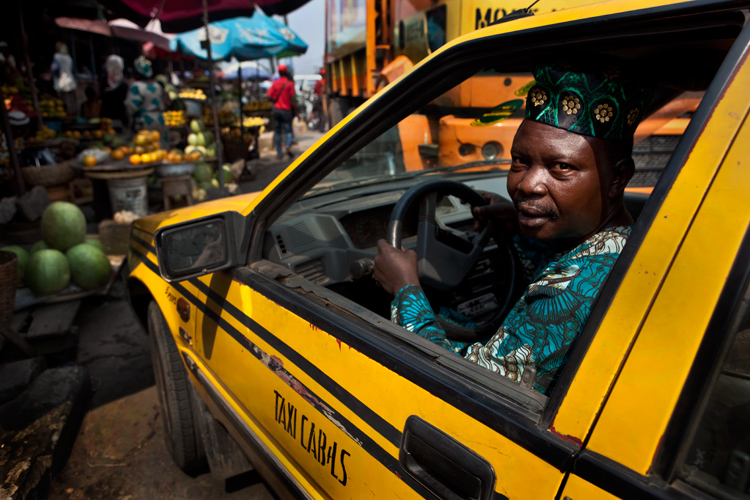
Lagos Yellow Cab

The Lagos State government has announced a total ban on street trading, hawking, building illegal structures on drainage systems, and displaying wares on walkways across the state.

The decision announced by Honourable Commissioner, Ministry of Environment and Water Resources in Lagos State, Tokunbo Wahab on his X handle, came amid Nigeria’s biting economic situation, stirring concern that it will compound crimes in the state.

The decision to ban street hawking and street trading in Lagos is part of a renewed effort to promote a cleaner, safer, and healthier environment, according to Wahab. He added that the measure is intended to address the issue of individuals who engage in criminal activities while posing as hawkers and street traders who disrupt traffic flow on highways and streets.

To enforce this ban, Wahab has issued directives to the Lagos State Environmental Sanitation Corps (commonly known as KAI) to rigorously enforce compliance with environmental sanitation laws.

However, many Lagos residents are concerned that the measure will hinder a lot of people from making a living, forcing them into crime. Most of the street hawkers depend on their daily earnings to feed.

Meanwhile, the Commissioner also issued an immediate closure order for Ladipo Market in Mushin due to numerous environmental violations. These offenses include reckless waste disposal, unclean premises, and failure to pay waste bills, among others.

The market will remain closed until traders and market stakeholders meet the mandatory conditions for rectification. The commissioner said this action is part of ongoing initiatives to promote compliance in markets throughout the state. He emphasized the importance of environmental hygiene within marketplaces.

“It is imperative that markets in the state adhere strictly to environmental laws and regulations put in place for the well-being of residents. The closure of Ladipo Market serves as a stern reminder that no entity, regardless of its size or influence, is above the law.”

He reiterated the state government’s strong commitment to working in partnership with market stakeholders to facilitate the essential changes and enhancements required to meet the prescribed environmental standards. He emphasized that the market would not resume operations until these established standards were satisfactorily met.

“Ladipo Market, a prominent hub for automotive spare parts and related services, has been a focal point for environmental concerns due to various activities that contravene established regulations. LAWMA’s intervention is a significant step towards rectifying these issues and bringing the market to compliance”.

The closure of Ladipo Market mirrors previous actions taken against Oyingbo, Alayabiagba, Oke-odo markets, and specific sections of Tejuosho Market, all for repeated violations. These decisions reflect the state government’s steadfast dedication to reinstating environmental orderliness within the state.

Nigeria Ranks 31st on Global List of Countries With Relatively Inexpensive Mobile Data Rates

0

According to a report by cable.co.uk, Nigeria is ranked at the 31st position in the global ranking of countries with the most affordable mobile data rates.

The country has an average price of 1GB at $0.39 which is equivalent to N390, using the exchange rate of (N1000/$).

On the global data ranking, Israel sits in the number one position of a country with the cheapest data rate, with a $0.02 average cost per 1GB of mobile data, followed by Italy having a $0.09 average cost per 1GB of mobile data.

On the other hand, Southern African country Zimbabwe occupies the last position (237) as the country with the most expensive data rate of $43.75 average cost per 1GB of mobile data.

It is understood that the high cost of data in Zimbabwe is attributed to the incessant surge in inflation and a deteriorating economy.

Other countries with the most expensive data in terms of the average cost of 1GB of mobile data are the Falkland Islands (USD 40.58), Saint Helena (USD 40.13), South Sudan (USD 23.70), and Tokelau (USD 17.24).

However, globally, the price of data is reported to have come down, as a vast majority of countries adjusted their data rates.

Speaking on the mobile data pricing report, consumer Telecoms analyst at Cable.co.uk, Dan Howdle said,

“Our yearly mobile data pricing tracking study is as much a measure of the quantity of data offered as it is the price of data more broadly.

“After all, those counties with the most improved (cheaper) pricing across the five years our tracker now covers tend to be those offering tens or even hundreds of times more data in 2023 as was available for similar money in 2019.

“It is encouraging to see the price of data coming down across the globe as a whole, with the vast majority of countries offering 1GB of mobile data for less than $2”.

The firm further noted that countries with long-established, ubiquitous 4G or new 5G infrastructure tend to fall towards the cheaper end of the table.

Check out how pricing is averaged in thirteen global regions

Northern Africa

All but two of the seven North African countries are in the cheapest half of the table. Western Sahara is the cheapest at USD 0.58, and the most expensive in the region is Mauritania (USD 1.32). All countries in this region are cheaper than the global average of USD 2.59 Northern Africa is the cheapest region in the world overall

Asia (excl. Near East)

Asian nations make up a significant portion of the top 20 cheapest countries for mobile data. Cambodia and Pakistan offer the most affordable rates at just USD 0.12 per 1GB, followed by India at USD 0. 16 and India at USD 0.16.  These countries rank among the top ten globally for the lowest mobile data prices. Only three Asian countries exceed the global average of USD 2.59 per 1GB – Japan (USD 3.48), British Indian Ocean Territory (USD 4 44), and South Korea, which stands as the most expensive in the region at USD 5.01 per 1GB.

Eastern Europe

Within Eastern Europe, Moldova (USD 0.28) is the cheapest, followed by Montenegro (USD 0.32), Poland (USD 0.37), and Romania (USD 0.54). The Czech Republic is the most expensive in the region, with 1GB of data costing USD 3.12 on average.

Central America

The cheapest mobile data plans in Central America can be found in Nicaragua, where 1GB of data costs USD 0.55 on average, and Honduras (USD 0.78). Prices are somewhat steeper in El Salvador (USD 1.08) and Guatemala (USD 1.17). The most expensive country in Central America is Belize, where an average of 1GB costs USD 2.92.

CIS

Several CIS countries are among the very cheapest in the world for mobile data and all but four sit inside the less expensive halt of the table. Kyrgyzstan is the cheapest in the region with an average of USD 0.17, and also the eighth cheapest in the world. At the bottom of the regional table is Turkmenistan (USD 11.42), which is also the seventh most expensive in the world.

Baltics

Estonia is the cheapest of the three with 1GB costing an average of USD 1.15 and sits in 107th place in the world, while in Lithuania 1GB costs USD 1.26 on average. Latvia sits in the most expensive half of the table with an average of USD 3.21 and is the only country in the region whose pricing is greater than the global average of USD 2.59.

Western Europe

The cheapest mobile data in Western Europe is in Italy – in second place globally – where the average price of 1GB is just USD 0.09 San Marino (USD 0.10) is the second-cheapest in Western Europe followed by France (USD 0.20) and Monaco (USD 0 42). The UK (USD 0.62) is the 8th cheapest in Western Europe and 58th cheapest in the world

Caribbean

Most Caribbean nations are in the more expensive half of the list but the difference between the most expensive and the cheapest is extreme. The Cayman Islands are the most expensive in the Caribbean with an average of USD 8.39, while an average of 1GB in the cheapest country – Haiti – is 38 times cheaper at USD 0.22.

Near East

Israel is the cheapest country in the Near East region and also the cheapest in the world, with 1GB costing an average of USD 0.02. Turkey (USD 0.44) is a distant second-cheapest, closely followed by Kuwait (USD 0.52) and Syria (USD 0.67). The most expensive mobile data in the region can be found in Yemen, where the average price of 1GB is USD 15.68

Sub-Saharan Africa

Sub-Saharan Africa has just six countries among the top 50 cheapest in the world – Malawi, in 29th place globally, is the cheapest in the region at USD 0.38.

The region also has five out of the ten most expensive countries in the world, with Zimbabwe being the most expensive in the region and the world (USD 43.75), followed by Saint Helena (USD 40.13), South Sudan (23.70), Central African Republic (USD 10.90) and Zambia (USD 8.01) all at the bottom of the table.

Oceania

The average 1GB of data costs USD 0.09 in Fiji, making it the cheapest country in Oceania, and the 3rd cheapest in the world. The region’s island nations are mostly in the more expensive half of the table, with, Tokelau being the most expensive at USD 17.24.

Samoa comes in at second cheapest in the region at USD 0.36, with New Zealand a long way behind – 18th in the region with an average 1GB cost of USD 5.89.

South America

Colombia, with an average of USD 0.20, Uruguay (USD 0.28) Brazil (USD 0.51) Peru (USD 0.45), and French Guiana (USD 0.49) are the only South American countries to make it into the top 50 cheapest in the world. The most expensive in the region is the Falkland Islands at USD 40.58 – it is also the second most expensive in the world.

Northern America

The average price of 1GB of mobile data in all four North American countries exceeds the global average of USD 2.59, making it the most expensive region overall. Bermuda is the cheapest country in the region with an average cost of USD 3.42, and the most expensive is the United States (USD 6.00).

Southeast Summit: Okonjo-Iweala Asks Igbos to Shun Individualism, Embrace Solidarity

0

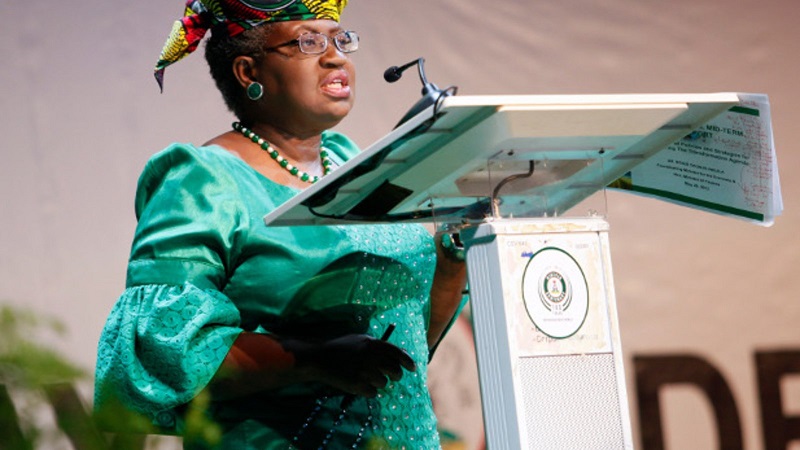
Ngozi Okonjo-Iweala, the Director-General of the World Trade Organization (WTO), has called upon stakeholders in the South-East region to come together and establish collaborative leadership to address the challenges afflicting the region as a unified effort.

Ms. Okonjo-Iweala delivered this message during her keynote address at the South-East Summit on Security and Economy, which commenced in Owerri on Thursday. The overarching theme of the two-day summit is ‘South East Beyond 2023, Time for a Reset’.

“We no longer have solidarity; instead, we are fragmented as a people, and that has made us forget how to support each other. If our big problem is ourselves, it means that the solution also lies in our hands,” she said.

The South-East has in recent years, watched as its economic prowess dwindle – masterminded by miscellaneous factors including insecurity and poor leadership by the region’s governors.

The head of the WTO emphasized the importance of the region enhancing its internally generated revenue, minimizing borrowing, and increasing capital expenditures.

“Governors, state legislatures and local government chairs must continuously ask themselves, are we using our FAC allocation wisely, transparently and effectively?” said Ms Okonjo-Iweala. “Can we generate more revenue internally, and how do we do it while motivating our productive sectors and factors? Are we taking on too much debt? Are we even spending the amount borrowed effectively?”

The South-East is known for its entrepreneurship prowess but has suffered from infrastructural decay, a high unemployment rate, and a dwindling economy. Ms Okonjo-Iweala said a key move in revitalizing the region’s economy is stable electricity.

She advised the region to seize the opportunity of privatization in the electricity sector to look towards solar and gas solutions to improve power supply.

“I want to suggest that we convene a South-East investment forum, not for people from outside the region or abroad but for our own Igbo business people. In this forum, we should examine what is blocking greater investment in the South-East region and what we can do to block these leakages,” Ms Okonjo-Iweala explained.

The DG of the WTO stressed the importance of the region diversifying its economic activities and attracting investments in areas such as pharmaceuticals, fertilizers, labor-intensive industries, and digital technology within the supply chain. She further advised stakeholders to leverage the advantages of digital trade, particularly for micro, small, and medium enterprises, as well as in online education, health, and accounting services.

Ms. Okonjo-Iweala also encouraged the region to tap into its diaspora resources to bolster the healthcare sector.

“I am sure the South-East governors, coming together, can do some financial engineering and find a way to float a South-East diaspora bond or fund to capture some loans and tenured to financing some development priorities,” she noted.

The South-East Summit also saw governors outline their plans for the region. Abia State Governor, Alex Otti, unveiled plans to establish the first-ever seaport in the Southeast region.

This proposed seaport will be strategically situated in Owazza, within the borders of Abia State’s Ukwa East Local Government Area. Governor Otti also disclosed that the seaport will incorporate an export processing zone and various business promotion facilities.

The primary objective of this seaport project is to serve as a catalyst for economic growth in the Southeast, fostering trade, attracting investments, and generating employment opportunities. Governor Otti highlighted that the construction of the seaport will require substantial investments in transportation and logistics infrastructure.

The project aims to promote balanced regional development, spreading economic benefits across the South-East. The commencement of the project is scheduled for September 30, 2023.

Crafting and Executing Visions – Tekedia Mini-MBA

0

Napoleon Bonaparte dropped those ageless words: “Impossible is a word to be found only in the dictionary of fools”. Yes,  humans can accomplish so much if we commit to plans. You craft the plans, you execute them. But if you live a life that is not connected to any plan, you wander like a lifeless feather tossed around by a mild water current.

In business. In careers. In personal economies. Visions matter. A man and a woman with Vision will win the future. Join me today at the #best school as we co-learn  on how to craft a vision – and executing one.

Zoom link in the board

Tekedia Mini-MBA >> the best school.

Certificate Saga: NADECO – USA Asks Tinubu to Resign and Save Nigeria from International Embarrassment

0

The controversy surrounding President Bola Tinubu’s certificate from Chicago State University (CSU) has generated a lot of faux that many believe is embarrassing Nigeria on the international stage.

The National Democratic Coalition in the United States of America (NADECO – USA) has become the latest group to weigh in on the matter. The group has asked Tinubu to resign to save the country from further embarrassment.

Former Vice President Atiku Abubakar had on August 2, filed a suit in the U.S. seeking an order to compel CSU to release Tinubu’s academic record. Tinubu, whose election is being challenged by Atiku and Peter Obi, the Labour Party’s presidential candidate, does not want his record released.

The educational background of Bola Ahmed Tinubu, who contested the Nigerian presidential election under the All Progressive Congress (APC), has been a subject of controversy and has become important for the election tribunal case at the Supreme Court.

The president said making his CSU academic record public would infringe on his privacy rights under the Family Educational and Privacy Rights Act (FERPA), a U.S. law that protects the academic records of students.

Tinubu has appealed an earlier ruling by Judge Jeffrey Gilbert of the United States District Court for the Northern District of Illinois, who in his ruling on September 19 ordered CSU to release the record.

At the Court of Appeal, Tinubu’s lawyers argued before Judge Nancy Maldonado of the United States District Court for the Northern District of Illinois in Chicago, that “Severe and irreparable harm will be done to Bola Tinubu if the records are released.”

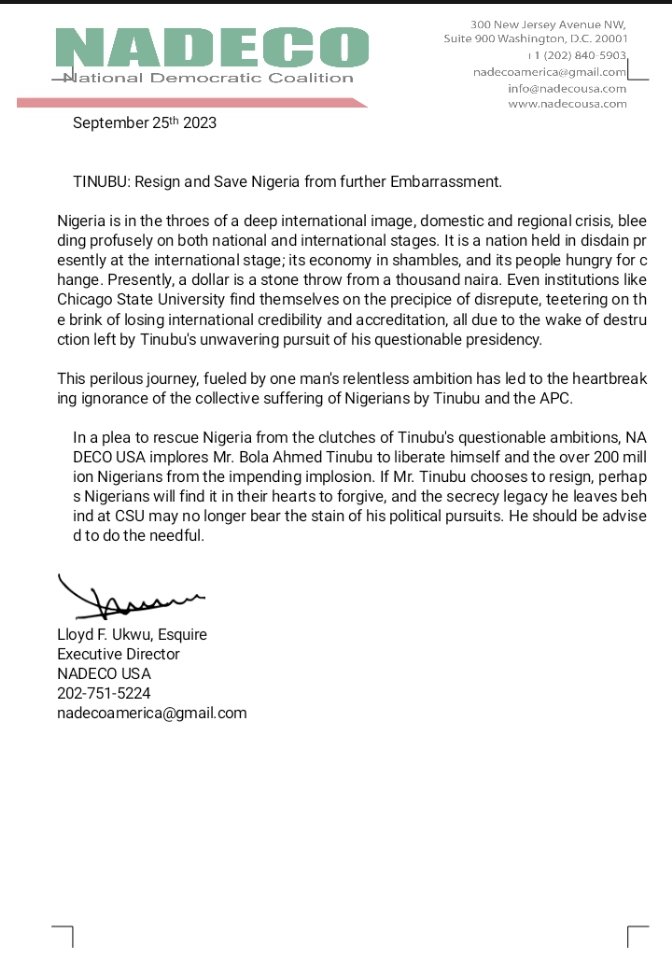
In a statement issued on September 25, 2023, NADECO – USA asserted that the controversies surrounding Bola Tinubu’s academic history at Chicago State University have disgraced the entire nation of over 200 million people on the global stage. The statement also strongly criticized the socio-economic challenges resulting from the perceived failures of Tinubu’s government policies that have adversely affected the lives of Nigerians.

The statement reads: “Nigeria is in the throes of a deep international image, domestic and regional crisis-bleeding profusely on both national and international stages. It is a nation held in disdain presently at the international stage; its economy is in shambles, and its people are hungry for change.

“Presently, a dollar is a stone’s throw from a thousand naira. Even institutions like Chicago State University find themselves on the precipice of disrepute, teetering on the brink of losing international credibility and accreditation, all due to the wake of destruction left by Tinubu’s unwavering pursuit of his questionable presidency.

“This perilous journey, fuelled by one man’s relentless ambition has led to the heartbreaking ignorance of the collective suffering of Nigerians by Tinubu and the APC.

“In a plea to rescue Nigeria from the clutches of Tinubu’s questionable ambitions, NADECO USA implores Mr Bola Ahmed Tinubu to liberate himself and the over 200 million Nigerians from the impending implosion. If MrTinubu chooses to resign, perhaps Nigerians will find it in their hearts to forgive, and the secrecy legacy he leaves behind at CSU may no longer bear the stain of his political pursuits. He should be advised to do the needful.”