DD
MM
YYYY

PAGES

DD
MM
YYYY

spot_img

PAGES

Home Blog Page 379

Elon Musk Reaches Settlement With Ousted Twitter Executives Over $128m Severance Dispute

0

Elon Musk has reached a settlement with four senior Twitter executives he abruptly fired after acquiring the company in 2022, ending a high-profile legal battle that shed light on his handling of the $44 billion takeover.

The settlement follows a year-long standoff over more than $128 million in unpaid severance benefits.

Court filings submitted to the U.S. District Court for the Northern District of California confirm that Musk and X Corp — Twitter’s rebranded parent company — have agreed in principle to settle with former CEO Parag Agrawal, CFO Ned Segal, chief legal officer Vijaya Gadde, and general counsel Sean Edgett. The four executives had sued Musk in March 2024, alleging that he engineered an “early closing” of the Twitter acquisition to deprive them of stock options set to vest the following day.

The filing indicates that the settlement is subject to “certain conditions” yet to be made public. The court has granted an extension of existing deadlines to give Musk time to fulfill those conditions, with proceedings scheduled to resume on October 31 if the terms are not met.

According to the executives’ lawsuit, Musk intentionally closed the acquisition on October 27, 2022 — a day earlier than scheduled — to block roughly $200 million worth of vested stock options. They cited passages from Walter Isaacson’s authorized biography of Musk, where the billionaire allegedly said he would “hunt every single one” of Twitter’s former leaders “till the day they die.” The lawsuit claimed this statement exemplified Musk’s personal vendetta against the executives who had previously resisted his takeover bid.

Agrawal and his team were dismissed within minutes of Musk assuming control of the company, reportedly escorted out of Twitter’s San Francisco headquarters under security supervision. Their abrupt termination formed part of a wider purge that saw more than 6,000 employees laid off globally between late 2022 and early 2023, as Musk sought to cut costs and overhaul the company’s business model.

X has been battling a string of lawsuits stemming from those layoffs. In August 2025, the company agreed to settle thousands of cases filed by ex-employees who accused Musk of violating federal labor laws by failing to provide the mandatory 60-day notice required under the Worker Adjustment and Retraining Notification (WARN) Act. The company has also faced claims from vendors, landlords, and former contractors who allege unpaid dues totaling tens of millions of dollars.

The legal tension comes amid ongoing turbulence at X, which has struggled with declining advertising revenue, operational restructuring, and regulatory challenges in multiple countries. Musk’s rebranding of Twitter into “X” was part of his long-term vision to transform the platform into an “everything app” offering payments, video streaming, and AI-powered services. However, that vision has been undermined by advertiser pullbacks, staffing shortages, and skepticism from regulators.

Analysts say the settlement with the four top executives is a pragmatic move for Musk, who faces mounting legal and financial pressures as X attempts to stabilize.

Dan Ives, a tech analyst at Wedbush Securities, said settling now allows Musk to limit exposure and draw a line under one of the most damaging disputes from his Twitter acquisition, adding that the case symbolized the chaos and personal acrimony that followed the takeover.

Under Musk’s ownership, X has also undergone dramatic policy shifts, including the reinstatement of previously banned accounts, a reduced focus on content moderation, and the introduction of paid verification. These moves have polarized users and advertisers alike, with the platform’s U.S. ad revenue reportedly falling by over 50% in 2023 before showing a modest recovery in mid-2025.

However, Musk remains determined to push X toward profitability and global expansion, particularly through new subscription models and AI-driven features. But legal experts say the latest settlement signals that even as Musk looks ahead, the legacy of his Twitter takeover continues to cast a long shadow.

With the settlement now pending final approval, Musk appears intent on closing one of the most contentious chapters of his ownership — though many within Silicon Valley say the consequences of his aggressive acquisition tactics will linger for years.

HR AI Assistants: Faster Recognition, Smarter Engagement

0

HR AI assistants are revolutionizing the way companies recognize and engage with their employees. By leveraging advanced HR tech and generative AI, these systems enable faster recognition and smarter engagement, transforming traditional human resources (HR) practices. Platforms like Flaree are leading the charge in making these AI solutions accessible and effective for modern workplaces, helping HR teams move from administrative firefighting to strategic employee engagement.

The integration of HR AI assistant technology into workplace systems marks a significant shift in business operations. These assistants automate routine tasks, allowing HR professionals to focus on creating a positive work environment. Employee recognition, a critical component of employee engagement, benefits greatly from AI’s ability to provide timely and personalized feedback. This ensures employees feel valued and motivated, ultimately enhancing productivity and overall team performance.

Key benefits of HR AI assistants include:

  • Automation of repetitive HR tasks such as scheduling, approvals, and reminders
  • Personalized recognition that acknowledges employees’ individual achievements
  • Increased productivity by freeing HR teams to focus on strategic initiatives
  • Streamlined workflows and consistent engagement for hybrid teams

AI’s Role in Enhancing Recognition and Engagement

HR AI assistants are redefining how organizations manage their workforce by streamlining HR processes and reducing administrative burdens. Automation in HR tech not only speeds up routine tasks but also facilitates instant feedback and appreciation, helping employees feel recognized in real time. AI tools leverage analytics to examine large datasets, offering insights into employee performance and engagement, identifying patterns, and suggesting actionable improvements.

For hybrid teams operating across multiple locations, AI ensures consistent recognition, aligning with company culture across geographical boundaries. Employees working remotely receive the same level of acknowledgment as those in the office, reducing feelings of isolation and improving morale. By combining AI with human insight, organizations can create recognition programs that are both scalable and highly personalized.

Machine learning algorithms within HR AI assistants continuously evolve to understand employee behaviors and preferences. These systems can predict when recognition is most impactful, such as after completing challenging projects, exceeding team goals, or reaching significant personal milestones. By analyzing historical data and engagement patterns, AI assistants proactively suggest recognition opportunities to managers, ensuring no achievement goes unnoticed. This predictive capability helps maintain consistent engagement levels, reduces the risk of employee burnout, and supports long-term retention.

Innovative Applications of HR AI Assistants

The potential of HR AI assistants in employee engagement is vast, with several innovative applications already in practice:

  • Auto-suggested recognition messages tailored to individual accomplishments, making kudos more personal and meaningful
  • Values-aligned templates that reinforce company culture and encourage behaviors aligned with organizational goals
  • Slack integration for immediate acknowledgment of achievements within daily workflows
  • Gamification features, including points, badges, and leaderboards, to boost motivation and healthy competition
  • Advanced natural language processing to analyze sentiment in communications, uncovering trends in morale and team dynamics
  • Automatic generation of personalized development plans based on performance patterns and career aspirations

Some forward-thinking implementations even incorporate virtual reality modules for immersive training experiences and team-building exercises, creating a more engaging and interactive workplace environment that goes beyond traditional recognition methods. These experiences help employees feel more connected to their teams, even in fully remote settings.

Leveraging Analytics for Smarter Engagement Strategies

Analytics play a critical role in shaping effective recognition and engagement strategies. By leveraging data analytics, companies can:

  • Track the effectiveness of recognition programs over time
  • Identify trends that drive employee engagement and satisfaction
  • Allocate resources efficiently to maximize impact
  • Tailor recognition strategies to individual teams or employees
  • Measure ROI to ensure recognition investments translate into tangible outcomes, such as higher productivity, engagement, and retention

Data-driven recognition also helps HR leaders make informed decisions about incentive programs, promotions, and professional development initiatives, ensuring recognition is strategic, fair, and measurable.

Privacy Considerations in AI-Powered HR Systems

Privacy concerns are paramount when implementing AI-driven HR systems. Maintaining trust requires robust strategies to protect employee data while utilizing advanced HR tech. Privacy-by-design principles should be integrated from the outset to ensure compliance with legal standards and ethical guidelines.

Key privacy practices include:

  • Strict access controls and encryption to safeguard sensitive information
  • Transparent communication about how employee data is collected and used
  • Ensuring compliance with regulatory requirements such as GDPR or CCPA

Transparency fosters trust among employees, reinforcing confidence in AI solutions like Flaree used by their employers. A commitment to privacy not only protects individuals but also enhances the overall credibility and reputation of an organization’s HR practices.

Tron & Dogecoin Show Mixed Trends as BlockDAG’s TGE Bonus Strengthens Its Position Among Long-Term Cryptos

0

The Tron (TRX) technical analysis reflects ongoing optimism, supported by consistent network activity and growing user metrics. Meanwhile, the Dogecoin (DOGE) price rally has reignited interest among retail traders, although questions remain about sustainability. Both projects continue to hold investor attention, yet they face limits that challenge their position as the best long-term crypto investments.

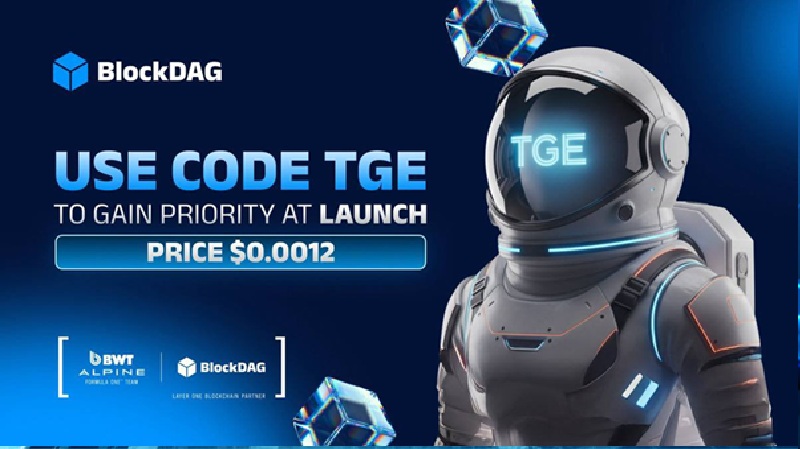
BlockDAG, however, continues to distinguish itself through tangible achievements and global recognition. Having raised $420 million in presale funds at a $0.0012 price, the project has sold nearly 27 billion coins. With 20,000 miners shipped, 312,000 holders onboarded, and 3 million X1 app users active, BlockDAG’s growth trajectory is unmatched. The addition of the TGE bonus, linked to its BWT Alpine Formula 1® Team partnership, solidifies its position as one of the best long-term crypto investments in 2025.

Tron Technical Analysis Shows Strength but Limited Upside

The latest Tron (TRX) technical analysis shows that the project continues to maintain strong fundamentals through active daily transactions and stable DeFi performance. Analysts studying the Tron (TRX) technical analysis highlight steady growth in total value locked (TVL), suggesting resilience even during market volatility.

However, despite this progress, the Tron (TRX) technical analysis reveals that price momentum remains limited. Much of the growth is offset by investor caution, as the token struggles to break above key resistance levels. This stagnation has left TRX performing steadily but without the explosive potential seen in emerging projects.

For investors exploring the best long-term crypto investments, the Tron (TRX) technical analysis signals consistency, yet not the scale of opportunity now visible in the BlockDAG ecosystem.

Dogecoin Price Rally Highlights Retail Energy

The Dogecoin (DOGE) price rally once again demonstrates the power of community-driven trading. Analysts reviewing the Dogecoin (DOGE) price rally point to increased social volume and speculative spikes as key drivers of recent gains. However, this trend also exposes DOGE to short-lived volatility.

While the Dogecoin (DOGE) price rally excites retail investors, analysts warn that it lacks sustained institutional interest. The absence of clear utility continues to limit long-term stability. Dogecoin’s appeal lies in brand recognition and simplicity, but that alone may not support continued valuation growth.

In contrast, long-term-focused investors seeking strong fundamentals and innovation are increasingly looking beyond meme-based rallies toward the best long-term crypto investments with real technological utility.

BlockDAG’s TGE Bonus Redefine the Best Long-Term Crypto

BlockDAG’s presale success is already reshaping the market, with $420 million raised, a $0.0012 presale price, and nearly 27 billion coins sold. Its adoption metrics, 20,000 miners shipped, 312,000 holders, and 3 million X1 mobile mining users position it far ahead of competitors. Add to that 20 confirmed exchange listings and verification from CertiK and Halborn, and it becomes clear why BlockDAG leads the best long-term crypto investments.

The introduction of the TGE bonus has elevated this momentum further. Created in collaboration with the BWT Alpine Formula 1® Team, this initiative ties blockchain innovation to one of the world’s most respected sports. The launch event at the Raffles Hotel featured Alpine’s official race car, driver appearances, and the CRYPTO FAST LANE experience, bringing Web3 technology into a global entertainment platform.

Unlike traditional sponsorships, the TGE bonus code focuses on integration, not advertising. BlockDAG is introducing blockchain-based fan engagement features such as racing simulators, interactive zones, and digital collectibles, merging technology with real-world engagement. This approach expands awareness beyond the crypto community, attracting new audiences worldwide.

Through TGE, buyers gain exclusive access to presale benefits while aligning with a brand that symbolises performance and innovation. Combined with BlockDAG’s DAG + Proof-of-Work hybrid design and scalable ecosystem, this partnership marks a new era for the best long-term crypto investments.

Takeaway

The Tron (TRX) technical analysis shows consistent development, and the Dogecoin (DOGE) price rally highlights strong retail interest. Yet both face limits that restrict long-term growth potential.

BlockDAG, on the other hand, delivers measurable expansion and global recognition. With $420 million raised, a $0.0012 presale price, 27 billion coins sold, 20,000 miners shipped, 312,000 holders, 3 million users, 20 confirmed exchange listings, and full audits, its growth is verifiable. The TGE bonus and BWT Alpine Formula 1® Team partnership link innovation, visibility, and utility, redefining what buyers expect from the best long-term crypto investments.

Presale: https://purchase.blockdag.network

Website: https://blockdag.network

Telegram: https://t.me/blockDAGnetworkOfficial

Discord: https://discord.gg/Q7BxghMVyu

The Lesson from Indomie Noodles and Beating Dangote in Business

0

In the chronicles of African capitalism, Aliko Dangote sits at the apex — a man who built empires out of commodities, transformed industries through vertical integration, and defined what it means to accumulate capability as a moat. Across sugar, cement, and flour, he mastered the art of compounding competitive advantages not by slogans but through control of everything from power plants to trucks.

His group’s playbook is simple but formidable: own the upstream, dominate the midstream, and manage the downstream with relentless efficiency. That model has worked flawlessly — except once. And that “once” holds a timeless lesson for anyone who wants to compete with the Dangote Group.

When Dangote Group launched its noodles business, many assumed the battle was already over. The company’s tradition of vertical integration meant it could control costs, generate its own electricity, train its own workforce, and leverage its vast logistics network to deliver speed and quality unmatched by competitors. But Dufil Prima Foods — the makers of Indomie Noodles — had long built the same fortress in the same terrain. Unknown to many, Indomie had already mastered the Dangote playbook years earlier.

Dufil’s strategy was an accumulation of capabilities, just like Dangote’s. The company invested heavily and owned the value chain. It wasn’t merely making noodles; it was engineering an ecosystem. So when Dangote entered the market, there was no inefficiency left to exploit, no gap to close, and no advantage to leverage. The master met his reflection — and this time, efficiency neutralized efficiency.

Magically, Dangote’s usual strength — superior quality at lower prices — could not find traction. Indomie was already efficient and beloved. The result was inevitable: Dangote Noodles could not gain the market share it desired, and in a remarkable twist of business irony, the subsidiary was eventually sold to Indomie’s parent company.

LESSON: The Dangote–Indomie case offers a profound business insight. You do not beat a master of accumulation by appealing to emotion or shallow marketing. You beat him by building equal or superior capability at the upstream — the foundation layer where efficiency, not advertisement, wins. To challenge a company like Dangote, your capital must be patient, your structure vertically integrated, and your leadership supremely excellent. There is no shortcut. Those who depend on distribution tricks or brand noise will perish when the real competitors control energy, logistics and production.

So, how do you beat Dangote? You rise to his level or higher. You do not play in the downstream when he controls the upstream. You don’t react; you re-engineer. Dufil did not fight with discounts or posters; it fought with systems, factories and control. That is the essence of modern competition — mastery, not just marketing. Dufil did, and for once, Dangote met his match.

Bitcoin Miner IREN Secures More Multi-Year Cloud Contracts, as YZi Labs Announces $1B Builder Fund for BNB Ecosystem

0

IREN Limited (NASDAQ: IREN), a Nasdaq-listed Bitcoin mining company formerly known as Iris Energy, announced it has signed additional multi-year cloud services contracts with leading AI firms. These deals focus on deploying NVIDIA’s next-generation Blackwell GPUs, marking a significant pivot toward high-performance computing (HPC) and AI infrastructure while maintaining its core Bitcoin mining operations.

IREN is on track to have approximately 23,000 GPUs operational by the end of Q1 2026, targeting over $500 million in annualized run-rate revenue (ARR) from AI cloud services. Contracts are already secured for 11,000 of these GPUs, representing about $225 million in ARR expected to come online by the end of 2025.

The new agreements average around two-year durations, with pricing structured for an approximate two-year revenue payback period. This includes pre-delivery commitments for Blackwell GPUs, highlighting strong demand ahead of NVIDIA’s supply rollout.

IREN’s facilities in British Columbia, Canada, and the Horizon 1 & 2 data centers under construction in Childress, Texas, provide capacity for over 100,000 GPUs. The company has secured 2,910 MW of grid-connected power across more than 2,000 acres in the U.S., enabling rapid scaling. It leverages 100% renewable energy sources, including renewable energy certificates (RECs).

Alongside AI growth, IREN operates ~50 EH/s of self-mining capacity, positioning it as one of the world’s largest and lowest-cost Bitcoin producers. IREN was designated a “preferred partner” by NVIDIA in August 2025, granting priority access to GPUs amid global shortages.

Co-CEO Daniel Roberts emphasized the company’s flexibility: “Our ability to rapidly transition from ASICs to GPUs across our British Columbia campuses, and the speed at which we’re building Horizon 1 & 2, demonstrates how IREN is uniquely positioned to meet accelerating demand for AI compute.”

This move diversifies IREN beyond volatile Bitcoin mining into the booming AI sector, where demand for GPU cloud compute is surging. The company recently doubled its AI fleet to ~23,000 units by procuring additional NVIDIA and AMD accelerators.

IREN’s stock surged ~9% to around $63 on October 7, extending a remarkable 591% gain over the past year and trading near its 52-week high of $58.28. However, shares dipped ~6% later that day following news of an $875 million convertible debt offering potentially upsizing to $1 billion, aimed at funding further AI expansions.

Analysts project continued revenue growth, with IREN’s trailing 12-month sales up 167.65%.Broader ImplicationsThis development underscores a trend among Bitcoin miners peers like BITF and HIVE shifting toward AI/HPC to hedge against crypto market cycles.

IREN’s renewable-powered, fiber-connected sites give it an edge in attracting hyperscale AI clients. Ongoing discussions for additional expansions could push ARR well beyond current targets, though execution risks like GPU delivery timelines and utilization rates remain.

By securing ~$225M in annualized run-rate revenue (ARR) from AI cloud services by Q1 2026, with a target of over $500M, IREN reduces reliance on volatile Bitcoin mining revenue. This pivot into high-performance computing (HPC) and AI infrastructure taps into the growing demand for GPU cloud compute, providing more stable and predictable cash flows.

The AI cloud contracts, structured for a ~2-year revenue payback, offer higher margins than Bitcoin mining, which faces price volatility and rising network difficulty. IREN’s low-cost, renewable energy-powered facilities 100% renewable via RECs enable competitive pricing and attractive returns on GPU deployments.

With 2,910 MW of grid-connected power and over 2,000 acres in the U.S., IREN can scale its AI operations rapidly. The Horizon 1 & 2 data centers in Texas and existing British Columbia facilities support deploying over 100,000 GPUs, positioning IREN to capture additional market share as AI demand grows.

YZi Labs Announces $1 Billion Builder Fund for BNB Ecosystem

YZi Labs—formerly known as Binance Labs and rebranded in January 2025 under the leadership of Binance co-founder Changpeng “CZ” Zhao—unveiled a $1 billion Builder Fund dedicated to accelerating innovation within the BNB ecosystem, with a primary focus on projects building on the BNB Chain.

This initiative comes at a pivotal moment, as BNB has surged to new all-time highs above $1,300, becoming the third-largest cryptocurrency by market cap and adding over $40 billion in value during October alone.

The Builder Fund is designed to empower early-stage founders by combining financial support with hands-on resources, aiming to position BNB Chain as a global hub for blockchain innovation.

Ella Zhang, Head of YZi Labs, emphasized the fund’s vision: “BNB is a living network with global reach and onchain depth… We’re backing founders building tools that connect blockchain technology to real-world use, across sectors like DeFi, AI, RWA, DeSci, and more—those building the next generation of open systems that connect technology back to human progress.”

YZi Labs has a track record of fueling BNB Chain growth, with prior investments in projects like PancakeSwap, ListaDAO, Aster a multichain DEX, and Aspecta.

BNB Chain boasts 58M+ monthly active addresses, #1 daily DEX volume, sub-second block times via the Maxwell Hardfork, and ultra-low fees. Dual burn mechanisms quarterly Auto-Burn + real-time BEP-95 have reduced BNB’s total supply by over 30%, enhancing scarcity.

Backing for initiatives like the BNB Digital Asset Treasury and RWA funds, alongside high staking yields and utility in trading, DeFi, and Launchpool/Megadrop.

This announcement aligns with broader BNB momentum, including institutional adoption and a full-stack Web3 economy. For builders interested in applying, YZi Labs encourages submissions via their channels, with the fund signaling a “renewed commitment to founders with vision.”

PancakeSwap, a leading decentralized exchange (DEX) on the BNB Chain, has been a flagship investment for YZi Labs (formerly Binance Labs). PancakeSwap is a decentralized exchange built on BNB Chain, known for its automated market maker (AMM) model, low transaction fees, and high-speed transactions.

Offers token swapping, yield farming, staking, liquidity pools, NFT marketplaces, and prediction markets. As of October 2025, PancakeSwap remains the top DEX by daily trading volume on BNB Chain, with significant user adoption contributing to BNB Chain’s 58M+ monthly active addresses.

YZi Labs invested in PancakeSwap during its early stages, likely around 2020–2021, when PancakeSwap emerged as a key DeFi protocol on BNB Chain. The exact date and amount remain undisclosed, but it was part of Binance Labs’ broader strategy to back high-potential DeFi projects.

PancakeSwap raised funds through a combination of YZi Labs’ investment, community token sales, and liquidity incentives. YZi Labs typically provides seed or Series A funding, ranging from $1M to $15M for early-stage projects, though specific figures for PancakeSwap are not public.

The investment was part of YZi Labs’ portfolio expansion, which includes other BNB Chain projects like ListaDAO and Aspecta. PancakeSwap leveraged BNB Chain’s low-cost, high-speed infrastructure sub-second block times via Maxwell Hardfork.

Access to YZi Labs’ network of 460 million users, CoinMarketCap integrations, and Binance’s Launchpool for CAKE token distribution. Guidance on scaling, user acquisition, and global expansion through programs like the Most Valuable Builder (MVB) track.

PancakeSwap grew to handle billions in trading volume, becoming a cornerstone of BNB Chain’s DeFi ecosystem. Enabled features like Syrup Pools, IFOs Initial Farm Offerings, and cross-chain bridging.

With BNB’s price surpassing $1,300 and a $1B Builder Fund announced by YZi Labs on October 8, 2025, PancakeSwap continues to benefit from ecosystem growth. The new Builder Fund offering up to $500K per startup suggests YZi Labs may further support PancakeSwap’s expansion into areas like AI-driven DeFi, real-world assets (RWA), or next-gen wallets.

PancakeSwap’s high daily DEX volume and user base align with BNB Chain’s metrics 58M+ monthly active addresses, low fees, amplifying the value of YZi Labs’ early investment. YZi Labs’ investment in PancakeSwap underscores its strategy of backing scalable, user-focused DeFi protocols that drive BNB Chain adoption.

PancakeSwap’s success has validated this approach, contributing to BNB’s rise as the third-largest cryptocurrency by market cap in 2025.Sources and VerificationInformation is drawn from posts on X mentioning YZi Labs’ portfolio.