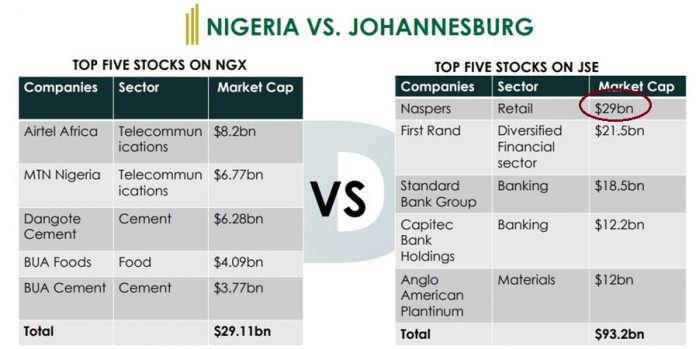
First, we must thank our legendary Bismarck Rewane for producing great business reports which compete supremely with what the Central Bank of Nigeria and National Bureau of Statistics produce. Specifically, on his table which compares the Nigerian stock exchange (NGX) and the South African one (JSE), I will want to expand the conversion.
First, there is really no basis for comparison between NGX and JSE; while NGX is worth $50 billion, JSE goes for $950 billion. And looking at the top stocks – Airtel Africa vs Naspers, the $8.2 billion and $29 billion may not offer the big picture.
A few years ago, South Africa changed its law, restricting fund managers on how much percentage they could hold on some publicly listed companies. That restriction affected Naspers as it could not grow since most of the funds have already max’d out on its assets. Then, the company was worth close to $133 billion.
With no space to grow in South Africa, Naspers had to create a new entity, Prosus, and listed it in the Netherlands. I chronicled all that here. Prosus quickly shot to $133B but lost momentum when China began the big clamp which affected Tencent and other companies which Naspers has in its portfolio; Prosus is worth about $80 billion now.
If you add a big chunk of Prosus which is majorly owned by Naspers, you can make a point that the largest company in South Africa is directly and indirectly worth close to $90 billion. I have not added other JSE pieces like MultiChoice which Naspers has ownership in. By the time you add everything under Naspers, you can have at least $100 billion consolidated company which is 2x the value of all the publicly traded companies in Nigeria!
In summary, Naspers is not worth $29 billion, but about $100 billion, in the real practical sense for the owners! This does not mean that Nigeria is not there. What is happening is that South Africa has unlocked Capital in its economy even as Nigeria continues to operate on “money” level. Because capital works in South Africa, one of his financial institutions, First Rand, can buy every bank and insurance company in Nigeria, and still have change to spare.
I had written: “Until Nigerian policymakers focus on creating systems for Capital development and evolution over our fixation on Money, we will continue to struggle. Money is a subset of Capital, and companies and nations which allow Money to rule over them underperform. In Nigeria, we’re pursuing so much money, with limited efforts designed to advance Capital,…”
Yes, Nigeria needs to restructure its economy, and move it towards capital, and away from our fixation with money and money! Poor nations operate with money, rich nations are built on capital.