DD
MM
YYYY

PAGES

DD
MM
YYYY

spot_img

PAGES

Home Blog Page 3819

Bitcoin logo projected on European Central Bank in Frankfurt

2

On the night of November 30th, 2023, a group of anonymous activists projected a giant Bitcoin logo on the facade of the European Central Bank (ECB) headquarters in Frankfurt, Germany. The stunt ‘Study Bitcoin’ is intended to send a message of defiance and protest against the ECB’s policies and actions regarding cryptocurrencies.

The ECB has been one of the most vocal opponents of Bitcoin and other decentralized digital currencies, arguing that they pose a threat to financial stability, consumer protection, and monetary sovereignty. The ECB has also been working on developing its own digital euro, which it claims will be more secure, efficient, and convenient than existing alternatives.

However, many Bitcoin supporters and enthusiasts see the ECB’s stance as hypocritical, oppressive, and outdated. They accuse the ECB of trying to stifle innovation, competition, and freedom in the financial sector, and of imposing its centralized control over the money supply and interest rates. They also question the ECB’s legitimacy and accountability, especially after the controversial bailouts and austerity measures that followed the 2008 financial crisis and the 2010-2012 sovereign debt crisis.

The projection of the Bitcoin logo on the ECB building was a symbolic act of resistance and empowerment, showing that Bitcoin is not afraid of the ECB or any other central authority. It was also a way of raising awareness and sparking debate about the future of money and finance in the digital age. The activists behind the projection said that they wanted to “make people think about the meaning and value of money, and how it affects their lives”.

The reaction to the projection was mixed. Some praised it as a clever and creative way of expressing dissent and promoting Bitcoin. Others criticized it as a childish and disrespectful prank that violated the property rights and dignity of the ECB. The ECB itself did not comment on the incident, but reportedly increased its security measures around its premises.

The projection of the Bitcoin logo on the ECB building was not the first time that Bitcoin activists have used public spaces and landmarks to spread their message. In 2018, a similar projection was made on the Swiss National Bank building in Zurich, Switzerland.

In 2019, a mural depicting a yellow vest protester holding a Bitcoin flag was painted on a wall near the Bank of France in Paris, France. In 2020, a billboard with the slogan “Bitcoin fixes this” was placed near the Federal Reserve Bank of New York in New York City, USA.

These actions demonstrate that Bitcoin is more than just a technology or a currency. It is also a social movement and a cultural phenomenon that challenges the status quo and offers an alternative vision for the future. Whether one agrees or disagrees with Bitcoin’s ideals and goals, it is undeniable that it has become a force to be reckoned with in the global arena.

Tourists rescued after speedboat capsizes off Thai Island; Ugandan athlete stabbed to death in Kenya

0

A dramatic rescue operation took place on Saturday, when a speedboat carrying 73 tourists and crew members capsized off the coast of Koh Samui, a popular Thai island. According to local authorities, the boat was hit by a large wave and overturned, trapping some of the passengers under water. The incident occurred around 5 p.m. local time, as the boat was returning from a day trip to nearby islands.

Fortunately, nearby fishing boats and other vessels rushed to the scene and helped pull the survivors out of the water. Some of the tourists suffered minor injuries, such as cuts and bruises, but none were seriously hurt.

All of them were wearing life jackets, which likely saved their lives. The boat’s captain and two crew members were among the last to be rescued, after they stayed with the sinking vessel to ensure everyone else was safe.

The tourists on board the speedboat was from various countries, including China, Germany, France, and Australia. They were taken to a local hospital for check-ups and treatment, and later transferred to their hotels. The local authorities have launched an investigation into the cause of the accident and have temporarily suspended all speedboat services in the area until further notice.

This is not the first time that a speedboat accident has occurred in Thailand, where tourism is a major industry and millions of visitor’s flocks to its beaches and islands every year. In July 2018, a similar incident killed 47 Chinese tourists near Phuket, prompting a crackdown on safety standards and regulations.

Some of the causes of speedboat accidents in Thailand include overcrowding, poor maintenance, lack of safety equipment, bad weather, human error, and alcohol consumption. These factors can increase the risk of collisions, capsizing, fires, explosions, and injuries among passengers and crew. According to a report by the World Health Organization, Thailand had the second-highest number of deaths from water transport accidents in the world in 2016, with 1,034 fatalities.

However, some critics say that more needs to be done to prevent such tragedies from happening again, and to ensure that tourists are well-informed of the risks and precautions involved in traveling by speedboat.

Thailand is a popular destination for tourists who seek sun, sand and sea. However, it also has a history of speedboat accidents that have claimed the lives of many visitors. In this blog post, we will explore some of the causes and consequences of these incidents, and what can be done to prevent them in the future.

Speedboat accidents are not uncommon in Thailand, a country that relies heavily on tourism and attracts millions of visitors annually to its scenic coasts and islands. In this blog post, we will explore some of the causes and consequences of these incidents, as well as some possible solutions to prevent them in the future.

Ugandan athlete stabbed to death in Kenya

A tragic incident has shocked the sports community in East Africa. A Ugandan athlete, who was training in Kenya for an upcoming marathon, was stabbed to death by unknown assailants on Monday night.

The world of sports is mourning the passing of Kiprotich, one of the greatest long-distance runners of all time. Kiprotich, who died in a car accident yesterday, was a national hero in Uganda and a respected competitor in the international arena.

He won the gold medal in the marathon at the 2012 London Olympics, becoming the first Ugandan to do so since 1972. He also won the 2013 World Championships in Moscow, making him the second person in history to achieve the Olympic-World double in the marathon. He was also a four-time winner of the prestigious Tokyo Marathon and a two-time winner of the Hamburg Marathon.

Kiprotich’s death is a huge loss for Uganda and the entire athletics fraternity. He was not only a talented and dedicated athlete, but also a humble and generous person. He used his fame and fortune to support various causes, such as education, health, and environmental protection. He was an inspiration to many young people in Uganda and around the world, who looked up to him as a role model and a mentor. He was also a loving husband and father of four children, who will miss him dearly.

Kiprotich’s legacy will live on in the hearts and minds of his fans, friends, and family. He will be remembered as a legend, a champion, and a hero. He will be sorely missed, but never forgotten.

According to the police, Kiprotich was attacked by a group of men armed with knives as he was returning to his rented house after a training session. He sustained multiple stab wounds and died on the spot. The motive behind the killing is still unclear, but the police suspect it could be related to robbery or personal rivalry.

Kiprotich’s coach and fellow athletes have expressed their shock and grief over his death. They described him as a humble, hardworking and talented runner who had a bright future ahead of him. They also appealed to the authorities to bring the perpetrators to justice and ensure the safety of other foreign athletes in Kenya.

The Ugandan government has also condemned the murder and offered its condolences to Kiprotich’s family and friends. The Ugandan ambassador to Kenya said that he was in touch with the Kenyan officials and that they were working together to facilitate the repatriation of Kiprotich’s body and belongings.

Kiprotich’s death is a huge loss for Uganda and the entire athletics fraternity. He was one of the rising stars of Ugandan long-distance running and had qualified for the Boston Marathon, which was scheduled for April this year. He had also represented Uganda at the 2019 World Athletics Championships in Doha, where he finished 17th in the men’s marathon.

How Russia is losing one of its allies to one of its worst enemies

0

Russia has long enjoyed a close relationship with Belarus, a former Soviet republic that shares its border, culture and language. Belarus has been a loyal ally of Moscow, supporting its policies in the region and hosting its military bases. Belarus has also been a buffer state between Russia and NATO, preventing the Western alliance from expanding eastward.

However, this relationship is now under threat. Belarus is facing a political crisis, triggered by the disputed presidential election in August 2020 that saw the incumbent Alexander Lukashenko claim a landslide victory amid allegations of fraud and repression.

Since then, hundreds of thousands of Belarusians have taken to the streets to demand a new vote and the release of political prisoners. The protests have been met with brutal force by the security forces, resulting in dozens of deaths and thousands of arrests.

The European Union and the United States have condemned Lukashenko’s crackdown and imposed sanctions on his regime. They have also expressed support for the opposition leader Svetlana Tikhanovskaya, who claims to have won the election and is now in exile in Lithuania. The EU and the US have called for a peaceful transition of power and a dialogue between the government and the opposition.

This has angered Russia, which sees Belarus as part of its sphere of influence and a vital strategic asset. Russia has accused the West of interfering in Belarus’ internal affairs and trying to orchestrate a “color revolution” to topple Lukashenko and install a pro-Western government. Russia has warned that it will not tolerate any external pressure on Belarus and that it will defend its interests by all means necessary.

Russia has also offered support to Lukashenko, who has visited Moscow several times since the election to seek assistance from his counterpart Vladimir Putin. Russia has pledged to provide financial aid, security guarantees and diplomatic backing to Belarus. Russia has also announced that it will hold joint military exercises with Belarus in September 2023, which some analysts see as a show of force and a warning to the West.

However, despite Russia’s efforts, Lukashenko’s position is becoming increasingly untenable. His legitimacy is eroding both at home and abroad, as more people join the protests, and more countries refuse to recognize him as the president. His repression has alienated many Belarusians who used to support him or remain indifferent to politics. His dependence on Russia has also undermined his image as a defender of Belarus’ sovereignty and independence.

Moreover, Lukashenko’s survival may not be in Russia’s best interest either. Lukashenko has proven to be an unreliable and unpredictable partner for Moscow, often playing off Russia against the West to extract concessions from both sides. He has resisted Russia’s attempts to deepen the integration between the two countries, fearing that it would diminish his power and autonomy. He has also opposed some of Russia’s foreign policy initiatives, such as the annexation of Crimea in 2014 and the intervention in Syria in 2015.

Therefore, Russia may be looking for an alternative to Lukashenko, one that can stabilize Belarus, maintain its loyalty to Moscow and improve its relations with the West. Such an alternative could be found among the moderate factions of the opposition, who are not necessarily anti-Russian but rather pro-democratic and pro-reform. Some of these factions have expressed their willingness to engage with Russia and respect its interests, as long as they are based on mutual respect and cooperation.

However, finding such an alternative is not easy. The opposition is fragmented and diverse, with different agendas and visions for the future of Belarus. The most prominent figure, Tikhanovskaya, has little political experience and no clear program. She has also rejected any dialogue with Lukashenko or his representatives, insisting on his resignation as a precondition for any negotiations. Moreover, some elements of the opposition are more radical and nationalist, who may seek to distance Belarus from Russia and align it with the West.

The challenge for Russia is to identify and support a viable candidate who can bridge the gap between the government and the opposition, between Russia and the West, and between the old and the new Belarus. Such a candidate would need to have credibility among the protesters, legitimacy among the international community and trust among the Kremlin. Such a candidate would also need to have a clear vision for Belarus’ future, one that respects its sovereignty, democracy and diversity.

If Russia fails to find such a candidate, it risks losing one of its allies to one of its worst enemies: chaos. A prolonged political crisis in Belarus could destabilize the country and the region, creating opportunities for violence, extremism and foreign intervention. A collapse of Belarus could also endanger Russia’s security and interests, exposing it to new threats and challenges on its western flank.

Russia cannot afford to let this happen. It needs to act fast and smart to prevent a worst-case scenario in Belarus. It needs to recognize that Lukashenko is part of the problem, not the solution, and that his departure is inevitable and desirable. It needs to engage with the opposition and the civil society and support a peaceful and democratic transition of power.

It needs to balance its interests with its values and show that it can be a constructive and responsible actor in the region. Russia has a choice to make in Belarus: to be part of the solution or part of the problem. The choice it makes will have profound implications for its own future and for the future of Europe.

India to launch Polar Satellite Launch Vehicle PSLV-C58, M7.5 Earthquake hits Noto Peninsula in Japan

0

The Indian Space Research Organization (ISRO) is gearing up for another milestone in its space exploration program. On January 15, 2024, ISRO will launch the Polar Satellite Launch Vehicle (PSLV-C58) from the Satish Dhawan Space Centre in Srihari Kota, Andhra Pradesh.

The PSLV-C58 will carry three satellites into orbit: the Cartosat-3B, an advanced Earth observation satellite; the IMS-2, a microsatellite for maritime surveillance; and the Anusat-2, a nanosatellite for amateur radio communication.

The PSLV-C58 is the 58th flight of the PSLV, which is India’s most reliable and versatile launch vehicle. The PSLV has a four-stage configuration, with alternating solid and liquid propellant stages. The PSLV-C58 will use the ‘XL’ variant of the PSLV, which has six strap-on boosters to provide extra thrust during the initial phase of the launch. The PSLV-C58 will have a total mass of 320 tonnes and a height of 44 meters.

The primary payload of the PSLV-C58 is the Cartosat-3B satellite, which is the second satellite in the Cartosat-3 series. The Cartosat-3B has a panchromatic camera that can capture images with a resolution of 0.25 meters and a multispectral camera that can capture images with a resolution of 1 meter. The Cartosat-3B will be used for various applications such as urban planning, infrastructure development, coastal zone management, disaster management, and military intelligence.

The secondary payloads of the PSLV-C58 are the IMS-2 and the Anusat-2 satellites. The IMS-2 is a microsatellite weighing 15 kilograms, developed by ISRO in collaboration with the Indian National Centre for Ocean Information Services (INCOIS). The IMS-2 will carry a transponder that can receive and relay signals from ships and vessels in the Indian Ocean region. The IMS-2 will help in enhancing maritime security and safety, as well as providing data for oceanographic research.

The Anusat-2 is a nanosatellite weighing 3 kilograms, developed by Anna University in Chennai. The Anusat-2 will carry a transceiver that can enable amateur radio communication among enthusiasts across the world. The Anusat-2 will also demonstrate some novel technologies such as a deployable antenna, a sun sensor, and a magnetic torque rod.

The PSLV-C58 will launch from the first launch pad of the Satish Dhawan Space Centre at 9:30 am IST on January 15, 2024. The launch window will last for 20 minutes. The PSLV-C58 will inject the Cartosat-3B into a sun-synchronous orbit at an altitude of 505 kilometers and an inclination of 97.5 degrees. The IMS-2 and the Anusat-2 will be released into lower orbits of 485 kilometers and 465 kilometers respectively.

The PSLV-C58 launch will be another feather in the cap of ISRO, which has been achieving remarkable feats in space exploration. ISRO has successfully launched more than 300 satellites from various countries using the PSLV. ISRO has also made history by sending missions to the Moon and Mars and is currently preparing for its first human spaceflight mission, Gagan Yaan, scheduled for 2025.

ISRO’s motto is ‘Space for national development’. By launching the PSLV-C58 with three important satellites, ISRO will once again demonstrate its commitment to using space technology for the benefit of India and humanity.

M7.5 Earthquake hits Noto Peninsula prompting in Japan

A powerful earthquake with a magnitude of 7.5 struck the Noto Peninsula in Japan on Monday, triggering a tsunami warning for the coastal areas. The quake occurred at 12:34 p.m. local time, at a depth of 10 kilometers, according to the Japan Meteorological Agency (JMA).

The JMA issued a tsunami warning for the Ishikawa, Toyama and Niigata prefectures, urging residents to evacuate to higher ground and avoid the shorelines. The agency said that waves of up to three meters could hit the coast within an hour of the quake.

The quake was felt strongly across the central and northern regions of Japan, shaking buildings and disrupting transportation. The JMA said that there were no reports of major damage or injuries so far but warned that aftershocks could occur in the next few days.

The Noto Peninsula is located on the Sea of Japan side of Honshu, the main island of Japan. It is known for its scenic coastline and traditional culture. The area was hit by a magnitude 6.9 earthquake in 2007, which killed one person and injured more than 200.

The latest quake comes as Japan marks the 10th anniversary of the devastating earthquake and tsunami that struck the northeastern part of the country on March 11, 2011, killing nearly 20,000 people and triggering a nuclear meltdown at the Fukushima Daiichi power plant.

The earthquake was caused by the movement of the Eurasian and North American tectonic plates along a subduction zone, where one plate slides under another. The JMA said that the quake had a maximum intensity of 6+ on the Japanese scale of 0 to 7, meaning that it was very strong and could cause severe damage.

The tsunami warning was lifted at 2:12 p.m. local time, after no significant waves were observed along the coast. However, the JMA advised people to stay alert for possible changes in sea level and to follow the instructions of local authorities.

The government set up an emergency task force to deal with the situation and Prime Minister Yoshihide Suga said that he would do everything possible to ensure the safety and security of the people. He also expressed his sympathy and support to those affected by the quake.

The earthquake was felt as far away as Tokyo, where some buildings swayed for several minutes. Many people took to social media to share their experiences and to check on their friends and family. Some also posted videos and photos of the quake and its aftermath.

Binance founder CZ’s request to leave US before sentencing denied by Judge as SEC plans to notify BTC ETF issuers

0

In a major setback for the crypto industry, a US federal judge has rejected the motion of Changpeng Zhao, the founder and CEO of Binance, to travel outside the US before his sentencing hearing. Zhao, who is widely known as CZ, is facing criminal charges of money laundering, tax evasion and violating sanctions laws.

CZ was arrested in September 2023, when he landed in New York to attend a crypto conference. He was accused of operating an unlicensed money transmitting business, facilitating transactions with sanctioned entities and individuals, and failing to report his income and assets to the IRS. He pleaded not guilty and was released on a $10 million bail, with the condition that he surrender his passport and remain in the US until his trial.

However, CZ filed a motion in November 2023, requesting permission to travel to Singapore, where Binance is headquartered, for business and personal reasons. He claimed that he needed to oversee the operations of his company, which is the largest crypto exchange in the world by trading volume, and that he had family and health issues that required his presence in Singapore. He also argued that he was not a flight risk, as he had cooperated with the authorities and had substantial ties to the US.

The prosecution opposed CZ’s motion, stating that he posed a significant flight risk, given his access to vast financial resources, his influence in the crypto community, and his connections to multiple jurisdictions that do not have extradition treaties with the US. They also alleged that CZ had continued to engage in illegal activities while on bail, such as transferring funds to offshore accounts, communicating with sanctioned entities and individuals, and promoting unregulated crypto products.

On December 15, 2023, Judge James Otero denied CZ’s motion, ruling that he had not shown sufficient reasons to justify his travel request. The judge said that CZ had failed to provide any evidence of his family or health issues, and that his business interests did not outweigh the risk of flight. The judge also noted that CZ had violated some of the terms of his bail agreement, such as using encrypted messaging apps and accessing crypto wallets.

CZ’s legal team appealed the judge’s decision, claiming that it was arbitrary and unreasonable. They also filed a new motion on December 29, 2023, asking for a reconsideration of the travel request, citing new developments in CZ’s personal and professional life. They said that CZ had received an urgent medical diagnosis that required him to undergo surgery in Singapore, and that Binance was facing a potential takeover by a rival company that threatened its existence.

However, on January 1, 2024, Judge Otero denied CZ’s new motion as well, saying that it was essentially a rehash of the previous motion, with no new or compelling evidence. The judge said that CZ had not provided any medical records or documents to support his diagnosis claim, and that Binance’s takeover threat was speculative and unsubstantiated. The judge also expressed skepticism about CZ’s sincerity and credibility, saying that he had shown a pattern of deception and evasion throughout the case.

CZ’s sentencing hearing is scheduled for February 15, 2024. He faces up to 20 years in prison if convicted on all charges. His lawyers have said that they will continue to fight for his rights and freedom, and that they will appeal the judge’s rulings to a higher court. Meanwhile, Binance has issued a statement saying that it is operating normally and that it is confident in its future prospects.

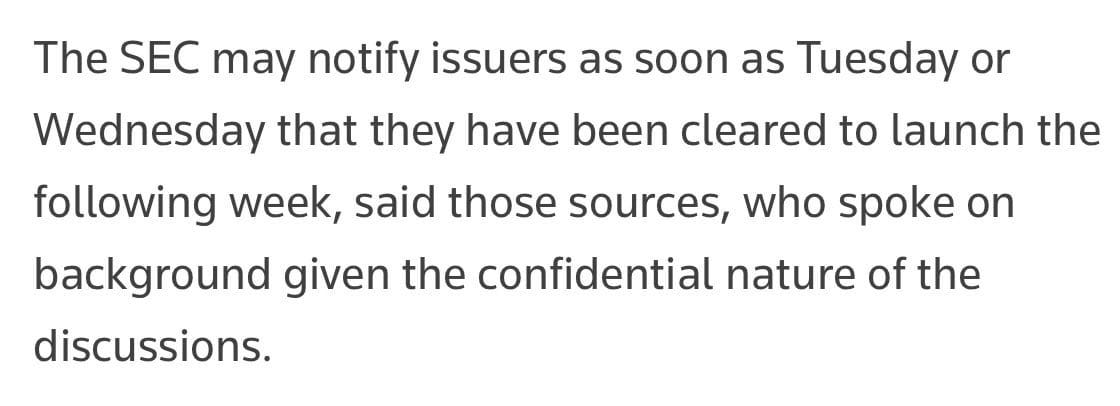
SEC may notify Bitcoin ETF issuers as soon as Tuesday or Wednesday – Reuters

Meanwhile, the long-awaited Bitcoin ETFs may finally get the green light from the U.S. Securities and Exchange Commission (SEC) as early as this week, according to a Reuters report. The report cites unnamed sources familiar with the matter, who said that the SEC could notify the issuers of the first Bitcoin futures ETFs as soon as Tuesday or Wednesday that they have met all the regulatory requirements and can start trading on Monday, January 15th.

This would be a major milestone for the cryptocurrency industry, which has been lobbying for years for a Bitcoin ETF that would allow retail and institutional investors to gain exposure to the digital asset without having to buy and store it directly. A Bitcoin futures ETF would track the price of Bitcoin through contracts traded on regulated exchanges, such as the Chicago Mercantile Exchange (CME).

The SEC has been reluctant to approve a Bitcoin ETF that would hold the underlying asset, citing concerns over market manipulation, custody, and investor protection. However, the agency has signaled a more favorable stance towards a Bitcoin futures ETF, which would fall under the existing regulatory framework for commodity-based funds.

The Reuters report did not name the issuers that could receive the SEC’s approval, but several firms have filed for a Bitcoin futures ETF in recent months, including, BlackRock, ProShares, Invesco, Valkyrie, VanEck, and Galaxy Digital. The SEC has set deadlines to either approve or reject these applications in October and November but shifted to January 2024 to accommodate more clarity and provisions.

However, the SEC has set a deadline of January 14, 2024, to make a decision on VanEck’s spot Bitcoin ETF proposal, which is the first one in line for review. If approved, it would be the first spot Bitcoin ETF in the US, and likely pave the way for others to follow. If rejected, it would be another setback for the crypto industry, which has been waiting for years for a spot Bitcoin ETF in the US.

BlackRock’s filing suggests that it is confident that the SEC will eventually approve a spot Bitcoin ETF in the US, and that it wants to be ready to launch its own product when that happens. BlackRock has already shown its interest in Bitcoin and other cryptocurrencies, as it has invested in several crypto-related companies and funds and has allowed some of its funds to hold Bitcoin futures contracts.

By launching a spot Bitcoin ETF in the US, BlackRock would further cement its position as a leader in the crypto space and offer its clients a new way to gain exposure to the digital asset class.

If approved, a Bitcoin futures ETF could boost the demand and liquidity for Bitcoin, as well as its price. It could also pave the way for more crypto-related products and services in the U.S. market, such as a spot Bitcoin ETF or an Ethereum ETF. However, some analysts have also warned that a Bitcoin futures ETF could introduce more volatility and risk for investors, as well as higher fees and tracking errors.