DD
MM
YYYY

PAGES

DD
MM
YYYY

spot_img

PAGES

Home Blog Page 3827

Your Account Setup Instructions for Tekedia Mini-MBA Edition 12 (Sept 11 – Dec 2, 2023) 

0

Hello,

Greetings. Thanks for joining us at Tekedia Institute. We have created or upgraded your account at https://school.tekedia.com/ with your email address (the very one you are receiving this invitation for account setup). This is a different location from where you read the ebooks.

There are three steps; Step 3 is compulsory. If you do not do Step 3, you will not see your course in your profile. Here is the instruction for account setup – https://school.tekedia.com/support/support/ . (Please note the support video on the page as it may be helpful)

Once you complete the setup, you will see a post under LESSONS titled “Board12: Program News, Zoom Schedules and WhatsApp Link”. Please read it and join the WhatsApp Group, and note the Live Zoom schedules. The Week 1, Week 2, etc will drop as we progress in the program.

Class begins on Sept 11, 2023. 

Regards,

Tekedia Mini-MBA TEAM

Twitter (Now Called X) Plans to Roll-Out Option For Users to Share Their Email With Creators

0

X (formerly Twitter), is reportedly working on adding an option for users to share their email when they Subscribe to a creator.

This according to Musk could be for a newsletter function to allow creators to easily take their email list with them to other platforms.

Announcing the proposed launch of the feature, Musk said,

“This platform will provide email addresses of subscribers (who opt-in) to content creators so that creators can leave this platform easily & take their subscribers with them if they want.

“It’s vital that creators be able to leave our platform at any time and take their subscribers with them. We want to give peace of mind to creators that they’re not trapped here if they build a large audience.”

Reports reveal that creators are already getting popup messages to opt in to receive subscribers’ email addresses.

The message reads,

“Please ensure you have an email address associated with your account and email notifications enabled to receive the email addresses. By Opting in, you agree to let X collect and share with you the email addresses of your subscribers who have opted to share them for the purpose of off-platform communications. You further accept the Email Sharing Terms which require, for example, you to be solely responsible for the data and maintain a privacy policy”.

The soon-to-be-launched feature has been lauded by different X users who stated that it will be a game changer for creators. It is understood that creators want their followers to stay connected with them over multiple platforms as it allows them to easily communicate with them.

Also, it will offer creators security, in case their account is blocked or compromised, they can still keep in touch with their followers via email. This feature even assures creators that they can leave the platform at any time without losing their core subscribers, and having to start from scratch.

Different users and analysts have said that enabling data portability like X could be another way to lure creators and brands that have considered building their presence on the platform, with many more now likely to factor in how they might be able to leverage this element, to expand their connections and build business, both on and off-platform.

One interesting thing about this feature is that it is not just creators that would benefit. Brands, for example, would be able to leverage the feature by offering special deals via subscriber-only tweets, and then use those collected emails to build their direct mailing lists.

Notably, X email feature, which is related to some form of newsletter function, could see the platform compete better with other popular platforms when it comes to creators focused on long-form writing, such as substack, and medium, amongst others.

As X continues to evolve its platforms and offerings, the implementation of this feature is poised to offer creators enhanced versatility in managing their subscriber interactions and leveraging their subscriber data.

Wale Edun’s “Decade” Statement And Why Efficiency Was Key Over Oil Money

2

Interesting comments explaining away the core thesis of Mr Wale Edun (Nigeria’s finance minister) statement where he noted that Nigeria had the most stable economic indicators during 2013-2015: “If we think back to when was the last time when the economy was stable, when it was growing, when inflation was low, when the exchange rate was stable, and when interest rates were affordable; that period was about a decade ago.”

I expanded that conversation by adding that Nigeria during that period experienced the highest GDP per capita ever recorded. You can read some of the comments here, and the core message was this: Jonathan stabilized the exchange rate, inflation rate, etc because oil prices were high.

But one comment there wrote: “we can’t push competent, capacity and networking aside.” Good People, that is the deal. If you look at the numbers, and focus on the national budgets, under Buhari, in absolute Naira and USD dollars, Buhari’s government spent more money than Jonathan’s, on yearly average, and what oil money did not provide to the administration, they borrowed. Because Naira is Naira, whether from oil sale or debt, the issue here is efficiency on its management and deployment. Follow me:

  • Nigeria 2013 budget: N4.99 trillion 
  • Nigeria 2014 budget: N4.69 trillion
  • Nigeria 2015 budget: N4.5 trillion 
  • Nigeria 2016 budget: N6.06 trillion
  • Budget 2019:  N8.92 trillion
  • Budget 2022:  N16.39 trillion

Here is my summary: if spending money is what matters, irrespective of how that money was obtained, it may not be fair to say that Jonathan stabilized our economy because of oil. Most times, it goes beyond balance sheets to TRUST and operational capabilities. Here is the fact, despite not governing under an oil boom, Buhari spent more  money in absolute Naira and US dollars, and yet did not stabilize those indicators the minister was talking about.

I seem to admire Mr. Edun as he seems to be a technocrat who is not interested in calling black white and vice versa. When we tend to explain away a prudent and capable management team with high oil prices, we make it look like we cannot control inflation, FX, etc unless oil price goes up.

(Disclosure: I supported Jonathan over Buhari in 2015).


Comment 1: While it’s essential to acknowledge moments of economic stability and growth, especially in a country as populous and economically diverse as Nigeria, it’s equally important to provide a more comprehensive perspective on the issue.
The points need to be considered.

  1. Context Matters: Economic stability depends on multiple factors, not just one administration’s actions. Global economic conditions, commodity prices, and previous policies play significant roles.

  2. Oil Dependency: Nigeria’s economy heavily relies on oil. The mentioned stability coincided with a short-lived oil price boom, but the country faced economic challenges when oil prices dropped.

  3. Socioeconomic Inequality: Increased GDP per capita doesn’t necessarily benefit everyone equally. Nigeria struggles with poverty and inequality, requiring attention beyond per capita income.

  4. Structural Challenges: Persistent issues like corruption and infrastructure deficiencies hinder long-term economic stability and growth.

  5. Long-Term Planning: Sustainable growth demands consistent policies and reforms addressing fundamental problems.

  6. Diverse Perspectives: Economic assessments should consider various viewpoints and acknowledge contributions from different administrations and individuals.

Comment 2: I am trying to understand how the “context” you provide explains the decline in the economy from 2015 to today

  1. Dependency on oil is the same now as it has been
  2. Global economic problems have not worsened. And they did not affect Nigeria any worse than other countries
  3. What has changed about the weaknesses of the GDP as a measure of prosperity?

Comment 3: One thing you must understand is that while I am not supporting the past President Buhari Administration, I am only looking at the economy from a balanced point of view.

The points you provided are valid and your question is in order but here is my response:

  1. Oil Dependency: Nigeria’s economy has historically been heavily dependent on oil exports. While the dependency on oil may appear to be the same, the global oil market has experienced significant fluctuations during this period. Oil prices plummeted in 2014-2016, affecting Nigeria’s revenue and foreign exchange earnings. Even though the dependency on oil remained constant, the volatility in oil prices and production disruptions due to militancy in the Niger Delta region have been ongoing challenges.

  2. Global Impact: Despite global economic problems not worsening, Nigeria’s economy was affected by its integration into the global market, impacting trade and foreign investment.

Hence; GDP, as a measure of prosperity, has limitations. It doesn’t account for income inequality, poverty, or overall quality of life. Nigeria’s economic decline highlighted these shortcomings as key facts.

Comment 4: Let me also put some figures to what Goodluck NNOROM is saying to help put things in perspective.

Average Crude Oil prices by year
2011 – $111.26
2012 – $111.63
2013 – $108.56
2014 – $98.97
2015 – $52.32 (Buhari Administration Started)
2016 – $43.67

Average daily Crude Oil production by year
2011 – 2,459,000 bpd
2012 – 2,409,000 bpd
2013 – 2,276,000 bpd
2014 – 2,273,000 bpd
2015 – 2,199,000 bpd (Buhari Administration started)
2016 – 1,898,000 bpd

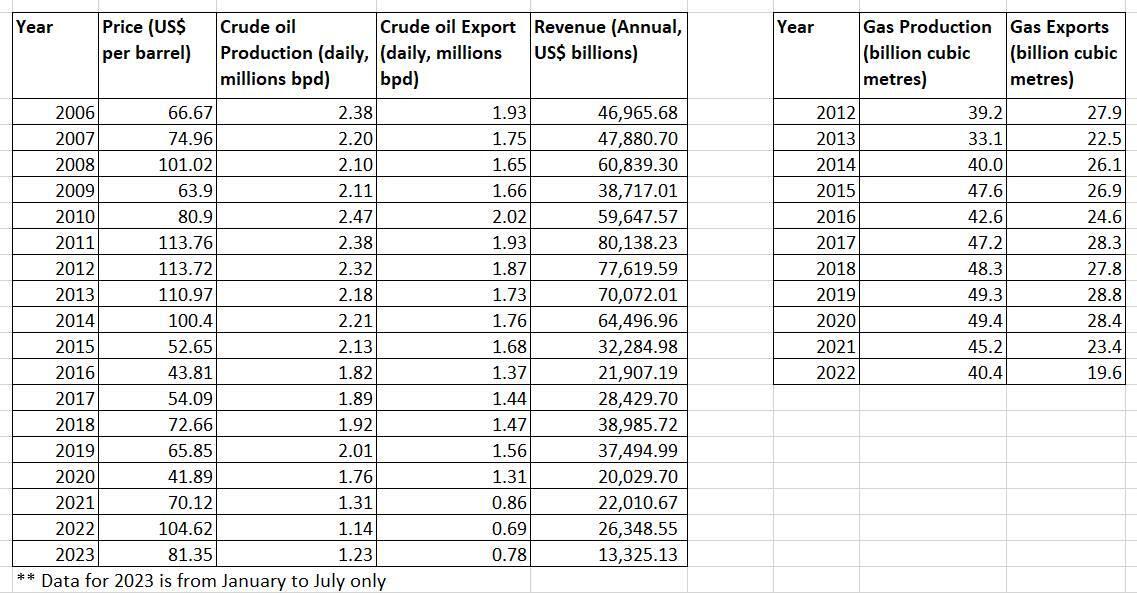
In 2015 which was the start of Buhari’s administration, crude oil took a nose dive, there was a sharp decline in global prices of crude that year, meanwhile since 2011 there has been a gradual decline in Nigeria’s daily crude production which fell below 2,000,000 bpd in 2016 for the first time since 1998. As of 2022, Nigeria’s crude production stood at 1,450,000 bpd.

Please note, I am not trying to support any administration over the other, I am simply buttressing some of the facts the

Comment 5: I think we can’t push competent, capacity and networking aside. The last manager of our economy before the current administration lack some of this attributes.

How do you network and relate with your western colleagues if you aren’t at their level. Manager of our economy must have the international exposures and cloud to competitive favourably in global market.

Comment 6: I agree that efficiency does matter a lot, and if you want to look at it from another perspective, you will see why your thesis on efficiency of deployment of resources may actually be the primary explainer of Nigeria’s overall underperformance throughout the eight years of Buhari’s presidency.

Nigeria has had a primary source of revenue over the years which is its oil and gas industry. What has happened is that, that primary source of revenue has come under serious attack from criminals and economic saboteurs thereby leading to its near collapse.

And then Buhari watched our primary source of revenue collapse, he then went on a reckless money printing and borrowing spree to complete make up the shortfall in revenue, and this has led to where our economy is today. This has led to a situation where the little revenue that came into government coffers, now goes to debt servicing up to the tune of about 90% of its revenue if not more going to service debts.

Daily crude oil exports has fallen over the years and collapsed since 2021. Nigeria loses about 1 million barrels per day since 2021 from its usual highs for crude oil exports. That is the reason why there is huge dollar shortages required to defend the naira.
Chainlink’s Cross-Border Interoperability Programme (CCIP) Experiment was Successful says Swift

0

Swift, the global provider of secure financial messaging services, has announced that it has successfully completed an interoperability experiment with Chainlink, the leading decentralized oracle network. The experiment, which was conducted as part of Swift’s Cross-Border Interoperability Programme (CCIP), aimed to demonstrate how Swift messages can be securely and reliably delivered to smart contracts on various blockchain platforms using Chainlink oracles.

Chainlink, the leading decentralized oracle network, has recently announced a new innovation that could revolutionize the way blockchains interact with each other: the Chainlink Cross-Chain Interoperability Protocol (CCIP). The CCIP is a framework that enables any blockchain to securely and reliably access any other blockchain’s data, state, and smart contracts, regardless of the underlying consensus mechanism, programming language, or data format. This means that blockchains can leverage the strengths and capabilities of other blockchains, creating a more interconnected and interoperable ecosystem.

The CCIP is powered by Chainlink’s flexible and modular architecture, which allows developers to customize their cross-chain communication needs according to their specific use cases. The CCIP consists of three main components:

Chainlink Proof of Reserve Nodes: These nodes monitor the reserves of assets on one blockchain and provide proofs of their existence and amount to another blockchain. This enables cross-chain asset transfers, such as wrapped tokens, stablecoins, and NFTs.

Chainlink External Adapters: These are modular components that allow Chainlink nodes to connect to any external API or data source, including other blockchains. This enables cross-chain data feeds, such as market prices, weather data, sports scores, and more.

Chainlink Decentralized Services Networks (DSNs): These are networks of Chainlink nodes that provide decentralized services to other blockchains, such as computation, randomness, identity, reputation, and more.

The CCIP is not only a technical breakthrough, but also a strategic one. By enabling seamless cross-chain communication, the CCIP opens up new possibilities for collaboration and innovation across the blockchain space. Some of the potential benefits of the CCIP are:

Enhanced scalability: Blockchains can offload computation and storage to other blockchains that are more suited for those tasks, reducing congestion and costs on their own networks.

Increased security: Blockchains can leverage the security and decentralization of other blockchains, such as Bitcoin and Ethereum, to enhance their own trustlessness and resilience.

Improved functionality: Blockchains can access the features and functionalities of other blockchains, such as smart contracts, DeFi protocols, NFT platforms, and more.

Greater diversity: Blockchains can benefit from the diversity and richness of data and services available across different blockchains, creating more value and utility for their users.

The CCIP is a game-changer for cross-chain communication, as it enables any blockchain to access any other blockchain in a secure, reliable, and customizable way. The CCIP is a testament to Chainlink’s vision of creating a more connected and interoperable blockchain ecosystem, where each blockchain can leverage the best of what other blockchains have to offer. The CCIP is not only a technical innovation, but also a catalyst for collaboration and creativity across the blockchain space.

The experiment involved sending Swift ISO 20022 messages from a test environment to Chainlink nodes, which then converted them into blockchain-compatible formats and delivered them to smart contracts on Ethereum, Polygon and Binance Smart Chain. The smart contracts then executed various business logic based on the Swift messages, such as triggering payments, updating balances, or verifying compliance. The experiment also showcased how Chainlink can provide bi-directional communication between Swift and blockchains, enabling smart contracts to send messages back to Swift using the same oracle network.

The experiment was a success, as it demonstrated that Swift and Chainlink can interoperate seamlessly and securely, enabling cross-border and cross-platform data exchange and automation. This opens up new possibilities for Swift members to leverage blockchain technology and smart contracts for various use cases, such as trade finance, securities settlement, or cross-border payments. Swift and Chainlink plan to continue their collaboration and explore further opportunities to enhance the CCIP and the future of cross-border interoperability.

It’s Graduation Day for Tekedia Mini-MBA edition 11 [photos, videos]

0

It’s Graduation Day at Tekedia Institute. And you’re invited. Our Learners are now #ready2lead because they’ve acquired the capabilities to advance the wealth of nations, the prosperity of firms, and the improvements in communities. The graduation academic festival has already started with graduation events taking place in many cities. 

Good People, Tekedia Institute is Africa’s temple for the mastering of entrepreneurial capitalism, and the unalloyed pursuit of the mission of firms, to fix market frictions and accelerate human welfare, through world-class affordable business education. 

In this graduation ceremony, Lead Faculty of Tekedia Institute, Ndubuisi Ekekwe, will deliver a graduation message titled  “Unlocking The Era of Abundance”. Here are the details:

Graduation Lecture: Unlocking The Era of Abundance 

Date/Time:  Sat, Sept 2 | 7pm – 8.30pm WAT

Presenter: Prof Ndubuisi Ekekwe

Zoom Link – click here for members and login (we will webcast the session on this page)

* As the graduation ceremonies take place across cities, I congratulate everyone. Go into the market and lead. You’re #ready2lead. Again, to all the generous sponsors of our ceremonies, we THANK you.