DD
MM
YYYY

PAGES

DD
MM
YYYY

spot_img

PAGES

Home Blog Page 3837

Nigeria Should Lobby for Shell Onshore To Continue Operations

0

Shell Onshore is exiting Nigeria even as it leaves it deepwater operations and integrated gas businesses intact: “Shell has reached an agreement to sell its Nigerian onshore subsidiary The Shell Petroleum Development Company of Nigeria Limited (SPDC) to Renaissance, a consortium of five companies comprising four exploration and production companies based in Nigeria and an international energy group. Completion of the transaction is subject to approvals by the Federal Government of Nigeria and other conditions.”

As an undergraduate student in FUTO, I did an internship in Shell Flow Station in Yenagoa, Bayelsa State, and it was an unforgettable technical experience. Besides the “eat as much as you want” in the canteen [the best part of the internship!], it was an initiation into engineering excellence.

I understand the challenges of operating onshore with kidnapping and other vices, I wish Shell would still be operating onshore. The deep technical manpower we have in Nigeria today, in our oil and gas sector, would not have been possible without companies like Shell. Yes, check all the indigenous oil and gas services firms in Nigeria, most of their leaders began their careers in international oil and gas companies like Shell. So, we cannot afford for these firms to exit, especially the onshore business, where to a large extent women get to experience the industry (when I was in the flow station, there was not a single woman there, and that was even onshore. At the deepwater facility, that imbalance may still be there in the industry).

So, Nigeria, try to keep Shell, and if you cannot keep it, work out a plan to ensure Shell technical excellence remains available in Nigeria’s onshore business. Sure, it is business but it cannot be all about money. (Just writing: this is already dotted in Europe for it to have been announced.)

Shell Announces Sale of Nigerian Onshore Subsidiary to Renaissance Consortium for $1.3 Billion

Shell Announces Sale of Nigerian Onshore Subsidiary to Renaissance Consortium for $1.3 Billion

0

Shell has reached an agreement to sell its Nigerian onshore subsidiary, The Shell Petroleum Development Company of Nigeria Limited (SPDC), to Renaissance, a consortium of five companies, comprising four exploration and production companies based in Nigeria and an international energy group.

The completion of this transaction is contingent upon approvals by the Federal Government of Nigeria and other relevant conditions, according to a statement from the company.

The sale has been strategically designed to maintain the full spectrum of SPDC’s operating capabilities after the change in ownership, including technical expertise, management systems, and processes that SPDC implements on behalf of all the companies in the SPDC Joint Venture (SPDC JV). SPDC’s staff will continue to be employed during the transition to new ownership.

Shell, post-transaction, will retain a role in supporting the management of SPDC JV facilities. These facilities play a crucial role in supplying a major portion of feed gas to Nigeria LNG (NLNG), aligning with Shell’s commitment to helping Nigeria achieve maximum value from NLNG.

“This agreement marks an important milestone for Shell in Nigeria, aligning with our previously announced intent to exit onshore oil production in the Niger Delta, simplifying our portfolio and focusing future disciplined investment in Nigeria on our Deepwater and Integrated Gas positions,” Zoë Yujnovich, Shell’s Integrated Gas and Upstream Director, stated.

She continued, “Shell sees a bright future in Nigeria with a positive investment outlook for its energy sector. We will continue to support the country’s growing energy needs and export ambitions in areas aligned with our strategy.”

The SPDC JV, an unincorporated joint venture, consists of SPDC Ltd (30%), the government-owned Nigerian National Petroleum Corporation (55%), Total Exploration and Production Nigeria Ltd (10%), and Nigeria Agip Oil Company Ltd (5%). It holds 15 oil mining leases for petroleum operations onshore and three for petroleum operations in shallow water in Nigeria, operated by SPDC.

Renaissance, the consortium acquiring SPDC, is comprised of ND Western, Aradel Energy, First E&P, Waltersmith, and Petrolin.

The financial details of the transaction reveal that the consideration payable to Shell is $1.3 billion. The buyer will make additional cash payments of up to $1.1 billion, primarily relating to prior receivables and cash balances in the business, with the majority expected to be paid at the completion of the transaction. Other contingent payments, including those related to gas supply to NLNG, may become payable depending on business performance and fluctuation of product prices.

The net book value of the entity subject to this transaction is approximately $2.8 billion as of December 31, 2023. Shell is set to provide secured term loans of up to $1.2 billion at closing, covering various funding requirements.

Additionally, Shell will be offering additional financing of up to $1.3 billion over future years to fund SPDC’s share of the development of the SPDC JV’s gas resources to supply feed gas to NLNG and its share of specific decommissioning and restoration costs. This financing will only be drawn down when these costs are approved and incurred by the SPDC JV.

The effective date of the deal structure is December 31, 2021. However, Shell will continue to consolidate SPDC until control transfers are completed. The company expects to recognize impairments in respect of the business up to the date of completion, dependent on the future financial performance of the business.

Shell said in its press statement that it has three other main businesses in Nigeria outside the scope of this transaction. These include Shell Nigeria Exploration and Production Company Limited (SNEPCo), Shell Nigeria Gas Limited (SNG), and Daystar Power Group. Additionally, Shell holds a 25.6% interest in NLNG, which produces and exports LNG to global markets. Shell’s interest in NLNG is also outside the scope of this transaction.

The sale of SPDC to Renaissance marks a significant shift in Shell’s strategic focus in Nigeria, emphasizing a streamlined portfolio with a concentration on Deepwater and Integrated Gas positions. The move is expected to have far-reaching implications on the Nigerian energy sector and aligns with Shell’s commitment to supporting Nigeria’s energy needs and export ambitions.

Concerning Shell employees, the company said: “We do not expect a loss of employment. SPDC’s staff will continue to be employed by the company as it transitions to new ownership.”

Beyond Levies, Nigeria Needs to Grow Capital to Advance

0

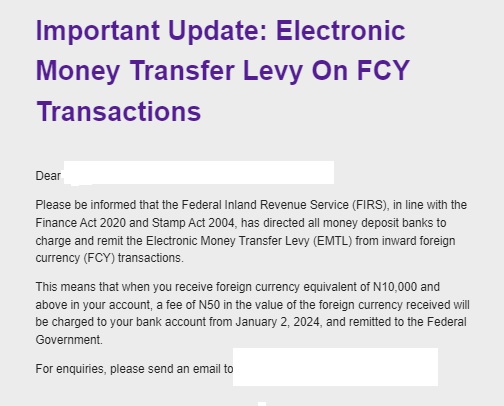
Nigeria continues to innovate in one area we have been great at: taxation, and collection of fees and levies. And if you check our track record, you will see many ironies. A few years ago, Nigeria would pay you for remitting money to the country via the N5 bonus for every $1 diaspora remittance. Today, you get taxed or levied for sending money to the country!

More money does not advance nations if they do not find ways to create more capital. Some of these levies generate more money but stunt the growth and development of capital. Nigeria will not advance until we can grow capital, irrespective of how much money we generate via levies and taxes.

Vodafone Signs $1.5 Billion Deal With Microsoft to Bring AI, Cloud And IoT to Millions of Businesses and Consumers

0

Giant Telecommunications company Vodafone has signed a 10-year $1.5 billion partnership deal with Microsoft, to offer scaled digital platforms to more than 300 million businesses, public sector organizations, and consumers across Europe and Africa.

Through this partnership, both companies will collaborate to transform Vodafone’s customer experience using Microsoft’s generative AI; hyperscale Vodafone’s leading managed IoT connectivity platform; develop new digital and financial services for businesses, particularly SMEs across Europe and Africa; and overhaul its global data center cloud strategy.

Vodafone will invest $1.5 billion over the next 10 years in cloud and customer-focused AI services developed in conjunction with Microsoft. Also, Microsoft will use Vodafone’s fixed and mobile connectivity services.

Additionally, Microsoft intends to invest in Vodafone’s managed IoT connectivity platform, which will become a separate, standalone business by April 2024. The new company will attract new partners and customers, driving growth in applications and expanding the platform to connect more devices, vehicles and machines.

The digital services generated by the new partnership will use the latest generative AI technology to provide a highly personalized and differentiated customer experience across multiple channels. They will be built on unbiased and ethical privacy and security policies under Vodafone’s established framework for responsible AI.

Speaking on the partnership, Vodafone Group chief executive, Margherita Della Valle said,

Today, Vodafone has made a bold commitment to the digital future of Europe and Africa. This unique strategic partnership with Microsoft will accelerate the digital transformation of our business customers, particularly small and medium-sized companies, and step up the quality of customer experience for consumers”.

Also speaking on the partnership deal, Chairman and CEO of Microsoft Satya Nadella said,

This new generation of AI will unlock massive new opportunities for every organization and every industry around the world. We are delighted that together with Vodafone we will apply the latest cloud and AI technology to enhance the customer experience of hundreds of millions of people and businesses across Africa and Europe, build new products and services, and accelerate the company’s transition to the cloud.”

Both companies noted that they have identified five key areas of collaboration which include Generative AI, Scaling IoT, Africa Digital Acceleration, Enterprise Growth, and Cloud Transformation.

Through African digital acceleration, Microsoft disclosed its intention to help further scale M-Pesa, Africa’s largest financial technology platform, by housing it on Azure and enabling the launch of new cloud-native applications.

Notably, Microsoft and Vodafone are also launching a purpose-led program that seeks to enrich the lives of 100 million consumers and 1 million SMEs across the African continent.

The goal is to enhance digital literacy, skilling and youth outreach programs, as well as offer digital services to the underserved SME market.

Have you been paid by Apple on the batterygate suit yet?

0
An Apple logo is seen at the entrance of an Apple Store in downtown Brussels, Belgium March 10, 2016. REUTERS/Yves Herman/File Photo

In 2018, a class action on what is now referred to as “the batterygate suit” was filed by some iPhone users against Apple Inc. on the grounds that Apple deliberately slowed down their older version of iPhones in making updates to its iOS mobile platform and made the batteries of its older iPhones die quicker. Apple Inc. always does this whenever they release a new version of an iPhone or any other product like MacBook or iWatch in order to force the users of the older version to discard the old products and jump on the newest version so as for them to boost the sales of the new release. 

This act of Apple Inc. has been condemned serially by both its users and even the court. Some of the users decided that they had had enough of Apple’s tricks and took Apple to court over this. 

A total of 3.3 million iPhone users who used iPhone 6, 6 Plus, 6s, 6s Plus and SE users running iOS 10.2.1 or later and iPhone 7 and 7 Plus users running iOS 11.2 joined submitted claims to have experienced this and they joined the class action against Apple Inc. There was an open call to millions of Apple users worldwide who may have experienced this to submit their claim and join the class action on or before 21 December 2017 but only 3.3 million users yielded to the call and submitted their claim before the 21 December 2017 deadline. 

Apple Inc. opted out of settlement instead of dragging the matter in court. They agreed to pay all the 3.3 million users who submitted their claims and joined the class action. Apple, while agreeing to the million-dollar settlement, denied the charge and claimed that its reason for reducing the performance of its older iPhones was not to hide battery defects, but rather was designed to prolong the lifespan of those devices. They also issued the disclaimer that the settlement is not an admission of wrongdoing or guilt by Apple Inc.

Each of the 3.3 million users that joined the class action is entitled to a share of $92.17 from the total settlement and most of the users, even Nigerians have received theirs. 

If you are one of those who filed a claim against Apple Inc. and joined the class action in 2017, you are entitled to your own share of $92.17. You ought to have already been paid.