DD
MM
YYYY

PAGES

DD
MM
YYYY

spot_img

PAGES

Home Blog Page 3850

Pantera Capital forecasting $148,000 USD for Bitcoin’s price by 2025

0

One of the most prominent venture capital firms in the crypto space, Pantera Capital, has recently published a report that predicts a bullish future for Bitcoin. According to the report, Bitcoin’s price could reach $148,000 USD by 2025, based on a model that incorporates the stock-to-flow ratio, the halving cycles, and the adoption curve. Bitcoin is the most popular and widely used cryptocurrency in the world. It has been around since 2009 and has grown exponentially in value and adoption over the years. However, Bitcoin is also known for its high volatility and unpredictability, which makes it challenging to forecast its future price movements.

The stock-to-flow ratio measures the scarcity of an asset by dividing its current supply by its annual production. This ratio is often used to value commodities like gold and silver, which have a limited supply and a predictable production rate. The higher the ratio, the scarcer and more valuable the asset is.

The halving cycles refer to the periodic events that reduce the reward for mining new bitcoins by 50%. These events occur every four years, or every 210,000 blocks, and they have a significant impact on the supply and demand dynamics of Bitcoin. The halving cycles create a supply shock that reduces the inflation rate of Bitcoin and increases its scarcity.

The adoption curve is a model that describes how new technologies spread in society. It assumes that there are different types of users who adopt new technologies at different rates, depending on their level of innovativeness, risk tolerance, and social influence. The adoption curve is usually divided into five segments: innovators, early adopters, early majority, late majority, and laggards.

Pantera Capital’s report combines these three factors to project Bitcoin’s price trajectory for the next four years. The report assumes that Bitcoin will follow a similar pattern as it did in the previous halving cycles, which resulted in exponential growth and parabolic peaks. The report also assumes that Bitcoin will continue to gain more users and adoption as it becomes more mainstream and accessible.

According to the report, Bitcoin’s price could reach $148,000 USD by 2025, which would represent a 10x increase from its current level of around $15,000 USD. The report also acknowledges that this is a conservative estimate, as it does not account for other factors that could boost Bitcoin’s price, such as institutional demand, regulatory clarity, innovation, and geopolitical events.

The report concludes that Bitcoin is still in its early stages of development and adoption, and that there is still a lot of room for growth and improvement. The report also states that Bitcoin is not only a store of value, but also a medium of exchange and a unit of account, which gives it multiple use cases and advantages over traditional currencies.

Some of the main drivers of Bitcoin’s price are supply and demand, adoption, regulation, innovation, and sentiment. Supply and demand are determined by the limited number of bitcoins that can be mined (21 million) and the rate at which new coins are created (halving every four years). Adoption refers to how widely Bitcoin is used and accepted as a form of payment or store of value.

Regulation affects how legal and safe it is to buy, sell, and hold Bitcoin in different countries. Innovation refers to the technological developments and improvements that make Bitcoin more efficient, secure, and scalable. Sentiment reflects the public perception and confidence in Bitcoin as an asset class.

Based on these factors, some analysts have made bullish predictions for Bitcoin’s price in the next few years. For example, Plan B, the creator of the stock-to-flow model, which relates Bitcoin’s price to its scarcity, projects that Bitcoin could reach $100,000 by the end of 2021, and $288,000 by 2024. Similarly, Mike McGlone, a senior commodity strategist at Bloomberg Intelligence, expects Bitcoin to hit $100,000 in 2021, and $400,000 by 2025.

On the other hand, some experts have more cautious or bearish views on Bitcoin’s price. For instance, Nouriel Roubini, a professor of economics at New York University, who is known for his pessimism on cryptocurrencies, predicts that Bitcoin will crash to zero eventually. He argues that Bitcoin has no intrinsic value, is plagued by fraud and manipulation, and faces regulatory hurdles that will limit its adoption.

Ultimately, no one can predict with certainty what will happen to Bitcoin’s price in the future. It depends on many factors that are constantly changing and evolving. However, one thing is clear: Bitcoin is here to stay, and it will continue to attract attention and interest from investors, enthusiasts, and skeptics alike.

Pantera Capital’s report is one of the most optimistic and bullish forecasts for Bitcoin’s price in the crypto industry. It reflects the confidence and enthusiasm that many investors and enthusiasts have for the future of Bitcoin and its potential to revolutionize the world of finance and beyond.


How does Bitcoin’s Scarcity compare to Gold and Silver?

0

One of the most important features of Bitcoin is its scarcity. Unlike fiat currencies that can be printed at will by central banks, Bitcoin has a fixed supply of 21 million coins that will ever be created. This makes Bitcoin a scarce asset, similar to gold and silver, which have limited supplies and are valued for their rarity. But how does Bitcoin’s scarcity compare to gold and silver? How can we measure the scarcity of different assets and what does it mean for their value?

One way to measure the scarcity of an asset is to look at its stock-to-flow ratio. This is the ratio of the existing stock of the asset (how much of it is available) to its annual flow (how much of it is produced each year). A higher stock-to-flow ratio means that the asset is scarcer, as it takes longer to produce more of it.

For example, gold has a high stock-to-flow ratio of about 62, meaning that it would take 62 years of current production to match the existing stock of gold. Silver has a lower stock-to-flow ratio of about 22, meaning that it would take 22 years of current production to match the existing stock of silver. Both gold and silver are considered scarce assets, as their production is limited by the availability of natural resources and the cost of mining.

Bitcoin, however, has an even higher stock-to-flow ratio than gold and silver. As of August 2023, there are about 19.5 million bitcoins in existence, and the annual production is about 328,500 bitcoins (based on the current block reward of 6.25 bitcoins per block and an average block time of 10 minutes). This gives Bitcoin a stock-to-flow ratio of about 59, meaning that it would take 59 years of current production to match the existing stock of bitcoins.

But unlike gold and silver, Bitcoin’s stock-to-flow ratio is not constant. It changes every four years, when the block reward is halved. This means that the annual production of bitcoins decreases by 50% every four years, making Bitcoin scarcer over time. The next halving is expected to occur in May 2024, when the block reward will drop to 3.125 bitcoins per block. This will increase Bitcoin’s stock-to-flow ratio to about 120, making it twice as scarce as gold.

The stock-to-flow model, which was popularized by a pseudonymous analyst known as Plan, predicts that the value of an asset is proportional to its stock-to-flow ratio. According to this model, as Bitcoin becomes scarcer, its value will increase exponentially. Plan B has projected that Bitcoin’s value will reach $1 million by 2025, based on the historical relationship between Bitcoin’s price and its stock-to-flow ratio.

Of course, the stock-to-flow model is not a perfect predictor of Bitcoin’s value, as there are many other factors that influence the supply and demand of Bitcoin, such as regulation, innovation, adoption, competition, etc. However, the model does capture one of the key features of Bitcoin that sets it apart from other assets: its digital scarcity.

Bitcoin is the first asset in history that has a verifiable, immutable, and programmable supply. No one can create more bitcoins than the protocol allows, no one can alter the history of transactions, and no one can change the rules without consensus. This makes Bitcoin a unique form of money that is resistant to inflation, censorship, and corruption.

Bitcoin’s scarcity is one of the main reasons why many investors consider it a store of value, a hedge against fiat currency devaluation, and a potential global reserve currency. As more people recognize the value proposition of Bitcoin, its demand will likely increase, driving its price higher in the long term.

Bitcoin’s scarcity is one of its most important features that distinguishes it from other assets. By comparing Bitcoin’s stock-to-flow ratio to gold and silver, we can see that Bitcoin is not only scarce but also becoming scarcer over time. This implies that Bitcoin’s value will likely increase as well, according to the stock-to-flow model. While this model is not a guarantee, it does provide a useful framework for understanding how scarcity affects value.

The Nigeria’s 4.1% Unemployment Rate

0

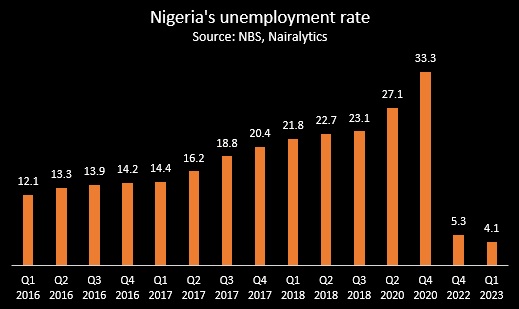
Now I can comment on it, since no department of statistics in any Nigerian university was bold enough to tell the National Bureau of Statistics that its methodologies and processes are faulty: “The National Bureau of Statistics (NBS) said Nigeria’s unemployment rate decreased to 4.1 percent during the first quarter (Q1) of 2023, down from the previous quarter’s 5.3 percent.”

The National Bureau of Statistics (NBS) said Nigeria’s unemployment rate decreased to 4.1 percent during the first quarter (Q1) of 2023, down from the previous quarter’s 5.3 percent.

Back in the fourth quarter (Q4) of 2020, the bureau reported the country’s unemployment rate to be 33.3 percent.

In a statement released on Thursday, the NBS announced that the recent unemployment report employed a new methodology and provided a comprehensive examination of the labor market.

“The latest Nigeria Labour Force Survey (NLFS) report sheds light on the dynamics of labor market within the country,” the statement reads.

Yes, with all secondary and primary indicators, Nigeria’s unemployment rate is not 4.1%. The NBS assessment is so untrue that it has the potential to give the government wrong signals as it works on policies designed to create jobs. Yes, if the unemployment rate is that low, why bother with efforts to create new jobs?

Good People, I understand that many people here will not agree with me. And please my intention is not to discredit any government or agency. Simply, I do think that we Nigerians must be friendly with data, if we hope to advance. If anyone tells you that out of 100 people in Nigeria actively looking for jobs, that 95 people are employed and only 5 cannot find jobs, tell him or her that the core thesis of making that call is faulty.

Comment on Feed

Comment 1: Ndubuisi Ekekwe thanks for writing about this. Its mind-boggling that the statistical agency of country with :
1) the highest # of persons living in poverty on earth :
2) mass exodus of its youth; probably africa’s largest exodus; and
3) rampaging hunger that is fueling insecurity;would put out a report that suggests that we have 4% unemployment.
Is this not a deliberate attempt to mislead those who are responsible for the economy that all is well?

Comment 2: Even to a lay man on the street, it is clear that the call made by NBS on the employment numbers is faulty. This is not about targeting the performance of an administration, we are simply saying, this data is not correct and as Nigerians, we deserve accurate statistics from NBS. Do not Confuse us the more!

Comment 3: Unless you are blinded by politics that report of 4% unemployment was outrageous. Whatever the basis we know that unemployment rate is in the two digits in Nigeria. Most times I choose not to comment on our socio economic realities. The President at least needs the right figures to help in formulation of policies that would help to resolve the issues.

Comment 4: I do not believe any informed mind will subscribe to such fundamentally flawed statistics. Those putting data out there for public consumption should be meticulous enough to produce accurate data that is reflective of the exact situation. Unemployment in Nigeria is in unfortunate and uncomfortable double figures at the moment. While it remains in the best interest of all citizens and government to achieve such audacious statistics, the current unemployment rate is far away from such enviable percentage. Accuracy of data can lead to better policies and budget planning.  hashtagtruestatistics  always win.

Comment 5: These Individuals are so self-assured that they appeared on television to uphold their assertions. Unless Nigerians start scrutinizing all the procedures used by different government organizations, they will persist in using faulty data and providing us with inaccurate information. This, in turn, will affect policy creation and decision-making and impede economic growth.

Comment 6: Ndubuisi Ekekwe I think our media still has a lot to do. This is a very good example of a national matter that affect every single person in Nigeria. In other developed and serious economies, the Director of that agencies will have been bombard with numerous questions as to how 4.1% was arrived at. At minimum, the head of the agency will vet this data before they are churn out.

Nigeria is on the negative side of the number line. We need to get to point zero and start growing every part of the country.

My Response: The challenge is that if you say 4% is not realistic, people will ask you to go and do your own research before you can challenge the government. Because few can afford to do a nationwide study, no one wants to talk. That is the position of Samuel , reading his comment where he wrote: “destructive criticism. What is the basis of your conclusions?”

As I write, many will say that I am unfair to the agency since I have not done any study to disqualify their results. Of course, if that is the yardstick, it means the media people cannot question anything.

Upon that strategy, even the media cannot talk. That is why an agency can say that Nigeria is largely at full employment because no one has any hard data to challenge it. With that pattern, you have alternative facts. Even JP Morgan cannot escape that. It is not new, it has been like that for decades in Nigeria.

Comment 6R: I agree with you prof. Profoundly, I think people with that perspective have forgotten that there is a wide difference between criticism and critique. And I think the gap between these two concept is what our media houses should fill. The media is our collective mouthpiece.

You are 100% correct sir. Media should have finished this agencies with challenging and probing question to bring a public knowledge of the thought process that gave us derivative of 4.1%.

Comment 6R2: The media people are journalists by career. They do not have the academic background for researches in these areas – science, economics, financial, etc.

My Response: Most journalists are trained professionals in certain domains before they take to writing. BusinessDay editorTayo Fagbule is an economist. Their former editorial executive holds a PhD in the social sciences. Helen Joyce studied mathematics but moved to journalism. My point is that it is not lack of academic background that is the issue, it is largely doing all NOT to offend in Nigeria. More so, most reputation media houses have external experts on certain domains.

Nigeria’s Unemployment Rate Drops to 4.1% in Q1 2023 – NBS

Tani Olohun and Evolution of Vertical Content Integration in the Age of Social Media-Driven Religious Conflict

0

In our interconnected world, the power of social media to influence and shape public opinion cannot be underestimated. Recent events surrounding Tani Olohun, an Isese practitioner in Nigeria, underscore the dynamic nature of information dissemination and its potential to exacerbate religious tensions. The convergence of vertical content integration and social media-driven religious conflict poses intriguing questions about the role of digital platforms in shaping discourse, fostering unity, and inciting division.

Tani Olohun’s case highlights how individuals can leverage social media to gather followers and propagate their beliefs across diverse faiths. The allure of digital platforms lies in their ability to transcend geographical boundaries and bring together people with shared interests, or in this case, curiosities about traditional religions. The democratization of content creation grants individuals the power to amplify their voices and foster online communities, transcending the limitations of physical presence.

However, the ease of creating, sharing, and remixing content carries both positive and negative consequences. The use of Tani Olohun’s Facebook page and YouTube channel to spread his beliefs is an exemplar of vertical content integration – the incorporation of existing content into new narratives. In this context, skit makers and digital content creators capitalized on his arrest and detention to generate content that capitalized on his actions and reactions of his detractors.

While these actions can be seen as creative expressions of freedom of speech, they also contribute to the amplification of conflict. By intertwining reactions from Tani Olohun’s targets into their own content, these creators inadvertently reinforce the animosity between different faith groups. This practice can fuel the flames of religious tension and intensify divisions that already exist within society. The Internet’s viral nature often magnifies these clashes, potentially leading to real-world consequences.

The implications of vertical content integration in the age of social media-driven religious conflict are multifaceted. On one hand, it showcases the power of online platforms to foster dialogue and understanding across faiths. Individuals with differing beliefs can engage in constructive conversations, learning about each other’s perspectives and contributing to societal harmony. On the other hand, the same platforms can be used to deepen existing divisions, amplifying negativity and potentially inciting offline conflicts.
It’s crucial to recognize the role that social media platforms play in shaping public opinion and influencing narratives. Content creators have a responsibility to consider the potential impact of their work on the larger community. Balancing creative expression with the broader social good is a challenge that every digital content creator must navigate.

To address these challenges, platforms can implement stricter content moderation and fact-checking mechanisms to curb the spread of misinformation or content that could incite violence. Education initiatives can be introduced to promote media literacy, empowering users to critically assess the information they encounter and discern credible sources from potentially divisive ones.

The Tani Olohun case serves as a cautionary tale about the power and pitfalls of vertical content integration within the realm of social media-driven religious conflicts. While the digital age offers unprecedented opportunities for dialogue and exchange, it’s essential to remain vigilant against the unintended consequences of content creation and dissemination. As we continue to navigate this rapidly evolving landscape, thoughtful and responsible engagement with online platforms is paramount to fostering a more harmonious society.

Attend the Launch of Egoras Dual-Fuel Tricycle in PHC

0

If you can, buy from Egoras, a Tekedia Capital portfolio company, as it unveils its dual-fuel tricycle tomorrow in PHC. So, with Egoras keke, if petrol goes up, you switch to gas, and if they make gas expensive, you go to petrol. So, head or tail, you win.  In the last two years, Egoras has created 300 jobs and plans to add an extra 1,000 by June 2024 when a new plant opens in Abia State.

Location and Time:

  • The Arena Event Center
  • Phase 2, 20 Tombia Street GRA, New GRA, PHC
  • Aug 28, 2023 | 12 noon WAT