DD
MM
YYYY

PAGES

DD
MM
YYYY

spot_img

PAGES

Home Blog Page 3862

Anambra State Moves to Implement Free Right of Way (RoW) to Boost Digital Economy

0

Anambra state has initiated the enforcement of zero charges for the Right of Way (RoW) per meter, paving the way for a digital economy boost in the state.

This development positions Anambra as the pioneer state in the Southeastern region of Nigeria to adopt the exemption of RoW charges per linear meter.

This departure from the National Economic Council’s 2020 recommendation of N145 per linear meter highlights the state’s distinctive approach. It also follows the steps of other states such as Kwara, which slashed its RoW fee from N5,500 per linear meter to N1 per kilometer of fiber in 2020.

Chukwuemeka Fred Agbata, the Managing Director and CEO of the Anambra State ICT Agency remarked that this action aligns with the Governor’s vision of ‘Everything Technology and Technology Everywhere.’

Agbata emphasized that, in collaboration with Globe International Carriers Limited (GICL), the ICT Agency has successfully deployed around 200 kilometers of fiber optic cables in the first phase of Anambra. The focus is on connecting Ministries, Departments, and Agencies of the Government (MDAs), educational institutions, and other clusters.

He further highlighted that Governor Charles Soludo has displayed significant interest in adopting modern strategies to overcome barriers to digital access, thereby reversing the decline of infrastructure in the state.

This initiative is aimed at facilitating the expansion of WiFi Hotspots to government offices, schools, and communities, thereby diversifying the economy and utilizing digital services for eGovernment, commerce, education, and innovation.

The head of the ICT Agency also underscored that the elimination of Right of Way charges by the State Government marks the initial stride toward establishing a digital economy that will attract key investors, innovators, and businesses to the state.

“His Excellency, Governor Charles Chukwuma Soludo has always demonstrated determination to turn Anambra State into a digitally driven economy. The broadband drive is the one of the many ways to do it and at the same time it connects to other plans. Yes, because without connectivity eGovernment programmes would become a mirage”.

“Africa’s digital landscape is changing at a rapid rate and Anambra State is no different. The Governor approved the implementation of the zero charges on Right of Way because he understands the benefits are enormous. We are partnering with GICL which is giving us a lot of connectivity capacity that we are hopeful will leapfrog the State’s digital economy agenda.

“This will power the Governor’s lodge and by extension, a local government and a university, as a pilot, he said.

Agbata also said that the agency is actively engaged in the process of standardizing the digital assets of the State Government by transitioning all official Government websites.

Concerning this, he stated that the Agency has commenced the comprehensive migration of all Government assets to the internet domain name anambrastate.gov.ng.

“Prior to the Soludo administration, Government digital assets were scattered all over the Internet, with different domain names and on different servers,” Agbata said.

“Today, most MDAs have been brought under the standard domain anambrastate.gov.ng in line with Federal Government policies amongst other achievements.”

Why Crypto Exchanges Want You to Go Through KYC Process

0

Implementing KYC procedures offers several advantages for crypto exchanges. Here are some of the benefits:

  1. Legal compliance: Adhering to KYC regulations ensures legal compliance and reduces the risk of legal action against the exchange.
  2. Enhanced customer trust: By demonstrating their commitment to preventing financial crimes and maintaining a secure platform, crypto exchanges can enhance customer trust.
  3. Secure transactions: KYC procedures help ensure the security of transactions on the exchange.

Furthermore, robust KYC measures contribute to market stability and enhance the reputation of the crypto industry. By reducing the likelihood of fraudulent activities, money laundering, and other illicit financial activities, KYC creates a more secure and reliable atmosphere, thereby attracting more customers and augmenting the exchange’s reputation. Even a bitcoin casino might want you to go through KYC these days.

Legal Compliance and Reduced Risk

By adhering to KYC regulations, exchanges can achieve the following benefits:

  • Reduce legal risks
  • Demonstrate commitment to preventing financial crimes
  • Ensure compliance with regulatory requirements and anti-money laundering (AML) laws
  • Reduce the possibility of legal action
  • Preserve their reputation

Through the implementation of comprehensive KYC checks, organizations can:

  • Reduce the likelihood of fraudulent activities
  • Prevent money laundering
  • Prevent terrorist financing
  • Prevent other illicit financial activities

This not only helps to maintain a secure and transparent environment for customers to trade cryptocurrencies, but also contributes to the overall stability and value growth of the market.

Enhanced Customer Trust and Security

KYC procedures help build customer trust by ensuring the security and transparency of transactions on the exchange. Exchanges with comprehensive KYC measures, such as customer identification and verification, risk assessment and management, and ongoing monitoring and reporting, demonstrate their recognition of applicable compliance regulations and their commitment to adhering to them.

This serves to establish trust between customers and the exchange, as customers are cognizant that their data is being securely stored and safeguarded. By offering a secure and transparent platform for customers to transact on, crypto exchanges can attract and retain more customers, ultimately contributing to the growth and success of their business.

Improved Market Stability and Reputation

Implementing robust KYC measures contributes to market stability and enhances the reputation of the crypto industry. By aiding in the prevention of illegal activities, KYC creates a more secure and reliable atmosphere, thus contributing to the stability and value growth of the market.

Moreover, as the reputation of the crypto industry improves, more businesses and individuals are likely to adopt cryptocurrencies and support their growth. This, in turn, can lead to increased adoption and acceptance of cryptocurrencies in the mainstream financial world, further solidifying their place in the global economy.

Challenges and Risks Associated with KYC in Crypto

While KYC offers numerous benefits, it also faces challenges and risks in the crypto world. Privacy and data security are major concerns for customers, as KYC procedures involve collecting sensitive personal information. Compliance with KYC regulations can be costly and resource-intensive for crypto exchanges, especially as requirements evolve and become more stringent. That’s why many bitcoin casinos prefer to stay anonymous.

Moreover, exchanges must strike a balance between meeting KYC requirements and providing a seamless user experience to attract and retain customers. Despite these challenges, the implementation of KYC procedures remains crucial in maintaining a secure and transparent environment for customers to trade cryptocurrencies and in upholding the integrity of the crypto market.

Privacy and Data Security

Privacy and data security are major concerns for customers, as KYC procedures involve collecting sensitive personal information. To ensure privacy and data security, KYC solutions employ secure procedures to verify the identity of individuals and assess their risk level without unnecessarily sharing their data or compromising its security. Moreover, KYC solution providers face challenges in terms of data protection and adhere to data privacy regulations such as GDPR (General Data Protection Regulation). These regulations strive to safeguard personal data and guarantee that it is collected, stored, and utilized in a secure and responsible manner.

While privacy and data security are crucial, they must be balanced with the need for:

  • robust identity verification
  • customer risk assessment
  • prevention of financial crimes
  • ensuring the overall integrity of the crypto market.

Compliance Costs and Resource Allocation

Compliance with KYC regulations can be costly and resource-intensive for crypto exchanges. The expenses associated with KYC can range from $13 to over $130 per check, with banks typically spending an average of $60 million per year on KYC processes. Large financial institutions may expend up to $30 million yearly on KYC when onboarding new clients, and KYC managed services can offer cost savings of 35-60% in comparison to in-house operations.

As KYC requirements evolve and become more stringent, crypto exchanges must allocate significant resources to ensure compliance. Despite the costs and resources required, implementing effective KYC procedures is imperative to uphold legal compliance, minimize risk, and maintain the overall stability and integrity of the crypto market.

Balancing KYC Requirements with User Experience

Exchanges must strike a balance between meeting KYC requirements and providing a seamless user experience to attract and retain customers. The difficulties associated with achieving a balance between KYC requirements and user experience include considerations of privacy and data security, compliance costs, and the allocation of resources.

By instituting KYC procedures that are tailored to the particular needs of the exchange, such as customer identification and verification, risk assessment and management, and ongoing monitoring and reporting, exchanges can ensure a balance between regulatory compliance and user experience.

Alternatives to Traditional KYC in Crypto

For those who prioritize privacy and control over their digital crypto assets, alternatives to traditional KYC in crypto are available. Decentralized exchanges (DEXs) and non-custodial wallets offer increased privacy and control for users, as they do not require KYC procedures.

These alternatives, known as cryptocurrency exchanges, provide users with the ability to trade and manage their cryptocurrencies without the need for a third-party intermediary, which can be particularly appealing to those who value anonymity and autonomy in their financial transactions.

Decentralized Exchanges (DEXs)

Decentralized exchanges (DEXs) allow users to trade cryptocurrencies without the need for KYC procedures, providing greater privacy and control over their assets. DEXs, as opposed to traditional centralized exchanges, do not require a third-party custodian to maintain customer funds, allowing users to trade directly with one another without the need for an intermediary.

Although DEXs offer increased privacy and control, they may also present challenges and risks, such as lower liquidity and slower transaction times. Nevertheless, for those who prioritize privacy and autonomy in their financial transactions, DEXs can be a viable alternative to traditional crypto exchanges.

Non-Custodial Wallets

Non-custodial wallets enable users to store and manage their cryptocurrencies without the need for KYC, as they are not held by a third party. Users can store their own private keys, granting them full control over their funds without the need for a third-party custodian. Popular non-custodial wallets come in many forms. MetaMask, MyEtherWallet and Trust Wallet are some of the leading choices.

While non-custodial wallets offer increased privacy and control for users, they may also come with their own set of challenges and risks, such as the responsibility of securely storing private keys. Nevertheless, for those who value privacy and autonomy in their financial transactions, non-custodial wallets can be a suitable alternative to traditional KYC procedures.

Summary

In conclusion, KYC procedures play a critical role in the cryptocurrency ecosystem, as they help to ensure legal compliance, prevent financial crimes, and maintain a secure and transparent environment for customers to trade cryptocurrencies. While there are challenges and risks associated with KYC in crypto, such as privacy concerns and compliance costs, the benefits of implementing robust KYC measures far outweigh the drawbacks.

For those who prioritize privacy and control over their digital assets, alternatives such as decentralized exchanges and non-custodial wallets offer increased privacy and autonomy in financial transactions. Ultimately, striking a balance between regulatory compliance and user experience is crucial for the continued growth and success of the crypto market.

Frequently Asked Questions

What does KYC mean for crypto?

Know Your Customer (KYC) is a requirement for financial institutions to verify the identity of their customers before they onboard them. This ensures compliance with the Bank Secrecy Act of 1970 and anti-money laundering regulations, so all cryptocurrency exchanges must apply KYC procedures to their customers.

KYC procedures involve collecting personal information from customers, such as name, address, date of birth, and other identifying documents. This information is then verified against public databases and other sources to ensure the customer is who they are.

Is KYC mandatory for crypto?

Yes, KYC is mandatory for crypto in the U.S., as companies dealing with cryptocurrencies are defined as money service businesses (MSBs) under federal regulations and are subject to the Bank Secrecy Act (BSA).

The BSA requires MSBs to collect and verify customer information, including name, address, date of birth, and other identifying information. This is done to help prevent money laundering and other financial crimes.

Why KYC in crypto?

KYC in crypto is a legal requirement to verify the identity of customers in order to prevent illegal activities such as money laundering, terrorist financing, and tax evasion. It helps safeguard regulated organizations from fraud, corruption, and financial terrorism by informing them about a client’s risk tolerance and financial position.

What are the benefits of implementing KYC procedures for crypto exchanges?

Implementing KYC procedures for crypto exchanges can ensure legal compliance, reduce risk, build customer trust and improve market stability.

What are some alternatives to traditional KYC procedures in the cryptocurrency space?

Alternative solutions for cryptocurrency KYC procedures include decentralized exchanges (DEXs) and non-custodial wallets, providing users with more autonomy over their data and privacy.

These solutions offer users the ability to control their own data and privacy, without having to rely on a third-party custodian. This gives users more control over their financial data and allows them to make more informed decisions about their investments.

How can Blockchain improve Security in the Workplace?

0
Security lock concept

Blockchain is a technology that allows data to be stored and exchanged in a decentralized, distributed and immutable way. It is often associated with cryptocurrencies, but it has many other potential applications in various sectors, including security.

One of the main benefits of blockchain is that it eliminates the need for intermediaries or trusted third parties, such as banks, governments or corporations, to verify transactions or data. Instead, blockchain relies on a network of nodes, or computers, that validate and record data using cryptographic algorithms and consensus mechanisms. This makes blockchain more transparent, resilient and secure than traditional systems.

In the workplace, blockchain can improve security in several ways. For example:

Blockchain can enable secure identity management and authentication. By using blockchain-based digital identities, employees can access authorized resources and services without relying on passwords or centralized databases that can be hacked or compromised. Blockchain can also provide a verifiable record of employees’ credentials, skills and achievements, as well as their interactions with other parties.

Blockchain can enhance data protection and privacy. By encrypting and storing data on a blockchain, employees can ensure that their personal and professional information is safe from unauthorized access or manipulation. Blockchain can also enable data sharing and collaboration among employees, partners and customers, while preserving data ownership and consent. Blockchain can also support compliance with data protection regulations, such as GDPR.

Blockchain can prevent fraud and corruption. By using blockchain-based smart contracts, employees can automate and enforce agreements and transactions without human intervention or intermediation. Smart contracts are self-executing programs that run on a blockchain and execute predefined rules and conditions. This can reduce the risk of fraud, errors, disputes and delays in the workplace. Blockchain can also provide a tamper-proof audit trail of all activities and transactions, increasing accountability and transparency.

One of the best practices for workplace blockchain integration is to have a clear and compelling vision and strategy for the technology. Blockchain is not a magic bullet that can solve all problems or create all opportunities. Rather, it is a tool that can enable or enhance certain solutions or outcomes. Therefore, it is crucial to have a clear understanding of why and how blockchain can add value to the organization, its stakeholders and its customers.

This involves defining the specific problems or pain points that blockchain can address, the expected benefits or impacts that blockchain can deliver, and the key performance indicators or metrics that can measure the success or progress of blockchain initiatives. Moreover, it involves aligning the vision and strategy with the organization’s mission, values and goals, as well as communicating them effectively to all stakeholders.

Another best practice for workplace blockchain integration is to have a collaborative and agile approach to the technology. Blockchain is a fast-moving and dynamic field that requires constant learning, experimentation and adaptation. Moreover, blockchain is a network-based technology that relies on the participation and cooperation of multiple parties across different domains or sectors. Therefore, it is vital to have a collaborative and agile mindset that embraces change, innovation and diversity.

This involves creating cross-functional teams that include experts from different disciplines, such as business, technology, legal or regulatory. It also involves engaging with external partners or stakeholders that are part of the blockchain ecosystem, such as developers, vendors, regulators or customers. Furthermore, it involves adopting agile methodologies that allow for iterative development, testing and feedback cycles that can optimize the performance and usability of blockchain solutions.

Nigeria’s Unemployment Rate Drops to 4.1% in Q1 2023 – NBS

0

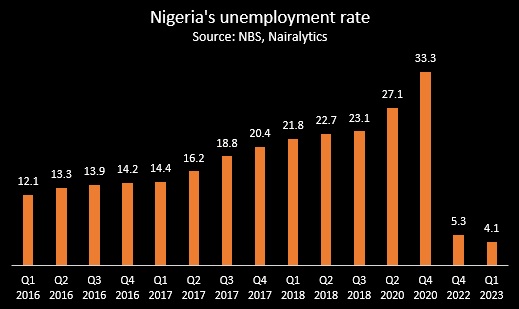
The National Bureau of Statistics (NBS) said Nigeria’s unemployment rate decreased to 4.1 percent during the first quarter (Q1) of 2023, down from the previous quarter’s 5.3 percent.

Back in the fourth quarter (Q4) of 2020, the bureau reported the country’s unemployment rate to be 33.3 percent.

In a statement released on Thursday, the NBS announced that the recent unemployment report employed a new methodology and provided a comprehensive examination of the labor market.

“The latest Nigeria Labour Force Survey (NLFS) report sheds light on the dynamics of labor market within the country,” the statement reads.

“This report covers the fourth quarter of 2022 and the first quarter of 2023, presenting an in-depth analysis of key labor market indicators such as employment, including unemployment rates, underemployment rates, hours worked, and informal employment.

“The revised methodology aligns with our contemporaries in Africa such as Ghana, Niger, Chad, Cameroon, Benin, Gambia etc, in line with international best practices.”

UNEMPLOYMENT RATE MOVED FROM 5.3% to 4.1% IN THREE MONTHS

The latest report from the NBS indicates that Nigeria’s unemployment rate stood at 5.3 percent during Q4 2022 and then declined to 4.1 percent in Q1 2023.

According to the agency, these figures are in line with rates seen in other developing nations where engaging in work, even in low-productivity roles for only a few hours, is vital to sustaining livelihoods, especially in the absence of any social safety nets for the unemployed.

The bureau also stated that the revised methodology now defines employed individuals as those who work for pay or profit and have worked for a minimum of one hour within the past seven days, as opposed to the previous criterion of 40 hours.

“The old methodology placed a range on the working-age population- 15 – 64 years, while considering working hours between 20-39 hours as underemployment, 1-19 hrs as unemployment,” the statement reads.

“In addition, subsistence agriculture and temporary absentees from employment work were not properly represented as well as the absence of mutually exclusiveness of unemployment and employment.

“These improvements, among others, captured in the revised computations will make Nigeria’s Labour Force data comparable with other countries.”

UNDEREMPLOYMENT MOVED FROM 13.7% to 12.2% in THREE MONTHS

The NBS defines the underemployment rate as the proportion of employed individuals working fewer than 40 hours per week while expressing willingness and availability to work more. This rate was recorded at 13.7 percent in Q4 2022 and reduced to 12.2 percent in Q1 2023.

The report highlights that the rate of informal employment, which includes agricultural work among employed Nigerians, was 93.5 percent during Q4 2022 and decreased to 92.6 percent in Q1 2023.

The NBS’s NLFS also indicated that approximately three-quarters of Nigerians within working age were gainfully employed. In Q4 2022, this rate stood at 73.6 percent, and in Q1 2023, it rose to 76.7 percent. This underscores that a majority of individuals were engaged in some form of job, involving at least one hour of work per week for compensation or profit.

Number of Active African Fintech Ventures Jumps 17.7% in Two Years

0

Recent report has revealed that Africa’s Fintech startup ecosystem has been on a growth trajectory, with the number of startups operating in the space increasing by 17.7 percent to 678 in 2023 as compared to 2021.

In the latest edition of Disrupt Africa’s Finnovating for Africa publication, the number of Fintech startups active in Africa increased by 125.2 percent between 2017 and 2023.

The growth is reportedly taking place across the continent, with all major markets such as South Africa, Egypt and Nigeria growing relatively fast. The number of Fintech companies based in these countries have leaped by 66.7 percent and 50 percent respectively over the last two years.

The Fintech space in Africa leads the way for investments, when it comes to both funding and exit activity. A report by Disrupt Africa revealed that since 2015, 540 Fintech startups from 25 countries have raised an extraordinary US$ 3,635,823,965 three times more than any other sector.

Since 2016, total investment per year has been on a fairly steady upward trajectory, and growth has been impressive in the last two years. The number of funded ventures has almost doubled since 2021, and more than US$ 2.7 billion has flooded into the ecosystem in the last 24 months.

Meanwhile, not only are African fintech startups more likely to raise funding than their peers, they are also more likely to be acquired.

Disrupt Africa tracked 26 fintech startup acquisitions between June 2021 and July 2023, compared to just seven between 2019 and 2021, and accounting for over 60 per cent of the 43 such deals reported since 2011.

In 2023, Disrupt Africa identified fintech startups operating across 25 African countries, the same as in 2021. The number of ventures per country ranges from one, in places such as Algeria, Burkina Faso and Mali, to 217 in Nigeria, which over the last couple of years has overtaken South Africa to become Africa’s most fintech-populated country.

South Africa has been for a long time being the most populated market, but has now fallen to second with 140 ventures. This accounted for 20.6 percent of Africa’s 678 fintech startups, behind Nigeria’s 217 ventures of 32 percent.

Kenya falls in third place with 102 companies in operation, 15 percent of the total. It is worth noting that 459 (67.7%) of Africa’s fintechs are located in either Nigeria, South Africa or Kenya, a percentage share that barely differs from a 67.9 per cent share in 2021 and 65.2 percent in 2019.

The share of Fintech activity contributed by the “big three” markets of South Africa, Nigeria and Kenya maintained its 2021 levels, with 459 (67.7%) of the startups tracked.

Notably, there were three new fintech markets to emerge for the first time in the 2023 edition of this report, which are Burkina Faso, Lesotho and Namibia.

While clearly levels of activity hugely differ, with different ecosystems at vastly different points in their lifecycle, fintech has certainly infiltrated markets across the continent, and is changing financial markets and boosting access to financial services.