DD
MM
YYYY

PAGES

DD
MM
YYYY

spot_img

PAGES

Home Blog Page 3879

AfriLabs Expands to Eswatini And Five New African Cities to Nurture And Support Innovative Ecosystems

0
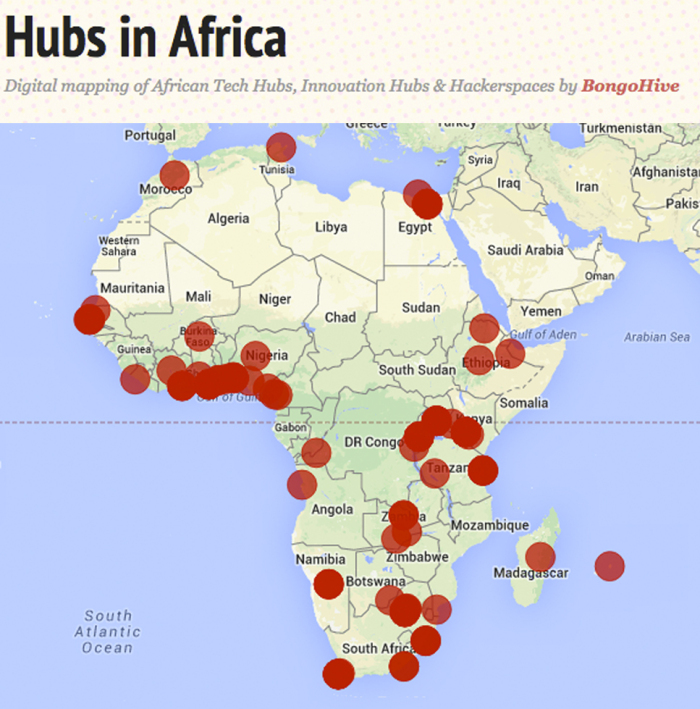
Figure 4.1: Regional Distribution of Innovation Spaces in Africa (Sources: AfriLabs, Africa.co, Tekedia, BongoHive Zambia, Fab Foundation). Please note this may not be comprehensive as new ones are emerging regularly.

AfriLabs, a pan-African network of innovation hubs and technology centers that support startups, entrepreneurs, and innovators across the African continent, has expanded to a new country, Eswatini, and five new African cities. These cities include Zanzibar, Ota, Matsapha, Musanze, and Baidoa.

AfriLabs’ latest expansion heralds exciting new opportunities for Africa’s digital economy, as expanding its reach will strengthen its efforts to achieve a digitalized Africa by 2030, as they continue to connect hub members to a network of other stakeholders.

For AfriLabs, one major goal of the pan-African network is to improve the local African innovation ecosystems by providing better support for the creation of investment-worthy digital startups and businesses.

AfriLabs Director of Community, Mayssa Mrabet has expressed optimism about the impact of the expansion. In her words, “We will continue nurturing, supporting, and celebrating innovative ecosystems across the continent. This is a major step towards our goal of achieving a digitalized Africa by 2030”.

Also speaking on AfriLabs expansion, the founder and CEO of Eureka Geo in Cameroon, Mely Monique said,

“Becoming a member of AfriLabs is a unique chance for us to be part of the African digital ecosystem and access numerous opportunities”.

Check Out AfriLabs New hubs

  • Novation City in Morocco
  • Privilege Access in Cameroon
  • Eureka Geo in Cameroon
  • Cube Zanzibar in Tanzania
  • Thousand Hills Hub in Uganda
  • Somaliland Innovation Zone (SIZ) in Somaliland
  • Southwest Innovation Hub in Nigeria
  • Kabarak University Innovation and Business Incubation Center in Kenya
  • Moolu Venture Lab in Nigeria
  • The Stalwart Hub in Ghana
  • Platinum Hub in South Africa
  • Ubulu Africa in Nigeria
  • Hebron Startup Lab in Ghana
  • WAN-Hive Ghana
  • Green Tech Innovation in South Africa
  • Royal Science and Technology Park-Business Incubator (RSTP) in South Africa

AfriLabs expansion is a significant step taken towards the growth and development of the African digital economy, which will help to create a more connected and vibrant innovation ecosystem on the African continent.

Founded in 2011, AfriLabs has made significant contributions to Africa’s digital ecosystem by fostering innovation, supporting startups, and promoting collaboration among various stakeholders in the technology and entrepreneurship sectors.

Some of the key contributions of AfriLabs to Africa’s digital ecosystem include:

  1. Supporting Startup Growth: AfriLabs provides a platform for startups to access resources, mentorship, training, and funding opportunities. By offering a conducive environment for innovation, these startups can develop their ideas and products, leading to the growth of homegrown solutions to local and global challenges.
  2. Networking and Collaboration: AfriLabs connects a diverse network of innovation hubs, co-working spaces, and tech communities across the continent. This connectivity facilitates knowledge sharing, collaboration, and the exchange of best practices among different regions, helping to create a more unified and robust digital ecosystem.
  3. Capacity Building: AfriLabs organizes workshops, training programs, and events that equip entrepreneurs with the skills and knowledge they need to succeed in the tech industry. These capacity-building initiatives contribute to the development of a skilled workforce and promote technology-driven entrepreneurship.
  4. Access to Funding: Through partnerships, events, and programs, AfriLabs provides startups with opportunities to access funding from investors, venture capitalists, and other sources. This financial support is crucial for startups to scale their operations and bring their products to market.
  5. Showcasing African Innovation: AfriLabs showcases African startups and innovations on a global stage, increasing their visibility and promoting a positive image of African technology and entrepreneurship.

Overall, AfriLabs has continued to play a crucial role in catalyzing the growth of Africa’s digital ecosystem by creating a network of support, knowledge sharing, and resources for startups and tech entrepreneurs across the continent.
Nigeria Underperforms in Africa’s GDP Per Capita Ranking; Nigeria 18th, Seychelles 1st

0

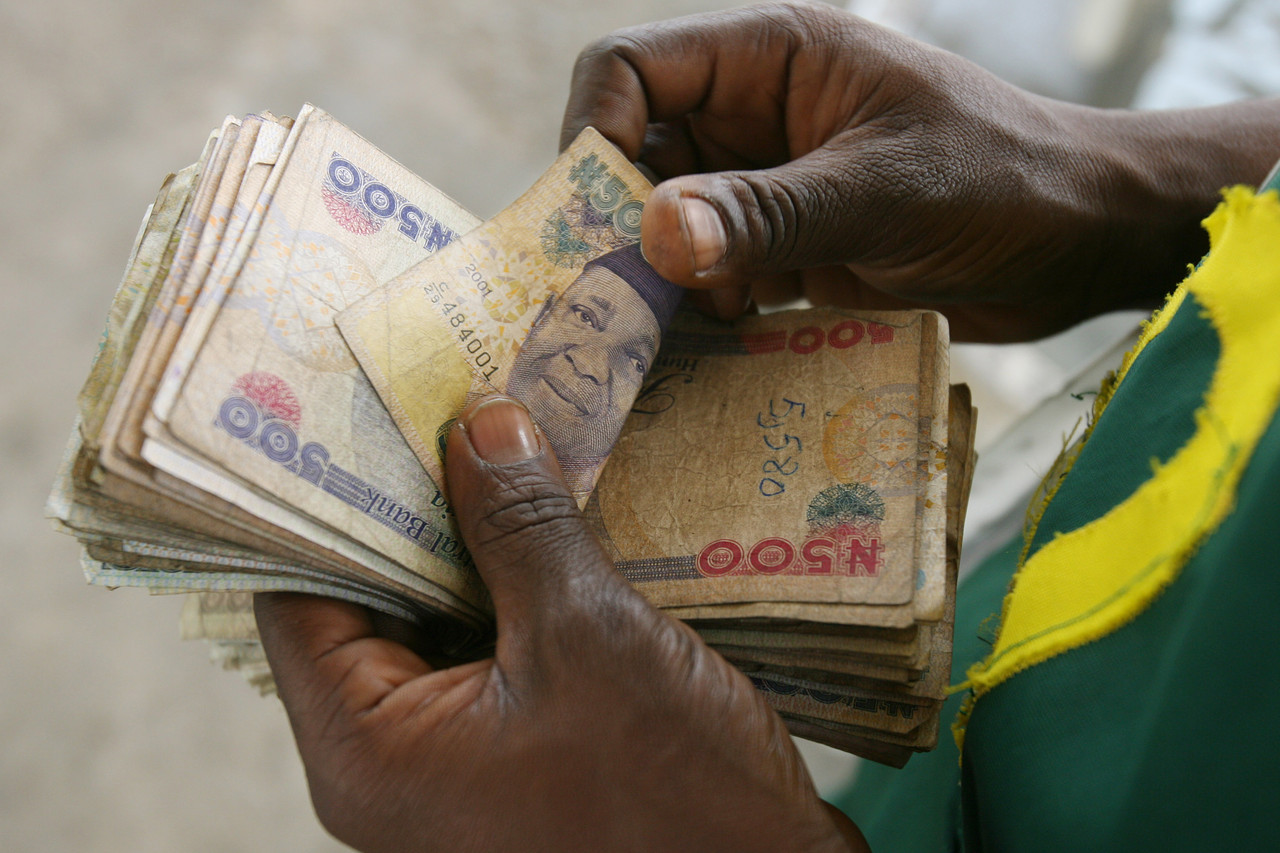
GDP per capita (i.e. gross domestic product divided by total population) is the most efficient way of measuring productivity in economies. It indicates a nation’s standard of living (think of what everyone will get if the whole “wealth” of a nation is shared equally). Here is how Africa stands, using 2022 data, courtesy of Nairametrics:

Africa – $2,705


#1: Seychelles – $15,875

#2: Mauritius – $10,216

#3: Gabon – $8,820

#4: Botswana – $7,738

#5 Equatorial Guinea – $7,053

#6: South Africa – $6,776

#7: Libya – $6,716

#8: Namibia – $4,911

#9: Egypt – $4,295

#10: Algeria – $4,274


#18: Nigeria – $2,184

Indeed, Nigeria is even below the African mean. We’re really a poor country despite what many of us think. Private jets, big suits, etc cannot hide the fact. Conclusion: Nigerians must get to work!

Comment on Feed:

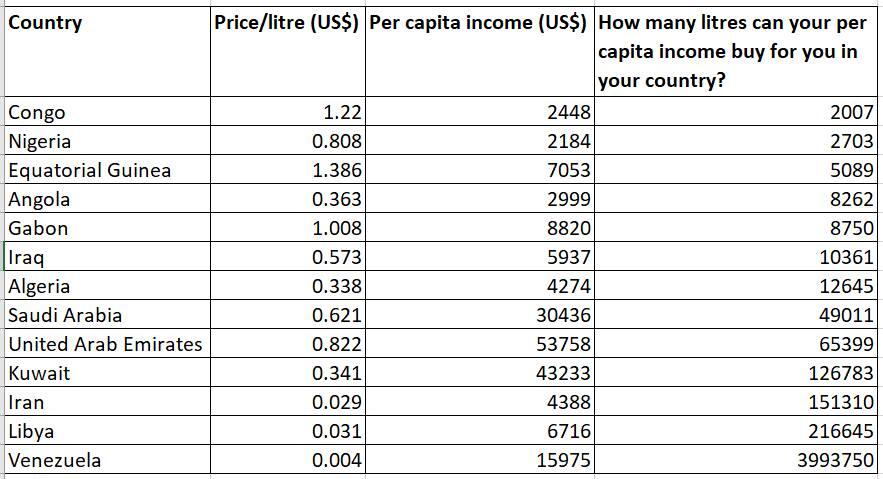
Comment 1A comparison of OPEC countries using price per litre of petrol versus their respective per capita income. Among the 13 OPEC member States, the price per litre of petrol goes from $0.004 in Venezuela to $1.386 in Equatorial Guinea. The per capita income goes from a low of $2184 for Nigeria and a maximum of $53,758 for UAE.

Based on what I would call “petrol access” for people in each of the 13 OPEC countries, I divided the per capita income by the price per litre in each country to get the quantity of petrol or number of litres which the income can purchase.

Congo came out with the lowest of 2007 litres followed by Nigeria with 2703 litres. Venezuela came out with the highest of about 4 million litres. The five countries with the lowest access to petrol (Congo, Nigeria, E.Guinea, Angola, and Gabon) are in sub-Saharan Africa. And from the data, it can be seen that the reason is because of a combination of low income and high price per litre. Libya would have been in the same category if not for its remarkably low price of petrol.

Why do countries in sub-Saharan Africa think it is okay to have high energy prices? High energy prices evidently a major factor that explains the prevalent poverty and low income across sub-Saharan Africa?

Comment 2: Prof … Forgive me … But GDP per capita is not in any way the almighty ,all powerful metric to determine the productivity of an economy or even the health of any Economy.
It is just one among many other parameters that should be assessed all together to know if an Economy is strong , viable and healthy. It is a bit as if you say because someone has headaches , then the person has malaria , which is not the right diagnosis. It could be that the person has overworked , the person thinks too much , the person is constipated ,etc. It could be anything , not only malaria. A typical case is Russia ,which is a strong economy that produces more than it consumes , that has almost zero debt compared to the most indebted country on earth , etc.

Also , African economies are not really evaluated for the simple reason that most businesses in Africa are informal , hence no data to really evaluate our strength. Like I laugh when I hear foreign agencies say Africans live with less than a dollar per day . Lol it can’t even buy yam or tomato , yet we eat.

Why the government is interested in the blockchain community

0

The global market has an impact on the creation of new technology, but this impact can also be destructive to new advancement. The global government is the market, and laws were enacted on their turf without the product being accepted or rejected.

The first and last readings of the bills that brought in so much technological research on how a product or a technology is for global progress or destruction, however, allowed for the passage of this acceptance. There are currently many differences in societal perception, attitude, and domestic acceptability of new products. “Truthfully, the world government controls the world market.”

The value and the policies that led us to believe that the paper bearing the faces of dead people and the writing of numbers indicating what number or currency is money was started by the global government. The paper is usually accepted for use as a payment and other business obligation medium in this introduction. Money currently holds a lot of power.

Even if the manufacturer will not be able to rest due to governmental regulations and consumer attacks on the goods, expectations, and demand from the worldwide market for items are quite high.

Why is blockchain technology so despised by the government?

“Where you invest and embrace is where you benefit,” This reference is well worth reading again since an unidentified person with a healthy brain and a high IQ will invest in a field that is not profitable for him and is growing. The blockchain community errs in this area. Most likely, ongoing Blockchain education from various fields and perspectives has been training those who conduct studies in this area. Binance, CoinmarketCap, CoinGecko, and others are among them.
There are currently high expectations for the global space program, which is why certain nations have rejected the technology.

Blockchain technology is a fantastic system to learn about and it offers a terrific way to speed up financial transactions and payments, both legally and illegally, that were created under computer control. The sender and the receiver are the only parties required to provide an explanation of what actually transpired in this decentralized transaction mechanism, which is simply known as an anonymous transaction.

The international government has no control over or knowledge of what is going on in this area. Because it differs from native banks, where everything is centralized and under the jurisdiction of the local government, blockchain technology is not profitable to the global government. The government is better equipped to control the nation’s financial institutions thanks to their centralized nature, which is 100% manipulable at any time. Implementing taxes, laws, and other legislative measures to control and manage the wealth of her citizens.
“The government does not benefit from Blockchain Technology,” is where the hostility erupted and governmental attacks are intense

Why does the government employ the deceptive phrase “Is a massive destruction to financial institutions on the people”?

This technique was developed in response to the restrictions on international transactions. Not only that but blockchain technology was actually created by governmental policies on payment and tax regulations. Well, if you don’t know, anonymous peer-to-peer transactions on the Dark Web are where Blockchain technology was born. Satoshi finished the history up to that point, which caused this technology to rapidly advance in tandem.

The government uses a brief history of how this technology came into existence as a hook to convince the populace to oppose progress and development. Web 1.0 was rejected by the so-called world government because it would “destroy the world population,” according to their reasoning.

The purpose of the bait was to mislead people into rejecting Blockchain technology as well as to manage and influence her financial situation. However, mistakes made in the Blockchain area including scams, difficult pull, money wasted, and unidentified developers seriously endanger the public and lead them to believe in the world government. Yes, that is accurate to state, since more and more educational resources from the blockchain field are sought after as the technology advances and allows users to explore without fear.

KYC Was Introduced

They claim that the implementation of KYC was made in order to find users and by-products to understand their customers because the government couldn’t defeat them. For futures trading, spot trading, and asset management, a centralized exchange was built through research and development. Similar restrictions and rules were created for local financial institutions. Since the decentralized genesis of the technology appears to be detrimental to users, centralized exchanges serve as the native global financial institution in blockchain technology.

However, when Blockchain technology advanced, it became far more secure, running as a chain under computer control and printing out secret phrases and private keys that the user acquired when creating an account or wallet. By using these terms, the user takes responsibility for anything that occurs to them. Even in our local financial institution, there have been instances of theft or unreported financial errors that were not the fault of the individual, but the local bank was unable to resolve the issue. We all know that their top responsibility is to defend the interests of the clients, but given what I see going on in my neighborhood every day, I find it painful to use a local financial institution.

Network problems, transaction restrictions, tax increases, and different users using the same phone number to receive bank alerts are all factors. Perhaps the problem is not with the local banks, but rather with the communication network. “My brother gets a notification whenever another user withdraws” Good day, Access Bank.

Rather than their personal benefit, the authorities did not expect much from blockchain technology

The international government expected the blockchain community to provide open centralized and decentralized education that improves and enables people to use and understand blockchain technology in a private and public manner.

The government’s attitude toward embracing new technology will change with the introduction of free educational learning to native and online schools, especially native centralized and decentralized schools focusing on urban and rural development. This is due to the clear and significant contribution that education enables to people’s growth.

Knowledge, study and a shift in perspective promote growth and progress. But ignorance or a lack of education jeopardizes user development, which leads to the user rejecting and despising new products and technologies.

A system with central control over education is called centralized. The government is referred to in the latter. School boards are allowed complete autonomy in the management of their institutions at the decentralized level. In a centralized system, school boards are contractually required to adhere strictly to governmental requirements. Not all users of modern technology, particularly new technology, are knowledgeable. If this concept were to be put into practice, I believe that Blockchain will unquestionably be accepted by most people as a form of exchange similar to money.

To Conclusion

Whether on a formal or informal level, learning is an ongoing assessment that must happen. Beyond its own interests, the government expects blockchain technology to defend the riches of its citizens. Additionally, for the banking institution’s protection. The world has to be introduced to a new, big blockchain education initiative that will undoubtedly lead the way for centralized and decentralized schools in both urban and rural areas.

Since blockchain technology is the future, let’s embrace the new system this time around and profit from it. “Is here to stay and the future is now, embrace the new system”.

Nigerian Banks Lose N9.5 Billion to Electronic Fraud in The First Eight Months of 2023

0

Banks in Nigeria have reportedly lost a whopping sum of N9.5 billion to electronic fraud in the first Eight (8) months of 2023.

This was reported by the Managing Director of the Nigeria Inter-Bank Settlement System (NIBSS) Premier Oiwoh, at the Nigeria Electronic Fraud Forum (NEFF) third-quarter general meeting held in Lagos on Friday. The meeting was focused on the theme “New Strategies for Combating e-Fraud in a cashless environment”.

Speaking at the meeting, NIBSS Managing Director, Premier Oiwoh, who was represented by Chief Risk Officer at NIBSS, Temidayo Adekanye expressed concerns at the dramatic increase of electronic fraud in the country, following the Central Bank of Nigeria (CBN) gradual transition to a cashless society.

He said,

“Recently, we had the cashless policies from CBN, which was incurring a dramatic increase in the volume of transactions in the industry which variably as the impact of the volume of fraud in the industry itself. Now, the increased efficiency has also meant that fraud has dramatically increased across the industry. For Q1 2023, the total fraud reported through the industry forum portal was N5.1 billion.

“For fraud trends over the last five years, in 2019, we’re looking at about N3 billion and currently 2023, we are looking at about N9.5 billion to date. Fraud losses have increased dramatically over the last five years. So, as you can see also from the current perspective, from January to July 2023, there has been a slight jump between June and July, a 39 percent increase with 8,649 with the actual fraud losses in July 2023, we’re looking at N1.2 billion which is a 54 percent increase over the period.

“Now as you can see from January in general, we recorded about N2.7 billion in actual fraud losses. What we see most is the fact that the primary channels are the betting platforms. So once the money hits the betting platform or a wallet account or in some cases POS agents once it’s cashed out, it is a black hole. There is no way you can recover that money. We’re talking about potentially five percent recovery rates across the industry. So, we all have to identify those betting and wallets accounts, POS agents, cryptocurrency accounts, and in some cases purchases.”

Also speaking at the event, the Chairman of NeFF and Director of Payment Systems Management at the CBN, Musa Jimoh, implored all relevant stakeholders to join hands on deck to combat the increased rates of electronic fraud bedeviling Nigerian banks.

He further stated that the objective is to have zero fraud, but he believes it would be a gradual process to achieve that.

Notably, Electronic fraud in Nigeria has become a major concern in Nigeria, following the CBN’s gradual transition to a cashless society.  As a large percentage of individuals now engage more in online transactions and electronic payments, cybercriminals have then targeted these electronic means, making it easier for them to execute e-fraud schemes.

These criminals go as far as creating fake apps or websites that mimic legitimate payment platforms to steal users’ credentials and financial information. Following Nigeria’s transition to a cashless society, people might be more likely to download and use these fraudulent apps, thinking they are legitimate.

To mitigate the risks associated with increased e-fraud in a cashless environment, the government, financial institutions, and individuals need to take proactive measures. This includes Education and Awareness, Strong cybersecurity, User Training, Regulations, and Consumer Protection, amongst others.

While the move towards a cashless society can bring many benefits, addressing the potential rise in -fraud requires a multifaceted approach.

Best Altcoins for 2023: Dogecoin (DOGE), Hedera (HBAR) and Pomerdoge (POMD)

0

When trading cryptocurrencies, a diversified portfolio can help investors reduce their risk and get higher profits as a result. Investors will typically look at the best-performing altcoins and choose them as the next investment or trading opportunity. According to analysts, for 2023 so far, Dogecoin (DOGE), Hedera (HBAR), and Pomerdoge (POMD) represent some of the best investment opportunities.

Summary

  • Dogecoin will climb to $0.098 by the end of the year
  • Hedera to climb to $0.065 by the end of 2023
  • Pomerdoge will climb 17x at launch

Click Here To Find Out More About The Pomerdoge (POMD) Presale

Dogecoin (DOGE) Price Forecast

Dogecoin (DOGE) is the ninth largest cryptocurrency in terms of market cap. It was originally released as a joke on December 6, 2023, and paved the way for other altcoins to follow.

Moreover, as of August 17, 2023, the Dogecoin crypto trades at $0.066893. During the past week, the lowest point of value for the altcoin was at $0.066834, while its highest point was at $0.077145. Moreover, Dogecoin has a market cap of $9,552,170,529 and a 24-hour trading volume of $524,146,711.

While the most recent weekly performance it’s been in the red zone, with a decrease of 9.9% in the past week, analysts believe that a breakout will happen after $0.08. Based on the Dogecoin price prediction, it can reach $0.098 by the end of the year.

Hedera (HBAR) Future Outlook

The Hedera (HBAR) cryptocurrency has been dominating the charts so far in August of 2023. Specifically, the cryptocurrency is up 14.6% in the past month and by 13.7% in the past week. As of August 17, the Hedera crypto trades at $0.060937. During the past week, it saw its lowest point at $0.055844, with its highest point at $0.073749.

With a market cap of $2,003,019,291 and a 24-hour trading volume of $135,474,335, the Hedera crypto ranks 31st on the top 100 crypto list. Based on this, according to the Hedera price prediction, it can surge to $0.065 by the end of the year.

Pomerdoge (POMD) Price Prediction for 2023

Both Dogecoin and Hedera have high-growth potential, but according to analysts, Pomerdoge (POMD) can provide the most significant returns in 2023. The project has numerous components that create an ecosystem that values each player’s time.

There’s Pomergame. This is an exciting P2E environment where players are rewarded when they complete activities or level up their Pomer. For example, once they reach Elite Level, they unlock an ability through which they can create custom items for their avatar. Moreover, at the point in time when they reach Gold Status, they are able to enter Pomerplace.

This is the ecosystem’s virtual marketplace in which anyone can buy, sell or trade skins or other valuable items that they’ve collected in-game. However, it also consists of an arena where players compete for the first spot, as the winner takes everything.

Subsequently, a collection of 7,777 NFTs will be released in September, each costing 0.2 ETH. But they will only be available to POMD token holders.

The Pomerdoge (POMD) token trades at $0.008 as of August 17, and the team has sold over 120M  tokens. With this massive momentum in mind, analysts believe the crypto can surge by 17x at launch.

Find out more about the Pomerdoge (POMD) Presale Today

Website: https://pomerdoge.com/

Telegram Community: https://t.me/pomerdoge