DD
MM
YYYY

PAGES

DD
MM
YYYY

spot_img

PAGES

Home Blog Page 388

A Look At Ethereum Foundation’s Latest ETH Sale And Lord Miles Profiting Off Personal Bets

0

The Ethereum Foundation (EF) announced it would convert 1,000 ETH—valued at approximately $4.5 million at the time—to stablecoins using CoW Swap’s Time-Weighted Average Price (TWAP) feature.

This method spreads the sale over time to minimize market impact, aligning with the foundation’s emphasis on DeFi tools and transparency. The proceeds are earmarked for research and development (R&D), community grants, and donations, consistent with the EF’s treasury policy updated in June 2025.

This policy caps annual spending at 15% of holdings and builds a multi-year fiat reserve buffer to ensure financial sustainability amid Ethereum’s growth phase.

This marks the EF’s 17th ETH sale in 2025, following a larger 10,000 ETH conversion announced in September worth $43 million then. Post-sale, the EF holds about 222,720 ETH $1 billion, plus additional assets like wrapped ETH and DAI, totaling a portfolio of roughly $950 million.

Over April–October 2025, cumulative sales have reached ~36,000 ETH $65–72 million, often timed near rallies, which some traders view as a drag on price action despite the modest scale relative to ETH’s $500+ billion market cap.

Proponents praise the transparency and DeFi integration as a model for non-profits, while critics argue it signals weak conviction in ETH’s upside or adds unnecessary sell pressure amid ETF inflows now holding ~10% of circulating ETH.

Historically, EF sales have had limited negative impact—average price change one week post-sale is +1.3%—but timing near highs fuels speculation. As of October 6, ETH trades around $4,500, up 12% from recent lows, with no immediate price dip tied to this announcement.

Lord Miles’ Polymarket Profit from His Own Challenge

YouTuber and adventurer Lord Miles real name: Miles Routledge sparked controversy in September 2025 by allegedly profiting ~$60,000 from betting against his own 40-day water-only fast in the Saudi Arabian desert—a challenge announced on July 4 and turned into a Polymarket prediction market.

The market asked: “Will Lord Miles complete a 40-day fast in the desert by September 13?” with “YES” shares peaking at 70¢ implying 70% odds of success before crashing to near zero after rumors of his death, arrest, or disappearance on September 17 his last stream.

On-chain sleuths, including Coffeezilla and Arkham Intelligence, traced funds from Miles’ known donation wallets to a Polymarket address (0x3DE18B0D551ED1d455B5724494Eff3c73070563F, labeled “MONEYMONEYPLS”). July 5: Miles buys $3,473 in “YES” shares at ~29¢ but sells them two months later for ~$500 profit—missing a later pump to 70¢, which frustrated him.

Arkham Intelligence data on Aug 30–Sep 17: He shifts to $29,500 in “NO” shares at an average 33¢ betting failure, inverse to YES at 66% odds. Post-Sep 17: Market tanks after unverified claims (e.g., coma, death, Saudi jail), yielding $60,000+ profit on the “NO” position as shares hit 99¢.

Some reports inflate the profit to $400,000, linking it to laundered casino funds or bribes via multiple accounts, with $15 million total volume on the market. Miles’ X account now claims he’s in a Saudi jail, but skeptics call it a stunt to rig the outcome, especially after a sponsor (Duel) declared his “death” confirmed.

This isn’t isolated—Polymarket faced U.S. scrutiny in 2022 but relaunched legally in 2025 after acquiring a CFTC-licensed exchange. The scandal highlights prediction markets’ vulnerability to self-manipulation by influencers, eroding trust despite $170B+ in stablecoin liquidity enabling such bets. No formal charges yet, but it could invite regulatory heat on platforms like Polymarket.

Bitcoin Sets New All-Time High, Breaks Past $126k With Record ETF Inflows, and then falls below $123k

0

Bitcoin has set a new all-time high on Monday, surging to $126,200, which has fueled bets on more upside. In early Wednesday, it is trading below $123k.

The milestone surpassed Sunday’s peak of $125,250, pushing Bitcoin mining stocks sharply higher as traders bet on more gains before year-end.

BTC rally comes amid the ongoing political gridlock in Washington, where many U.S. federal employees remain furloughed due to the government shutdown. Lawmakers have yet to pass a stopgap funding measure, leaving agencies such as the Securities and Exchange Commission (SEC) and the Commodity Futures Trading Commission (CFTC) partially inactive.

Prediction markets on platforms like Kalshi and Polymarket suggest that traders expect the shutdown to persist for some time, though not for a historically long duration.

According to Bloomberg, Bitcoin’s recent upward momentum was accompanied by a surge in call option interest targeting $140,000. Jean-David Péquignot, Chief Commercial Officer at Deribit by Coinbase, described the move as the result of “a perfect storm of macroeconomic tailwinds.” He cited factors including the U.S. government shutdown, record spot ETF inflows, and declining exchange reserves as key drivers.

“ETF demand is squeezing supply, while seasonal optimism and geopolitical agitation position BTC as a prime hedge against inflation,” Péquignot explained, noting that technical indicators point to potential price targets between $128,000 and $130,000 by mid-October.

Supporting BTC momentum, U.S. spot Bitcoin ETFs recorded $3.2 billion in inflows last week their second-highest total since debuting in early 2024. Data from SoSoValue showed that on October 6 alone, Bitcoin ETFs attracted $1.19 billion in new investments.

BlackRock’s iShares Bitcoin Trust (IBIT) led the pack with $969 million in inflows, followed by Fidelity’s FBTC with $112 million. Bitwise’s BITB and Grayscale’s GBTC also saw modest inflows of $60.12 million and $30.55 million, respectively.

On-chain analytics further revealed that short-term Bitcoin holder whale investors who purchased BTC within the past 155 days are currently sitting on $10.1 billion in unrealized gains, the highest of the current market cycle. These holders, often considered more reactive to volatility, have played a significant role in amplifying recent price swings.

Bitcoin Analysts’ Projections

Amid the surging price of Bitcoin, several analysts are optimistic about a new high. Billionaire investor Paul Tudor Jones, speaking on CNBC, predicted that Bitcoin could experience a massive rally next year, drawing parallels to the dot-com bubble of 1999.

Juan Leon, Senior Strategist at Bitwise, views Bitcoin’s current trajectory as evidence of its maturing market behavior. He noted that Bitcoin’s volatility is beginning to converge with that of gold, signaling its evolution into a more stable asset class.

Bitcoin emerges as a superior store of value compared to gold

As global economic uncertainty deepens and traditional markets face mounting pressure, Bitcoin is increasingly being viewed as a superior store of value compared to gold.

Once seen as a speculative asset, the world’s leading cryptocurrency is now gaining recognition as “digital gold”, a hedge against inflation, currency debasement, and geopolitical instability.

Matthew Sigel, Head of Digital Assets Research at VanEck, emphasized Bitcoin’s growing appeal among younger investors in emerging markets. According to Sigel, this demographic increasingly views Bitcoin as a superior store of value compared to gold.

The comparison between Bitcoin and gold has intensified throughout the year. Gold climbed above $4,000 per ounce. At the same time, Bitcoin set back-to-back record highs. For many investors, gold still serves as the established hedge. However, Bitcoin’s digital attributes and scarcity are resonating with a younger generation that is more accustomed to digital-native assets.

Future outlook

Bitcoin’s trajectory appears increasingly tied to institutional participation and regulatory clarity in the U.S. Analysts forecast that sustained ETF inflows, coupled with Bitcoin’s fixed supply and growing appeal among younger investors, could propel prices toward $150,000 by early 2026.

As the crypto asset continues to position itself as a digital hedge against inflation and economic instability, it may further cement its role as the preferred store of value for investors, potentially challenging gold’s dominance in the years to come.

Nvidia-OpenAI $100B Partnership Drives AI Infrastructure Revolution

0

Nvidia is in the spotlight again, this time together with OpenAI, with which it has agreed to a partnership. The deal looks very promising, as the graphics accelerator manufacturer is investing about $100 billion in the development of large language models. The funds will be used for the construction of data processing centers with a total capacity of 10 GW. Such a scale is difficult to comprehend, but to put it in perspective, it is comparable to the energy consumption of entire regions and requires infrastructure comparable in cost to several dozen nuclear reactors.

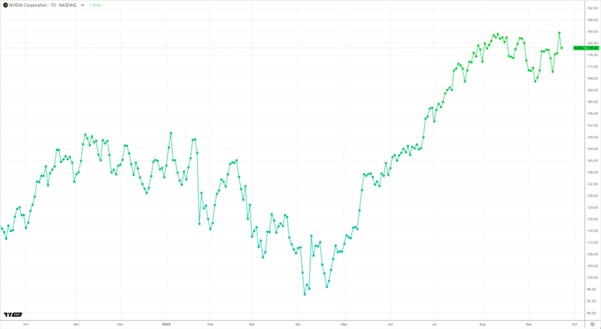
The news immediately impacted Nvidia’s valuation, which at one point exceeded $4.5 trillion, solidifying its position as the world’s most expensive public company. The largest indexes and their derivatives, such as Nasdaq futures, have received a significant boost, as Nvidia’s price growth traditionally pulls up the entire high-tech sector. Additionally, Nvidia’s weight in the S&P 500 exceeds 7%, and any significant movement in its shares can impact the entire trading session.

The Nvidia and OpenAI project is radically changing and reframing the discussion about the future scale of global AI infrastructure. To power a 10 GW data center, more than ten power units of the highest level will be required. To put this in perspective, all Google data centers in 2024 consumed an average of 3.67 GW, which is almost three times less. Already, data centers worldwide consume about 1.5% of global electricity generation, and this share is expected to grow rapidly.

OpenAI previously announced plans to build at least seven data centers with a capacity of 5 GW each. If it succeeds, it will potentially double the energy consumption of the entire state of New York. And, as everyone has long understood, such a scale poses issues of sustainability, diversification of energy sources, and accelerated implementation of nuclear generation for the industry.

Nvidia’s revenue growth over the past year, which has not gone unnoticed, has been accompanied by an increase in its dependence on a rather narrow group of customers. In the last fiscal quarter, 39% of the company’s revenue was provided by only two customers, with the largest accounting for 23%. Nvidia earned a total of $46.7 billion during this period, of which 88% was in the server segment.

It is now becoming clear that investing in OpenAI is only increasing this dependence. Although some of the funds will actually be returned to Nvidia in the form of contracts for the purchase of accelerators, this makes the company both an investor and a key supplier for OpenAI. This concentration creates risks for shareholders, particularly in the event of regulatory changes, the influence of the US government, as well as competitor policies or even potential power outages. For investors seeking stability, such risks often redirect attention toward the US highest dividend stocks, which provide income cushions even during market volatility.

However, the partnership between Nvidia and OpenAI aligns with the overall picture of the technological transformation of the market. Microsoft, Oracle, SoftBank, and other players are already investing in the Stargate megaproject, and Nvidia is becoming its industrial core. At the same time, competition from AMD and cloud providers that are developing their own chips is increasing.

Thus, the Nvidia and OpenAI deal is not only the deal of the century in monetary terms, but also a symbol of a new reality. AI infrastructure continues to evolve into an independent energy and technology sector, the scale of which is comparable to that of traditional industries.

Affiliate Marketing Strategies for Online Casinos

1

Affiliate marketing in online casinos continues to evolve through hybrid and CPA models, blending flexibility with predictable income. This article explores how affiliates can optimize campaigns, leverage cryptocurrency integrations, and use data-driven tools to maximize ROI. A must-read for professionals aiming to scale in the competitive iGaming space.

Understanding Revenue Share Models

Revenue share agreements anchor many casino affiliate programs. Affiliates earn a percentage of net gaming revenue from referred players, typically ranging from 25% to 50%. For instance, certain programs calculate commissions based on player losses after deducting bonuses and operational costs. This structure emphasizes long-term player engagement over one-time sign-ups.

High-performing affiliates, driving over 100 depositing players monthly, often secure rates up to 45%, while smaller-scale affiliates earn around 30%. Industry data shows top affiliates in this model generate $5,000 to $20,000 monthly, depending on traffic sources such as SEO-optimized blogs or social media campaigns. Selecting programs with transparent payout terms ensures stable earnings.

Optimizing Revenue Share Campaigns

To boost revenue share earnings, affiliates prioritize player retention. Strategies involve crafting detailed casino reviews highlighting unique features, for example, game variety or bonus structures. Data indicates content targeting specific player demographics, such as slot enthusiasts, increases retention by 10-15%.

Exploring Hybrid Commission Models

Hybrid commission structures combine revenue share with fixed payments, offering affiliates immediate payouts alongside ongoing earnings. The Coolzino affiliate program exemplifies this model, providing tailored deals through G.Partners to maximize earnings across diverse traffic sources. Key features of the program include:

  • Flexible hybrid deals blending CPA payments of $50 to $200 per qualifying player with 20-30% revenue share, adapting to affiliate performance and traffic quality.
  • Conversion-driven tools, including a 3-deposit welcome package for casino and sports betting, boosting player sign-ups and engagement across multiple verticals.
  • Retention-focused features, such as a 4-tier VIP Loyalty Program and 5-20% cashback on losses with low wagering requirements, extending player lifetime value for higher revenue share earnings.
  • Global reach with support for over 30 countries and multi-language platforms (English variants for Canada, Australia, New Zealand, plus Deutsch, Français, Español, Português, Polski, Italiano), enabling affiliates to target diverse markets.
  • Streamlined registration via G.Partners, with applications reviewed within 24-48 hours, granting immediate access to a dashboard with tracking links and geo-specific creatives.
  • Ethical promotion requirements, prohibiting personal circle promotions and fake traffic, ensuring compliance and sustainable commission flows.
  • Scalable earnings, with affiliates averaging $150 per player in high-conversion regions such as Southeast Asia, driven by competitive sports betting odds and casino offerings.

Tools for Affiliate Tracking

Affiliates rely on tracking tools to monitor performance. Platforms such as Post Affiliate Pro or operator APIs deliver real-time data on click-through rates and player lifetime value. Dashboards provide tracking links, banners, and updated reports, enabling segmentation of casino and sports betting conversions for optimization.

Mobile users, over 65% of casino traffic, drive higher conversions, requiring smartphone-optimized campaigns. Multi-device dashboards support on-the-go monitoring. Affiliates submit traffic details at signup to customize reports, ensuring ethical campaigns. Authentic traffic is enforced, excluding fake accounts, with geo-restriction filters for compliance.

Payments support monthly cycles via bank transfers, VISA, Skrill, Neteller, Bitcoin, or Ethereum. Low thresholds and real-time earnings aid commission adjustments, with responsive support enhancing performance.

Cryptocurrency in Affiliate Programs

Cryptocurrency integration has reshaped casino affiliate marketing by enabling fast, low-cost transactions. Programs supporting Bitcoin or Ethereum attract affiliates in regions with banking restrictions. Crypto payouts reduce fees to under 1%, compared to 3-5% for traditional bank transfers.

The crypto casino affiliate program landscape offers up to 50% revenue share on crypto-based bets. Affiliates promote features such as anonymous play and instant withdrawals, appealing to blockchain-savvy users. Crypto-focused programs have seen rapid growth, driven by demand for seamless payment options.

Commission Structures Across Programs

Program Category Revenue Share Range CPA Range Hybrid Availability
Crypto Casinos 30-45% $100-250 Yes
High-Stakes Platforms 25-40% $150-300 Yes
Sportsbook-Integrated 35-50% $50-200 No
VIP Programs 40-50% $200-400 Yes

This table summarizes commission structures across casino affiliate categories, based on aggregated network data. Crypto and VIP programs offer higher payouts but require established traffic sources.

CPA Models: Fixed Payouts for Actions

Cost Per Action (CPA) models deliver fixed payments for specific player actions, for instance, a minimum deposit. Rates typically range from $50 to $300 per player, varying by program and market. Unlike revenue share, CPA focuses on immediate outcomes, appealing to affiliates seeking predictable income.

In competitive markets, CPA dominates due to its quick cash flow. Affiliates must meet strict quality criteria, ensuring players wager a baseline amount post-deposit. Non-compliance, such as fraudulent referrals, leads to withheld payments in about 20% of cases. For deeper insights into cpa marketing, note its emphasis on precision targeting to meet program standards.

Benefits of CPA Structures

CPA models protect affiliates from fluctuations in player behavior. Fixed payouts ensure steady income, even if players win frequently. Analytics from affiliate networks indicate CPA campaigns yield 20-30% higher ROI for affiliates using targeted ads on platforms including native networks or search engines. Success relies on refining audience segments to maintain conversion rates above 5%.

Effective Affiliate Strategies

To succeed, affiliates prioritize programs with reliable tracking and clear terms. Researching payout histories on specialized affiliate forums helps avoid unreliable operators. Diversifying across multiple programs reduces risks from policy changes.

Key strategies include:

  • Targeting niche markets, for instance, crypto enthusiasts or mobile gamers.
  • Creating SEO-optimized content, such as guides on top casino bonuses, to drive 10-20% more organic traffic.
  • Ensuring compliance with regulations, including age verification, to avoid account suspensions.
  • Analyzing campaign data to maintain ROI above industry averages.

Networking at industry events such as iGB Affiliate conferences secures exclusive deals, boosting earnings potential.

Navigating Industry Challenges

Affiliates face obstacles including advertising restrictions on platforms such as Google, pushing reliance on native ads or email campaigns. Compliance with responsible gaming laws adds complexity, with violations risking account bans. Payment delays, averaging 30-45 days in some programs, remain a challenge, though crypto options process within 24 hours.

iGaming Affiliate

Affiliate marketing in the online casino industry offers diverse opportunities through revenue share, CPA, and hybrid models. Success depends on selecting reliable programs, optimizing campaigns for mobile and crypto-savvy audiences, and leveraging data-driven tools to maximize ROI. While challenges like compliance, fraud, and advertising restrictions persist, strategic adaptation and audience-focused content ensure sustainable growth. Ultimately, affiliates who combine ethical promotion, precise targeting, and innovation are best positioned to thrive in this competitive iGaming landscape.

WTO Raises 2025 Global Trade Forecast Amid AI Boom but Warns of Sharp Slowdown in 2026

0

A new World Trade Organization (WTO) report paints a two-sided picture of the global economy — one powered by artificial intelligence exports and another bracing for the chill of rising tariffs.

The trade body’s latest Global Trade Outlook and Statistics, released Tuesday, shows that world trade has found new life in 2025, driven largely by booming demand for AI-related products. But that momentum, the WTO warns, may be short-lived. The organization expects global trade to grow 2.4% this year, more than double its earlier forecast, only to drop sharply to 0.5% in 2026 once the full weight of U.S. President Donald Trump’s tariff regime takes hold.

It’s a rare case of technological optimism clashing head-on with protectionist policy.

The Tariff Trap

The WTO describes 2025 as a year of “front-loaded trade” — a global scramble to ship goods before tariffs bite. The catalyst was Trump’s sweeping tariff expansion in April, which sent shockwaves through supply chains from London to Seoul. Even the U.K., a U.S. ally, has not escaped, with a 10% baseline tariff now slapped on its exports to American markets.

Importers rushed to beat deadlines as a result, giving global trade a temporary boost of 4.9% in the first half of the year. But WTO economists caution that the rush is unsustainable. When tariffs stabilize, they say, the world may face the quiet aftermath of overstocked warehouses and slowing demand.

AI Keeps the Engines Running

The irony, however, is that the same technological forces reshaping economies — AI, automation, and advanced computing — are also propping up trade. According to the WTO, nearly half of the growth in global trade this year has come from AI-related goods like semiconductors, servers, and telecom components.

“Trade growth spanned the digital value chain, from raw silicon and specialty gases to devices powering cloud platforms and AI applications,” the report notes.

Asia, led by China, South Korea, and Taiwan, has been the epicenter of this boom, accounting for nearly two-thirds of all AI-related export growth. The United States, meanwhile, has driven about one-fifth, reflecting the fierce competition between Washington and Beijing for AI supremacy.

That rivalry is increasingly shaping trade patterns. As the U.S. imposes tariffs on Chinese goods, companies have redirected production to Southeast Asia, helping Vietnam, Malaysia, and Indonesia emerge as key players in the AI supply chain.

Cracks Beneath the Surface

Still, the WTO’s tone is far from celebratory. Behind the data lies a fragile recovery, propped up by temporary demand and a narrow slice of high-tech exports. Broader trade in goods and services remains weak, and signs of fatigue are already emerging in major economies.

Services trade, covering areas such as logistics, finance, and travel, is projected to slow from 6.8% in 2024 to 4.6% in 2025, before edging down further to 4.4% in 2026. Manufacturing confidence has dipped across Europe and North America, while consumers face stagnant wages and rising prices.

“The global economy is cooling, and trade growth will cool with it,” the WTO warns.

WTO Director-General Ngozi Okonjo-Iweala sought to strike a balance between realism and resolve. She credited “measured responses” by countries and the explosive potential of AI for helping trade stay afloat this year, but warned against complacency.

“Trade resilience in 2025 is thanks in no small part to the stability provided by the rules-based multilateral trading system. Yet complacency is not an option,” she said.

In her view, the world is at an inflection point — between a new era of digital-led globalization and a retreat into trade nationalism.

“Today’s disruptions to the global trade system are a call to action,” she said. “Nations must reimagine trade and lay a stronger foundation that delivers greater prosperity for people everywhere.”

The bottom line of the WTO’s message is that technology may be fueling trade, but politics is steering it. The world’s ports are humming again, powered by shipments of chips and servers. Yet behind that hum lies a note of uncertainty — one that could soon echo across the global economy once the tariff surge settles and the AI boom cools.