DD
MM
YYYY

PAGES

DD
MM
YYYY

spot_img

PAGES

Home Blog Page 3893

Nigeria’s Inflation Rose to 24.08% in July, Highest in More Than A Decade

0

The consumer price index (CPI), which measures the rate of change in prices of goods and services, rose to 24.08 percent in July 2023; the highest Nigeria has had in more than a decade.

The latest figure, which marks the seventh consecutive increase in the nation’s inflation rates this year, jumped from 22.79% recorded in June, according to the CPI report published by the National Bureau of Statistics (NBS) on Tuesday.

According to the NBS report, the headline inflation rate rose to 24.08 percent in July 2023, relative to that of the previous (June 2023) rate which was 22.79 percent.

“Looking at the movement, the July 2023 headline inflation rate showed an increase of 1.29 percent points when compared to June 2023 headline inflation rate,” NBS said.

“On a year-on-year basis, the headline inflation rate was 4.44 percent points higher compared to the rate recorded in July 2022, which was 19.64 percent.

“This shows that the headline inflation rate (year-on-year basis) increased in July 2023 when compared to the same month in the preceding year (i.e., July 2022).”

Nigeria’s inflation rate had previously touched the 24 percent mark in September 2005, registering at 24.3 percent during that period.

On a month-on-month basis, NBS said the headline inflation rate in July 2023 was 2.89 percent — 0.76 percent higher than the rate recorded in June (2.13 percent).

This means that in July 2023, on average, the general price level was 0.76 percent higher relative to June 2023.

“The percentage change in the average CPI for the twelve-month period ending July 2023, over the average of the CPI for the previous twelve-month period, was 21.92 percent; showing a 5.17 percent increase compared to 16.75 percent recorded in July 2022,” the data body said.

Food inflation jumped to 26.98 percent

The report also said the food inflation rate in July 2023 hit 26.98 percent on a year-on-year basis. This was 4.97 percent points higher relative to the rate recorded in the same month last year.

The rise in the food index, NBS said, was caused by increases in prices of oil and fat, bread and cereals, fish, potatoes, yam and other tubers, fruits, meat, vegetable, milk, cheese, and eggs.

“On a month-on-month basis, the food inflation rate in July 2023 was 3.45 percent, this was 1.06 percent higher compared to the rate recorded in June 2023 (2.40 percent). The rise in food inflation on a month-on-month basis was caused by increases in prices of bread and cereals, potatoes, yam and other tubers, fish, oil, and fat,” the report reads.

“The average annual rate of food inflation for the twelve-month ending July 2023 over the previous twelve-month average was 24.46 percent, which was a 5.71 percent points increase from the average annual rate of change recorded in July 2022 (18.75 percent).”

Food inflation was higher in Lagos, Ondo, and Bayelsa in July

According to NBS, CPI is weighted by consumption expenditure patterns that differ across states and locations.

This means the weight assigned to a particular food or non-food item may differ from state to state making interstate comparisons of consumption baskets inadvisable and potentially misleading.

However, the report shows that Lagos, Ondo, and Kogi residents paid more for food in the period under review.

“In July 2023, food inflation on a year-on-year basis was highest in Kogi (34.53 percent), Lagos (32.52 percent), and Bayelsa (31.31 perecnt), while Jigawa (20.90 perecnt), Sokoto (21.63 percent), and Kebbi (22.45 percent), recorded the slowest rise in food inflation on a year-on-year basis,” NBS said.

The statistics agency said on a month-on-month basis, July 2023 food inflation was highest in Kogi (6.73 percent), Akwa Ibom (5.64 percent), and Bayelsa (4.59 percent), while Taraba (-0.21 percent), Jigawa (0.28 percent), and Yobe (0.90 percent), recorded the slowest rise in inflation.

Google’s N1.2bn Grant Initiative to Nigeria Lauded by Vice President Shettima

0

Nigeria’s Vice President, Kashim Shettima, has commended Google’s N1.2 billion grant initiative, which supports President Bola Tinubu’s administration in its endeavor to create one million jobs.

The Vice President expressed his appreciation on Tuesday during a meeting with executives from Google, a prominent global technology company, at the Presidential Villa. A statement released by Olusola Abiola, Director of Information at the Vice President’s Office, said.

According to the Vice President, the decision to provide a grant of N1.2 billion to bolster the Tinubu administration’s digital jobs project is praiseworthy and sets a valuable example for other companies to follow.

“Let’s think outside the box and create more job opportunities. We need to walk the talk. It is easy to pontificate but very difficult to bring all of the ideas to fruition. I want to assure you, this administration is ready to partner with you.

“Nigeria is ready for business. The President that we have now wants to leave a legacy that Nigerians will be proud of many years after,” the VP said.

Google’s grant came at a time when the youth unemployment rate in Nigeria has risen to 53 percent, underlining the need for the government to create youth empowerment programmes, especially in the area of digital skills.

Nigeria has a teeming population with a vibrant median age of 17.2, one of the youngest in the world. Shettima said there is a unique opportunity to harness the potential of our huge youth population to create millions of jobs in the digital sector.

“We have more English-speaking people than many countries in Africa and beyond. We missed the agricultural age, we missed the industrial age and we are now in the knowledge-driven post-industrial age. We have the potential and a unique opportunity to fill the anticipated global talent deficit.

“Access Bank is doing a lot in terms of digital skills, training 1000 youths in digital skills to create employment opportunities. We are working with Wema Bank, the Bank of Industry and other partners on this project. We are willing to partner with Google, we will work closely with you for the good of our nation,” he said.

The Google delegation comprises Ms. Oluwatamilore Oni, Programme Manager for Google Africa; Mr. Adewolu Adene, Manager of Government Affairs and Public Policy; and Mr. Taiwo Kola-Ogunlade, Manager of Communications and Public Affairs for Google West Africa.

Mr. Olumide Balogun, Director of Google West Africa, expressed the company’s enthusiasm for the Tinubu administration’s ambitious goal of generating one million digital jobs. Google is dedicating more than N1.2 billion in grants to back this initiative.

Balogun elaborated that the company’s program will furnish digital skills to over 20,000 young individuals and women, thereby enhancing their lives and livelihoods. Additionally, the program will facilitate the growth of numerous startups, ultimately leading to the creation of thousands of jobs within the sector.

The Google initiative is made possible by a grant from Google’s philanthropic division, in collaboration with “Mind the Gap,” alongside partnerships with Data Science Nigeria and the Creative Industry Initiative for Africa. This endeavor is in line with President Bola Tinubu’s administration’s commitment to bolstering the involvement of young Nigerians in the digital economy, with a goal of establishing one million digital jobs.

Google Africa’s Director of Government Relations and Public Policy, Mr. Charles Murito, said the company remains committed to investing in digital infrastructure across Africa, noting that digital transformation in the continent can be the driver of the targeted technology jobs.

“Google cannot achieve its vision and objectives if it doesn’t cover Nigeria effectively,” he said, acknowledging the potential in Africa.

Besides Planned Reversal on Fuel Subsidies, Expect a Reversal on Naira Float

0

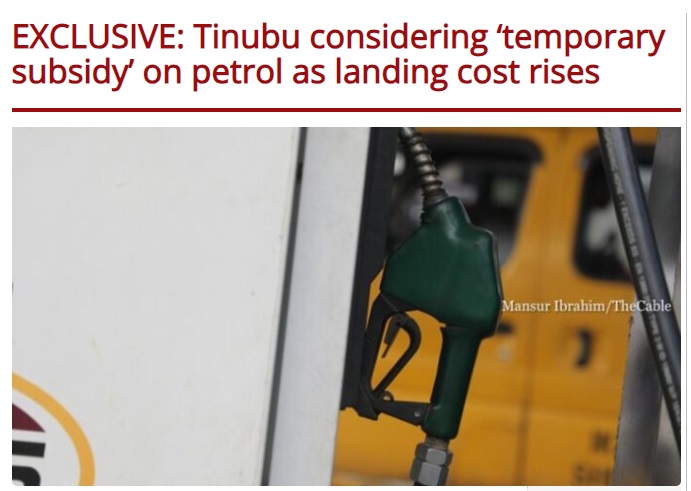
TheCable reports that the Nigerian government is considering bringing back fuel subsidies, temporarily, as the paralysis caused by high energy costs continues to put the nation into a miry clay. In the last five days, I have made that point many times here. Yes, Nigeria must forget the liturgical purity of campaign promises or manifestos and face governing realities.

Also, the nation must also ignore big banks like Morgan Stanley which just put out a report which has no basis on the current state of Nigeria. That report will work in America but has no chance in Nigeria! We must understand that, unlike the United States, the Nigerian government has limited tools to stimulate consumer demand since consumer lending is largely non-existent.

American multinational investment bank and financial services company, Morgan Stanley, has lauded Nigeria’s president, Bola Tinubu’s reforms to reposition Nigeria’s economy, urging for more sound policies.

In the company’s recent advisory report titled “Tales from the Emerging World Nigeria’s New Dawn?”, it hailed the Tinubu-led administration, for several strategic reforms implemented, to recover the dwindling Nigeria economy.

The report began by stating how the previous administration of President Muhammadu Buhari led Nigeria to suffer eight years of stagnation, despite his claims to tackle corruption.

And if that is the case, the correlation between interest rate and consumer behaviour is weak in the short term. Also, a high cost of fuel will have a devastating impact on production, and that will push inflation high, and in a non-credit economy, welfare losses become rampant since people have limited means to borrow, to compensate for the high costs of items.

In the next few weeks, I expect a reversal on the Naira float because that policy cannot work, based on the fundamental principles of economics. Nigeria still has many core tools, and the government must be bold to use them to bring Naira back to a better position. And this should be a lesson: we must be nuanced on policy formulation, and plan better.

Nigerian Government is Reportedly Considering Providing Temporary Fuel Subsidy

Nigerian Government is Reportedly Considering Providing Temporary Fuel Subsidy

0

The Nigerian government is believed to be making plans to provide a new temporary subsidy regime for Premium Motor Spirit (PMS), according to sources in the presidency and moves being made by the government.

Following the report that petrol pump price is going to hit N720 per liter in the coming weeks, the Nigerian National Petroleum Company Limited (NNPCL), announced that it has no plan to increase fuel prices. The NNPCL assured Nigerians that fuel will continue to sell at N588 and N617 across its stations, even though market indices support marketers’ stance that given the continuous drop of the naira in the forex market, the prices will surely go up.

“It is simple mathematics, once the dollar is going up, have it in mind that the prices of petroleum products would definitely increase because the products are dollar-driven,” the National Public Relations Officer, Independent Petroleum Marketers Association of Nigeria, Chief Chinedu Ukadike said.

However, the crux of the matter is that further increase in pump price will push Nigerians, already overburdened by the subsidy removal-induced high cost of living, to their breaking point.

The Nigerian Labour Congress has already threatened to embark on an indefinite strike if the prices of fuel rise again.

Against this backdrop, the federal government is believed to be working on a plan to provide some subsidy to ensure that petrol prices are not raised above where they currently are.

President Bola Tinubu, who announced the removal of fuel subsidy in May, said on Tuesday that petrol prices will not be increased. He however said that he is committed to maintaining competitiveness in the petroleum industry.

During a press briefing at the State House, Ajuri Ngelale, the spokesperson for the President, said that the President is urging all parties involved to maintain a sense of calm and refrain from jumping to hasty judgments in light of recent threats issued by the organized labor movement.

The removal of fuel subsidy has put the government in a very difficult situation, especially as it came along with the deregulation of the FX market, which has seen the naira perform horribly – dropping to N950 against the dollar.

Though Tinubu affirms the continuation of the deregulation policy – asserting Nigeria’s pump prices as the most cost-effective among West African neighbors, his promise that fuel pump prices will not be increased is believed to be backed by a fresh subsidy plan that the NNPCL will execute.

The temporary subsidy, if implemented, will follow the steps of the Kenyan government which has reinstated its subsidy on petrol due to the overwhelming outcry of Kenyans over the soaring cost of living.

According to Al Jazeera, Kenya’s energy regulatory body, the Energy and Petroleum Regulatory Authority (EPRA), announced that oil marketing companies will receive compensation from the Petroleum Development Fund.

The regulator has directed that the uppermost retail cost for a liter of petrol remain steady at 194.68 shillings ($1.35) throughout the upcoming month. This measure aims to protect consumers from a potential rise of 7.33 shillings ($0.05).

It is not yet clear how the Nigerian government intends to implement its own. some believe that the plan includes stabilizing the naira in the FX market and by extension – offering oil importers subsidized FX rates.

Tinubu has called for patience, promising to remain transparent about the issues, including foreign exchange illiquidity due to past mismanagement of the Central Bank of Nigeria.

Beyond IMF’s Previous Recommendations on Fuel Subsidies, FX Unification; Current Realities in Nigeria

1

For years, the IMF has maintained that Nigeria must remove fuel subsidies and also float its Naira currency, for it to advance economically.  Some have gone back to some of those statements as Nigeria has implemented the policies, with some challenging short-term results (could still work in the long-term). I will quote some previous press releases:

Case 1: “The IMF urged the Nigerian authorities to remove fuel subsidies by mid-2023, and to increase well-targeted social spending. The International Monetary Fund (IMF) has urged the Nigerian government to deliver on its commitment to remove fuel subsidies by mid-2023”.

Case 2: “IMF recommends establishing a market-clearing unified exchange rate with the near-term focus on allowing greater flexibility and removing the backlog of requests for foreign exchange.”

But what if I tell you that the IMF is not actually wrong even in the short-term. If you read their reports, they always put something like this: The IMF recommends a “multi-step approach to exchange rate unification and flexibility.” In other words, both the fuel subsidies and exchange rate removals cannot be one-time events, rather, extended and cascaded series of events, before they’re removed. Nigeria’s playbook was different.

This is important because everyone, in the long-term, expects fuel subsidies to go and the Naira floated, as the economy matures. What that long-term means  varies; it could be 2 years, 5 years or 10 years!

But right now, Ndubuisi Ekekwe maintains that fuel subsidy in Nigeria is not a wrong policy; what is wrong is the corruption in Nigeria’s fuel subsidy management. In my position, Nigeria has to reform that process and remove that corruption, and if it does, it can advance economically. In the United States, the US postal service has not made a profit in the last 20 years because it subsidizes the US supply chain to drive productivity in the economy. If you check the top 10 largest economies in the world, more than 80% subsidize energy.

And on floating Naira, it makes no sense since basic economics will always work.  Nigeria does not “produce” enough US dollars even as it needs tons of it. So, if you float it, without fixing that lack of parity, the equilibrium point will shift, and Naira will lose value. 

In AO Lawal’s Economics textbook for secondary schools, he postulated “floating” companies and industries as means towards economic development, as he discussed location and localization of industries, and their associated benefits. Nigeria must focus on floating companies over just Naira, as floating firms provide paths to a sustainable economic future, by improving US dollar supply via exports, and reducing demand for it via local substitution of import.

The IMF recommended a multi-step approach to exchange rate unification and flexibility. While such an approach carries some implementation and credibility risks, it seems appropriate given the need for monetary policy to support the economy and steps needed to move from the current system to a well-functioning exchange rate system. At the same time, it will be crucial to follow through with reforms without delays and not to backtrack, to ensure maximum effect. Likewise, clear and timely communications of the FX strategy to the private sector are also important to instill confidence.

Comment on Feed

Comment 1: Ndubuisi Ekekwe with the recent result posted by CBN, how long can Nigeria subsidize forex?

I read a write-up today that states that about 90% of stock fish produced in Norway is exported to Nigeria market. When we aren’t producing enough, should we spend the little we have on such imports?

We abandoned the important things like Education, Healthcare, etc. to attend to less important things. We don’t even acknowledge that government is subsidizing many of these things. It is their responsibility.

Nigeria economy is very dominant in the west African sub-region. Our subsidy on fuel is a blessing to many of our neigbouring countries. To me it’s a major indicator that as much as we are protecting our economy, we also influence many other countries’ economy. Like you said, how do we remove the corruption of subsidy? I am sure Nigerians will gladly endure a N500 per litre PMS price till the government can sort itself out but unfortunately, nobody can vouch for NNPlc’s calculation of what the landing cost is and thus it has created trust issues.

I hope the forensic auditor to CBN, NNPlc, etc. will conclude its job on time and the ministers will be given portfolio as soon as possible. We need all hands on deck to drive this economy.

My Response: “Ndubuisi Ekekwe with the recent result posted by CBN, how long can Nigeria subsidize forex?”  – Nigeria generates close to $100 billion yearly from crude oil, agro, etc yearly. And we import about the same with refined fuel taking $77 billion. Largely, we should not have a real issue. The problem is “corruption”. Some of these subsidies are not bad if you eliminate corruption. But if you think you do not want to face it, you will bring the house down (the masses) when fighting the issues. If you think any manufacturer will absorb a 4X increase in the cost of energy, I will respectfully argue that you are wrong!

My Response 1: “Nigeria economy is very dominant in the west African sub-region. Our subsidy on fuel is a blessing to many of our neigbouring countries. ” – you made the case. Why not fix your border?

Comment 2:  Ndubuisi Ekekwe , floating the naira is a bad for the Nigerian economy. The IMF should back off IMF policies are evil to our economy. They don’t mean well for us at all. Floating naira when our useless politicians don’t even buy made in Nigeria cars etc. If it continues like this the Naira will be dead. I see the naira going down as low as 1,500 to 2,000 naira to a US dollar before the end of 2023. Mark my words