DD
MM
YYYY

PAGES

DD
MM
YYYY

spot_img

PAGES

Home Blog Page 3925

World is Becoming More Equal and Prosperous Than Ever Before – Report

0
UN has a goal for NO Poverty

This is the main message of a new report by the World Bank, which shows that global poverty has fallen to its lowest level in history, and that income inequality has also declined in many regions. The report, titled “Poverty and Shared Prosperity 2023: Reversing the Inequality Pandemic”, argues that the COVID-19 crisis, while devastating for many people and countries, also created an opportunity for positive change and transformation.

According to the report, the number of people living in extreme poverty, defined as living on less than $1.90 a day, dropped from 10% of the world’s population in 2015 to 7% in 2020, and is projected to fall further to 5% by 2030. This means that more than 700 million people have escaped extreme poverty in the past five years, and that the world is on track to achieve the Sustainable Development Goal of ending extreme poverty by 2030.

The report also finds that income inequality, measured by the Gini coefficient, has decreased in 40 out of 83 countries for which data are available between 2010 and 2020. The global Gini coefficient fell from 0.52 to 0.49 over the same period, indicating that the income gap between the rich and the poor has narrowed.

The report attributes this trend to several factors, such as social protection programs, progressive taxation, investments in health and education, and technological innovations that have increased access to information and opportunities for many people.

The report acknowledges that there are still significant challenges and risks ahead, such as climate change, conflict, fragility, and violence, as well as persistent inequalities based on gender, race, ethnicity, and geography. However, it also highlights the potential for building a more inclusive and sustainable future for everyone, by leveraging the lessons learned from the pandemic and the recovery efforts.

The report argues that reversing the inequality pandemic requires a comprehensive and coordinated approach that addresses both the immediate and the long-term challenges. In the short term, this means scaling up social protection, ensuring universal access to health care and education, supporting the most vulnerable sectors and workers, and strengthening global cooperation and solidarity.

In the long term, this means investing in human capital, promoting fair taxation and fiscal policies, enhancing social mobility and voice, and fostering green and digital transitions that benefit everyone.

The report also highlights the role of data and innovation in advancing the agenda of poverty reduction and shared prosperity. It showcases examples of how new technologies, methods and partnerships can improve the measurement, monitoring and evaluation of poverty and inequality, as well as the design, delivery and impact of policies and programs. It calls for more investment in data systems and capacities, especially in low- and middle-income countries, to ensure that no one is left behind or invisible in the development process.

Poverty and Shared Prosperity 2023: Reversing the Inequality Pandemic is a timely and urgent call to action for a more just and resilient world. It provides a wealth of insights, evidence and recommendations for policymakers, practitioners, researchers, civil society, media and citizens who are committed to ending poverty and building a more equal society for all.

The report calls for more global cooperation and solidarity, more effective and accountable institutions, more human capital development and innovation, and more respect for human rights and environmental sustainability.

The report concludes that the world is not doomed to a fate of rising poverty and inequality, but rather has the opportunity and the responsibility to create a better world for all. It urges policymakers, civil society, private sector, and individuals to take action and make choices that can shape the future we want.

Six Bites, and a bit of Globetrotting as tech news takes us to China, EU, Nigeria, UAE and US.

0

NIGERIA – The ever uncertain position of Nigeria and its CBN

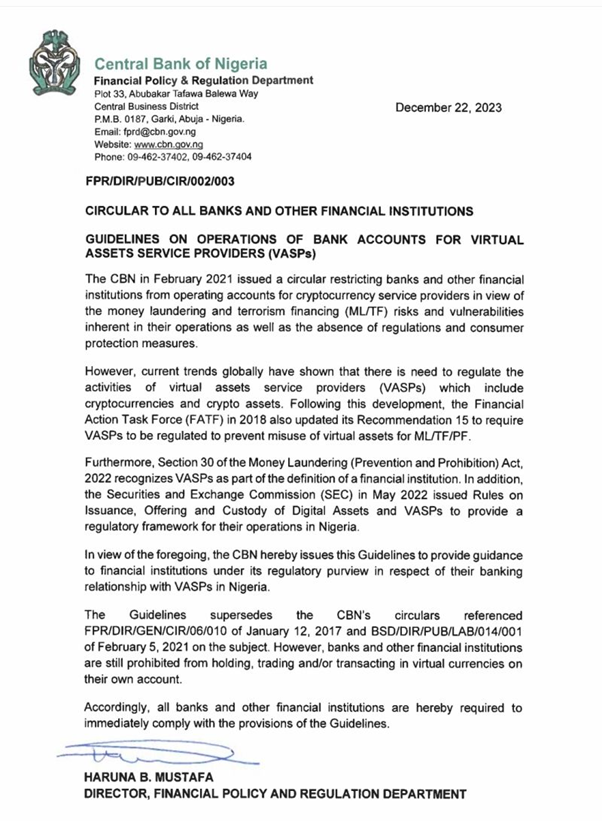
For some time now, the blockchain sector in Nigeria has been lobbying against the circular of February 2021, restricting Banks and other Financial Institutions from operating accounts for cryptocurrency service providers.

In a new circular addressed to banks yesterday (December 22), the CBN acknowledged that the increasing worldwide demand and usage of cryptocurrencies makes the expectations implied in the February 2022 circular directed at financial institutions unsustainable.

Some are taking this as a good sign, in that it will free up the industry to restore it to its former glory, when it was once the top nation globally, in day trades.

Some are not so sure the measure will not become a double-edged sword.

The concern comes from the coining of a new acronym VASPs – Virtual Asset Service Providers.

Much has happened in the blockchain space since February 2021, Cryptopunks were really the only high profile NFA (Non-Fungible Asset) around; the ‘Bored Apes’ didn’t debut until August the same year.

Now, NFAs encompass tokenizing Digital Art, Music, Animations, Web 3 Domains, RWAs (Real World Assets) In-Game Assets, and a wide range of Digital Collectibles.

The circular quite clearly says ‘there is need to regulate the activities of Virtual Asset Service Providers (VASPs), which include Cryptocurrencies and Crypto Assets.’ They also mention ‘custody of Crypto Assets and VASPs’.

It would seem obvious that the complete virtual spectrum of Assets will now be within the scope of the new circular. ‘Custody’ services will also come under the scope, so proof of trade will not be required to ‘qualify’ for CBN ‘attention’.

Many have referred to the 2021 document as ‘The Crypto Ban’, though it needs to be pointed out, both the 2021 and 2022 circulars represent CBN interpretation of existing law(s) and not the creation or repeal of one.

Sole Write-up.

EU –  Discriminative regulatory approach against PoW in the EU

The Open Dialogue Foundation has charged that the EU is adopting a discriminatory approach to PoW (Proof of Work) consensus blockchains in the EU, to the benefit of other (more commercial and centralized) crypto-architectures.

The ODF is seeking support from the public in a European Securities and Markets Authority (ESMA)  consultation entitled:  “Technical Standards specifying certain requirements of Markets in Crypto Assets Regulation (MiCA)”

The article:  ‘Defend PoW: Submission to ESMA’ is written by Lyudmyla Kozlovska and Bota Jardemalie

UAE – The Bite eases for Venom

Venom is a multi-blockchain network consisting of a masterchain (PoS, layer 0), workchains, and shardchains, with its own Virtual Machine. It is based in UAE.

It’s targeting customers who want to establish new products such as NFT marketplaces, derivative exchanges, GameFi, fiat-backed stablecoins, launchpads, and others.

It’s market is focusing on the MENA countries with global aspirations for the future.

In July, Alibek Garcia Isaaev, one of the founders and main investors was involved in legal problems which brought criticism to himself, Venom Blockchain, and its Foundation.

At the time, the media did not treat Issaev kindly and he was serially labelled a “fraudster”; now, he has been cleared of all charges.

Ilya Kligman, a Russian banker has now been found guilty and sentenced to prison in the UAE, being convicted in absentia.

Kligman, currently in Germany, will face extradition to the UAE, and the recovery of multibillion-dollar damages he caused to numerous companies through extortion, blackmail, and obstructing their normal functioning. This includes around a billion due to Isaaev.

Source – Lara on the Block

Buterin has sold tons of Memecoins

Vitalik Buterin recently made a significant transaction involving trillions of meme tokens.

Security and analytics company PeckShield Alerts said a Vitalik labelled wallet address was seen swapping 100,000,000,000,111.111 DOBE tokens worth approximately $22,900 for 10.44 Ethereum tokens (ETH). The wallet also initiated another sale of 1,858,140,000,000 DOJO tokens worth $6800 for 3.12 ETH.

This is on the back of some of his Ethereum crypto wallets becoming short of $29 million between December 15 and 21.

The loss was reported by blockchain analytics service, Arkham Intelligence. The reason was due to crypto market fluctuations which saw Buterin’s wallets losing 5% of the total value of its assets.

Source – Bitcoinist.com

US – CATO Institute slams Bretton Woods Committees’ Call for US CBDC

‘The Cato Institute is a public policy research organization—or think tank—that creates a presence for and promotes libertarian ideas in policy debates. Our mission is to originate, disseminate, and advance solutions based on the principles of individual liberty, limited government, free markets, and peace.’ – from their site.

The Bretton Woods Committee has released a new call for the United States to launch a central bank digital currency, or CBDC. In fact, the report also calls for the Bank for International Settlements (BIS) and the Financial Stability Board (FSB) to take the lead on establishing CBDC rules and standards around the world.

The response article from CATO side came from Nicholas Anthony.

Nicholas Anthony is a policy analyst in the Cato Institute’s Center for Monetary and Financial Alternatives and a fellow at the Human Rights Foundation.

Anthony charges that the Bretton Woods Committee fails to adequately explain why a CBDC is needed.

He also added that it is not a safe assumption to consider central banks more trusted than the private sector (a major plank of the Bretton Woods argument). Pew Research reports that even in the United States, public trust in government is at historic lows.

Likewise, a Cato Institute survey found that 79 percent of Americans trust the private sector to handle their money more than the government.


CHINA – New Regulation sees Tencent shares fall one eighth.

At fairly short notice, Beijing has issued a new set of rules aimed at curbing excessive gaming and spending.

Shenzhen-based Tencent, which owns WeChat and generated over a fifth of its third-quarter revenue from domestic online gaming, saw its shares tumble 12.4% , shaving $43.5 billion off its’ market value. This was its lowest day close  since November 2022.

Other losers on the news, NetEase shares plunged 24.6% while Bilibili shares slid 9.7%.

Source – CNBC

9ja Cosmos is here…

Get your .9jacom and .9javerse Web 3 domains  for $2 at:

.9jacom Domains

.9javerse Domains

Visit 9ja Cosmos LinkedIn Page

Visit 9ja Cosmos Website

Preview our Sino Amazon/Sinosignia releases

EIU Forecasts Over 10% Currency Devaluation for Nigeria, Egypt and other African Economies in 2024

0

The Economic Intelligence Unit (EIU) has projected a challenging outlook for several African economies, predicting a significant depreciation of their domestic currencies in the coming year.

Nigeria, Egypt, Angola, Ethiopia, and Sudan—key players in the region—could experience currency devaluation exceeding 10%, a result of negative macroeconomic factors that continue to exert pressure on their economies.

The EIU’s Africa Outlook 2024 report, titled “Strong growth amid heated elections and financial woes,” highlights the impending double-digit depreciation of the naira, Egyptian pound, kwanza, birr, and Sudanese pound. This forecast amplifies previous warnings, particularly concerning the naira, citing President Bola Tinubu’s implementation of foreign exchange market convergence as a trigger.

The convergence led to the closure of multiple official exchange windows, consolidating trading into the Nigerian Autonomous Foreign Exchange Market (NAFEM) and the black market. However, since its implementation in May, the naira has seen a drastic loss in value, plummeting over 50% on both markets and resulting in severe hardships for Nigerians.

EIU’s November report highlighted the Nigerian central bank’s inability to address the FX demand backlog, a critical factor exacerbating the naira’s decline. This, coupled with unsupportive monetary policies, is expected to sustain pressure on the naira, leaving foreign investors unsettled and the exchange rate regime unstable, potentially leading to periodic devaluations.

“In Nigeria, an unsupportive monetary policy implies that the naira will remain under pressure while the central bank lacks the firepower to adequately supply the market or clear a backlog of foreign exchange orders, which will keep foreign investors unnerved.

“High inflation and a continued spread with the parallel market will leave the exchange rate regime unstable and result in periodic devaluations,” the EIU said.

The EIU’s broader analysis indicates a similar trend across much of Africa, foreseeing various degrees of currency depreciation against the US dollar in 2024, albeit less severe than in 2023. Notably, Southern African economies like South Africa, Namibia, and Botswana, which experienced considerable currency devaluation in 2023, are expected to stabilize their currencies in 2024.

“We forecast currency depreciation against the US dollar across much of Africa in 2024, although adjustments are expected to be less severe than those recorded in 2023,” the unit said.

However, Zimbabwe stands out within Southern Africa, grappling with a struggling local currency that is expected to face further devaluation. The country’s weak economy heavily reliant on the dollar, alongside the potential adoption of digital gold coins in 2024, could exacerbate the devaluation of the Zimbabwean dollar.

Countries tied to the euro, such as those in the CFA franc zone, will witness currency fluctuations based on euro-US dollar movements. The euro’s anticipated strengthening in 2024, supported by economic growth and the euro zone’s current account surplus, might lead to currency appreciation for Central and West African countries using the CFA franc.

The EIU’s forecasts paint a complex picture for African economies, indicating potential challenges and fluctuations in currency values in the year ahead, influenced by both domestic policies and global economic trends.

Uncovering Real Market Catalysts About to Trigger Price Shifts

0
FILE PHOTO: An exterior view of China Evergrande Centre in Hong Kong, China March 26, 2018. REUTERS/Bobby Yip/File Photo/File Photo/File Photo

If you are an investor, trader, or analyst, you know how important it is to identify the factors that can drive the market up or down. These factors are called market catalysts, and they can be anything from earnings reports, economic data, geopolitical events, policy changes, or industry trends. Market catalysts can create opportunities for profit or loss, depending on how you react to them.

But how can you uncover the real market catalysts that are about to trigger price shifts? How can you distinguish between the noise and the signal, the hype and the reality, the rumors and the facts? How can you avoid being caught off guard by unexpected market movements or missing out on lucrative opportunities?

We will share some tips and strategies on how to uncover the real market catalysts that are about to trigger price shifts. We will also provide some examples of recent market catalysts that have had a significant impact on various sectors and assets.

Follow the news and social media.

One of the most obvious ways to uncover market catalysts is to follow the news and social media. These sources can provide timely and relevant information on what is happening in the world and how it may affect the markets. However, not all news and social media sources are reliable or accurate. You need to be careful about what you read and who you trust. You also need to filter out the noise and focus on the signal. Here are some questions to ask yourself when following the news and social media:

  • Is the source credible and reputable? Does it have a track record of providing accurate and unbiased information?

  • Is the information verified and confirmed by other sources? Does it cite reliable data or evidence?

  • Is the information relevant and material to the market? Does it have a direct or indirect impact on the supply or demand of a sector or asset?

  • Is the information new or old? Does it reflect a change or a continuation of the status quo?

  • Is the information expected or unexpected? Does it surprise or confirm the market expectations?

By asking these questions, you can filter out the noise and focus on the signal. You can also avoid falling for fake news, rumors, or speculation that may mislead you or manipulate the market.

Analyze the data and trends.

Another way to uncover market catalysts is to analyze the data and trends. These sources can provide objective and quantitative information on how the market is performing and where it is heading. However, not all data and trends are relevant or meaningful.

You need to be selective about what you look at and how you interpret it. You also need to look beyond the surface and dig deeper into the underlying causes and effects. Here are some questions to ask yourself when analyzing the data and trends:

  • Is the data reliable and consistent? Does it come from a reputable source? Does it match with other data sources?

  • Is the data timely and frequent? Does it reflect the current or past market conditions? Does it capture short-term or long-term trends?

  • Is the data relevant and material to the market? Does it measure a key indicator or variable that affects the market performance?

  • Is the data positive or negative for the market? Does it show an improvement or deterioration of the market conditions?

  • Is the data expected or unexpected? Does it surprise or confirm the market expectations?

By asking these questions, you can select the most relevant and meaningful data and trends. You can also look beyond the surface and dig deeper into the underlying causes and effects.

Monitor the sentiment and behavior

A third way to uncover market catalysts is to monitor the sentiment and behavior of the market participants. These sources can provide subjective and qualitative information on how the market is feeling and acting.

However, not all sentiment and behavior sources are reliable or indicative. You need to be cautious about what you observe and how you use it. You also need to balance the sentiment and behavior with the facts and logic.

Here are some questions to ask yourself when monitoring the sentiment and behavior:

Is the sentiment positive or negative for the market? Does it show optimism or pessimism, confidence or fear, greed or caution?

Is the sentiment extreme or moderate for the market? Does it show euphoria or panic, overconfidence or despair, overbought or oversold?

Is the sentiment consistent or divergent for the market? Does it align with or contradict the facts, data, or trends?

Is the behavior active or passive for the market? Does it show buying or selling, demand or supply, volume or liquidity?

Is the behavior rational or irrational for the market? Does it reflect logic or emotion, fundamentals or technical, value or momentum? By asking these questions, you can monitor the sentiment and behavior of the market participants. You can also balance the sentiment and behavior with the facts and logic.

Examples of recent market catalysts

To illustrate how to uncover market catalysts, let’s look at some examples of recent market catalysts that have had a significant impact on various sectors and assets.

The Omicron variant: In late November 2021, a new variant of the coronavirus, named Omicron, was detected in South Africa and quickly spread to other countries. This was a negative and unexpected market catalyst that triggered a sell-off in global equities, commodities, and cryptocurrencies, as investors feared a resurgence of the pandemic and its economic consequences.

However, the market reaction was also exaggerated and short-lived, as more information emerged about the variant’s transmissibility, severity, and vaccine resistance. The market soon recovered and resumed its upward trend, as investors realized that the variant was not as disruptive as initially feared.

The Fed tapering: In early November 2021, the Federal Reserve announced that it would start reducing its monthly bond purchases by $15 billion, from $120 billion to $105 billion, starting in mid-November.

This was a positive and expected market catalyst that signaled a vote of confidence in the US economic recovery and inflation outlook. It also reduced the uncertainty and speculation about the Fed’s monetary policy stance.

The market welcomed the Fed’s tapering announcement and reacted positively, especially in the US dollar, Treasury yields, and financial stocks, as investors anticipated a gradual normalization of the Fed’s balance sheet and interest rates.

The Evergrande crisis: In mid-September 2021, China’s largest property developer, Evergrande Group, faced a liquidity crisis and defaulted on its debt obligations. This was a negative and unexpected market catalyst that sparked a contagion risk in China’s real estate sector and financial system.

It also raised concerns about China’s economic growth and stability. The market reacted negatively to the Evergrande crisis and sold off risky assets, especially Chinese stocks, bonds, and currencies, as investors feared a hard landing or a systemic collapse in China.

However, the market impact was also limited and temporary, as China’s authorities intervened to contain the crisis and prevent a spillover to the global markets.

We have shared some tips and strategies on how to uncover the real market catalysts that are about to trigger price shifts. We have also provided some examples of recent market catalysts that have had a significant impact on various sectors and assets.

By following these tips and strategies, you can improve your market awareness and analysis skills. You can also enhance your market performance and profitability by reacting appropriately to the market catalysts.

56 countries have over 420 million Cryptocurrencies users

0

The rise of cryptocurrencies has been one of the most remarkable phenomena of the 21st century. From being a niche and obscure technology, they have become a mainstream and widely adopted form of digital money. Today, 56 countries have over 420 million crypto users, according to a recent report by Chainalysis, a blockchain analytics firm.

This is an impressive growth, considering that just a decade ago, there were only a few million people who knew about Bitcoin, the first and most popular cryptocurrency.

But what are the factors behind this rapid adoption? And what are the implications for the global economy and society? we will explore some of the key drivers and challenges of the crypto revolution, as well as some of the opportunities and risks that it presents.

One of the main reasons why cryptocurrencies have gained popularity is their ability to provide fast, cheap and secure transactions across borders. Unlike traditional payment systems, which rely on intermediaries such as banks, credit card companies and governments, cryptocurrencies use a decentralized network of computers, called a blockchain, to verify and record transactions.

This eliminates the need for trust and reduces the costs and delays associated with intermediation. For example, sending money from one country to another using Bitcoin can take minutes and cost a fraction of what it would cost using a bank wire transfer.

Another reason why cryptocurrencies have attracted users is their potential to offer financial inclusion and empowerment. Many people around the world lack access to basic financial services, such as bank accounts, loans and insurance. This limits their ability to save, invest and participate in the formal economy.

Cryptocurrencies can provide an alternative way for these people to access and control their own money, without relying on third parties or facing discrimination or censorship. For example, in countries with high inflation or political instability, such as Venezuela or Zimbabwe, cryptocurrencies can offer a more stable and reliable store of value than the local currency.

However, cryptocurrencies also face significant challenges and risks that could hinder their further adoption and impact. One of these challenges is regulation. While some countries have embraced cryptocurrencies and provided clear and supportive legal frameworks for them, such as Switzerland or Singapore, others have banned or restricted them, such as China or India.

This creates uncertainty and confusion for users, investors and businesses who want to use or offer crypto-related services. Moreover, regulation can also affect the innovation and development of the crypto industry, as it can either foster or stifle its growth.

Another challenge is scalability. As more people use cryptocurrencies, the demand for processing power and storage space increases. This can lead to congestion and high fees on the network, as well as environmental concerns due to the high energy consumption of some cryptocurrencies, such as Bitcoin.

To address this issue, various solutions have been proposed or implemented, such as increasing the block size, using second-layer protocols or switching to more efficient consensus mechanisms. However, these solutions also involve trade-offs between security, decentralization and performance.

A third challenge is education and awareness. Despite their popularity, cryptocurrencies are still complex and unfamiliar to many people. They require a certain level of technical knowledge and skills to use them safely and effectively. For example, users need to understand how to store and protect their private keys, which are essentially passwords that grant access to their crypto funds.

If they lose or compromise their keys, they can lose their money irreversibly. Moreover, users need to be aware of the volatility and unpredictability of cryptocurrency prices, which can fluctuate significantly due to various factors, such as supply and demand, news events or market manipulation.

Cryptocurrencies are a revolutionary technology that has transformed the way we think about and use money. They have enabled millions of people around the world to access faster, cheaper and more secure transactions, as well as financial inclusion and empowerment.

However, they also face significant challenges and risks that need to be addressed and overcome in order to achieve their full potential and benefit society at large.