DD
MM
YYYY

PAGES

DD
MM
YYYY

spot_img

PAGES

Home Blog Page 3951

The BTC Irony And The Breaking of Bitcoin Worlds

1

The web will likely break into two: US-led and BRICS*-led. And that will also affect every asset built on the web. I posit that Binance will likely fade in North America as more lawsuits emerge, pushing the company to give up the region. Once that is done, Coinbase will become the king of the market. But Binance will be expected to power the BRICS world, anchoring their bitcoin and blockchain categories.

The next financial warfare will be fought on the control of BTC and the US has done everything to make major investors confident, ironically, by going after rogue players, and locking them up. If BlackRock gets the spot BTC ETF approved, expect a new dawn in BTC.

People, when two elephants fight, the grass suffers, they say. But on this one, as the US Department of Justice goes after crypto  criminals, it is validating the sector, because doing that gives those with money to get closer to the game. Remember my piece last year in which I concluded, “Governments need to save Bitcoin!”. Today, the government has arrived, cleaning the sector, and if that continues, major players will arrive!

But there is a caution: choose your exchange strategically because the sector will soon break into US-led and BRICS-led domains very soon, and that can affect access to your funds if care is not taken.

*BRICS: Brazil, Russia, India, China and South Africa, plus.

Bitcoin hovered around $41,000 on Monday after briefly topping $42,000 earlier in the day for the first time since April 2022, pushing the cryptocurrency closer to its biggest yearly gain since 2020. Industry “optimists” suggest that the recent U.S. crackdown on crypto — including legal actions against the founders of FTX and Binance— has investors feeling more confident. Another potential factor behind Bitcoin’s boom: the first U.S. spot Bitcoin ETFs, which are expected to be approved by the Securities & Exchange Commission early next year. The cryptocurrency’s growth in 2023 has outpaced more traditional assets such as gold. Despite its $4 billion settlement with the Justice Department last month, Binance is still battling the SEC over a lawsuit the regulatory agency brought in June. (LinkedIn News)

BlackRock Re-submits Spot Bitcoin ETF Application, as Itau Unibanco Bank Launches BTC and Crypto trading in Brazil

0

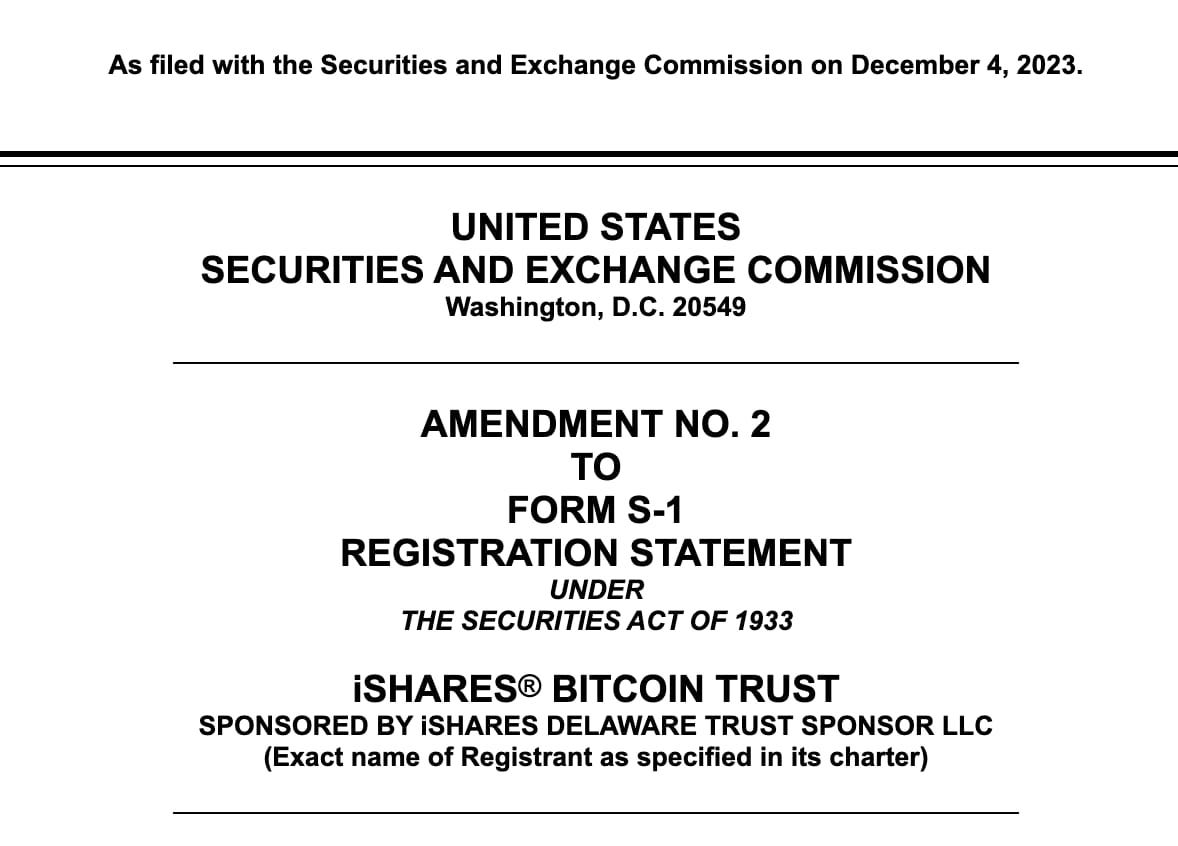
BlackRock, the world’s largest asset manager, has submitted a revised version of its spot Bitcoin ETF proposal to the U.S. Securities and Exchange Commission (SEC). The updated filing, dated December 4, 2023, indicates that BlackRock intends to offer an exchange-traded fund that will invest directly in Bitcoin, rather than through futures contracts or other derivatives. This would make it the first spot Bitcoin ETF in the U.S., if approved by the SEC.

The filing states that the BlackRock Bitcoin ETF will seek to track the performance of the Bloomberg Galaxy Bitcoin Index, a benchmark that measures the price of Bitcoin based on data from multiple exchanges. The fund will use a custodian to hold the Bitcoin on behalf of the shareholders and will charge a management fee of 0.75% per year. The fund will also employ various risk management and security measures to protect the investors and comply with the regulatory requirements.

BlackRock, the world’s largest asset manager, has filed an application with the U.S. Securities and Exchange Commission (SEC) to launch a Bitcoin exchange-traded fund (ETF). The proposed fund, named BlackRock Bitcoin ETF, will seek to track the performance of the Bloomberg Galaxy Bitcoin Index, which measures the price movements of Bitcoin based on data from selected cryptocurrency exchanges.

The filing comes amid growing investor interest and demand for exposure to Bitcoin, which has surged more than 300% in 2021 and reached a new all-time high of over $68,000 in November. Bitcoin ETFs are seen as a way to provide easier and cheaper access to the cryptocurrency market, as well as to reduce some of the risks and challenges associated with buying and storing Bitcoin directly.

BlackRock is not the first company to apply for a Bitcoin ETF in the U.S., but it is certainly one of the most influential and reputable ones. The SEC has so far rejected or delayed several applications for Bitcoin ETFs, citing concerns over market manipulation, fraud, and lack of regulation.

However, some analysts believe that the SEC may soon approve a Bitcoin ETF, given the increasing maturity and liquidity of the cryptocurrency market, as well as the regulatory developments in other countries such as Canada and Brazil, where Bitcoin ETFs have already been launched.

If approved, BlackRock Bitcoin ETF could be a game-changer for the cryptocurrency industry, as it would attract more institutional and retail investors to the space, potentially boosting the adoption and value of Bitcoin. It would also enhance BlackRock’s position as a leader and innovator in the asset management industry, as it would be one of the first major firms to offer a Bitcoin ETF to its clients.

The BlackRock Bitcoin ETF is one of several spot Bitcoin ETF applications that are currently pending before the SEC. The regulator has not yet approved any of them, citing concerns about market manipulation, investor protection, and custody issues. However, some analysts believe that the SEC may be more receptive to spot Bitcoin ETFs than futures-based ones, as they would provide more transparency and liquidity to the market.

The firm has also expressed interest in other digital assets, such as stablecoins and central bank digital currencies (CBDCs). In October 2023, BlackRock CEO Larry Fink said that he was “fascinated” by Bitcoin and that he believed it had “a huge role” in the future of finance.

Itau Unibanco Bank launches Bitcoin and crypto trading in Brazil

Brazil’s largest bank, Itau Unibanco, has announced that it will offer its customers the option to buy and sell Bitcoin and other cryptocurrencies through its digital platform. The bank said that it has partnered with US-based crypto exchange Gemini to provide the service, which will be available in the first quarter of 2024.

Itau Unibanco is the first major Brazilian bank to enter the crypto market, following the footsteps of other global financial institutions that have embraced digital assets in recent years. The bank said that it sees crypto as an innovative and disruptive technology that can offer new opportunities for its clients and the Brazilian economy.

The bank’s CEO, Candido Bracher, said in a statement that “We are very excited to launch this initiative, which is aligned with our vision of being a leading digital bank in Latin America. We believe that crypto can play a key role in the future of finance, and we want to offer our customers access to this new asset class in a safe and convenient way.”

Trust Charter with Gemini Exchange

Itau Unibanco, the largest bank in Latin America, has announced a strategic partnership with Gemini Exchange, a leading cryptocurrency platform based in New York. The partnership will enable Itau Unibanco to offer its clients access to the regulated and secure crypto ecosystem of Gemini, as well as to leverage its expertise in digital assets.

According to the press release, Itau Unibanco will apply for a trust charter from the New York State Department of Financial Services (NYDFS), which will allow it to custody and trade cryptocurrencies on behalf of its customers. The bank expects to receive the approval by the end of 2023.

The partnership with Gemini is part of Itau Unibanco’s digital transformation strategy, which aims to provide innovative and diversified solutions for its clients in the fast-changing financial landscape. The bank believes that cryptocurrencies are an important asset class that can offer diversification, hedging, and new opportunities for its customers.

Gemini Exchange, founded by the Winklevoss twins, is one of the most reputable and compliant crypto platforms in the world. It operates under a trust license from NYDFS and adheres to high standards of security, transparency, and regulatory oversight. Gemini also offers a suite of products and services for institutional and retail investors, such as custody, trading, lending, staking, and NFT marketplace.

The partnership between Itau Unibanco and Gemini Exchange is a milestone for the crypto industry, as it marks the first time that a major Latin American bank collaborates with a US-based crypto platform. It also demonstrates the growing interest and adoption of cryptocurrencies among traditional financial institutions and their clients.

The bank said that it will initially offer Bitcoin, Ethereum, Litecoin and Bitcoin Cash trading, and that it plans to expand its crypto portfolio in the future. The bank also said that it will comply with all the regulatory and security requirements for crypto transactions, and that it will use Gemini’s custody and settlement services to ensure the safety of its clients’ funds.

Gemini’s co-founder and CEO, Tyler Winklevoss, said that “We are thrilled to partner with Itau Unibanco, one of the most respected and innovative banks in Latin America. Gemini is committed to building bridges between the traditional and crypto worlds, and we look forward to working with Itau Unibanco to bring the benefits of crypto to millions of Brazilians.”

UK Signs Treaty with Rwanda for Asylum Seeker Deportation Despite Legal Setback

0

The British government, led by Home Secretary James Cleverly, has signed a contentious treaty with Rwanda aimed at deporting asylum seekers, despite the UK’s Supreme Court deeming the deportation scheme illegal.

Prime Minister Rishi Sunak emphasized his commitment to halting illegal migration, highlighting the newly signed treaty with Rwanda as a critical measure in the government’s resolve to decide who enters the UK and the fight against human trafficking by criminal gangs.

“I said I would stop the boats. I meant it,” Sunak said Tuesday.

“We’ve signed a treaty with Rwanda making it clear that it’s us who decides who comes to this country – not criminal gangs.”

The deportation strategy, central to the UK’s migration reduction plan, has faced significant controversy, particularly following the Supreme Court’s ruling that such actions would breach international human rights laws enshrined in domestic legislation.

Seeking to address the court’s concerns, the UK has sought to renegotiate terms with Rwanda, aiming for a binding treaty ensuring asylum seekers sent there by Britain will not face expulsion—a move intended to allay the court’s apprehensions.

For Cleverly, who assumed the role of Home Secretary just three weeks ago, this development marks a pivotal moment under immense pressure from his party and the Prime Minister to deliver on a strategy significantly challenged in the courts.

Cleverly expressed Rwanda’s commitment to refugee rights, pointing to discussions surrounding the signing of the agreement and the collaboration in addressing the global issue of illegal migration.

The treaty’s purpose is to assure the Supreme Court that Rwanda will adhere to legal processes and not repatriate asylum seekers back to their countries of origin, potentially impacting the plan to redirect thousands of asylum seekers, who arrived in the UK without permission, to Rwanda as a deterrent to Channel crossings.

In exchange for this agreement, Rwanda has received an initial payment of £140 million ($180 million) with promises of additional funding for the accommodation and welfare of deported individuals.

About the treaty: Details are sketchy about the plan. However, details made available by Home Office officials, a primary focus of the treaty revolves around preventing “refoulement,” which refers to the act of returning asylum seekers to a country where they might face persecution. The intention behind addressing this issue is to address concerns raised by the Supreme Court’s findings.

This treaty aims to ensure that Rwanda does not repatriate migrants to their home country or another location after they have arrived from the UK. It proposes the establishment of a new appeals process within Rwanda’s high court to consider exceptional cases, such as situations where individuals under this scheme have committed crimes.

The appeals process would involve British and Commonwealth judges, in addition to Rwandan judges, presiding over the hearings. Ultimately, a decision would be reached regarding whether the asylum seeker remains in Rwanda or is sent back to the UK.

For the treaty to have international legal force, it must be ratified by both the UK and Rwandan parliaments.

While this treaty signals progress in Sunak’s immigration reforms, its implementation faces the significant hurdle of gaining approval from the Supreme Court. The Prime Minister on Monday unveiled a five-point plan to reduce legal migration, but he still faces the challenge of gaining parliamentary support should the Court reconsider its earlier ruling for the treaty’s approval.

The controversial approach raises ethical and legal questions, highlighting the complex intersection of immigration policy, human rights considerations, and international cooperation. The outcome of the ongoing legal and political processes will likely shape the future of asylum and migration policies in other countries.

Qatar’s Sovereign Wealth Fund is Considering Investing $500billion in Bitcoin

3

In a surprising move, Qatar’s Sovereign Wealth fund (QSWF) has announced its intention to allocate $500 billion of its assets to Bitcoin, the leading cryptocurrency. This would make QSWF the largest institutional investor in Bitcoin, surpassing MicroStrategy, Tesla and other companies that have embraced the digital asset.

QSWF is one of the world’s largest sovereign wealth funds, with an estimated value of over $300 billion. It was established in 2005 to diversify Qatar’s oil and gas revenues and invest in various sectors, such as real estate, infrastructure, technology and healthcare. QSWF has a long-term vision and a global reach, with investments in more than 40 countries.

According to a press release, QSWF sees Bitcoin as a “strategic asset” that can enhance its portfolio performance and hedge against inflation and currency devaluation. QSWF also believes that Bitcoin has the potential to become a “global reserve currency” that can facilitate cross-border transactions and financial inclusion.

QSWF plans to acquire Bitcoin gradually over the next five years, using a dollar-cost averaging strategy to reduce market volatility and price risk. QSWF will also allocate some of its funds to Bitcoin-related companies and projects, such as exchanges, mining, custody and innovation.

The announcement of QSWF’s interest in Bitcoin has sent shockwaves across the crypto industry and the financial markets. Bitcoin’s price surged to a new all-time high of over $100,000, breaking its previous record of $69,000 set in November 2021. The market capitalization of Bitcoin also surpassed $2 trillion, making it the third-largest asset in the world after gold and the US dollar.

Many analysts and experts have praised QSWF’s decision as a bold and visionary move that will boost Bitcoin’s adoption and legitimacy. They argue that QSWF’s endorsement of Bitcoin will inspire other sovereign wealth funds, central banks and institutional investors to follow suit and allocate a portion of their assets to the cryptocurrency.

Some other large investors in Bitcoin include BlackRock, the world’s largest asset manager with over $9 trillion under management; PayPal, the online payment giant that allows its users to buy, sell and hold Bitcoin; Square, the fintech company led by former cofounder of Twitter Jack Dorsey that has invested $220 million in Bitcoin; and ARK Invest, the innovation-focused investment firm run by Cathie Wood that has bought over $1 billion worth of Bitcoin through its exchange-traded funds.

However, some critics and skeptics have questioned QSWF’s rationale and timing for investing in Bitcoin. They point out that Bitcoin is still a highly volatile and risky asset that is subject to regulatory uncertainty and security breaches. They also warn that QSWF’s massive investment in Bitcoin could create a market imbalance and a liquidity crunch that could destabilize the crypto ecosystem and the global financial system.

The new UK Immigration rules and Implications for Care Workers

0

The UK government has introduced a new points-based immigration system that will take effect from 1 January 2024. The new system aims to attract skilled workers and reduce low-skilled migration, as well as to end free movement of people from the European Union (EU).

Under the new system, anyone who wants to work or study in the UK will need to apply for a visa and meet certain criteria, such as having a job offer from an approved employer, speaking English at a required level, and earning a minimum salary threshold. The points are awarded based on the skills, qualifications, and experience of the applicant, as well as the type and level of the job offer.

The UK new five-point plan to reduce immigration as announced by Home Secretary, James Cleverly.

  1. Care workers will no longer be allowed to come to the UK with dependants.

  2. NHS surcharge to be increased by 66%.

  3. Graduate visa route to be reviewed to prevent abuse.

  4. The minimum salary needed to get a Skilled worker visa to the UK is increasing to $38,700.

  5. Shortage Occupation list to be reformed, with a reduced number of occupations.

The new system will also introduce some changes for EU citizens who want to visit, work, or study in the UK. EU citizens who want to stay in the UK for more than six months will need to apply for a visa, unless they have settled or pre-settled status under the EU Settlement Scheme. EU citizens who want to visit the UK for up to six months will not need a visa, but they will need to have a valid passport and may be asked to show proof of sufficient funds and health insurance.

The new system will not affect Irish citizens, who will continue to have the right to live and work in the UK without a visa. It will also not affect those who already have indefinite leave to remain or enter in the UK, or those who are eligible for British citizenship.

The new system is designed to create a fair and balanced immigration system that supports the UK economy and society, while ensuring that public services and welfare are protected. The government claims that the new system will make it easier for employers to recruit the talent they need, while also encouraging them to invest in training and development of the domestic workforce.

However, some critics argue that the new system will create barriers and bureaucracy for migrants and employers, and that it will not address the labour shortages in some sectors, such as health and social care, hospitality, and agriculture. They also warn that the new system will reduce the diversity and cultural richness of the UK, and that it will harm the UK’s relations with its European neighbors and other countries.

The new rules have been welcomed by some business groups and sectors, such as technology, science, and health care, who say they will help fill skills gaps and boost innovation. However, some critics and opposition parties have raised concerns about the impact of the new rules on sectors that rely on low-skilled workers, such as hospitality, agriculture, and social care. They argue that the new rules will create labour shortages, increase costs, and reduce quality of service.

The new rules are part of the UK’s post-Brexit immigration policy, which aims to end the UK’s reliance on cheap foreign labour and to restore public confidence in the immigration system. The government says the new rules will allow the UK to take back control of its borders and to decide who can come to live and work in the country.

Implications of UK Immigration Policy on Care Workers

The UK government has announced a new immigration policy that will affect care workers from overseas. Under the new rules, care workers who want to work in the UK will not be able to bring their family members with them, unless they meet certain criteria. This is a significant change from the previous system, which allowed care workers to come to the UK with their dependants, such as spouses and children.

The government claims that this policy is necessary to reduce the pressure on the public services and the housing market, and to encourage care workers to integrate into the British society. However, critics argue that this policy is unfair and discriminatory, and that it will have negative consequences for the care sector and the people who rely on it.

Care workers play a vital role in providing support and assistance to elderly and disabled people, as well as those with mental health problems and other complex needs. Many care workers come from countries such as India, the Philippines, Romania, and Nigeria, where they have acquired skills and experience that are in high demand in the UK. According to the latest figures from the Office for National Statistics, there are about 1.5 million care workers in the UK, of which 17% are non-British nationals.

The new immigration policy will make it harder for care workers to come to the UK, as they will have to meet stricter requirements, such as having a job offer with a minimum salary of £25,600 per year or having a PhD in a relevant field. Moreover, they will have to leave their family members behind, unless they can prove that they have enough funds to support them, or that their dependants have exceptional circumstances that require them to join them in the UK.

This policy will have a negative impact on both the care workers and the people they care for. For the care workers, it will mean that they will have to face separation from their loved ones, which can cause stress, anxiety, and loneliness.

They will also have to deal with the challenges of adapting to a new culture and environment, without having the support of their family network. For the people they care for, it will mean that they will have less choice and quality of care, as there will be fewer care workers available to meet their needs. They will also lose the benefit of having care workers who can speak their language and understand their culture.

The government should reconsider this policy and recognize the valuable contribution that care workers make to the UK society. Care workers should be treated with respect and dignity and be allowed to come to the UK with their dependants, if they wish to do so. This would not only benefit them personally, but also improve the quality of care for the people they serve.