DD
MM
YYYY

PAGES

DD
MM
YYYY

spot_img

PAGES

Home Blog Page 3953

Goldman Sachs-Backed BNPL Startup ZestMoney Shuts Down Operations

0
The logo for Goldman Sachs is seen on the trading floor at the New York Stock Exchange (NYSE) in New York City, New York, U.S., November 17, 2021. REUTERS/Andrew Kelly/Files

Goldman Sachs-backed Indian Buy Now Pay Later (BNPL) startup ZestMoney, has shut down operations following failure to find a buyer.

The move to shut down the Bengaluru-headquartered startup which was last valued at $450 million, comes after it failed to raise fresh capital from Quona Capital, Omidyar Network India, Flourish Ventures, Zip and Scarlet Capital.

Management at the company in a town hall meeting on December 5, informed employees that it would be shutting down this month, which would see about 150 employees laid off.

Speaking concerning the shutdown of the company, ZestMoney Co-founder Lizzie Chapman said,

“Over the last few weeks, we have done a lot of thinking and it has been hard for us to arrive at this conclusion. We have immense belief and faith in the potential that ZestMoney has. We will also ensure to provide full support to the incoming management team and do everything we can to support them for the next four months to ensure smooth transition”.

The company will retain a legal and finance team to oversee the closure. The decision to shut down operations comes months after the startup founders resigned from their positions, leaving ZestMoney in the hands of a new management, as well as few investors.

Recall that in March this year, Walmart-backed PhonePe, called off its deal to buy ZestMoneg over due diligence concerns. After the deal fell through, ZestMoney laid off 100 employees.

Before it’s shutdown, ZestMoney facilitated Buy Now Pay Later (BNPL) loans by disbursing the purchase amount from lending partner directly to the merchant, allowing the customer to repay the lender in instalments.

Also, it accepted 10,000 online stores and 75,000 physical retail stores, with 17+ million registered users. The platform enabled easy, cardless checkouts with partner merchants, EMIs at 0% interest, no hidden charges, no joining fees, quick paperless approvals, amongst others.

ZestMoney was among a handful of Indian startups that used alternative data points to help build credit profiles on consumers, making them eligible to make their first online purchases. It partnered with registered banks and NBCs to facilitate consumer and personal loans.

India’s low credit card penetration left a majority of the population without traditional credit scores, which banks rely on to evaluate creditworthiness before issuing loans. Furthermore, small loans do not yield significant returns for banks, disincentivizing them from issuing such financial products.

In response, ZestMoney, alongside other emerging startups like Axio and LazyPay, attempted to carve out a niche in a market traditionally dominated by financial giant Bajaj Finance.

The startup’s innovative technology and work to make affordable digital finance accessible led to their selection as a 2020 technology pioneer by the World Economic Forum.

The Evolving Experience of Foreign Students in Russia

0

In recent years, the Russian Federation has pursued the internationalisation of its education sector with the goal of improving its global status and leveraging education as a tool for a sustainable multipolar world. This initiative has not only improved educational quality, but it has also served as a catalyst for altering preconceptions connected with Russia on the international stage.

This is hardly surprising given the country’s rich cultural and historical past, as well as scientific achievements, which place it as a global educational hub. As previously said, Russia’s commitment to education is one of its key foreign policy solutions to a multipolar world in which each participating country gains mutual benefits without jeopardizing its sovereignty.

According to a 2017 study by a team of Russian academics, education is a potent tool for promoting Russian realities, values, and culture among international students. This proactive engagement with the host society promotes a more nuanced perception of Russia, challenging old stereotypes that are spread by the media.

Values and Distinctions

The survey also provides insight into how international students view Russia’s cultural identity. While 27.4% of respondents attributed Russia to the European family of peoples, nearly 59% saw it as a distinct civilization that connected Europe and Asia. This complex understanding adds to a more comprehensive picture of Russia by challenging monolithic perceptions.

What’s interesting is that 72.6% of students who responded to the study acknowledged that Russian society had unique values. Still, more than half of them (54.8%) think these disparities are not that significant. According to this nuanced viewpoint, education in Russia acts as a bridge that enables international students to understand and negotiate local quirks, strengthening their bonds with the host community.

Stereotypes and Global Interest

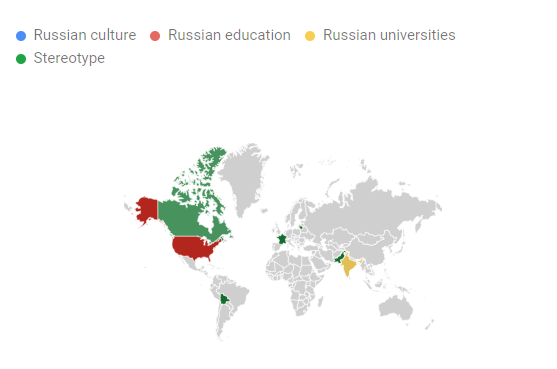
The data (of 5, 668 searches) from January 5, 2020, to November 26, 2023, which represents the global public’s search interest, indicates that people were more interested in stereotypes than in learning about Russian culture (19.54%) when they were trying to figure out how to study abroad and where to study specifically. Analyses show that a significant portion of people are interested in Russian education (24.80%) and Russian universities (26.12%).

Exhibit 1: Countries where searches came from mostly

Source: Google Trends, 2023

There was a favourable relationship between stereotypes and Russian culture at the time. However, preconceptions and Russian education, as well as Russian universities, have a negative relationship. While prejudices may remain, they are actively contested and countered by actual experiences of people involved in Russian education. For example, there are a number of self-reports on social media and in mainstream media from students who have firsthand experience with Russian culture at interpersonal and corporate levels. Unfriendly, humourless, and never smile preconceptions were later proven false by their experiences. In their interactions with our analyst, Russians only believe that smiling happens on purpose and after true relationship has been created. This does not apply when a hilarious scenario occurs in a public area, the students said.

The experiences of foreign students in Russia are helping to dispel outmoded misconceptions and shape a more accurate global picture. As education emerges as a critical component of Russia’s one of the major geopolitical policies for establishing and maintaining multipolarity, it not only attracts talent and investment but also develops cross-cultural understanding. These students’ growing narratives add to a broader conversation that goes beyond stereotypes, underlining Russia’s distinct character, values, and key position in global education.

The BTC Irony And The Breaking of Bitcoin Worlds

1

The web will likely break into two: US-led and BRICS*-led. And that will also affect every asset built on the web. I posit that Binance will likely fade in North America as more lawsuits emerge, pushing the company to give up the region. Once that is done, Coinbase will become the king of the market. But Binance will be expected to power the BRICS world, anchoring their bitcoin and blockchain categories.

The next financial warfare will be fought on the control of BTC and the US has done everything to make major investors confident, ironically, by going after rogue players, and locking them up. If BlackRock gets the spot BTC ETF approved, expect a new dawn in BTC.

People, when two elephants fight, the grass suffers, they say. But on this one, as the US Department of Justice goes after crypto  criminals, it is validating the sector, because doing that gives those with money to get closer to the game. Remember my piece last year in which I concluded, “Governments need to save Bitcoin!”. Today, the government has arrived, cleaning the sector, and if that continues, major players will arrive!

But there is a caution: choose your exchange strategically because the sector will soon break into US-led and BRICS-led domains very soon, and that can affect access to your funds if care is not taken.

*BRICS: Brazil, Russia, India, China and South Africa, plus.

Bitcoin hovered around $41,000 on Monday after briefly topping $42,000 earlier in the day for the first time since April 2022, pushing the cryptocurrency closer to its biggest yearly gain since 2020. Industry “optimists” suggest that the recent U.S. crackdown on crypto — including legal actions against the founders of FTX and Binance— has investors feeling more confident. Another potential factor behind Bitcoin’s boom: the first U.S. spot Bitcoin ETFs, which are expected to be approved by the Securities & Exchange Commission early next year. The cryptocurrency’s growth in 2023 has outpaced more traditional assets such as gold. Despite its $4 billion settlement with the Justice Department last month, Binance is still battling the SEC over a lawsuit the regulatory agency brought in June. (LinkedIn News)

BlackRock Re-submits Spot Bitcoin ETF Application, as Itau Unibanco Bank Launches BTC and Crypto trading in Brazil

0

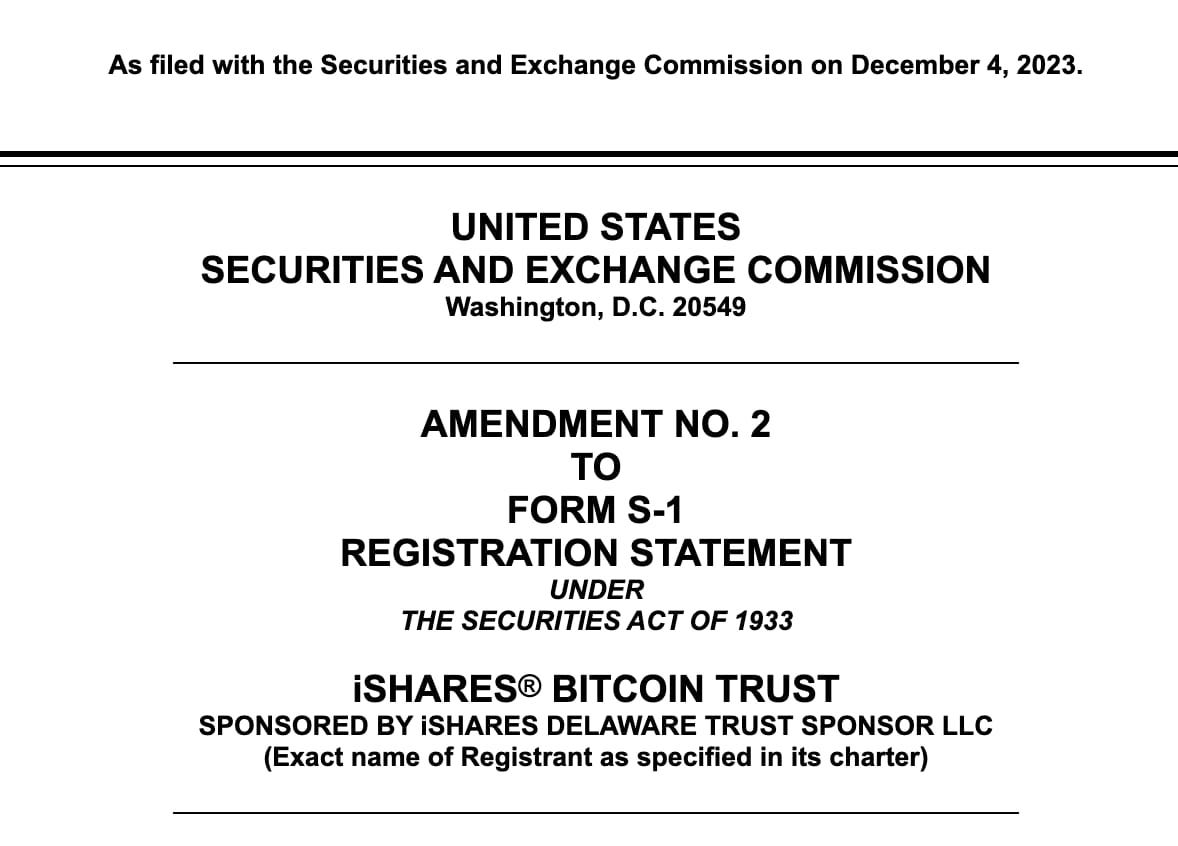
BlackRock, the world’s largest asset manager, has submitted a revised version of its spot Bitcoin ETF proposal to the U.S. Securities and Exchange Commission (SEC). The updated filing, dated December 4, 2023, indicates that BlackRock intends to offer an exchange-traded fund that will invest directly in Bitcoin, rather than through futures contracts or other derivatives. This would make it the first spot Bitcoin ETF in the U.S., if approved by the SEC.

The filing states that the BlackRock Bitcoin ETF will seek to track the performance of the Bloomberg Galaxy Bitcoin Index, a benchmark that measures the price of Bitcoin based on data from multiple exchanges. The fund will use a custodian to hold the Bitcoin on behalf of the shareholders and will charge a management fee of 0.75% per year. The fund will also employ various risk management and security measures to protect the investors and comply with the regulatory requirements.

BlackRock, the world’s largest asset manager, has filed an application with the U.S. Securities and Exchange Commission (SEC) to launch a Bitcoin exchange-traded fund (ETF). The proposed fund, named BlackRock Bitcoin ETF, will seek to track the performance of the Bloomberg Galaxy Bitcoin Index, which measures the price movements of Bitcoin based on data from selected cryptocurrency exchanges.

The filing comes amid growing investor interest and demand for exposure to Bitcoin, which has surged more than 300% in 2021 and reached a new all-time high of over $68,000 in November. Bitcoin ETFs are seen as a way to provide easier and cheaper access to the cryptocurrency market, as well as to reduce some of the risks and challenges associated with buying and storing Bitcoin directly.

BlackRock is not the first company to apply for a Bitcoin ETF in the U.S., but it is certainly one of the most influential and reputable ones. The SEC has so far rejected or delayed several applications for Bitcoin ETFs, citing concerns over market manipulation, fraud, and lack of regulation.

However, some analysts believe that the SEC may soon approve a Bitcoin ETF, given the increasing maturity and liquidity of the cryptocurrency market, as well as the regulatory developments in other countries such as Canada and Brazil, where Bitcoin ETFs have already been launched.

If approved, BlackRock Bitcoin ETF could be a game-changer for the cryptocurrency industry, as it would attract more institutional and retail investors to the space, potentially boosting the adoption and value of Bitcoin. It would also enhance BlackRock’s position as a leader and innovator in the asset management industry, as it would be one of the first major firms to offer a Bitcoin ETF to its clients.

The BlackRock Bitcoin ETF is one of several spot Bitcoin ETF applications that are currently pending before the SEC. The regulator has not yet approved any of them, citing concerns about market manipulation, investor protection, and custody issues. However, some analysts believe that the SEC may be more receptive to spot Bitcoin ETFs than futures-based ones, as they would provide more transparency and liquidity to the market.

The firm has also expressed interest in other digital assets, such as stablecoins and central bank digital currencies (CBDCs). In October 2023, BlackRock CEO Larry Fink said that he was “fascinated” by Bitcoin and that he believed it had “a huge role” in the future of finance.

Itau Unibanco Bank launches Bitcoin and crypto trading in Brazil

Brazil’s largest bank, Itau Unibanco, has announced that it will offer its customers the option to buy and sell Bitcoin and other cryptocurrencies through its digital platform. The bank said that it has partnered with US-based crypto exchange Gemini to provide the service, which will be available in the first quarter of 2024.

Itau Unibanco is the first major Brazilian bank to enter the crypto market, following the footsteps of other global financial institutions that have embraced digital assets in recent years. The bank said that it sees crypto as an innovative and disruptive technology that can offer new opportunities for its clients and the Brazilian economy.

The bank’s CEO, Candido Bracher, said in a statement that “We are very excited to launch this initiative, which is aligned with our vision of being a leading digital bank in Latin America. We believe that crypto can play a key role in the future of finance, and we want to offer our customers access to this new asset class in a safe and convenient way.”

Trust Charter with Gemini Exchange

Itau Unibanco, the largest bank in Latin America, has announced a strategic partnership with Gemini Exchange, a leading cryptocurrency platform based in New York. The partnership will enable Itau Unibanco to offer its clients access to the regulated and secure crypto ecosystem of Gemini, as well as to leverage its expertise in digital assets.

According to the press release, Itau Unibanco will apply for a trust charter from the New York State Department of Financial Services (NYDFS), which will allow it to custody and trade cryptocurrencies on behalf of its customers. The bank expects to receive the approval by the end of 2023.

The partnership with Gemini is part of Itau Unibanco’s digital transformation strategy, which aims to provide innovative and diversified solutions for its clients in the fast-changing financial landscape. The bank believes that cryptocurrencies are an important asset class that can offer diversification, hedging, and new opportunities for its customers.

Gemini Exchange, founded by the Winklevoss twins, is one of the most reputable and compliant crypto platforms in the world. It operates under a trust license from NYDFS and adheres to high standards of security, transparency, and regulatory oversight. Gemini also offers a suite of products and services for institutional and retail investors, such as custody, trading, lending, staking, and NFT marketplace.

The partnership between Itau Unibanco and Gemini Exchange is a milestone for the crypto industry, as it marks the first time that a major Latin American bank collaborates with a US-based crypto platform. It also demonstrates the growing interest and adoption of cryptocurrencies among traditional financial institutions and their clients.

The bank said that it will initially offer Bitcoin, Ethereum, Litecoin and Bitcoin Cash trading, and that it plans to expand its crypto portfolio in the future. The bank also said that it will comply with all the regulatory and security requirements for crypto transactions, and that it will use Gemini’s custody and settlement services to ensure the safety of its clients’ funds.

Gemini’s co-founder and CEO, Tyler Winklevoss, said that “We are thrilled to partner with Itau Unibanco, one of the most respected and innovative banks in Latin America. Gemini is committed to building bridges between the traditional and crypto worlds, and we look forward to working with Itau Unibanco to bring the benefits of crypto to millions of Brazilians.”

UK Signs Treaty with Rwanda for Asylum Seeker Deportation Despite Legal Setback

0

The British government, led by Home Secretary James Cleverly, has signed a contentious treaty with Rwanda aimed at deporting asylum seekers, despite the UK’s Supreme Court deeming the deportation scheme illegal.

Prime Minister Rishi Sunak emphasized his commitment to halting illegal migration, highlighting the newly signed treaty with Rwanda as a critical measure in the government’s resolve to decide who enters the UK and the fight against human trafficking by criminal gangs.

“I said I would stop the boats. I meant it,” Sunak said Tuesday.

“We’ve signed a treaty with Rwanda making it clear that it’s us who decides who comes to this country – not criminal gangs.”

The deportation strategy, central to the UK’s migration reduction plan, has faced significant controversy, particularly following the Supreme Court’s ruling that such actions would breach international human rights laws enshrined in domestic legislation.

Seeking to address the court’s concerns, the UK has sought to renegotiate terms with Rwanda, aiming for a binding treaty ensuring asylum seekers sent there by Britain will not face expulsion—a move intended to allay the court’s apprehensions.

For Cleverly, who assumed the role of Home Secretary just three weeks ago, this development marks a pivotal moment under immense pressure from his party and the Prime Minister to deliver on a strategy significantly challenged in the courts.

Cleverly expressed Rwanda’s commitment to refugee rights, pointing to discussions surrounding the signing of the agreement and the collaboration in addressing the global issue of illegal migration.

The treaty’s purpose is to assure the Supreme Court that Rwanda will adhere to legal processes and not repatriate asylum seekers back to their countries of origin, potentially impacting the plan to redirect thousands of asylum seekers, who arrived in the UK without permission, to Rwanda as a deterrent to Channel crossings.

In exchange for this agreement, Rwanda has received an initial payment of £140 million ($180 million) with promises of additional funding for the accommodation and welfare of deported individuals.

About the treaty: Details are sketchy about the plan. However, details made available by Home Office officials, a primary focus of the treaty revolves around preventing “refoulement,” which refers to the act of returning asylum seekers to a country where they might face persecution. The intention behind addressing this issue is to address concerns raised by the Supreme Court’s findings.

This treaty aims to ensure that Rwanda does not repatriate migrants to their home country or another location after they have arrived from the UK. It proposes the establishment of a new appeals process within Rwanda’s high court to consider exceptional cases, such as situations where individuals under this scheme have committed crimes.

The appeals process would involve British and Commonwealth judges, in addition to Rwandan judges, presiding over the hearings. Ultimately, a decision would be reached regarding whether the asylum seeker remains in Rwanda or is sent back to the UK.

For the treaty to have international legal force, it must be ratified by both the UK and Rwandan parliaments.

While this treaty signals progress in Sunak’s immigration reforms, its implementation faces the significant hurdle of gaining approval from the Supreme Court. The Prime Minister on Monday unveiled a five-point plan to reduce legal migration, but he still faces the challenge of gaining parliamentary support should the Court reconsider its earlier ruling for the treaty’s approval.

The controversial approach raises ethical and legal questions, highlighting the complex intersection of immigration policy, human rights considerations, and international cooperation. The outcome of the ongoing legal and political processes will likely shape the future of asylum and migration policies in other countries.