DD
MM
YYYY

PAGES

DD
MM
YYYY

spot_img

PAGES

Home Blog Page 3955

The Political Economy of Action and Participatory Research

0

In the realm of knowledge production, two powerful research approaches, Action Research (AR) and Participatory Research (PR), have emerged as transformative methodologies. Rooted in the scientific method, these approaches enable researchers to tackle societal challenges by actively involving stakeholders, addressing real-world problems, and fostering collaboration. This piece focuses on the political economy underlying these methodologies, shedding light on their potential to revolutionize how we generate knowledge and drive positive change.

At the core of both AR and PR lies a political economy that centers on inclusivity, power dynamics, and democratizing knowledge. Both approaches challenge traditional top-down research models, aiming to dismantle the hierarchies that often perpetuate marginalization and exclusion. By embracing a collaborative spirit, AR and PR empower communities, amplifying their voices and promoting agency in the research process.

AR and PR actively involve communities in defining research problems and shaping research questions. By recognizing local knowledge and experiences, these approaches ensure that the research process is grounded in the reality of those most affected by the issues at hand. This engagement fosters a sense of ownership and empowerment, enabling participants to take charge of their narratives and contribute meaningfully to knowledge production.

Traditional research models have often concentrated knowledge within academic circles, reinforcing existing power structures. In contrast, AR and PR emphasize democratizing knowledge by making research findings accessible and applicable to the wider public. By promoting transparency and open dialogue, these approaches aim to bridge the gap between academia and society, fostering a more egalitarian dissemination of knowledge.

The political economy of AR and PR extends to the realm of research ethics. These methodologies prioritize collaboration and consent, ensuring that participants’ rights are protected throughout the research journey. Ethical considerations become an integral part of the research process, reflecting the commitment to respect, reciprocity, and mutual benefit.

AR and PR do not confine themselves to ivory towers; they actively seek to influence policy and practice. By involving policymakers and stakeholders from the outset, these approaches enhance the chances of research findings being translated into meaningful action. Through this process, AR and PR challenge the conventional linear model of research-to-policy transfer, promoting more nuanced and context-specific policy interventions.

By challenging the status quo, these methodologies hold the potential to disrupt traditional power structures and create a more equitable society. Embracing these research approaches requires acknowledging the inherent value of diverse perspectives and recognizing that true scientific progress lies in the co-creation of knowledge.

As the world’s needs and challenges change, researchers need to embrace the transformative potential of AR and PR, using them as powerful tools to address pressing global challenges and pave the way towards a more just and sustainable world.

Exploring AI in Business: From Process Automation to Predictive Analytics, there’s so much AI can do for your business

0

Artificial Intelligence (AI) has rapidly emerged as a transformative technology, revolutionizing the way businesses operate and make decisions. From streamlining operations to enhancing customer experiences, AI is driving business innovation and efficiency across various industries. In this article, we will delve into how AI is reshaping businesses through process automation, predictive analytics, demand forecasting, and supply chain optimization.

1. Process Automation

Process automation is one of the primary areas where AI is making a significant impact on business efficiency. Tedious and repetitive tasks that once consumed valuable time and resources are now being automated through AI-powered systems. Robotic Process Automation (RPA) and intelligent bots have become instrumental in automating workflows, reducing manual errors, and freeing up valuable human resources to focus on more strategic activities. AI-driven robotic process automation (RPA) can handle data entry, invoice processing, customer support inquiries, and more with speed and accuracy.

By integrating AI-powered chatbots and virtual assistants, businesses can offer 24/7 AI for customer support solutions, enhancing the overall customer experience. Furthermore, AI-driven workflow automation can optimize business processes, leading to increased productivity and cost savings.

For example, in the finance industry, AI-powered bots can automate mundane tasks like data entry, transaction processing, and report generation. This not only frees up employees’ time to focus on more strategic initiatives but also enhances accuracy and accelerates overall business processes.
2. Predictive Analytics

Predictive analytics is changing the way businesses make decisions by leveraging and analyzing historical data to identify patterns and predict future outcomes. This is beyond what individuals may have been able to do in the past, and if at all they could, it would have taken significant time to do it. By analyzing large datasets, businesses can gain valuable insights into customer behaviour, market dynamics, and operational patterns, empowering them to make informed decisions and stay ahead of the competition. Machine learning algorithms are also employed to forecast future trends and outcomes.

In marketing for instance, AI-driven predictive analytics can help businesses target specific customer segments more effectively, optimize ad campaigns, and personalize recommendations. Moreover, in sectors like healthcare and finance, predictive analytics aids in identifying potential risks and frauds, leading to improved outcomes and better risk management.

3. Demand Forecasting

AI-driven demand forecasting has become an indispensable tool for businesses, especially in retail and manufacturing. By leveraging AI algorithms to analyze historical sales data, market trends, and external factors, companies can accurately predict future demand for their products and services, and prepare in advance to handle them.

The benefits of precise demand forecasting are numerous: optimized inventory management, reduced costs, minimized waste, and improved customer satisfaction. With Artificial Intelligence, businesses can react proactively to fluctuations in demand, ensuring they can meet customer expectations efficiently.

4. Supply Chain Optimization:

Artificial Intelligence is revolutionizing supply chain management by optimizing various aspects of the supply chain, including inventory management, logistics, and supplier selection. By employing AI-driven algorithms, businesses can analyze real-time data, anticipate disruptions, and make data-driven decisions to streamline their supply chain operations.

Through AI-powered supply chain optimization, businesses can minimize inventory holding costs, reduce lead times, and enhance overall operational efficiency. Additionally, it enables proactive risk management, allowing companies to respond swiftly to unexpected events, such as natural disasters or changes in regulations.

5. Personalization and Customer Experience:

Artificial Intelligence is transforming the customer experience by enabling businesses to offer personalized products and services tailored to individual preferences and needs. By analyzing vast amounts of customer data, AI algorithms can identify patterns, preferences, and behaviour, allowing businesses to provide highly relevant and personalized recommendations. And isn’t this what personalised customer experiences are about?

E-commerce platforms, for instance, utilize AI to create personalized product recommendations based on customers’ browsing and purchase history. This level of personalization not only enhances customer satisfaction but also boosts sales and customer loyalty. After all, of what need would a Nike boot recommendation be to a middle-aged woman who is only concerned with finding out new products for her kitchen.

Final words

AI has become an essential driver of business innovation and efficiency, transforming the way organizations operate, strategize, and deliver value to customers. From process automation to predictive analytics, demand forecasting, and supply chain optimization, AI empowers businesses with data-driven insights, improved decision-making capabilities, and enhanced customer experiences. If you have not started applying AI in your business, you seriously should. The fear that AI creates lazy employees is unfounded. Instead, you should be focused on how AI could create more efficient processes for your business.

As AI technology continues to advance, businesses across various sectors will have the opportunity to harness its potential and stay competitive in an increasingly data-driven and fast-paced world. Embracing AI in their operations will undoubtedly be the key to unlocking new levels of growth and success in the dynamic and ever-evolving landscape of modern business.

In the fast-paced and technology-driven landscape of modern business, Artificial Intelligence (AI) has emerged as a game-changer, revolutionizing the way companies operate and make critical decisions. From process automation to predictive analytics, AI is driving business innovation and efficiency across various sectors, transforming operations and enabling organizations to stay competitive in the digital era.

Artificial Intelligence (AI) has emerged as a transformative force in the business world, revolutionizing how organizations operate and make decisions. From process automation to predictive analytics, AI-driven solutions are driving business innovation and efficiency in unprecedented ways. In this article, we will explore some of the key areas where AI is making a significant impact, including process automation, predictive analytics, demand forecasting, and supply chain optimization.

Nigeria Must Avoid STRIKES Right Now; Patience Is Needed

1
The coat of arm of Nigeria

Good People, do not accuse me of insensitivity by telling the hard working members of Nigeria’s labour unions what to do right now, as Nigeria experiences immense economic pressure, due partly to evolving policies in the nation.  But the fact is this: strikes will compound Nigeria’s problems when you see that we have lost capacity to control/influence inflation, our fuel price, currency exchange rate, etc. If we do not show up at work, a vicious circle could be activated and that could be dangerous.

Here is my suggestion: the government should move fast with solutions since it moved really fast with policy changes. And this is not really about sharing money, but making it clear that Nigeria needs foreign investments to stabilize the exchange rate (the export driven path will take years, not months).

A huge incentive could bring in $billions from the diaspora provided the funds are coming to stimulate production, and not accelerate consumerism. We can explore the Israeli model.

Can we pay 13th month to Labour so that the government can have a few more weeks to architect what it wants to do, now that some ministers are hopefully going to start?

(Remember, I am against the removal of fuel subsidies; I want Nigeria to fight what makes fuel subsidies look bad: corruption. I am also against floating or swimming Naira; I want Nigeria to use data to run its forex so that only productive ventures are pushed into “official” rates – and that means fight the corruption in forex. Yes, Nigeria’s imbalance in the balance of payment makes floating Naira hopeless.)

Comment on Feed

Comment:  Well ND, I know you are trying so hard to be neutral and avoid talking about politics but the truth is that what Nigeria needs is good leader(s) not all these your economic theories. The current leaders we have now care nothing about these your theories.

My Response: You see why people like you are the reasons Nigeria is collapsing. You have your name as “Advocacy” and yet you do not want a debate because you have already made up your mind. You do not want a professor to share his ideas because you have made up your mind. But yet, you are advocating – advocating what?

Let me tell you – there used to be a time when to be hired as a CBN governor in Nigeria, you must have published many papers on economics. And when you arrive, you have tested many indicators. Today, we hire bankers with no fundamental element of economics. Yes, theories work because from theory you move to practice.

More so, what is good leadership? It comes from knowledge and awareness. Some people you call bad leaders are offering the best they have. The problem is YOU who cannot understand that their best will not be good. 

So, do not diminish the world by using the Nigerian standards to define how things work. Oliver De Coque wrote “egwu oma si na chukwu” [good music comes from God]. Good leaders come from when people like you act well by voting competence over tribe, money, etc and advocating with open hearts and not closed mindsets.

Comment 2: Unfortunately, your solution focus is the removal or the taming of corruption in both fuel subsidies and forex. That makes it already impossible to implement in Nigeria at the moment as corruption in both the public and private sector remains the biggest single problem the country faces.
It will be wishful thinking for anyone to imagine that they can fix corruption in Nigeria to a point that allows policy, institutions and laws to work as intended for the good of all(within the short period of 4 years).
As painful as it may be, the option that may succeed is to take away the bait and hope that a more productive economy will evolve.

Comment 3: I completely agree Ndubuisi Ekekwe with your suggestion of attracting foreign direct investment (FDI) to stabilize Nigeria’s exchange rates and strengthen the economy. To achieve this, it is crucial for the government to focus on creating an investor-friendly environment through policy changes and frameworks. Streamlining bureaucratic processes and creating a transparent regulatory environment will undoubtedly make Nigeria more attractive to foreign investors. By reducing red tape and providing clear guidelines, the government can encourage both large companies and SMEs to invest in the country, leading to economic growth and job creation. Investing in infrastructure is vital to attract FDI. Developing reliable transportation networks, power supply, and efficient ports will not only benefit large industries but also provide a solid foundation for SMEs to operate more efficiently and access local and international markets. This, in turn, will bolster economic activities and create opportunities for SMEs to thrive.

Comment 4: What is happening to Nigeria and every other country is what we have said before. Virtually, all African countries are cut off guard by the challenges of the digital economy. We did not build the required infrastructure to thrive in it and the economists we have are not willing to gather new knowledge to play catch-up. Africa is growing so fast that its manual system cannot deal with new challenges of a new context. We hope all African countries will wake up to this reality and build the required digital infrastructure to manage and thrive in a new context. This could also happen at state level if we build this infrastructure in one state to show case what it is and how nations can leverage it.

Artificial Intelligence (AI) and Its Concerns

0

Artificial Intelligence (AI) is a hot topic and has gained much attention lately. However, it’s essential to consider the potential risks associated with its development to ensure that humans don’t suffer negative consequences from its use. Some of the most prominent concerns include:

1. Bias in output: AI systems can exhibit biases similar to humans when trained with incomplete information. This could lead to unfair targeting of specific individuals or groups.

2. Privacy and security: The vast amount of personal data processed and stored by AI systems raises concerns about privacy and security. This data can be used for identity theft, fraud, and other cybercrimes if it falls into the wrong hands.

3. Job security: The automation of many jobs through AI could lead to economic and social challenges for those who are at risk of losing their jobs.

4. Harmful invention: The development of autonomous weapons raises ethical concerns about decision-making without human intervention.

5. Dark execution process: The lack of transparency in AI systems makes it difficult for people to understand how they arrive at their conclusions.

6. Regulation concerns: The lack of regulations surrounding the use of AI could lead to its misuse and abuse, causing unforeseen consequences.

Recommendations

To address these concerns, several strategies can be taken:

– To combat bias in output, AI development teams should focus on improving the quality and diversity of data used to train AI. Diverse data sets can help reveal and correct biases.

– Stronger data protection regulations can be implemented to ensure safe data collection, processing, and storage.

– Investment in AI training programs for reskilling and upskilling can help employees who risk losing their jobs due to automation.

– Autonomous weapons should be developed and used in a morally responsible way.

– Open-sourcing algorithms and emotional processes used by AI systems can help identify and correct potential weaknesses, increasing user trust in the system.

– Governments should establish ethical, data protection, and transparency requirements to govern the creation and use of AI.

It’s vital to approach AI development and deployment cautiously, considering ethical considerations, transparency, and accountability.

Collaboration between governments, businesses, and the public is necessary to maximize the benefits of AI while minimizing its adverse effects.

Conclusion

In summary, while AI presents many exciting opportunities, it’s essential to consider the potential risks and take measures to ensure its development and use are responsible and ethical.

Nigerian Labour Congress Insists Nationwide Strike Begins Wednesday

0

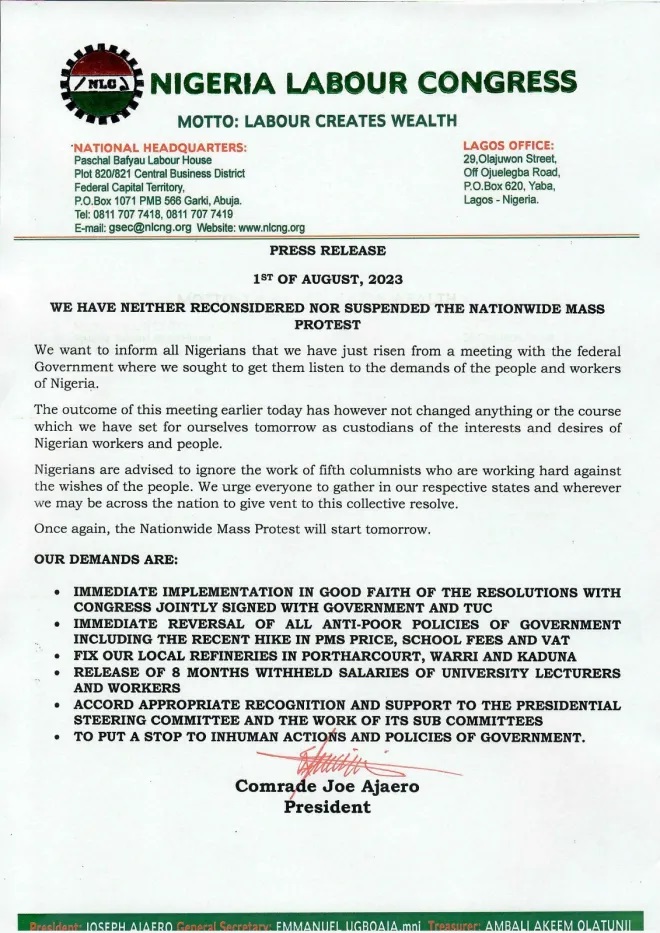
The Nigeria Labour Congress (NLC) has reiterated its commitment to embark on a nationwide strike starting Wednesday, following the expiration of its seven-day ultimatum to the federal government.

The labor union conveyed this message on Tuesday evening through a statement signed by its President, Joe Ajaero, reiterating that their demands remain unchanged.

The announcement comes a day after President Bola Tinubu announced a series of intervention measures to cushion the impact of the subsidy removal.

The Secretary of the NLC, Emma Ugbaja, had previously mentioned that although they appreciated President Tinubu’s intervention measures, they found them to be insufficiently comprehensive.

Ugbaja indicated that the NLC and the Trade Union Congress (TUC) would consult with their members to reach a consensus on the next course of action before the end of Tuesday, in preparation for Wednesday.

“We want to inform all Nigerians that we have just risen from a meeting with the Federal Government where we sought to get them to listen to the demands of the people and workers of Nigeria,” Ajaero said in the union’s statement.

“The outcome of this meeting earlier today has however not changed anything or the course which we have set for ourselves tomorrow as custodians of the interests and desires of Nigerian workers and people.

“Nigerians are advised to ignore the work of fifth columnists who are working hard against the wishes of the people. We urge everyone to gather in our respective states and wherever we may be across the nation to give vent to this collective resolve.

“Once again, the Nationwide Mass Protest will start tomorrow.”

The removal of the fuel subsidy, which was announced by Tinubu in May, triggered a significant rise in the cost of living, prompting the (TUC) and the NLC to issue their first ultimatum to the federal government.

Organized labor is demanding the prompt reversal of all government policies that negatively affect the poor, including the recent increases in petrol prices, school fees, and VAT.

Additionally, the labor unions are calling for the government to undertake the rehabilitation of local refineries in Port Harcourt, Warri, and Kaduna and release eight months’ worth of withheld salaries for university lecturers (members of the Academic Staff Union of Universities, ASUU) and workers.

Furthermore, organized labor insists on the government giving appropriate recognition and support to the Presidential Steering Committee and its subcommittees to address and halt human actions and policies detrimental to the people.

The union said in June that it is unfair for the government to remove fuel subsidies without making adequate provisions to mitigate the impact. That is because the local refineries, especially the publicly owned four, have remained comatose as a result of “the government’s inability to get them operationally turned around.”

The NLC said that between 1993 and 2023 about U$6b was used for Turn Around Maintenance of the Refineries without any results.