DD
MM
YYYY

PAGES

DD
MM
YYYY

spot_img

PAGES

Home Blog Page 3961

“We Will Fund 100,000 MSMEs and Start-ups with N75bn” (Full Text of Tinubu’s Address to Nigerians on July 31 2023)

0

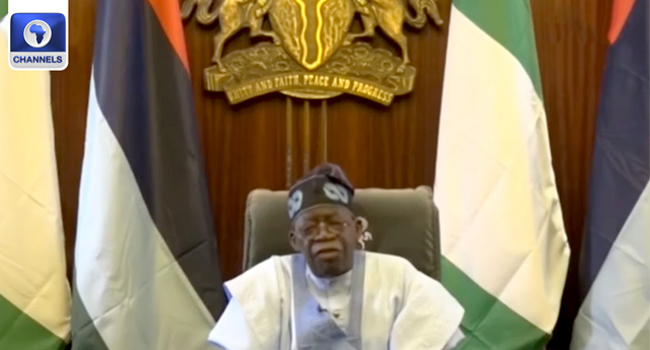
TEXT OF THE NATIONAL BROADCAST BY PRESIDENT BOLA TINUBU TO NIGERIANS ON CURRENT ECONOMIC CHALLENGES.

AFTER DARKNESS COMES THE GLORIOUS DAWN

My fellow citizens,

I want to talk to you about our economy. It is important that you understand the reasons for the policy measures I have taken to combat the serious economic challenges this nation has long faced.

  1. I am not going to talk in difficult terms by dwelling on economic jargon and concepts. I will speak in plain, clear language so that you know where I stand. More importantly, so that you see and hopefully will share my vision regarding the journey to a better, more productive economy for our beloved country.
  2. For several years, I have consistently maintained the position that the fuel subsidy had to go. This once beneficial measure had outlived its usefulness. The subsidy cost us trillions of Naira yearly. Such a vast sum of money would have been better spent on public transportation, healthcare, schools, housing and even national security. Instead, it was being funneled into the deep pockets and lavish bank accounts of a select group of individuals.
  3. This group had amassed so much wealth and power that they became a serious threat to the fairness of our economy and the integrity of our democratic governance. To be blunt, Nigeria could never become the society it was intended to be as long as such small, powerful yet unelected groups hold enormous influence over our political economy and the institutions that govern it.
  4. The whims of the few should never hold dominant sway over the hopes and aspirations of the many. If we are to be a democracy, the people and not the power of money must be sovereign.
  5. The preceding administration saw this looming danger as well. Indeed, it made no provision in the 2023 Appropriations for subsidy after June this year. Removal of this once helpful device that had transformed into a millstone around the country’s neck had become inevitable.
  6. Also, the multiple exchange rate system that had been established became nothing but a highway of currency speculation. It diverted money that should have been used to create jobs, build factories and businesses for millions of people. Our national wealth was doled on favorable terms to a handful of people who have been made filthy rich simply by moving money from one hand to another. This too was extremely unfair.
  7. It also compounded the threat that the illicit and mass accumulation of money posed to the future of our democratic system and its economy.
  8. I had promised to reform the economy for the long-term good by fighting the major imbalances that had plagued our economy. Ending the subsidy and the preferential exchange rate system were key to this fight. This fight is to define the fate and future of our nation. Much is in the balance.
  9. Thus, the defects in our economy immensely profited a tiny elite, the elite of the elite you might call them. As we moved to fight the flaws in the economy, the people who grow rich from them, predictably, will fight back through every means necessary.
  10. Our economy is going through a tough patch and you are being hurt by it. The cost of fuel has gone up. Food and other prices have followed it. Households and businesses struggle. Things seem anxious and uncertain. I understand the hardship you face. I wish there were other ways. But there is not. If there were, I would have taken that route as I came here to help not hurt the people and nation that I love.
  11. What I can offer in the immediate is to reduce the burden our current economic situation has imposed on all of us, most especially on businesses, the working class and the most vulnerable among us.
  12. Already, the Federal Government is working closely with states and local governments to implement interventions that will cushion the pains of our people across socio-economic brackets.
  13. Earlier this month, I signed four (4) Executive Orders in keeping with my electoral promise to address unfriendly fiscal policies and multiple taxes that are stifling the business environment. These Executive Orders on suspension and deferred commencement of some taxes will provide the necessary buffers and headroom to businesses in the manufacturing sector to continue to thrive and expand.
  14. To strengthen the manufacturing sector, increase its capacity to expand and create good paying jobs, we are going to spend N75 billion between July 2023 and March 2024. Our objective is to fund 75 enterprises with great potential to kick-start a sustainable economic growth, accelerate structural transformation and improve productivity. Each of the 75 manufacturing enterprises will be able to access N1 Billion credit at 9% per annum with maximum of 60 months repayment for long term loans and 12 months for working capital.
  15. Our administration recognizes the importance of micro, small and medium-sized enterprises and the informal sector as drivers of growth. We are going to energize this very important sector with N125 billion.
  16. Out of the sum, we will spend N50 billion on Conditional Grant to 1 million nano businesses between now and March 2024. Our target is to give N50,000 each to 1,300 nano business owners in each of the 774 local governments across the country.
  17. Ultimately, this programme will further drive financial inclusion by onboarding beneficiaries into the formal banking system. In like manner, we will fund 100,000 MSMEs and start-ups with N75 billion. Under this scheme, each enterprise promoter will be able to get between N500,000 to N1million at 9% interest per annum and a repayment period of 36 months.
  18. To further ensure that prices of food items remain affordable, we have had a multi-stakeholder engagement with various farmers’ associations and operators within the agricultural value chain.
  19. In the short and immediate terms, we will ensure staple foods are available and affordable. To this end, I have ordered the release of 200,000 Metric Tonnes of grains from strategic reserves to households across the 36 states and FCT to moderate prices. We are also providing 225,000 metric tonnes of fertilizer, seedlings and other inputs to farmers who are committed to our food security agenda.
  20. Our plan to support cultivation of 500,000 hectares of farmland and all-year-round farming practice remains on course. To be specific, N200 billion out of the N500 billion approved by the National Assembly will be disbursed as follows:

-Our administration will invest N50 billion each to cultivate 150,000 hectares of rice and maize.

-N50 billion each will also be earmarked to cultivate 100,000 hectares of wheat and cassava.

  1. This expansive agricultural programme will be implemented targeting small-holder farmers and leveraging large-scale private sector players in the agric business with strong performance record.
  2. In this regard, the expertise of Development Finance Institutions, commercial banks and microfinance banks will be tapped into to develop a viable and an appropriate transaction structure for all stakeholders.
  3. Fellow Nigerians, I made a solemn pledge to work for you. How to improve your welfare and living condition is of paramount importance to me and it’s the only thing that keeps me up day and night.
  4. It is in the light of this that I approved the Infrastructure Support Fund for the States. This new Infrastructure Fund will enable States to intervene and invest in critical areas and bring relief to many of the pain points as well as revamp our decaying healthcare and educational Infrastructure.
  5. The fund will also bring improvements to rural access roads to ease evacuation of farm produce to markets. With the fund, our states will become more competitive and on a stronger financial footing to deliver economic prosperity to Nigerians.
  6. Part of our programme is to roll out buses across the states and local governments for mass transit at a much more affordable rate. We have made provision to invest N100 billion between now and March 2024 to acquire 3000 units of 20-seater CNG-fuelled buses.
  7. These buses will be shared to major transportation companies in the states, using the intensity of travel per capital. Participating transport companies will be able to access credit under this facility at 9% per annum with 60 months repayment period.
  8. In the same vein, we are also working in collaboration with the Labour unions to introduce a new national minimum wage for workers. I want to tell our workers this: your salary review is coming.
  9. Once we agree on the new minimum wage and general upward review, we will make budget provision for it for immediate implementation.
  10. I want to use this opportunity to salute many private employers in the Organised Private Sector who have already implemented general salary review for employees.
  11. Fellow Nigerians, this period may be hard on us and there is no doubt about it that it is tough on us. But I urge you all to look beyond the present temporary pains and aim at the larger picture. All of our good and helpful plans are in the works. More importantly, I know that they will work.
  12. Sadly, there was an unavoidable lag between subsidy removal and these plans coming fully online. However, we are swiftly closing the time gap. I plead with you to please have faith in our ability to deliver and in our concern for your well-being.
  13. We will get out of this turbulence. And, due to the measures we have taken, Nigeria will be better equipped and able to take advantage of the future that awaits her.
  14. In a little over two months, we have saved over a trillion Naira that would have been squandered on the unproductive fuel subsidy which only benefitted smugglers and fraudsters. That money will now be used more directly and more beneficially for you and your families.
  15. For example, we shall fulfill our promise to make education more affordable to all and provide loans to higher education students who may need them. No Nigerian student will have to abandon his or her education because of lack of money.
  16. Our commitment is to promote the greatest good for the greatest number of our people. On this principle, we shall never falter.
  17. We are also monitoring the effects of the exchange rate and inflation on gasoline prices. If and when necessary, we will intervene.
  18. I assure you my fellow country men and women that we are exiting the darkness to enter a new and glorious dawn.
  19. Now, I must get back to work in order to make this vision come true.
  20. Thank you all for listening and may God bless the Federal Republic of Nigeria.
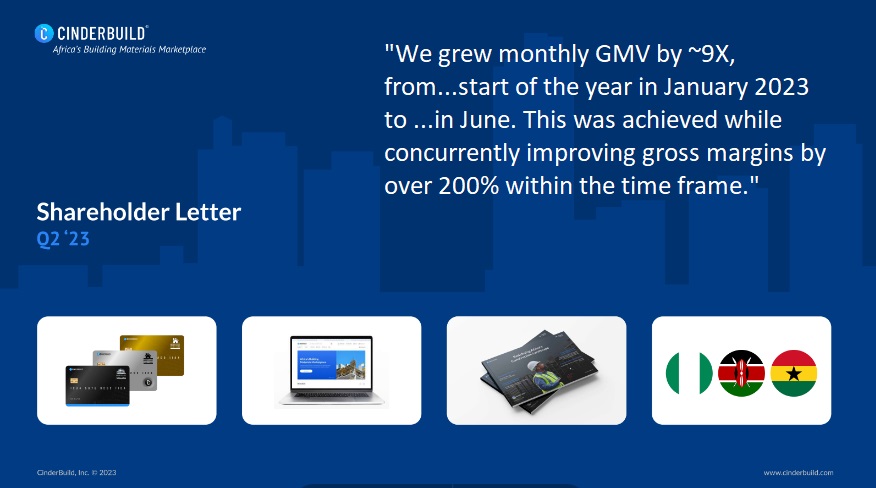
Cinderbuild, a Tekedia Capital Portfolio Company, Continues to SCALE

0

9X growth on GMV.

200% gross margin.

In 6 months.

Thank you Team CinderBuild Inc.

We discover and support category-king companies in Africa before most investors know about them. Yes, visionary founders with GREAT IDEAS make here home. To learn more about Tekedia Capital, go here capital.tekedia.com .  To use Cinderbuild for that project, go here cinderbuild.com

CinderBuild brings bulk off-takers and suppliers onto one collaborative platform streamlining the materials procurement process from requisition to delivery.

Tekedia Capital invests in technology-anchored early stage startups and companies. Our opportunity antenna and grassroot connections with innovators enable us to see patterns as they develop.  We invite you to partner with us as we nurture and build category-king companies in Africa and beyond, and in the process advance citizens, communities and nations. At Tekedia Capital, we fund the foundations of the NEXT African economy.  Join the African syndicate here.

Where is Marx in President Tinubu’s Fuel Subsidy Removal Economic Reforms Speech?

0

As citizens, public affairs analysts, and social commentators continue to scrutinise President Bola Ahmed Tinubu’s nationwide broadcast on his plans to mitigate the effects of the recently removed fuel subsidy, our analyst examines the broadcast using Karl Marx’s political economy approach in this piece.

Class Struggle and Inequality: President Tinubu’s speech highlights the existence of a select group of unelected individuals who hold enormous influence over the country’s political economy. This group, referred to as the “elite of the elite,” is portrayed as having amassed significant wealth and power, creating a form of class struggle where the privileged few benefits at the expense of the majority. This observation resonates with Marx’s critique of capitalism, where he argues that society is divided into two classes – the bourgeoisie (the owners of capital) and the proletariat (the working class).

Capitalist Exploitation: The President’s condemnation of the fuel subsidy and the multiple exchange rate system reflects concerns over the diversion of national wealth towards a small group of individuals. Marx’s political economy focuses on the inherent exploitation within capitalist systems, where profits are extracted from the labor of the working class and concentrated in the hands of the capitalist class. The speech implies that these economic policies serve the interests of a privileged few at the expense of the wider population.

Commodification of Labour: The President’s emphasis on the need to end the fuel subsidy can be interpreted as a recognition of the commodification of labour. Marx argued that under capitalism, labour is treated as a commodity, and its value is reduced to the wages workers receive. In the speech, the President appears to challenge the notion that subsidizing fuel serves as a mechanism to control the cost of labour and maintain profits for a select group of capitalists.

Democratic Governance and Power: President Tinubu’s call for democratic governance and the sovereignty of the people aligns with Marxist critiques of the political superstructure under capitalism. Marx argued that the ruling ideas in society are the ideas of the ruling class, and democracy under capitalism may be distorted or influenced by the dominant economic interests. The President’s concern over the unelected elite influencing the political economy reflects this critique.

Promoting the Welfare of the Masses: While President Tinubu advocates for the removal of the fuel subsidy and the overhaul of the exchange rate system, he also emphasizes his commitment to promoting the welfare of the masses. This aligns with Marxist ideals of socialism, which advocate for a society where the means of production are collectively owned and the benefits are distributed more equitably among the population. The President’s proposed interventions to support small businesses, farmers, and education, as well as his focus on financial inclusion, echo these socialist principles.

Our analyst notes that it is essential to reiterate that this analysis is based on the content of the speech and does not provide a comprehensive understanding of President Tinubu’s overall political ideology or actions. Additionally, Marxist analysis is one among many lenses through which political economy can be examined, and other perspectives may offer different insights into the issues addressed in the speech.

President Tinubu Unveils Post-Fuel Subsidy Removal Economic Reforms, Promises Nigerians Better Future

0

In a televised address to the nation, President Bola Tinubu addressed Nigeria’s pressing economic challenges and unveiled a series of reforms to steer the country towards prosperity.

President Tinubu began his speech by reaffirming his commitment to speak plainly and transparently about the nation’s economic issues. He stressed the necessity of removing the fuel subsidy, which he believed had outlived its usefulness and cost the country trillions of Naira annually.

“The subsidy costs us trillions of Naira yearly. Such a vast sum of money would have been better spent on public transportation, healthcare, schools, housing, and even national security,” President Tinubu said.

He expressed his concern over the disproportionate influence wielded by a select group of unelected individuals in the country’s political economy, emphasizing the need for the people’s sovereignty to drive Nigeria’s democratic system.

The President highlighted that the multiple exchange rate system had become a highway for currency speculation, diverting funds from essential sectors. He emphasized the urgent need to reform this system to ensure fair and equitable distribution of resources.

President Tinubu reassured the nation that these measures were essential to secure a better future for Nigeria. He acknowledged the immediate hardships facing citizens due to increased fuel prices and rising costs of goods.

However, he went on to unveil an array of interventions aimed at mitigating the impact on the most vulnerable and stimulating economic growth.

Among the key measures, the President announced a N75 billion investment to support 75 manufacturing enterprises. These enterprises would receive access to credit at a low-interest rate, fostering sustainable economic growth and job creation.

Additionally, the administration is set to energize micro, small, and medium-sized enterprises and the informal sector with a N125 billion stimulus package. This initiative aims to provide conditional grants to one million nano businesses and fund 100,000 MSMEs and start-ups.

President Tinubu also underscored the government’s commitment to agricultural development, with a plan to cultivate 500,000 hectares of farmland for rice, maize, wheat, and cassava. This ambitious program targets small-holder farmers and private-sector players, fostering growth and food security.

President Tinubu unveiled the Infrastructure Support Fund for States, aimed at revamping healthcare and educational infrastructure and improving rural access roads.

President Tinubu acknowledged the immediate difficulties Nigerians faced but urged them to focus on the broader picture. He expressed confidence that these reforms would lead Nigeria out of the darkness into a brighter, more prosperous future.

The government assured Nigerians that the implementation of the reforms would be closely monitored, and interventions would be made if necessary to address inflation and gasoline prices.

President Tinubu ended his address by reaffirming his dedication to work for the welfare of the people and the progress of the Federal Republic of Nigeria.

Meanwhile, mixed reactions from citizens have been trailing President’s address, with some expressing optimism about the proposed changes and others expressing concerns over the immediate economic impact.

Tinubu Cautions Federal Schools to Stop Arbitrary Increase in Tuition Fees

0

President Bola Tinubu has cautioned federal institutions against implementing arbitrary increases in sundry fees payable as the economic challenges buoyed by fuel subsidy removal take a toll on Nigerians.

This was made known through a statement issued by Dele Alake, the special adviser to the president on communication and strategy, on Monday.

Following the assent of the ‘Student’s Loan Bill’ into law, federal schools have increased their fees by more than 100% – raising concern that higher education will soon become unaffordable to most Nigerians.

The Student Loan Act was designed to give Nigerians access to Students Loan Fund (SLF), which provides interest-free loans for the poor to pursue higher education.

Federal Government Colleges, also referred to as Federal Unity Colleges, increased their fees to N100,000, from N45,000. The University of Lagos (Unilag) and other federal universities also announced an increase in fees.

The president’s move comes amid criticism of the student loan act, which Nigerian students have lamented that it is impossible to access due to the rigorous criteria. Tinubu also approved the removal of all restrictions on the students’ loan to ensure it is easily accessible to students.

The sudden hike in tuition fees amid outcry over the soaring cost of living appears to have prompted the president to intervene.

According to Alake’s statement, the federal government has also ordered the release of over 200,000 Metric Tonnes of grains to families in 36 states and the Federal Capital Territory, Abuja. The move is geared toward mitigating hunger orchestrated by fuel subsidy removal and the floating of Nigeria’s forex market.

Read the statement below:

“In line with his promise to ensure no Nigerian student abandons his or her educational pursuits as a result of lack of money and economic circumstances of their parents, President Tinubu has also approved the removal of all restrictions on the students’ loan to make it available to any student or household that may desire it,” the statement reads.

“Similarly, President Tinubu has directed the authorities in all Federal Institutions of higher learning to avoid an arbitrary increase in sundry fees payable and where possible defer further increase so that parents and students don’t face too many difficulties.

“While it is important to reiterate that President Tinubu has directed the release of over 200,000 Metric Tonnes of grains to families in 36 states and Federal Capital Territory, Abuja, the government is working to ensure that vulnerable students can also benefit from conditional cash transfers and food distribution.

“The federal government salutes the courage, wisdom, and partnership of Nigerian Students as our country navigates this challenging time.

“President Tinubu will continue to prioritize education and the needs of the students, improve the welfare of teaching and non-academic staff, and invest in infrastructure to make our institutions of higher learning more globally competitive.”