
DD
MM
YYYY

PAGES

DD
MM
YYYY

spot_img

PAGES

Home Blog Page 3995

Why do developers adopt pessimistic mindset?

0
Work Space

Why do developers adopt the base pessimistic mindset? There are many possible reasons, but I think the main one is that they have been burned by the code base before. They have experienced the pain of dealing with legacy code, spaghetti code, or code rot. They have wasted hours or days trying to figure out how something works, why something doesn’t work, or how to make something work.

They have faced the wrath of angry users, clients, or managers who blamed them for breaking something that was already broken. They have felt the pressure of tight deadlines, changing requirements, or unrealistic expectations. They have learned to distrust the code base and to doubt their own abilities.

This pessimistic mindset has a negative impact on the quality and productivity of software development. It leads to defensive coding, over-engineering, or under-engineering. It discourages innovation, experimentation, or refactoring. It reduces collaboration, communication, or feedback. It lowers motivation, satisfaction, or morale. It creates a vicious cycle of pessimism that feeds on itself and makes the code base worse over time.

How can we break this cycle and foster a more optimistic mindset? Here are some suggestions:

Adopt a growth mindset. Believe that you can learn from the code base and improve your skills. Don’t let your past failures define your future success. Embrace challenges as opportunities to grow.

Practice gratitude. Appreciate the good aspects of the code base and the people who contributed to it. Recognize the value and purpose of your work. Celebrate your achievements and those of your teammates.

Seek feedback. Ask for help when you are stuck or unsure. Listen to constructive criticism and learn from it. Share your ideas and opinions and welcome different perspectives.

Refactor continuously. Don’t be afraid to change the code for the better. Apply good design principles and coding standards. Remove duplication and complexity. Add clarity and simplicity.

Test thoroughly. Write automated tests that cover all the important scenarios and edge cases. Run them frequently and fix any issues as soon as possible. Use code analysis tools to detect potential problems and improve quality.

Deploy frequently. Deliver working software to your users or clients as often as possible. Get their feedback and incorporate it into your next iteration. Measure the impact and value of your work.

dYdX won’t profit from v4 as it becomes public benefit corporation.

dYdX, one of the leading decentralized exchanges (DEXs) in the crypto space, has announced a major change in its governance and business model. The platform, which recently launched its v4 protocol, has decided to become a public benefit corporation (PBC), a type of legal entity that prioritizes social and environmental impact over profits.

According to a blog post by dYdX founder Antonio Juliano, the move was motivated by the desire to align the platform’s values with its users and community. He wrote:

“We believe that decentralization is not only a technological innovation, but also a social one. Decentralization empowers individuals to take control of their own financial destiny and enables new forms of collaboration and coordination that can create positive change in the world.”

As a PBC, dYdX will have a fiduciary duty to consider the interests of all stakeholders, not just shareholders, when making decisions. This means that the platform will prioritize user experience, security, innovation, and social impact over maximizing profits.

Additionally, dYdX will allocate 10% of its revenue to a public benefit fund, which will be used to support projects and initiatives that advance the mission and vision of dYdX. The fund will be governed by a board of directors, which will include representatives from the dYdX community.

Juliano also clarified that becoming a PBC does not mean that dYdX will stop being profitable or competitive. He said:

“We believe that being a PBC will actually make us more successful in the long term, as it will help us attract and retain the best talent, partners, and users who share our vision and values. We also believe that being a PBC will give us a competitive edge in the market, as it will differentiate us from other platforms that may have conflicting incentives or agendas.”

The transition to a PBC is part of dYdX’s broader vision to become a fully decentralized and community-owned platform. The platform plans to launch its own governance token in the near future, which will enable users to participate in the decision-making process and benefit from the growth of dYdX.

dYdX is one of the most popular and innovative DEXs in the crypto space, offering users access to various trading products such as spot, margin, perpetuals, and options. The platform leverages layer 2 scaling solutions to provide fast, cheap, and secure transactions. According to its website, dYdX has processed over $40 billion in trading volume since its inception in 2017.

Is Nigeria’s Fintech Market Almost Saturated?

0

Since the start of the tech boom in Africa, the financial sector has recorded significant growth which has led to the launch of Fintech companies across different African nations, with Nigeria leading in the region with the highest number of fintech companies.

In a 2021 Fintech Times report, Nigeria’s fintech landscape was reported to consist of 210 to 250 fintech companies, with the country taking most of the slice in funding.

Nigeria has assumed a market-leading position when it comes to activity it has long held in the area of fintech investment. Of the about $3.64 billion in funding secured by African fintech ventures in the last 8.5 years, about $1.51 billion or 41.6 percent went into Nigeria-based companies.

In terms of fintech unicorns, Nigeria is home to five of the seven African unicorns on the continent, which include Interswitch, Jumia, Flutterwave, Opay, and Andela.

As more fintechs continue to launch in Nigeria, there are arguments that the country’s fintech space is almost saturated.

Recently, the Chief Executive Officer of Aladdin Digital, Mr. Darlington Onyeagoro said that Nigeria’s fintech space is almost saturated as there are now many players doing the same thing.

He described the fintech space in Nigeria as a “Red Ocean”, stating that any newcomer into the market must either come with something unique and disruptive or with a lot of funds to drive visibility in the market.

In his words,

“The fintech space in Nigeria is almost saturated. There are so many players. For loan apps alone, the last time I checked there are over 300 or 400 lending companies via apps on Play Store. That is Play Store alone, I’m not talking about loS.

So, today for you to compete you need a lot of money unless the idea you’re bringing is quite disruptive, unless you are bringing something that nobody has done. I mean that thing is very new and very disruptive and then you will now depend on word of mouth to help you sell because today to even become visible in this saturated market, you need a lot of marketing and you need a lot of funds to do that”.

In as much as the Nigerian Fintech space might look almost saturated, Financial inclusion rates in the country have gradually improved, but still fall short of the targets adopted in Nigeria’s 2012 financial inclusion strategy.

This implies that the narrative of Nigeria having too many fintechs is somewhat not valid, as the launch of more fintechs will help to drive the nation’s financial inclusion rate and ensure that a significant amount of the unbanked population has access to financial products and services.

According to data from the Central Bank of Nigeria and EfinA, in 2020, about 36 percent of the Nigerian population was unbanked, and in 2022, the World Bank listed Nigeria among the countries with a huge unbanked population, comprising about 64 million people.

This shows that despite the hype, Fintech in Nigeria has not scratched the surface in addressing financial inclusion challenges and the unbanked population.

The challenge of financial inclusion in the country is still rife with a great deal of innovation and technology needed to ensure that more citizens have access to financial services that can drive economic growth.

It is worth noting that Fintech can support Nigeria’s human capital development by driving financial inclusion and it is undoubtedly fascinating to see how Fintech has improved and is creating strategies for improving financial inclusion in Nigeria.

Unfortunately, one widely held misconception is that most of these fintech platforms are all about payments which isn’t entirely true.

Interestingly, Fintech companies in Nigeria have diversified their offerings to cater to different financial needs, which include mobile payments, peer-to-peer lending, digital banking, and wealth management.

In data published by EY last year, payment, mobile money, and digital banking share 38% of the Nigerian fintech market, 23% deals with lending, 15% with savings investment and crowdfunding, 13% with business services and infrastructure, 8% with cryptocurrency and 3% on Insurtech, which suggests a widely spread ecosystem.

With the growing population and increasing mobile and internet penetration in the country, it is imperative for more fintechs to emerge, to cater to their needs, bringing financial products and services to the unbanked.

Additionally, it is important to note that while the fintech sector may be approaching saturation, there is still room for innovation and growth. New opportunities and startups with unique offerings will emerge as technology evolves and consumer needs change.

Also, collaboration between fintech companies and traditional financial institutions can lead to new synergies and disruptive developments in the Nigerian financial services industry.

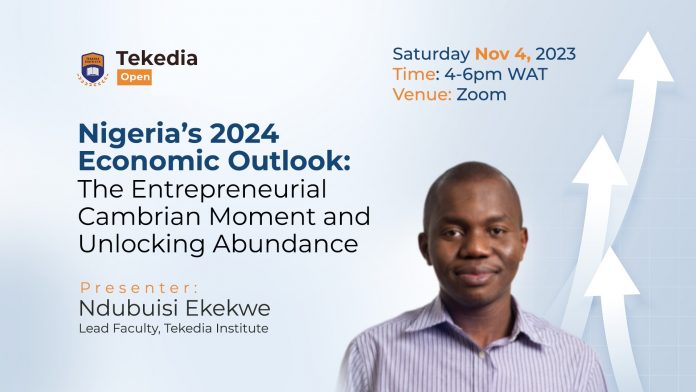
You’re Invited To Tekedia Open on Saturday: “Nigeria’s 2024 Economic Outlook” by Ndubuisi Ekekwe

0

Tekedia Institute and Tekedia Capital invite the general public to Tekedia OPEN, a twice-yearly webinar where we discuss important economic and business components of the market systems. For the second half of 2023, the topic is “Nigeria’s 2024 Economic Outlook: The Entrepreneurial Cambrian Moment and Unlocking Abundance”, and we will be looking at how businesses could use the lessons of 2023 to architect winning business models in 2024.

Date: Saturday: Nov 4, 2023 

Time: 4-6pm WAT 

Topic: Nigeria’s 2024 Economic Outlook: The Entrepreneurial Cambrian Moment and Unlocking Abundance

Venue: Zoom link 

Presenter: Ndubuisi Ekekwe is the Lead Faculty of Tekedia Institute and Chairman of Tekedia Capital. He graduated from Secondary Technical School Ovim, Abia State, and holds the school’s all-time-best academic results in WAEC. Also, since 2009, he has been writing in the Harvard Business Review, examining innovation, strategy and broad business and economic competitiveness. 

Register for Tekedia Institute Programs

Meanwhile, Tekedia Investment and Portfolio Management program begins on Nov 6, 2023. If you have not registered, now is the time to pick your seat. Other programs like the next Tekedia Mini-MBA, Tekedia Startup Masterclass, etc are accepting registrations; check them here.

Login Instructions For Tekedia Investment & Portfolio Management Program Which Begins Nov 6

Join Tekedia Capital Syndicate

Through Tekedia Capital, you co-invest in some of the most amazing startups in Africa and beyond, along with our hundreds of members. Register and join here. That registration comes with a free admission to Tekedia Venture Investing and Portfolio Management program.

Why Abuja Men Live Fake Lives

1

I read the post of Prof. Ndubuisi Ekekwe yesterday about how they visited a big man’s house in Maitama, Abuja and the gatekeeper refused to open the gate for them to drive inside the compound simply because they came with a small car. 

Well as an Abuja boy, I can fully relate and validate that post. Abuja is a city where you are judged by the material things that are in your possession at that point in time. Nobody cares if you borrowed it or not or stole it, they just want to see you as a big man. 

But to be fair, this is not just an Abuja thing, it’s a Nigerian thing, and it is even worse in Lagos. Nigeria is that society where you will be given preferential treatment if, from your demeanor or appearance, people presume or take you to be a “big man”.

I have lived in Abuja for a while, I have used a small car and I have used a fairly big car as well and I can tell you that the treatment I get is different. The same me, but with different cars, I get different treatments solely based on the kind of car I am seen with. Other Motorists will not cut you out or overtake you rudely if you are with a big car, law enforcement agents will be more courteous while addressing you if you are with a big car and so on.

Even when I go to church or social meetings with my fairly good car, I always get exclusively reserved parking spaces. You will see the security guards struggling amongst themselves to direct you or to show you the most comfortable spot for you to park. 

Even in business relationships, some prospective clients will weigh you and size you up by the type of car you drive especially if the client is meeting you for the first time, some clients will want to see the kind of car you pulled up with. I have read stories of people losing contracts simply because they didn’t have a good car to attend the meeting with and they were therefore presumed broke. The worst is when you are attending a meeting and you go along with an Uber or taxi and the other people see that it was an Uber or taxi that brought you, thereby giving them the impression that you do not have a car especially if they are meeting you for the first time, they will treat you like a peasant. 

I recently met with a prospective client and he was asking me what kind of car I drive, I told him, and we went on to discuss why I prefer such a car over others but deep down I knew he was sizing me up. 

Even in a romantic or cordial relationship, there are some ladies you don’t stand a chance of dating if you don’t use a good car. Some ladies used to insist that their man must have a car but they are now specific about the kind of car the man must have before they can grant him an audience.

It is just a human thing; no matter how you want to twist it, people will always address you by the car you drive, your attire and the most ridiculous one, the kind of phone or gadget you use. If you use an iPhone, you are automatically presumed to be rich or elite even if you stole the phone or not.

This is why most Abuja men borrow things or package up to present the appearance of being rich so that they will not be stereotyped to be poor or broke hence the popular cliche that Abuja men live fake lives; they borrow Benz or use expensive Benz but live in a “one room self contain” apartment. You won’t blame them, they are simply playing to the societal gallery because since we are in a society where you are first judged by the car you are seen with, nobody cares if you are living in a hole or you borrowed the Benz. 

It is funny and ridiculous but it is what we have come to live with.

Interior Ministry Announces Plan to Enact Comprehensive Immigration, Visa Policies

0

Minister of Interior, Hon. Olubunmi Tunji-Ojo, has announced a comprehensive review of Nigeria’s migration and visa policies in collaboration with key stakeholders.

This initiative aims to simplify and improve the immigration processes for Nigerians both within the country and abroad. The move is part of the Ministry of Interior’s efforts to bring about positive changes in the nation’s immigration system.

Abdur-Rahman Balogun, the Head of Media, Public Relations, and Protocols Unit at the Nigerians in Diaspora Commission (NIDCOM), made this announcement in a statement on Tuesday. He disclosed that the Minister made the assurance during a courtesy visit by the Chairman/CEO of NIDCOM, Hon. Abike Dabiri-Erewa.

Tunji-Ojo expressed concern over certain imbalances in migration and visa policies that have led to Nigeria being perceived as a dumping ground. He emphasized that the upcoming policy review will prioritize the principle of reciprocity in accordance with international standards, reaffirming an announcement he made earlier last month.

The Minister had last month, issued a stern warning to embassies and foreign ministries, declaring that Nigeria would adopt a strict “eye for an eye” approach in response to visa and immigration policies.

“… The director of the Center for Illegal Migration in Turkey came to my office, and I told him in the next couple of weeks expect reciprocity in terms of travel policy.

“Any country that does not give me the visa on arrival cannot have a visa on arrival in Nigeria. I’m sorry but it is the truth. We’re not a dumping ground. If you say you are useful, people will see you as being useful.

“But if you tell people you are useless, people will tell you why are you this useless. We want to partner with you and so on the table, we must be partners. We must be equal partners and our relationship of investment must be on the basis of the principle of reciprocity.

“So we are doing that to all the countries in the world. The committee is working. I will receive the report tomorrow, you charge me $100 for a visa, I will charge you $100 for a Nigerian visa.

“If you give me visa on arrival. I give it to you. If you say the condition for me to enter your country today is that I must have American visa, Schengen visa, UK visa etc, you will have the same conditions to enter my country. It is not fight; it is about the issue of mutual respect,” he said.

He also commended the efforts of NIDCOM, particularly the proactive nature of its Chairman, in enhancing the welfare of Nigerians in the diaspora and promoting a positive image of the country internationally.

Tunji-Ojo also raised concerns about the challenges associated with passport processing, capturing, and collection. He expressed hope that steps would be taken to enhance the efficiency of these processes.

In her remarks, Hon. Abike Dabiri-Erewa emphasized the need for a more effective passport-capturing and collection process for Nigerians living abroad. She called for a collaborative effort between NIDCOM and the Ministry of Interior, citing the various activities the Commission has undertaken since its inception.

Dabiri-Erewa stressed the urgency of establishing a structured platform for addressing complex diaspora issues that require coordinated efforts from different Ministries, Departments, and Agencies.

The comprehensive review of migration and visa policies, with a focus on reciprocity and international standards, is expected to have a significant impact on easing immigration processes for Nigerians at home and abroad, as well as improving the overall image of Nigeria on the global stage.