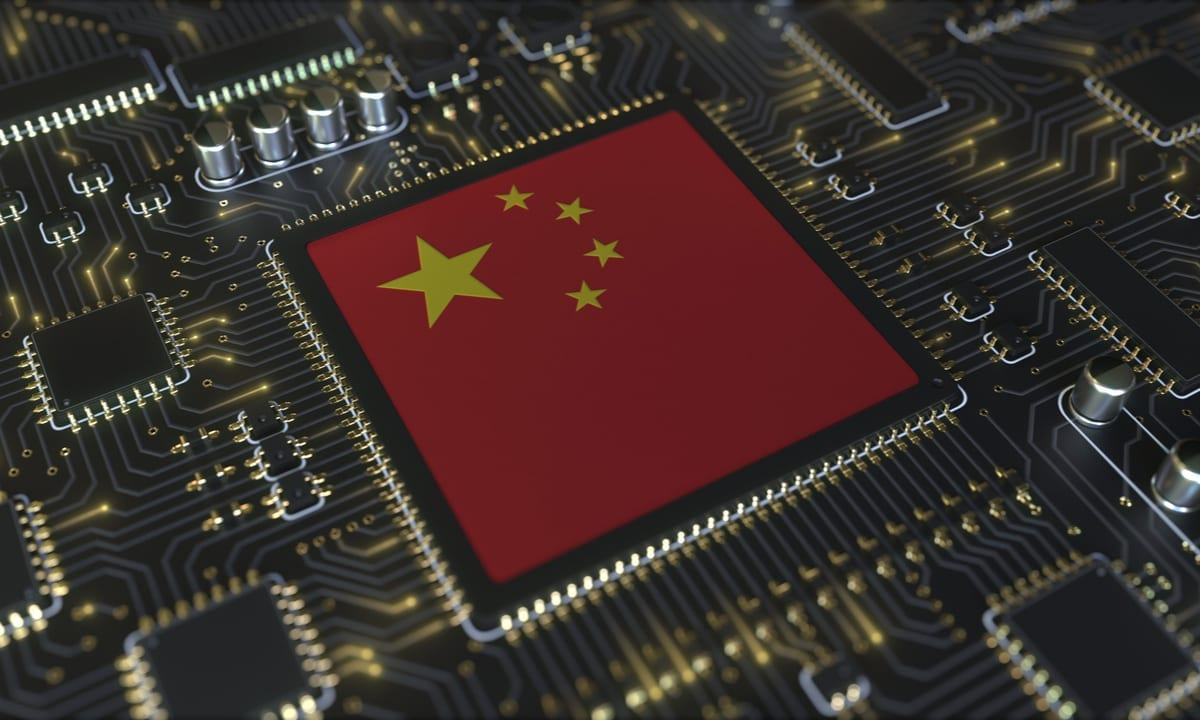
Chinese artificial intelligence company Z.ai said on Wednesday that its latest model can handle online requests entirely on domestically produced semiconductors, underpinning the rapid push by China’s AI industry to reduce its reliance on foreign chips amid tightening U.S. technology restrictions.
Z.ai said its new GLM-5.3-Flash model was powered by 100,000 China-made chips to process all online inference requests after its release on Aug. 20 under the code name “Ox Alpha.” The company did not disclose the chip manufacturers or the specific processors used.
The claim could not be independently verified.
Z.ai’s Hong Kong-listed shares rose more than 8% on Thursday, extending a rally that has lifted the stock more than 800% since its January initial public offering.
The release has caught the industry’s interest because inference, the process of running a trained AI model to generate responses for users, is becoming a major source of computing demand as AI applications move from experimentation toward mass deployment. While inference generally requires less computing power than training, operating models at large scale still requires substantial quantities of chips, servers, and data-center capacity.
GLM-5.3-Flash ranks 10th on the Artificial Analysis Intelligence Index, according to Z.ai, placing it ahead of DeepSeek V4 Pro Max. The company also said the model ranked first by usage on the global OpenRouter platform over the past week.
Z.ai’s ability to deploy the model using Chinese chips, if independently confirmed, would provide another indication that domestic AI developers are adapting to restrictions on access to advanced U.S. semiconductors.
Nvidia has faced restrictions on selling its most advanced AI processors to Chinese customers, while Beijing has simultaneously encouraged domestic companies to develop alternatives. Huawei has emerged as one of the leading suppliers of AI accelerators in China, alongside a growing group of domestic chip designers and manufacturers.
Counterpoint Senior Research Analyst Ivan Lam said Z.ai was likely using Huawei Ascend processors alongside chips from other suppliers, although he stressed that the company had not disclosed the details.
“Chinese AI model developers have continued to allocate more resources and investment toward AI servers and computing infrastructure built on domestic chips,” Lam said.
The development reveals that in China, rather than relying solely on domestic substitutes for Nvidia GPUs, technology companies are seeking to optimize the entire AI stack, from semiconductors and servers to models and software, around locally available hardware.
That approach has become necessary as U.S. restrictions limit Chinese access to cutting-edge processors. It also creates a feedback loop in which domestic AI developers provide demand for Chinese chipmakers, while better software optimization helps make those chips more useful for increasingly capable AI models.
Still, some analysts warn that Z.ai’s claim should be treated cautiously. The company has not identified the processors used, and there is no independent confirmation that all of the model’s online inference workloads were handled exclusively by Chinese-made chips. A large-scale deployment also does not necessarily demonstrate that domestic processors match the performance, efficiency, or cost characteristics of Nvidia’s highest-end systems.
The distinction between training and inference is important. China’s domestic chip ecosystem may find it easier to support inference workloads, where model-specific optimization can reduce hardware requirements, than to immediately match Nvidia’s performance in the most demanding frontier-model training workloads.
The broader commercial picture for China’s AI companies also remains mixed.
Z.ai rival MiniMax rose about 3% in Hong Kong after reporting a 283% increase in first-half revenue from a year earlier. The company’s adjusted net loss, however, more than doubled to $293 million, showing the substantial costs still associated with scaling AI products even as demand expands.
MiniMax’s M3 model ranks 18th on the Artificial Analysis Intelligence Index, according to the report.
Both Z.ai and MiniMax went public in Hong Kong in January, becoming part of a new generation of Chinese AI companies seeking public-market funding as Beijing promotes technological self-sufficiency.
Their share-price performances have diverged sharply. Z.ai has gained more than 800% since its IPO, while MiniMax has risen more than 80%, underscoring the premium investors have placed on companies seen as potential beneficiaries of China’s push to build an independent AI ecosystem.
Z.ai is due to report its first-half results on Monday. The results could provide a clearer indication of whether the extraordinary market enthusiasm surrounding the company is beginning to translate into commercial growth.
However, the capacity of domestic chips to support increasingly capable models at commercially viable costs has been put to the test by Z.ai’s claim. If that is demonstrated at scale, the impact of U.S. chip restrictions could shift from simply limiting China’s access to advanced computing to accelerating the development of a separate domestic AI technology stack.