DD
MM
YYYY

PAGES

DD
MM
YYYY

spot_img

PAGES

Home Blog Page 4027

Peter Obi Criticizes 2024 Budget, Calls for Reprioritization Towards Urgent Needs

0

Peter Obi, the Labour Party presidential candidate in the last Nigeria general elections, has raised concerns about the features of the proposed 2024 national budget, particularly criticizing the allocation for presidential aides’ trips and office renovations.

In a post he made on X (Twitter) on Friday, Obi who had earlier criticized the 2023 supplementary budget for being extravagant, expressed his reservations about the substantial funds earmarked for certain items in the appropriation bill.

Although full details of the budget are yet to be published, he pointed out, based on available information, that a staggering sum of N15.961 billion has been budgeted for trips for the aides of the president and vice president. Extrapolating this, he estimated that the combined spending for the President and Vice President, along with their aides, would reach about N45 billion for trips alone.

Additionally, the budget allocates N20 billion for the renovation of the President and Vice President’s offices in Lagos and Abuja, including their full digitization.

Obi raised questions about the priorities outlined in the budget, particularly when considering the significant allocation for trips and renovations. He emphasized the need to redirect these funds towards critical areas such as internal security, pointing out that the budget for the Police Trust Fund, which is essential for securing over 200 million people, was passed with an amount of N57 billion.

“If you add N45 billion, being the least that will be spent on transportation, and N20 billion earmarked for renovations, it comes to about N65 billion, which is more than N57 billion, being the amount passed by the Senate last week for the Police Trust Fund, to secure over 200m people,” he said.

Suggesting alternative uses for the allocated funds, Obi proposed that the N65 billion budgeted for trips and renovations could be redirected to address pressing issues. He urged a focus on internal security, highlighting that over 5,000 police stations and operations across the country lack functional vehicles and sufficient fuel allowances.

He recommended allocating funds to purchase 2,500 4×4 trucks for the police stations, supporting local manufacturers like Innoson.

“Half of these police stations have no functional vehicles. Even those that have been given less than N5000 for fuel in a day, which is why if you are lucky, for prominent people like me, to call the police for any intervention in an emergency, the first thing they tell you is – ‘we have no fuel’.

“Assuming we decide to prioritize our lists and use these resources as most of the trips and the renovations are of no value to our growth and productivity, we can approach local manufacturers like Innoson and others and order 2500 4×4 trucks which as of today cost about N30 million.

“We will be able to get a 20% discount because we are buying in large quantities and paying them upfront. It will amount to N25 million each, which will be N62.5 billion for half of the police stations that do not have operational vehicles today, and which will be taken care of by the money we save from the budgeted travel and renovations,” he said.

The former Anambra State governor further suggested utilizing the N15 billion budgeted for the new residence of the Vice President to triple the fuel allowances for police operational cars, addressing immediate operational needs. He emphasized on the importance of prioritizing critical areas such as health, education, and poverty alleviation in the budget, redirecting funds to areas that have a direct impact on the well-being of the population.

Obi urged a comprehensive review and revision of the budget to align with the urgent needs of the country, emphasizing the importance of prioritizing expenditures to address the challenges faced by the masses.

“By prioritizing our planning, and budgeting this way, we will not only be securing the country better but will be making our local industries more productive and profitable, thereby creating the desperately needed Jobs,” he said.
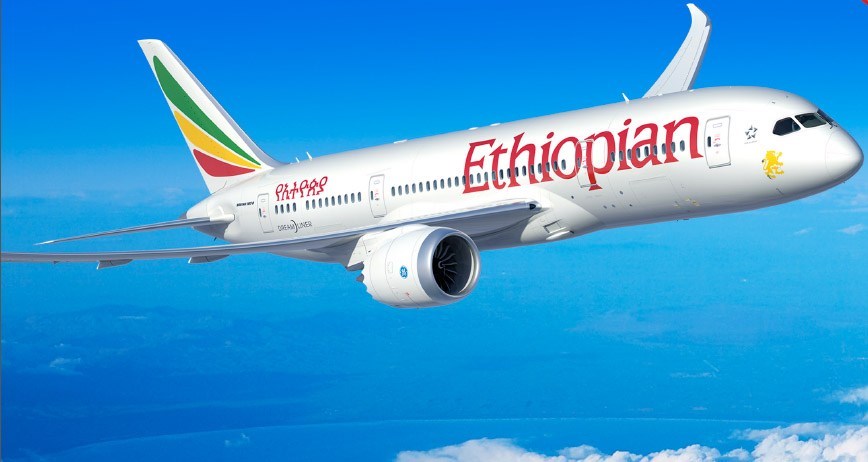

IATA Warns of Foreign Airlines Pullout Over Trapped Funds, Labels Nigerian Airports Most Expensive

0

The International Air Transport Association (IATA) has issued a warning to the Central Bank of Nigeria (CBN) about the potential withdrawal of foreign airlines from the Nigerian market if urgent action is not taken regarding the $790 million ticket revenue currently trapped in the country.

Kamil Alawadhi, IATA Regional Vice President, Africa & Middle East, conveyed this concern on Thursday during a media presentation at the IATA Global Media Day in Geneva, Switzerland.

Alawadhi stated that Nigeria currently holds the highest amount of airline-trapped funds globally, totaling $792 million. He said there is a need for engagement between relevant parties, including the CBN Governor and the aviation minister, to address the issue.

Despite the CBN’s intervention in 2022, releasing $265 million to affected airlines, the challenge, which is significantly influenced by Nigeria’s ongoing forex crisis, persists.

Last November, Emirates Airlines suspended its flight operations to Nigeria for the second time due to the failure to repatriate the company’s earnings trapped alongside other foreign airlines’ funds. Emirates’ trapped fund at that time was $85 million.

The IATA VP urged proactive measures to prevent further withdrawals by foreign carriers.

According to him, Nigeria tops the list of countries with the highest amount of airlines’ blocked funds, totaling $792 million. Following closely are Egypt with $348 million, Algeria with $199 million, the AFI zone with $183 million, and Ethiopia with $128 million.

The VP noted that while Ethiopia has devised a plan to settle the debt, Nigeria has not taken any action to address its blocked funds.

“Ethiopia is seeking a way to resolve this issue even though the blocked fund is rising. The first step for us to solve these blocked funds is for both parties to engage. If parties don’t engage, it is very difficult to move forward. I have not been able to engage with Nigeria’s CBN Governor.

“He said he would engage with me when he had a solution. He is not promising but I have engaged with the Aviation Minister who is very understanding, new to the position, or maybe wowed by the situation he inherited will help to resolve the matter,” he said.

The IATA VP expressed concern that airlines in Africa are collectively owed $34 million, which is currently blocked. The delay in releasing these funds has led to depreciation, resulting in a loss of $10 million. This situation is deemed unfair by the airlines, as they have fulfilled all financial obligations to airport operators, including carrying Nigerian officials on their flights. He lamented that despite meeting their dues, the airlines find themselves unable to access the funds rightfully owed to them.

The IATA chief commented on Nigeria’s aviation sector, highlighting significant challenges faced by airlines in the country. He mentioned the burden of a 25 percent interest rate on loans, exorbitant airport taxes, and insurance premiums six times higher than global standards. These factors collectively hinder the profitability of Nigerian airlines.

Al-Awadhi disclosed that any airline operating beyond Nigeria’s borders operates with lower operating costs and offers more competitive prices compared to domestic Nigerian carriers.

Furthermore, he pointed out that despite Lagos and Abuja airports having infrastructure that falls short of optimal standards, they are ranked as the most expensive gateways in the region, exacerbating the difficulties faced by airlines operating within the country.

“… Nigeria has two most expensive airports; their fuel is higher than elsewhere in the world, and insurance is six times more expensive than anywhere else in the world.

“The interest on loans is 25%. It is ridiculous. It is the highest interest I have ever seen. When you set up these airlines, you are already disadvantaged. Any airline in Nigeria operating outside of Nigeria has a cheaper operating cost and better prices than Nigerian airlines. You can see why it is difficult for African airlines to make profit,” he said.

Nevertheless, Al-Awadhi conveyed IATA’s unwavering commitment to pinpointing and mitigating the factors that contribute to the elevated operating costs in Nigeria. The organization aims to work collaboratively to create a more favorable and conducive environment that enables airlines to prosper within the country.

“We are expecting that the operating costs of the African airlines will be lowered and they can become profitable”, he said.

NECA Decries Exits of Multinationals from Nigeria, Says Over 2,000 Jobs Lost

0

The Nigeria Employers’ Consultative Association (NECA) has expressed alarm over the consequences of recent divestments by multinationals in the country, citing the loss of over 20,000 direct jobs.

NECA, the umbrella body for employers and a voice of business in Nigeria warned that the continuous divestments and closures of businesses would lead to growing unemployment, insecurity challenges, increased child labor, reduced disposable income, and decreased economic output.

The mass departure of global and local businesses in the last few years, representing over 15 organizations, has raised significant concerns about unemployment’s impact on societal stability and the economy.

“It is worrisome to note that in the last three years, over 15 organisations with a combined value-chain staff strength of over 20,000 employees have either divested or partially closed operations,” the association said.

The Director-General of NECA, Adewale-Smatt Oyerinde, described the situation as worrisome.

“We are concerned at the growing rate of unemployment in the country, made worse by the continuous divestment of global businesses and closure of local ones,” he said in a statement.

To address this challenge, NECA said there is an urgent need for the government to tackle multifaceted challenges faced by businesses.

According to Oyerinde, there is a need for swift action to improve the business environment by addressing regulatory hurdles, enhancing critical infrastructure, stabilizing the foreign exchange market, and ensuring government agencies facilitate and promote businesses rather than impede them.

“The harsh business environment has made local businesses to be uncompetitive. The government must urgently address regulatory and legislative bottlenecks that tend to stifle businesses rather than promote them.

“Continuous efforts must be made to promote locally-made goods through the provision of critical infrastructures; urgent stabilization of the foreign exchange market and ensuring that Ministries, Departments and Agencies are appraised not only by how much income they generate but also by how many businesses they facilitated or promoted,” he said.

Recognizing the critical role of the private sector in job creation, NECA stressed the importance of fostering a competitive and sustainable environment for businesses to thrive. The association urged deliberate efforts to support local industries and emphasized the need for government agencies to prioritize not just revenue generation but also the facilitation of businesses.

The ongoing exits of multinational companies from ground operations in Nigeria, such as Procter & Gamble, Glaxosmithkline and Equinor, are expected to result in a significant loss of Foreign Direct Investments (FDI).

This loss so far is estimated at $335 million (approximately N310 billion), representing the combined asset value of these recent exits. The departures of these major players in the FMCG and upstream oil sectors raise concerns about the future of Nigeria’s wobbling economy due to the reduction in FDI inflows.

Nigeria’s CAC Rescinds N100m Paid-up Capital Directive Following Backlash

0

The Corporate Affairs Commission (CAC) has rescinded its earlier directive mandating companies with foreign involvement in Nigeria to maintain a minimum paid-up capital of N100 million. 

This reversal comes after significant criticism and opposition from financial experts and company founders.

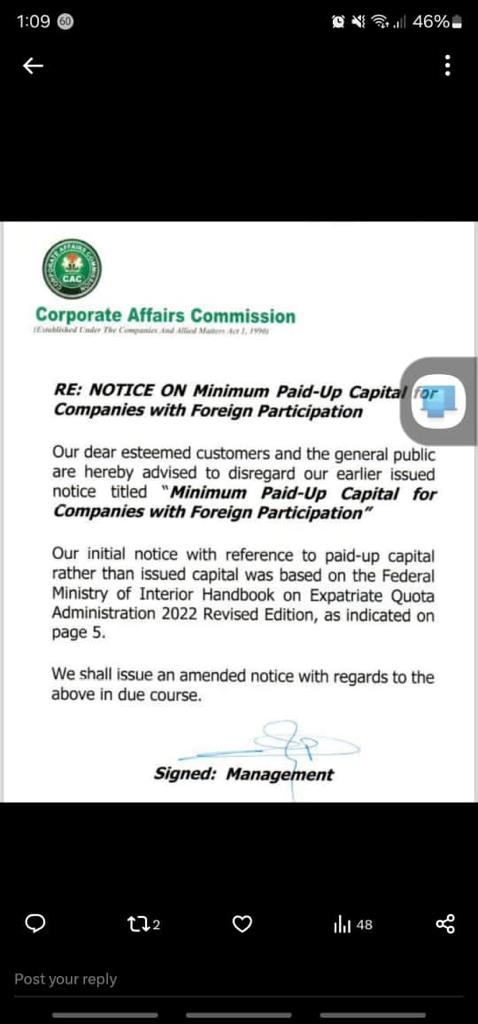
The commission issued a circular shared on its official account, retracting its initial notice titled “Minimum Paid-Up Capital for Companies with Foreign Participation.” The CAC clarified that the initial notice was based on the Federal Ministry of Interior Handbook on Expatriate Quota Administration 2022 Revised Edition, which referenced paid-up capital rather than issued capital.

In its statement, the commission advised its customers and the public to disregard the earlier notice and announced its intention to issue a revised notice in due course, indicating a more updated stance on the matter.

“Our dear esteemed customers and the general public are hereby advised to disregard our earlier issued notice titled “Minimum Paid-Up Capital for Companies with Foreign Participation”, the commission said.

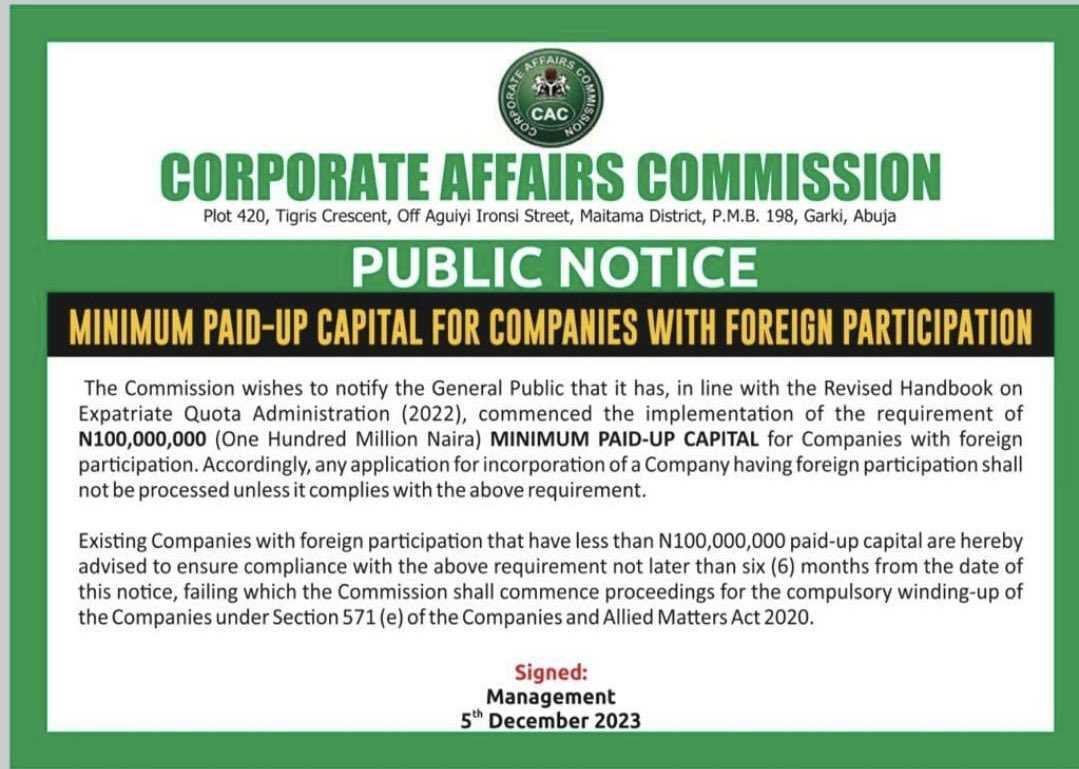
Previously, the CAC had indicated its implementation of the requirement for companies with foreign involvement to maintain a minimum paid-up capital of N100 million. 

“The Commission wishes to notify the General Public that it has, in line with the Revised Handbook on Expatriate Quota Administration (2022), commenced the implementation of the requirement of N100,000,000 (One Hundred Million Naira) MINIMUM PAID-UP CAPITAL for Companies with foreign participation.” 

This directive, in line with the Revised Handbook on Expatriate Quota Administration (2022), stated that any application for incorporating a company with foreign participation would not be processed unless it complied with the specified capital requirement.

The directive, which shot up the cost of market participation by 900 percent, riled up the Nigerian business section on social media.

Before now, the minimum paid-up capital for such foreign companies to participate in the Nigerian market was N10 million. That is even considered high compared to other places.

“A country that is seeking foreign investment is requesting a minimum paid-up capital of $100k for foreigners to set up business in Nigeria. Even if Nigeria was Heaven, nobody is paying that amount,” a Nigerian said. “Delaware costs like $50 to register a new entity. If you even add agents and stuff, max $500. The UK is less than $500. Even Cayman or BVI doesn’t cost more than $3k to incorporate in as a foreigner.”

Analysts believe the decision to increase the market participation cost is “short-sighted” and makes the idea of a $1 trillion economy being pushed by the current administration laughable.

“THIS IS WRONG, this is a terrible idea,” financial expert, Kalu Aja noted. “You are essentially saying I must incorporate with N100m, PAID UP before I can get a foreign partner. The focus on PAID UP capital shows they are targeting IGR not FDI. This is so short sighted. Who is making these rules? Is the coordinating minister of the economy aware of this?”

He added that laws like that are part of the reasons Nigerians are leaving CAC to incorporate their startups in the US. 

“This is why 80% of Nigerian startups are flocking to Delaware to incorporate; it’s far CHEAPER,” he said.

“You are here arguing that US investors should pay N100m to FG before they can invest in Nigeria. This is 2023 not 1981. It’s now a global village. You are competing with the Mexico, Vietnam and Rwanda. Grow up.”

When Nigeria’s Corporate Affairs Commission Caused Panic And How Nigeria Has Lost Its Next Generation Companies

1
CAC

There was a massive panic in the startup world when Nigeria’s Corporate Affairs Commission (CAC) dropped a notice, telling the general public that companies with foreign participation must have a N100,000,000 (about US$100,000) minimum paid-up capital. First, for most startups and companies with foreign investors and shareholders, this is nothing. Of course, that is not where Nigeria is going; Nigeria is not going after the Delaware- and London-holding companies, but their Nigerian subsidiaries.

In other words, if you have a startup in Nigeria but have a holding company in Delaware, USA, the government expects that paid-up capital to be applied in the Nigerian subsidiary. Of course, when that is done, there is a stamp duty and other fees which can also help the economy.

Understand that most major startups are structured in such a way that Nigeria’s slow, opaque and unpredictable legal system will not derail them. In other words, most investors will not invest directly in the Nigerian entity because our legal system can make a dispute which Delaware can resolve in 3 months to run into a decade. And if you are a fund manager who must return money to your limited partners (investors in your fund), you have no luck with the Nigerian legal system if there is a disagreement. As a result of this, about 90% of all startups in Nigeria which have raised at least $1 million are headquartered in the US or UK.

This setup deprives Nigeria of huge foreign direct investment which ends up affecting the economy in many ways since most of the raised funds are left in American banks (not in Lagos). As I have noted previously, if the funds raised by Nigerian startups are kept in Nigerian banking, our FX paralysis will not be this severe.

Of course, you cannot blame the founders and the investors. He who pays the piper dictates the tune. If the investor does not want to wire $20m to a Lagos bank, because he is afraid of Nigeria’s legal system, you will likely agree to set up a company in Delaware, re-domicile, and then access that money, since no one is going to make-up in Lagos on that investment. 

People, Nigeria has lost the next generation of its finest companies to America and England. Imagine if GTBank, Zenith Bank, etc of the 1990s were not Nigerians, possibly, we may not have them in the stock market today. By 2030 when we are expected to replenish our stock market with new species of companies, Nigeria will not have any because we have lost them already:

Every ten years, something great happens in the Nigerian/African economy. In the 1990s, the new generation banks were established, and they used technology to create competitive advantages in markets. In the 2000s, the voice telephony era came at scale, led by MTN.  The 2010s provided the mobile internet era as mobile phones connected to the internet, enabling new vistas of opportunities. Right now, in this decade of the 2020s, we’re in the application utility era where the power of cloud computing, mobile internet and software will redesign market sectors across territories in Africa. “

Yes, the 2020s belong to the application utility era which most of the digital startups fall under.

Back to the notice, the CAC has clarified that it was not “paid-up” but “issued capital” [issued share capital refers to the total shares that have been given to shareholders while paid-up share capital refers to the amount of issued share capital that has already been fully paid for].  Nonetheless, even if it did not clarify, that notice would not have affected many companies as many are well paid–up to in excess of $100k even locally. Also, the fee may not even be much (possibly less than N100,000 using recent guidance).

Nonetheless, Nigeria should focus on why its young people and its young companies are abandoning it even as it clarifies that it was “issued capital” and not “paid-up capital”.